Have you ever paused over phrases like continual interruptions and continuous rain? Both words come from the same root and both describe something that happens over time. That similarity makes them easy to mix up.
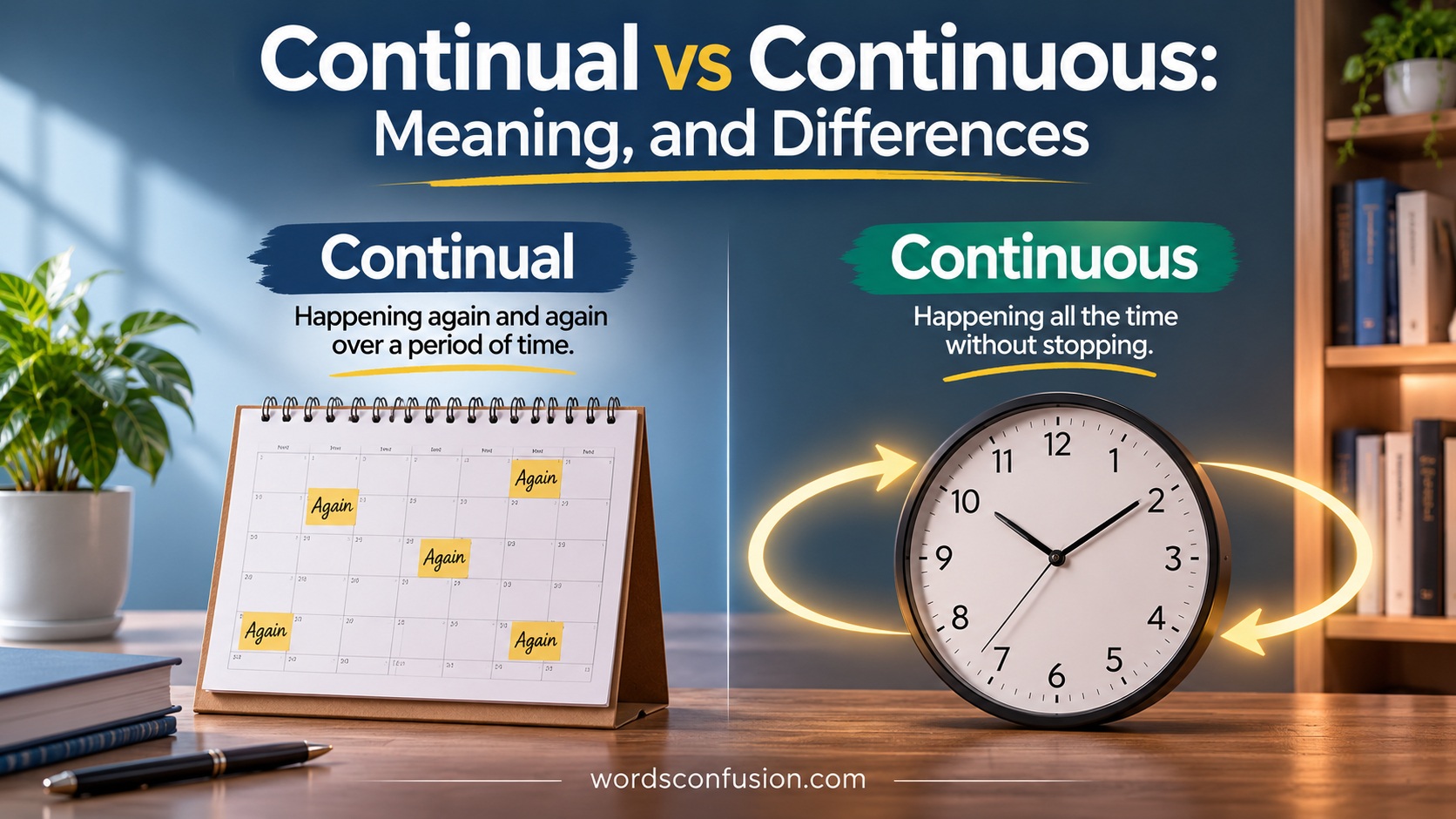
The key difference, however, is simple: continual means repeated with breaks, while continuous means happening without interruption.
Think of a dripping faucet and a running river. A faucet that drips every few seconds creates a continual sound. A river flows in a continuous stream. The distinction may seem small, yet choosing the right word can make your meaning sharper and your writing more precise.
Quick Answer
Continual means something happens repeatedly, usually with breaks between events. Continuous means something continues without stopping or interruption.
| Word | Meaning | Example |
| Continual | Repeated again and again, often with breaks | The continual interruptions made it hard to concentrate. |
| Continuous | Continuing without stopping | The machine produced a continuous humming sound. |
Easy memory trick:
Continual = repeated.
Continuous = uninterrupted.
So, if your phone keeps ringing every few minutes, you receive continual calls. If one phone call lasts for three uninterrupted hours, it is a continuous call.
What Does Continual Mean?
Continual describes something that happens repeatedly over a period of time. The action or event usually stops and starts again.
The word often suggests a pattern of recurrence:
Event → Break → Event → Break → Event
For example, imagine trying to write an important report while someone keeps interrupting you. The interruptions don’t happen every single second. Instead, they occur repeatedly. You might describe them as continual interruptions.
Continual Definition
The adjective continual means:
Happening repeatedly or frequently over a period of time, with possible breaks between occurrences.
The breaks matter. They help distinguish continual from continuous.
Consider these examples:
- The continual interruptions disrupted the meeting.
- The company faced continual delays during construction.
- Her continual questions showed that she wanted to understand the subject.
- The team dealt with continual changes to the project schedule.
- The child made continual attempts to solve the puzzle.
In each example, the action happens more than once. It doesn’t necessarily continue every second without a pause.
When Should You Use Continual?
Use continual when you want to emphasize repetition.
It works especially well when something:
- Happens again and again
- Occurs frequently
- Repeats over time
- Has breaks between occurrences
- Creates a recurring pattern
For example:
The continual power outages affected the business.
This sentence suggests that the power keeps going out repeatedly. The electricity probably returns between outages.
Now compare that with:
The power outage was continuous for six hours.
This sentence means the power stayed off for six uninterrupted hours.
The difference is only one word. The meaning changes considerably.
What Does Continuous Mean?
Continuous describes something that carries on without stopping or interruption.
Imagine drawing a line without lifting your pencil from the paper. The line is continuous because it forms one unbroken movement.
The pattern looks like this:
Start → Ongoing activity → No break → End
Continuous Definition
The adjective continuous means:
Continuing without interruption, pause, or break.
Here are several examples:
- The continuous rain caused flooding.
- The machine operates in a continuous cycle.
- The road forms a continuous curve around the mountain.
- The patient required continuous monitoring.
- The factory maintained continuous production throughout the night.
In each sentence, the focus rests on an unbroken flow.
When Should You Use Continuous?
Use continuous when something:
- Does not stop
- Continues without interruption
- Forms an unbroken sequence
- Remains active throughout a particular period
For example:
The alarm sounded continuously for ten minutes.
This means the alarm did not stop during those ten minutes.
However:
The alarm sounded continually throughout the night.
This usually means it went off repeatedly. It may have stopped between alarms.
That small distinction is the heart of the continual vs continuous debate.
Continual vs Continuous: The Main Difference
The clearest way to understand continual vs continuous is to focus on breaks.
Continual describes repeated events.
Continuous describes one uninterrupted event or process.
| Pattern | Correct Word | Example |
| Event, pause, event, pause | Continual | Continual interruptions |
| One unbroken activity | Continuous | Continuous rainfall |
Continual Means Repeated With Breaks
Suppose your neighbor’s dog barks every few minutes throughout the night. The barking stops and starts repeatedly.
You could say:
The continual barking kept me awake.
The barking isn’t necessarily happening every moment. Instead, it keeps returning.
Other examples include:
- Continual complaints
- Continual delays
- Continual interruptions
- Continual changes
- Continual questions
- Continual efforts
These phrases generally describe repeated events rather than one uninterrupted action.
Continuous Means Without Interruption
Now imagine a loud machine that produces the same sound for eight hours without stopping.
You could say:
The machine made a continuous noise.
The sound doesn’t disappear and return. It continues as one uninterrupted stream.
Other examples include:
- Continuous movement
- Continuous rainfall
- Continuous monitoring
- Continuous operation
- Continuous flow
- Continuous production
The word focuses on unbroken duration.
Continual vs Continuous Comparison Table
| Feature | Continual | Continuous |
| Main idea | Repeated occurrence | Uninterrupted duration |
| Breaks | Usually present | Absent |
| Pattern | Again and again | Without stopping |
| Focus | Frequency | Continuity |
| Example | Continual interruptions | Continuous noise |
| Memory word | Repeated | Unbroken |
A useful question can solve most usage problems:
Does it happen repeatedly? Use continual.
Does it happen without stopping? Use continuous.
Continual vs Continuous Examples in Sentences
Real examples make the difference easier to recognize.
Examples With Continual
- The continual interruptions made it difficult to finish the presentation.
- The company experienced continual delays during the construction project.
- Her continual questions helped reveal gaps in the explanation.
- The team faced continual changes to the original plan.
- His continual efforts eventually produced excellent results.
- The city experienced continual traffic problems during the holiday season.
- The software required continual updates to remain secure.
- The manager dealt with continual complaints from customers.
Each example suggests repetition. The event happens multiple times over a period.
Examples With Continuous
- The continuous rain caused several roads to close.
- The device provides continuous monitoring of the system.
- The factory maintains continuous production throughout the day.
- A continuous line connects the two points.
- The engine produced a continuous vibration.
- The river moves in a continuous flow toward the sea.
- The machine ran continuously for twelve hours.
- The patient received continuous care during the procedure.
These examples emphasize an uninterrupted process.
Continual vs Continuous in Common Phrases
Some word combinations appear more naturally than others.
Common Phrases With Continual
- Continual interruptions
- Continual complaints
- Continual delays
- Continual changes
- Continual problems
- Continual efforts
- Continual pressure
- Continual questions
- Continual updates
- Continual attempts
For example:
Continual delays pushed the project several weeks behind schedule.
The delays occur repeatedly.
Common Phrases With Continuous
- Continuous rain
- Continuous noise
- Continuous flow
- Continuous movement
- Continuous monitoring
- Continuous operation
- Continuous production
- Continuous improvement
- Continuous data
- Continuous access
For example:
Continuous monitoring allowed the engineers to identify the problem immediately.
The monitoring doesn’t stop during the period being discussed.
Is Continual Improvement or Continuous Improvement Correct?
This question causes plenty of confusion because both phrases can be correct.
Continuous Improvement
Continuous improvement emphasizes an ongoing process of improvement.
A company may continuously review its systems, identify weaknesses, and make adjustments. The process continues without a complete end.
For example:
The company uses continuous improvement to make its manufacturing process more efficient.
This phrase appears frequently in business, management, engineering, and quality-control discussions.
Continual Improvement
Continual improvement emphasizes repeated improvements over time.
For example:
The school made continual improvements to its curriculum.
This sentence highlights multiple improvements made at different times.
The practical distinction is:
- Continuous improvement = an ongoing improvement process
- Continual improvement = repeated improvements
In everyday writing, the two expressions can overlap. Context determines which word communicates the intended idea more precisely.
Read More: Can vs May: What’s the Difference and When Should You Use Each?
Continual vs Continuous: Common Mistakes
Understanding the difference becomes easier when you recognize the mistakes people make most often.
Mistake 1: Using Continuous for Repeated Events
Consider:
The continuous interruptions made the meeting difficult.
This wording suggests that the interruptions occurred without stopping. That meaning sounds unusual because an interruption generally breaks something else.
A more natural sentence is:
The continual interruptions made the meeting difficult.
The interruptions happen repeatedly.
Mistake 2: Using Continual for an Unbroken Activity
Now consider:
The continual rain lasted for six hours without stopping.
This sentence isn’t impossible. However, continuous rain fits the meaning more precisely because the rain remains unbroken.
Better:
The continuous rain lasted for six hours.
If the rain stopped and started repeatedly, then continual rain would make more sense.
Mistake 3: Assuming Continual Always Means Negative
Many people associate continual with annoying situations because it often appears with words like:
- Complaints
- Interruptions
- Delays
- Problems
- Arguments
However, continual itself isn’t automatically negative.
For example:
She received continual support from her friends.
The phrase describes repeated or ongoing support. The meaning remains positive.
Mistake 4: Assuming Continuous Means Forever
Continuous doesn’t mean something lasts forever.
It simply means something doesn’t stop during the period being discussed.
For example:
The machine operated continuously for eight hours.
The machine ran without stopping for eight hours. It eventually stopped.
So, continuous means uninterrupted, not eternal.
Continual vs Continuous: A Simple Memory Trick
The easiest memory trick is this:
Continual has breaks. Continuous has no breaks.
You can also remember the words this way:
Continual events keep coming back. Continuous events keep going.
Imagine two situations.
Situation One: A Doorbell
The doorbell rings every five minutes.
Continual ringing.
It stops between rings.
Situation Two: A Siren
The siren sounds for thirty minutes without stopping.
Continuous sound.
It remains active throughout the entire period.
That mental picture makes the difference much easier to remember.
Continually vs Continuously
The adverbs continually and continuously follow the same basic distinction.
Continually
Continually means repeatedly or frequently.
She continually checked her phone during the meeting.
This suggests that she checked it again and again. She probably put it down between checks.
Continuously
Continuously means without stopping.
The machine operated continuously for twelve hours.
The machine kept operating throughout the entire twelve-hour period.
| Adverb | Meaning | Example |
| Continually | Repeatedly | He continually changed his mind. |
| Continuously | Without interruption | The engine ran continuously for six hours. |
Compare these sentences:
The alarm rang continually.
The alarm went off repeatedly.
The alarm rang continuously.
The alarm did not stop during the stated period.
The difference is subtle yet meaningful.
Continual vs Continuous vs Constant
The word constant often enters the conversation because it also describes something that continues over time.
However, constant has a slightly different focus.
| Word | Main Meaning | Example |
| Continual | Repeated with breaks | Continual interruptions |
| Continuous | Without interruption | Continuous noise |
| Constant | Persistent or unchanging | Constant pressure |
Consider these examples:
- Continual rain = rain occurs repeatedly, possibly with breaks.
- Continuous rain = rain falls without stopping.
- Constant rain = rain is persistent or seems to remain steady.
Constant can sometimes overlap with both words. Its main idea, however, involves persistence or lack of change.
Continual vs Continuous vs Perpetual
Perpetual is another word that may seem similar.
It generally suggests something that continues for a very long time or appears never-ending.
| Word | Meaning |
| Continual | Repeated with breaks |
| Continuous | Without interruption |
| Perpetual | Lasting indefinitely or seeming endless |
Examples:
The project suffered continual delays.
The delays happened repeatedly.
Continuous rain flooded the streets.
The rain did not stop.
The perpetual noise from the old machine annoyed everyone.
The noise seems endless or constantly present.
The three words overlap in some contexts. Their emphasis differs.
FAQs:
What is the difference between continual and continuous?
Continual means something happens repeatedly with breaks between occurrences. Continuous means something continues without stopping or interruption. For example, continual interruptions happen again and again while continuous rain falls without a break.
Is continual the same as continuous?
No. Although the two words have similar meanings, they emphasize different patterns. Continual focuses on repetition while continuous focuses on an uninterrupted flow.
Should I use continual improvement or continuous improvement?
Both phrases can be correct. Continuous improvement usually describes an ongoing process of making improvements. Continual improvement emphasizes repeated improvements made over time. In many contexts, continuous improvement is the more common expression.
What is the difference between continually and continuously?
Continually means repeatedly or frequently. Continuously means without stopping. For example, “She continually checked her phone” means she checked it again and again. “The machine ran continuously for six hours” means it operated without interruption.
How can I easily remember the difference between continual and continuous?
Use this simple memory trick: continual means repeated, while continuous means uninterrupted. If something happens again and again with breaks, choose continual. If it continues without stopping, choose continuous.
Conclusion:
The difference between continual vs continuous comes down to one simple idea: breaks. Use continual when something happens repeatedly with pauses between events. Use continuous when something carries on without interruption.
Think of continual interruptions as events that keep returning. By contrast, continuous noise keeps going without stopping. Once you ask whether the action has breaks, the right word usually becomes clear.
Continual means repeated. Continuous means unbroken. Keep that distinction in mind and you’ll have no trouble choosing the correct word in everyday conversation, professional writing, and academic English.

Andrew Wilson is an experienced language researcher and content writer specializing in WordsConfusion topics. He helps readers understand commonly confused English words, spelling differences, grammar rules, word meanings, and proper usage through clear explanations, practical examples, and easy-to-follow language guides. His goal is to make English learning simple, accurate, and accessible for students, writers, professionals, and everyday learners.