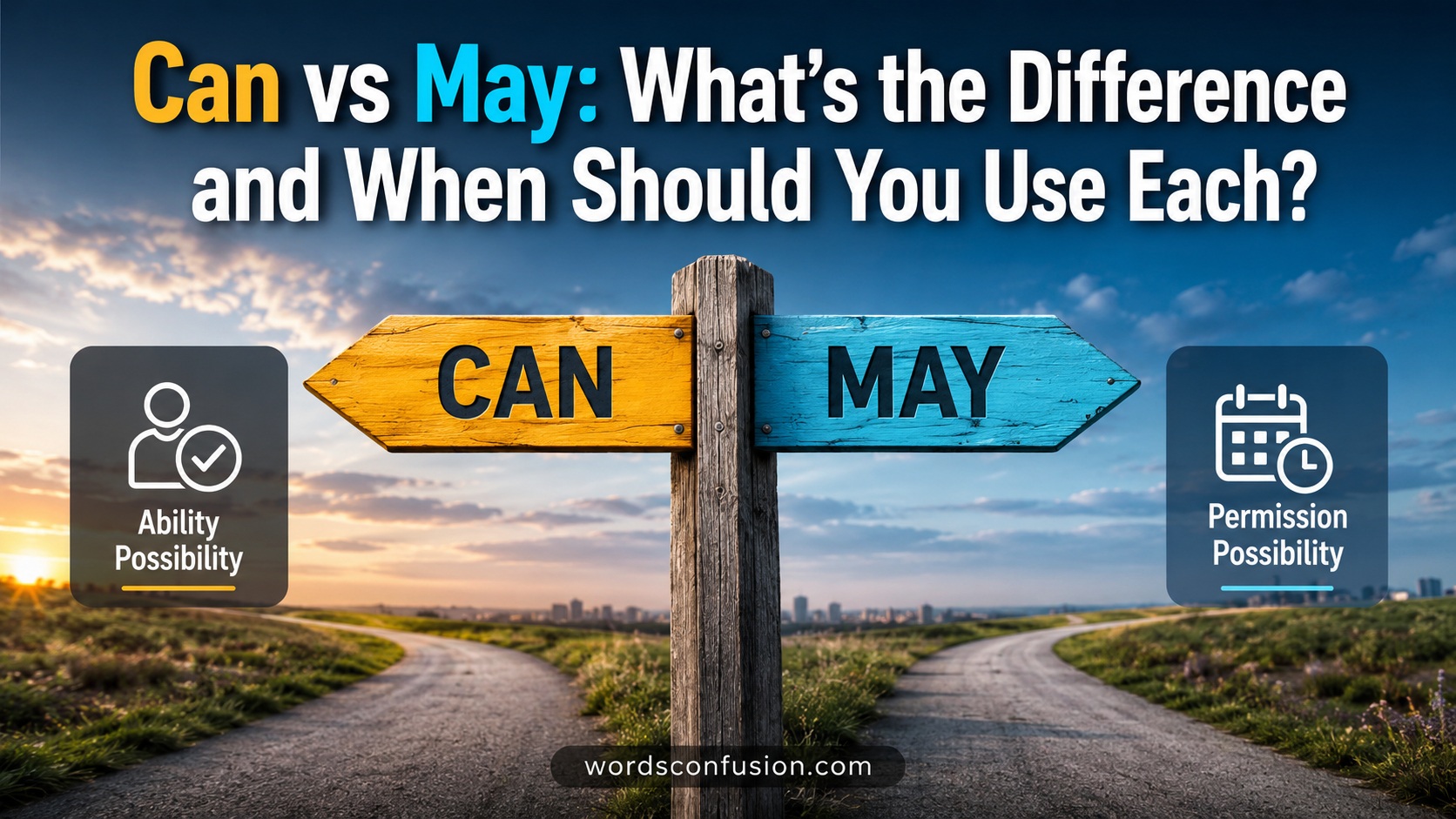
Confusing can vs may is one of those small grammar problems that can make a sentence feel unexpectedly tricky. Both words can appear in questions about permission. Both can describe what might happen. Yet they don’t mean exactly the same thing.
Consider these sentences:
- I can swim.
- It may rain tonight.
- Can I borrow your pen?
- May I leave early?
Each sentence uses a modal verb, but each one carries a different meaning. Can usually focuses on ability, general possibility, or informal permission. May commonly expresses possibility or formal permission.
The old rule that says “can is for ability and may is for permission” helps beginners, but it doesn’t tell the whole story. Modern English uses can to ask for permission all the time. In fact, Can I…? sounds perfectly natural in everyday American English.
So, when should you use can and when should you use may? Let’s break it down clearly.
Quick Answer: Can vs May
Can usually expresses ability, general possibility, or informal permission. May usually expresses possibility, formal permission, or a formal wish.
| Word | Main Meaning | Example |
| Can | Ability | I can drive. |
| Can | Informal permission | Can I use your phone? |
| Can | General possibility | Mistakes can happen. |
| May | Possibility | It may rain tonight. |
| May | Formal permission | May I come in? |
| May | Formal wish | May you find success. |
The simplest rule is:
Can often answers “Are you able to do it?”
May often answers “Is it possible?” or “Is permission granted?”
However, context matters. English rarely behaves like a machine with only one setting.
Can vs May: The Main Difference
The biggest difference between can and may comes down to the idea each modal verb emphasizes.
Can generally focuses on ability or possibility based on circumstances.
- She can speak French. → She has the ability.
- Accidents can happen. → Accidents are generally possible.
- Can I sit here? → An informal request for permission.
May generally focuses on possibility or permission.
- She may speak at the conference. → It is possible.
- It may rain later. → Rain is possible.
- May I sit here? → A formal or polite request for permission.
Think of can as a door showing what is possible because of ability or circumstances. May often acts like a sign asking whether the door is open.
What Does “Can” Mean?
Can for Ability
The most common use of can involves ability. It tells you that someone or something has the skill, power, knowledge, or capacity to do something.
Examples:
- I can swim.
- She can play the violin.
- They can solve the problem.
- This machine can process thousands of files.
- My car can reach high speeds.
In each example, can means is able to.
For example:
I can speak Spanish.
This means you have the ability to speak Spanish. It doesn’t mean that speaking Spanish might happen someday. It means you possess the ability now.
Can for Physical and Mental Ability
Can works for many kinds of ability.
Physical ability:
- He can lift 100 pounds.
- She can run five miles.
Mental ability:
- I can understand the problem.
- She can remember long lists of numbers.
Learned skills:
- They can code in Python.
- He can repair bicycles.
You can often replace can with be able to.
- I can drive.
- I am able to drive.
The first sentence sounds more natural in everyday conversation. Be able to becomes useful when grammar requires a form that can cannot provide.
For example:
- I have been able to solve the problem.
- She will be able to join us later.
Can for Informal Permission
Modern English commonly uses can to ask for permission.
Examples:
- Can I borrow your pen?
- Can we leave now?
- Can I use your bathroom?
- Can I take tomorrow off?
These sentences sound completely natural in everyday American English.
The traditional grammar rule says that may should express permission while can should express ability. However, real-world English has moved beyond that strict distinction. Native speakers have used can for permission for generations.
So, Can I borrow your phone? is not automatically wrong.
The difference often involves formality:
- Can I leave early? → Casual and natural.
- May I leave early? → More formal and respectful.
Can for General Possibility
Can also describes something that is possible in general or under certain conditions.
Examples:
- Winters can be extremely cold here.
- Anyone can make a mistake.
- Heavy rain can cause flooding.
- Too much sunlight can damage wooden furniture.
Notice the difference between general possibility and a specific prediction.
Cars can break down.
This means car breakdowns are generally possible.
My car may break down today.
This means there is a possibility that your particular car will break down today.
That distinction matters.
Can’t for Impossibility
The negative form can’t can express inability, prohibition, or impossibility.
Inability:
I can’t swim.
This means I don’t have the ability to swim.
Prohibition:
You can’t park here.
This means parking isn’t allowed.
Impossibility:
That can’t be true.
This means the speaker believes something is impossible or highly unlikely.
The same word can carry different meanings. Context does the heavy lifting.
What Does “May” Mean?
May for Possibility
The most common meaning of may involves possibility.
Examples:
- It may rain tonight.
- She may arrive late.
- The package may come tomorrow.
- Prices may increase next year.
In these sentences, may means perhaps or possibly.
He may join us later.
This doesn’t mean he has the ability to join. It means there is a possibility that he will join.
This is one of the clearest differences between can vs may.
Compare:
- He can join us later. → He is able to join us.
- He may join us later. → Perhaps he will join us.
The first sentence focuses on ability. The second focuses on possibility.
May for Formal Permission
May traditionally expresses permission, especially in formal or polite situations.
Examples:
- May I ask a question?
- May I come in?
- May we begin the meeting?
- You may leave now.
You may hear may in classrooms, formal workplaces, official announcements, and polite conversations.
For example:
May I speak with the manager?
This sounds more formal than:
Can I speak with the manager?
Both sentences can request permission. The difference lies mainly in tone and context.
May for Rules and Official Permission
May frequently appears in formal rules, instructions, and policies.
Examples:
- Visitors may enter through the main entrance.
- Employees may work remotely on Fridays.
- Applicants may submit additional documents.
- Guests may use the conference room until 5 p.m.
In these examples, may sounds official. It grants permission rather than simply describing ability.
May for Wishes and Formal Expressions
May also appears in formal wishes.
Examples:
- May your dreams come true.
- May peace prevail.
- May you have a successful future.
- May your journey be safe.
This use doesn’t express ordinary possibility or permission. Instead, it expresses a hope or wish.
Can I or May I: Which One Is Correct?
Both Can I…? and May I…? can be correct.
The difference usually involves formality and tone.
| Sentence | Tone | Meaning |
| Can I leave early? | Casual | Asking permission |
| May I leave early? | Formal | Asking permission |
| Can I borrow your pen? | Everyday | Asking permission |
| May I borrow your pen? | Polite or formal | Asking permission |
When to Use Can I?
Use Can I…? in everyday situations.
Examples:
- Can I sit here?
- Can I have some water?
- Can I use your computer?
- Can I call you later?
These sentences sound natural in casual conversations.
When to Use May I?
Use May I…? when you want a more formal or respectful tone.
Examples:
- May I ask a question?
- May I have your attention?
- May I speak with you privately?
- May I submit the form tomorrow?
In a formal meeting, May I…? may sound more appropriate. At home, however, saying May I use the bathroom? can sound unusually formal.
Context is king.
Can vs May for Possibility
The difference between can and may becomes especially important when both words describe possibility.
“It Can Happen” vs “It May Happen”
Compare these sentences:
Mistakes can happen.
This expresses a general truth. Mistakes are possible in life.
A mistake may happen during this process.
This refers to a specific possibility.
The distinction looks small. The meaning changes significantly.
| Sentence | Meaning |
| Snow can occur in this region. | Snow is generally possible there. |
| It may snow tomorrow. | Snow is possible tomorrow. |
| Anyone can make a mistake. | Mistakes are generally possible for everyone. |
| She may make a mistake. | There is a possibility she will make one. |
A useful rule is:
Can often describes what is possible in general. May often describes what might happen in a particular situation.
Read More: Backward vs Backwards: Meaning, and How to Use Them Correctly
Can vs May for Ability
When you want to talk about present ability, can is usually the correct choice.
- I can drive.
- She can cook.
- They can speak English.
- He can fix computers.
Using may changes the meaning.
I may drive.
This usually means perhaps I will drive. It doesn’t normally mean I know how to drive.
Compare:
- I can drive. → I have the ability.
- I may drive. → Perhaps I will drive.
- I can attend the meeting. → I am able to attend.
- I may attend the meeting. → Perhaps I will attend.
One word changes the entire message.
Can vs May in Questions
Can You…?
Can you…? commonly asks about ability or makes an informal request.
Examples:
- Can you swim? → Do you have the ability?
- Can you help me? → Are you able or willing to help?
- Can you send the file? → An informal request.
May I…?
May I…? normally asks for permission.
Examples:
- May I ask a question?
- May I sit here?
- May I leave now?
A useful contrast is:
Can you help me? asks about ability or willingness.
May I ask you for help? asks whether permission exists to make the request.
The two modal verbs point in different directions.
Can vs May in Negative Sentences
Negative forms can create confusion because can’t and may not don’t always mean the same thing.
Can’t
Can’t may express:
- Inability
- Prohibition
- Impossibility
Examples:
- I can’t swim. → I lack the ability.
- You can’t enter this room. → Entry isn’t allowed.
- That can’t be correct. → It seems impossible.
May Not
May not can express either possibility or prohibition.
Possibility:
She may not attend the meeting.
This means perhaps she won’t attend.
Prohibition:
Visitors may not enter this area.
This means visitors aren’t allowed to enter.
Context determines the meaning.
Why “May Not” Can Be Confusing
Consider this sentence:
He may not come.
This usually means:
Perhaps he won’t come.
Now consider:
He may not enter the building.
This usually means:
He doesn’t have permission to enter.
The surrounding words provide the clues.
Can vs May in the Past
Could as the Past Form of Can
Could commonly expresses past ability.
- When I was young, I could run very fast.
- She could read by the age of four.
- We could see the mountains from our house.
It can also express possibility or make polite requests.
- Could you help me?
- It could rain later.
Might and May
Might often expresses possibility with a weaker or more uncertain tone.
Compare:
- She may come tonight.
- She might come tonight.
Both sentences express possibility. Might often sounds less certain.
A simple comparison looks like this:
| Modal | Common Use | Example |
| Can | Present ability | I can swim. |
| Could | Past ability or possibility | I could swim at five. |
| May | Possibility or formal permission | It may rain. |
| Might | Less certain possibility | It might rain. |
FAQs:
Is “Can I?” correct when asking for permission?
Yes. Can I…? is grammatically correct and widely used in everyday American English. For example, Can I borrow your pen? sounds natural in casual conversation. May I…? also asks for permission, but it usually sounds more formal or polite.
What is the main difference between can and may?
Can usually expresses ability, general possibility, or informal permission. May commonly expresses specific possibility or formal permission. For example, I can swim shows ability, while It may rain tonight shows possibility.
Can “can” express possibility?
Yes. Can often describes something that is generally possible or can happen under certain conditions. For example, Heavy rain can cause flooding means flooding is a possible result of heavy rain.
Can “may” express ability?
Usually, no. Use can to talk about someone’s ability. I can drive means you know how to drive. I may drive usually means you might drive at some point.
Which is more formal: “Can I?” or “May I?”
May I…? is generally more formal. Can I…? sounds more casual and conversational. Both can be correct when asking for permission. Your choice depends on the situation and the level of formality you want.
Conclusion:
Understanding can vs may becomes easier when you focus on the meaning behind each sentence. Use can for ability, general possibility, and informal permission. Use may for specific possibility, formal permission, and formal wishes.
Remember these simple examples:
- I can swim. → I have the ability.
- It may rain tonight. → Rain is possible.
- Can I leave now? → Casual permission.
- May I leave now? → Formal permission.
The old rule that can only expresses ability and may only expresses permission is too strict for modern English. In everyday American English, Can I…? is perfectly natural when asking for permission. Still, May I…? remains the better choice when you want a more formal tone.
Once you identify whether you’re talking about ability, general possibility, specific possibility, or permission, choosing between can and may becomes much simpler.

Andrew Wilson is an experienced language researcher and content writer specializing in WordsConfusion topics. He helps readers understand commonly confused English words, spelling differences, grammar rules, word meanings, and proper usage through clear explanations, practical examples, and easy-to-follow language guides. His goal is to make English learning simple, accurate, and accessible for students, writers, professionals, and everyday learners.