
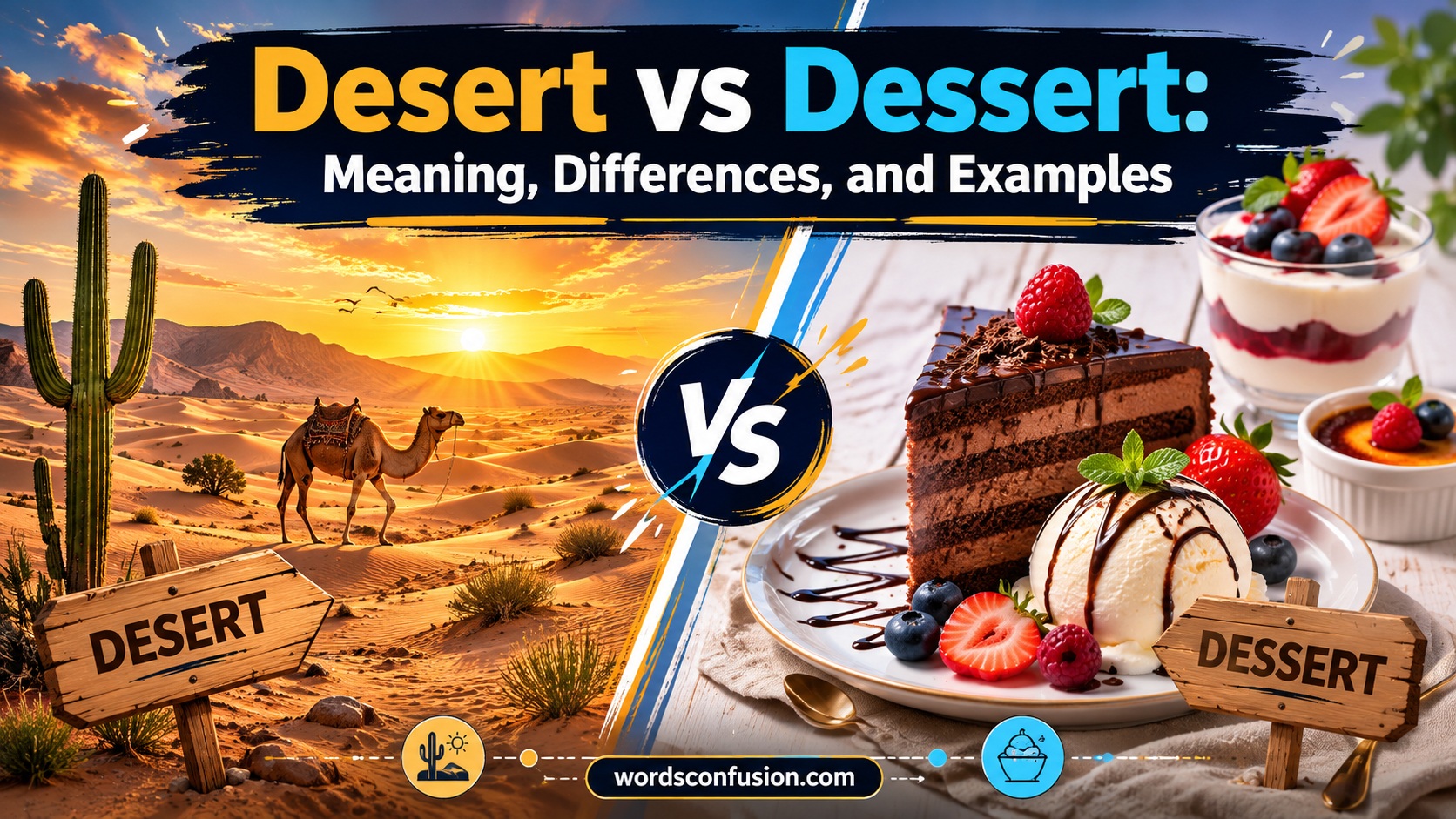
Choosing between desert and dessert seems simple until you’re writing quickly. One extra “s” changes the meaning completely. Instead of talking about a delicious slice of cheesecake, you might accidentally describe a hot, dry landscape. It’s a tiny spelling difference with a huge impact.
This confusion happens because the two words look almost identical. Their pronunciation also sounds similar, especially to English learners. Even native speakers occasionally mix them up in emails, school assignments, social media posts, and business writing.
Fortunately, learning the difference doesn’t take long. Once you understand what each word means, how it’s pronounced, and when to use it, you’ll rarely confuse them again. A few simple memory tricks can make the distinction stick for life.
In this guide, you’ll discover the meaning of desert vs dessert, learn how to spell each word correctly, explore pronunciation differences, review practical examples, avoid common mistakes, and test your knowledge with an easy quiz.
Quick Answer
The difference between desert and dessert is straightforward:
- Desert refers to a dry, arid region with very little rainfall. It can also mean to abandon someone or something.
- Dessert refers to the sweet course served after a meal, such as cake, ice cream, pie, pudding, cookies, or fruit.
Quick Examples
- We crossed the desert during our vacation.
- Chocolate cake is my favorite dessert.
- The soldier refused to desert his unit.
- We ordered cheesecake for dessert.
Easy Memory Trick
Think of dessert as getting an extra serving of sweetness.
Dessert has two “S” letters because everyone wants a second serving.
Desert has only one S because few people want more desert.
Comparison Overview
| Feature | Desert | Dessert |
| Primary Meaning | A dry region with little rainfall | A sweet course eaten after a meal |
| Secondary Meaning | To abandon or leave behind | No verb form |
| Part of Speech | Noun and verb | Noun |
| Pronunciation | DEZ-ert (noun), dih-ZURT (verb) | dih-ZURT |
| Number of S’s | One | Two |
| Common Context | Geography, climate, military, literature | Food, restaurants, cooking |
| Example | The Sahara is the world’s largest hot desert. | Apple pie is a classic dessert. |
Main Differences Between Desert vs Dessert
Although desert and dessert differ by only one letter, they belong to completely different categories.
Meaning
A desert is a geographical area that receives very little rainfall throughout the year. These regions often experience extreme temperatures and support specially adapted plants and animals.
A dessert is a sweet dish enjoyed after the main course. It can include cakes, pastries, ice cream, puddings, chocolates, fruit, or other sweet treats.
Function in English
The word desert serves two grammatical purposes.
- A noun describing an arid landscape.
- A verb meaning to abandon someone or something.
The word dessert functions only as a noun.
Spelling
This is where most mistakes happen.
- Desert → one S
- Dessert → two S’s
Adding or removing one letter changes the meaning entirely.
Pronunciation
The noun desert stresses the first syllable.
DEZ-ert
The verb desert stresses the second syllable.
dih-ZURT
The noun dessert also stresses the second syllable.
dih-ZURT
Because the verb desert and the noun dessert sound almost identical, context becomes important.
Usage
You usually encounter desert when discussing:
- Geography
- Climate
- Wildlife
- Travel
- Military writing
- Literature
You usually encounter dessert when discussing:
- Restaurants
- Recipes
- Family dinners
- Celebrations
- Baking
- Food reviews
Side-by-Side Examples
| Correct Sentence | Why It Is Correct |
| Camels survive in the desert. | Refers to an arid landscape. |
| Ice cream is my favorite dessert. | Refers to sweet food. |
| They refused to desert their friends. | Uses the verb meaning abandon. |
| Brownies make an excellent dessert. | Refers to food served after a meal. |
Why This Difference Matters
Using the wrong word can completely change your message.
Imagine writing:
We enjoyed a delicious desert after dinner.
Readers immediately notice the mistake because deserts are sandy landscapes—not chocolate cake.
Likewise, writing:
The Sahara is the world’s largest dessert.
Creates an unintentionally funny sentence.
Correct spelling improves your credibility in:
- Academic writing
- Professional emails
- Business reports
- Blog articles
- Social media posts
- Exams
- Job applications
Mastering desert vs dessert helps your writing appear polished, accurate, and professional.
What Does Desert Mean?
The word desert has two completely different meanings depending on how you use it. It can describe a dry geographical region or act as a verb meaning to abandon someone or something. Understanding both meanings helps you use the word correctly in every situation.
Desert as a Noun
As a noun, a desert is a region that receives less than 10 inches (25 cm) of precipitation each year. Contrary to popular belief, not every desert is hot. Some deserts are freezing cold, yet they still qualify because they receive very little rainfall.
Deserts cover about one-third of Earth’s land surface, making them one of the planet’s largest ecosystems.
Some famous deserts include:
- Sahara Desert (Africa)
- Arabian Desert (Middle East)
- Gobi Desert (China and Mongolia)
- Mojave Desert (United States)
- Atacama Desert (Chile)
- Kalahari Desert (Southern Africa)
- Thar Desert (India and Pakistan)
- Antarctic Polar Desert (Antarctica)
Characteristics of a Desert
Most deserts share several defining features.
- Very little annual rainfall
- Dry air with low humidity
- Sparse vegetation
- Extreme temperatures
- Specialized plants and animals
- Sandy, rocky, or icy landscapes
Interestingly, not every desert is covered with sand. Many consist of gravel plains, rocky plateaus, or even ice.
Examples of Desert (Noun)
- We drove across the desert during our road trip.
- Cacti thrive in the desert because they store water.
- The Sahara is the largest hot desert in the world.
- Desert animals have adapted to survive harsh conditions.
- Rain rarely falls in this desert region.
Desert as a Verb
As a verb, desert means to leave someone or something behind when you have a responsibility to stay.
The word often appears in military, legal, historical, and literary contexts.
For example:
- Soldiers who leave their military service without permission desert their unit.
- Someone who abandons a family may be described as having deserted them.
- Businesses can also desert projects or contracts.
Examples of Desert (Verb)
- He refused to desert his teammates during the competition.
- Many workers did not desert the construction project.
- The captain promised never to desert the crew.
- She felt her friends had deserted her during difficult times.
- Nobody should desert their responsibilities.
Common Expressions with Desert
You’ll often encounter these phrases.
- Desert island
- Desert climate
- Desert wildlife
- Desert storm
- To desert one’s duty
- To desert a cause
Notice that none of these expressions relate to food.
What Does Dessert Mean?
Unlike desert, the word dessert has only one meaning.
A dessert is the sweet course served at the end of a meal. While desserts vary across cultures, they generally include sugar, fruit, chocolate, cream, or other sweet ingredients.
Desserts often mark the end of lunch or dinner and are commonly served during holidays, birthdays, weddings, and celebrations.
Popular Types of Desserts
Desserts come in many forms.
Cakes
- Chocolate cake
- Cheesecake
- Carrot cake
- Red velvet cake
Frozen Desserts
- Ice cream
- Gelato
- Frozen yogurt
- Sorbet
Pastries
- Apple pie
- Cherry pie
- Danish pastries
- Croissants with sweet fillings
Puddings and Custards
- Rice pudding
- Chocolate pudding
- Vanilla custard
- Bread pudding
Cookies and Bars
- Brownies
- Chocolate chip cookies
- Blondies
- Lemon bars
Fruit-Based Desserts
- Fruit salad
- Apple crisp
- Berry parfait
- Baked pears
Examples of Dessert
- We shared chocolate mousse for dessert.
- My grandmother always serves pie for dessert.
- Ice cream is a classic summer dessert.
- She skipped dessert because she was full.
- Cheesecake remains one of America’s favorite desserts.
Dessert Around the World
Different countries enjoy unique desserts.
| Country | Popular Dessert |
| United States | Apple Pie |
| Italy | Tiramisu |
| France | Crème Brûlée |
| Japan | Mochi |
| India | Gulab Jamun |
| Turkey | Baklava |
| Mexico | Churros |
| England | Sticky Toffee Pudding |
Although ingredients differ, every culture has its own sweet traditions.
Desert vs Dessert: Spelling Differences
At first glance, these words look nearly identical. The only visible difference is one extra “s.”
| Word | Spelling |
| Desert | One S |
| Dessert | Two S’s |
That single letter changes the entire meaning.
Consider these examples.
We ate a delicious desert after dinner.
We ate a delicious dessert after dinner.
Camels live in the dessert.
Camels live in the desert.
A quick spelling check can save you from embarrassing mistakes.
Desert vs Dessert Pronunciation
Pronunciation creates another challenge because dessert and the verb desert sound almost identical.
| Word | IPA | Stress |
| Desert (noun) | /ˈdɛzərt/ | First syllable |
| Desert (verb) | /dɪˈzɝːt/ | Second syllable |
| Dessert | /dɪˈzɝːt/ | Second syllable |
Desert (Noun)
Say:
DEZ-ert
Stress falls on the first syllable.
Desert (Verb)
Say:
dih-ZURT
Stress falls on the second syllable.
Dessert
Say:
dih-ZURT
Its pronunciation matches the verb desert.
Because these two sound alike, context tells readers which meaning you intend.
Read More: Council vs Counsel: Meaning, Differences, and Examples
Why People Confuse Desert and Dessert
The confusion isn’t surprising. Several factors contribute to this common spelling mistake.
Similar Spellings
Only one letter separates the two words.
When typing quickly, it’s easy to miss the extra “s.”
Similar Pronunciation
The verb desert and the noun dessert sound almost identical.
Many people rely on sound instead of spelling, leading to errors.
Autocorrect Doesn’t Always Help
Spell-check tools recognize both words because both are correct English words.
That means software may not detect the mistake.
Fast Typing
During emails, exams, or text messages, people often focus on speed instead of accuracy.
English Learners
Students learning English usually memorize pronunciation before spelling, making these words especially confusing.
Easy Ways to Remember the Difference
Fortunately, a few simple memory tricks make these words almost impossible to confuse.
The Second Serving Trick
Everyone loves an extra serving of cake.
Dessert has two S’s because you want a second serving.
This is the most popular memory trick.
Think About Sugar
Both words begin with “Des.”
Only dessert contains an extra S.
Think:
Sugar starts with S.
Sweet foods deserve another S.
The Smile Trick
Imagine smiling after eating chocolate cake.
Your smile reminds you that dessert contains an extra letter because desserts make people happy.
Picture Association
Visual memory works surprisingly well.
Imagine:
- Endless sand → Desert
- Chocolate cake → Dessert
Your brain naturally separates the two.
Make Your Own Sentence
Creating personal examples strengthens memory.
For instance:
We crossed the desert before enjoying dessert at the hotel.
One sentence reinforces both meanings at once.
FAQs:
Is desert spelled with one or two “S” letters?
Desert is spelled with one “S.” It refers to a dry, arid region or, as a verb, means to abandon someone or something. Dessert is spelled with two “S” letters because it refers to the sweet course served after a meal.
What is the easiest way to remember desert vs dessert?
A simple memory trick is to remember that dessert has two “S” letters because everyone wants a second serving of dessert. Since deserts aren’t something most people want more of, desert has only one “S.”
Can desert be used as a verb?
Yes. Besides being a noun that describes a dry landscape, desert also works as a verb. It means to abandon or leave someone or something behind, especially when you have a duty or responsibility to stay.
Example:
- The soldier refused to desert his unit.
- She felt her friends had deserted her during a difficult time.
Why is the phrase “just deserts” spelled without dessert?
The correct expression is “just deserts,” not “just desserts.” Here, deserts comes from an older meaning of the word that refers to what someone deserves. Although many people mistakenly write “just desserts,” the traditional and grammatically correct form is “just deserts.”
Are desert and dessert pronounced the same?
Not always.
- Desert (the noun meaning a dry region) is pronounced DEZ-ert, with the stress on the first syllable.
- Desert (the verb meaning to abandon) and dessert (the sweet course) are both pronounced dih-ZURT, with the stress on the second syllable.
Because the verb desert and the noun dessert sound alike, context is essential for understanding the intended meaning.
Conclusion:
Understanding the difference between desert vs dessert becomes much easier once you focus on their meanings, spelling, and pronunciation. A desert is a dry region with little rainfall, and it can also mean to abandon someone or something. A dessert, on the other hand, is the sweet dish served after a meal.
The extra “S” in dessert is the easiest clue to remember. Think of it as the second serving of your favorite treat. That simple memory trick can help you avoid one of the most common spelling mistakes in English.

Andrew Wilson is an experienced language researcher and content writer specializing in WordsConfusion topics. He helps readers understand commonly confused English words, spelling differences, grammar rules, word meanings, and proper usage through clear explanations, practical examples, and easy-to-follow language guides. His goal is to make English learning simple, accurate, and accessible for students, writers, professionals, and everyday learners.