
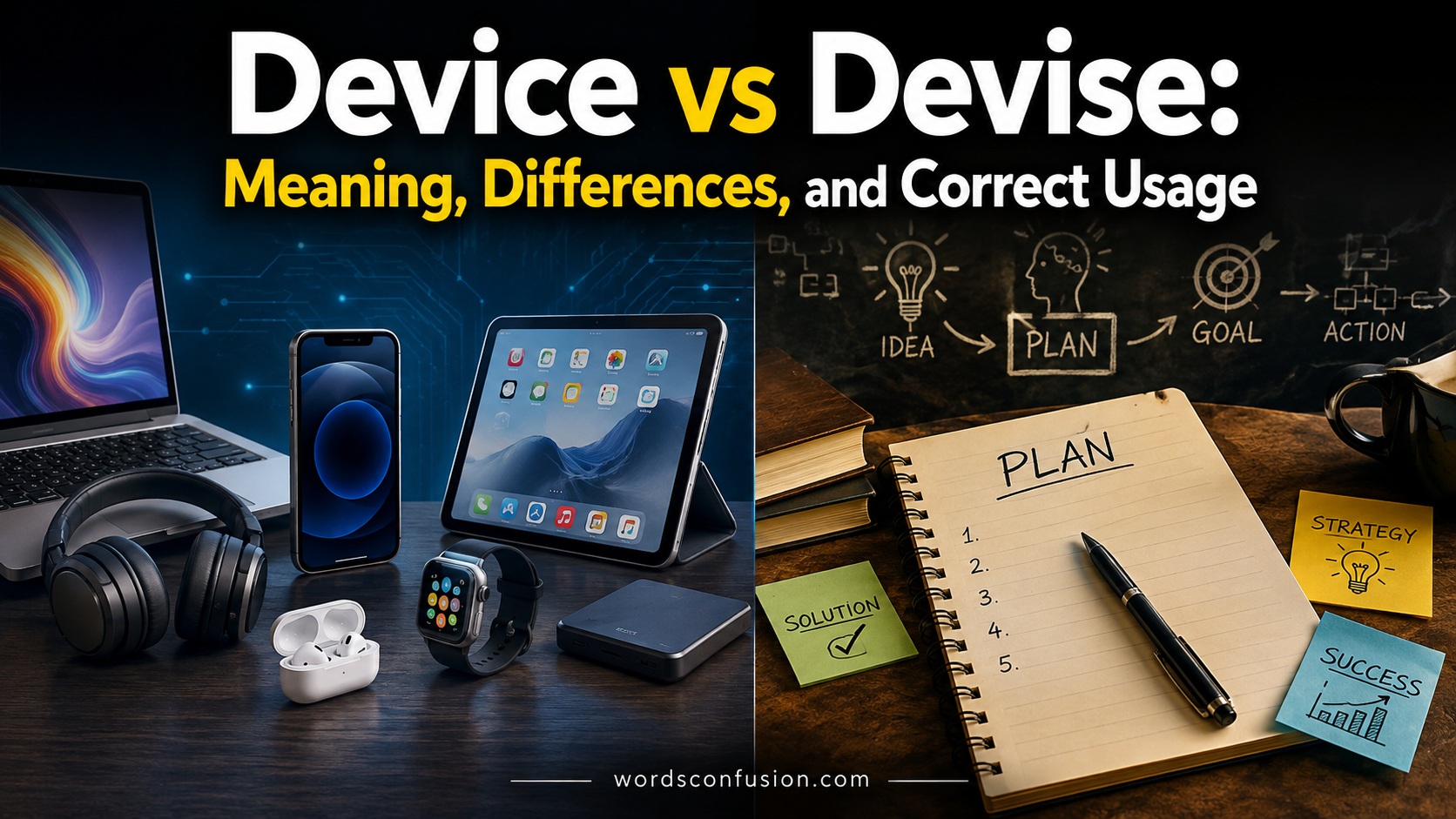
Many English words look almost identical yet carry completely different meanings. Device and devise are a perfect example. They differ by just one letter, which makes them easy to mix up when you’re writing quickly. However, they belong to different parts of speech and serve entirely different purposes.
If you’ve ever paused while typing and wondered whether you should write device or devise, you’re not alone. Students, professionals, writers, and even native English speakers occasionally confuse these words because of their similar spelling and pronunciation.
The good news is that the distinction is simple once you understand it. Device is a noun that refers to a thing, object, tool, or technique. Devise is a verb that means to invent, create, or plan something.
Throughout this guide, you’ll learn the exact meaning of each word, discover practical examples, compare them side by side, avoid common mistakes, and pick up memory tricks that make choosing the correct word almost effortless.
Quick Answer
The simplest way to remember Device vs Devise is this:
- Device is a noun. It refers to an object, tool, machine, method, or literary technique.
- Devise is a verb. It means to invent, create, plan, or develop something.
| Word | Part of Speech | Meaning | Example |
| Device | Noun | A tool, machine, object, or method | I bought a new mobile device. |
| Devise | Verb | To invent or create a plan or solution | The team devised a better marketing strategy. |
Quick Tip: If you’re talking about a thing, use device. If you’re talking about creating something, use devise.
Comparison Overview
Understanding the difference becomes much easier when you compare both words side by side.
| Feature | Device | Devise |
| Part of Speech | Noun | Verb |
| Meaning | A thing, tool, machine, or technique | To invent, plan, or create |
| Refers To | An object or concept | An action |
| Common Contexts | Technology, literature, engineering, medicine | Business, education, research, problem-solving |
| Example | This device measures blood pressure. | Scientists devised a new testing method. |
Although these words share the same Latin roots, English has assigned them different grammatical roles. That single difference changes how you use them in every sentence.
For example:
- The engineer designed a device to detect leaks.
- The engineer devised a new way to prevent leaks.
Notice how device names the object while devised describes the action.
Main Differences Between Device vs Devise
At first glance, these words seem interchangeable because they differ by only one letter. In reality, they function in completely different ways.
Device Is a Noun
A device is something that exists. You can often see it, hold it, use it, or describe it.
Examples include:
- A smartphone
- A laptop
- A medical scanner
- A GPS tracker
- A literary device
- A safety mechanism
Example sentences:
- Every student received a digital device for online learning.
- This security device alerts homeowners when someone enters the property.
- The author used symbolism as a literary device throughout the novel.
In each example, device refers to something identifiable.
Devise Is a Verb
Devise means to think of, invent, or create something new.
People devise:
- Plans
- Strategies
- Solutions
- Systems
- Experiments
- Methods
- Games
- Policies
Examples:
- The company devised a more efficient production process.
- Doctors devised a treatment plan for the patient.
- Researchers devised a new experiment to test the theory.
Unlike device, devise describes an action rather than an object.
One Creates, One Exists
A useful way to remember the difference is this:
- You devise a plan.
- The plan may eventually become a device.
Imagine an inventor.
First, the inventor devises an idea.
Later, the inventor builds a device based on that idea.
The action comes first. The object comes afterward.
They Cannot Replace Each Other
Consider these incorrect examples:
She bought a new devise.
She bought a new device.
The engineers device a solution.
The engineers devised a solution.
Replacing one word with the other changes the sentence from correct to incorrect because the grammar no longer works.
Real-Life Analogy
Think of a chef creating a new recipe.
The chef first devises the recipe by experimenting with ingredients.
Once the recipe is complete, the chef may use a kitchen device, such as a blender or food processor, to prepare the meal.
One word describes the creative process. The other names the tool.
Quick Memory Trick
Here’s an easy trick that works almost every time:
- Device contains the word ice. Imagine holding a cold smartphone made of ice. It’s a physical object.
- Devise ends with -ise, similar to verbs like organize, realize, and summarize. It describes an action.
Another way to remember it:
Device = Thing
Devise = Think
If you’re thinking or creating, choose devise.
If you’re naming something that exists, choose device.
Common Sentence Patterns
You’ll often see these patterns in everyday English.
Device
- A device for measuring temperature
- An electronic device
- A medical device
- A tracking device
- A communication device
Devise
- Devise a strategy
- Devise a solution
- Devise a plan
- Devise a method
- Devise an experiment
Learning these common combinations helps you recognize the correct word naturally while reading or writing.
Why Writers Confuse Them
Several factors make these words easy to mix up.
- Their spellings differ by only one letter.
- Their pronunciation sounds very similar.
- Both originate from related historical roots.
- Spell check may not catch the mistake because both are correctly spelled words.
- Fast typing often causes accidental substitutions.
Fortunately, once you remember that one is a noun and the other is a verb, the confusion usually disappears.
At a Glance
| If You Mean… | Use |
| A phone | Device |
| A laptop | Device |
| A machine | Device |
| A literary technique | Device |
| To invent something | Devise |
| To create a plan | Devise |
| To develop a strategy | Devise |
| To think of an idea | Devise |
Understanding this distinction will improve your grammar, make your writing more precise, and help you avoid one of the most common word-choice mistakes in English.
What Does “Device” Mean?
A device is a noun that refers to a physical object, machine, tool, instrument, or even a technique created to perform a specific task. While many people immediately think of smartphones and tablets, the meaning of device is much broader.
You can use device to describe:
- Electronic gadgets
- Mechanical tools
- Medical equipment
- Safety mechanisms
- Literary techniques
- Clever methods or schemes
In simple terms, a device is something designed for a purpose.
Definition of Device
According to standard English dictionaries, device means:
A thing made or adapted for a particular purpose, especially a piece of mechanical or electronic equipment.
The word can also refer to a technique or strategy used to achieve a desired effect, especially in literature, speeches, or storytelling.
Pronunciation
Device is pronounced:
/dɪˈvaɪs/
It sounds like:
dih-VICE
The stress falls on the second syllable.
Origin and Etymology
The word device comes from the Old French word devis, meaning plan, design, or wish. It later entered Middle English and gradually evolved to describe an object or invention created for a specific purpose.
Over time, its meaning expanded beyond physical tools to include artistic and literary techniques.
Today, device appears in technology, engineering, medicine, education, law, and literature.
Common Meanings of Device
The meaning of device changes slightly depending on the context.
Electronic Device
This is the most common meaning in modern English.
Examples include:
- Smartphones
- Tablets
- Laptops
- Smartwatches
- Digital cameras
- Gaming consoles
Example sentences:
- Every student received a digital device for remote learning.
- Turn off your electronic device before boarding the airplane.
- This device connects to Wi-Fi automatically.
Mechanical Device
A mechanical device uses moving parts to perform work.
Examples include:
- Pulley systems
- Clocks
- Locks
- Pumps
- Gears
Example sentences:
- The engineer invented a device that reduces fuel consumption.
- This safety device prevents accidental injuries.
Medical Device
Healthcare professionals rely on thousands of specialized devices every day.
Examples include:
- Pacemakers
- Blood pressure monitors
- Hearing aids
- MRI scanners
- Insulin pumps
Example sentences:
- The doctor recommended a portable breathing device.
- Modern medical devices improve patient care significantly.
Safety Device
A safety device helps protect people or property.
Common examples include:
- Smoke detectors
- Fire alarms
- Seat belts
- Security cameras
- Carbon monoxide detectors
Example sentences:
- Every home should include at least one smoke detection device.
- The factory installed new safety devices to protect workers.
Storage Device
A storage device stores digital information.
Examples include:
- USB flash drives
- Hard drives
- SSDs
- Memory cards
- External drives
Example sentences:
- Save a backup on another storage device.
- The external device holds two terabytes of data.
Literary Device
Not every device is physical.
In literature, a literary device is a writing technique that helps authors communicate ideas more effectively.
Common literary devices include:
- Metaphor
- Simile
- Irony
- Foreshadowing
- Personification
- Symbolism
- Hyperbole
- Alliteration
Example sentences:
- Shakespeare frequently used dramatic irony as a literary device.
- Symbolism is a powerful literary device that adds deeper meaning.
Symbol or Emblem
Although less common today, device can also refer to a decorative symbol or emblem used by families, organizations, or governments.
For example:
- Military insignia
- Family crests
- Official emblems
This meaning mostly appears in historical writings.
Device as a Clever Method
Sometimes device describes a strategy or trick rather than a physical object.
Examples include:
- A negotiating device
- A legal device
- A storytelling device
Example sentences:
- Flashbacks are a common storytelling device.
- Humor became an effective persuasive device during the presentation.
Common Collocations with Device
Native English speakers naturally pair device with certain words.
Here are the most common combinations:
| Collocation | Example |
| Mobile device | My mobile device needs charging. |
| Electronic device | Electronic devices require regular updates. |
| Medical device | The hospital purchased new medical devices. |
| Digital device | Children use digital devices for learning. |
| Storage device | A USB drive is a portable storage device. |
| Safety device | Every car includes several safety devices. |
| Tracking device | Police recovered the vehicle using a tracking device. |
| Communication device | Smartphones are versatile communication devices. |
| Security device | Install a security device before traveling. |
| Literary device | Imagery is a popular literary device. |
Learning these combinations makes your English sound more natural.
Read More: Desert vs Dessert: Meaning, Differences, and Examples
Examples of Device in Everyday Sentences
Here are several practical examples.
Technology
- My favorite device is my tablet because I can read and work anywhere.
- Every electronic device eventually needs software updates.
Education
- Schools increasingly provide each student with a learning device.
- Interactive classroom devices improve participation.
Business
- The company introduced a new payment device for retail stores.
- Portable scanning devices reduced checkout times.
Healthcare
- The wearable device monitors heart rate throughout the day.
- Doctors tested a new diagnostic device before approving it.
Engineering
- Engineers designed a compact device that filters polluted water.
- The measuring device delivers highly accurate readings.
Literature
- Repetition is an effective literary device when writers want to emphasize an important idea.
- The novelist used foreshadowing as a storytelling device to build suspense.
Device in Different Industries
The word device appears across many professions.
| Industry | Meaning of Device |
| Technology | Computer, smartphone, tablet, smart watch |
| Medicine | Pacemaker, monitor, scanner |
| Engineering | Mechanical tool or machine |
| Education | Learning equipment |
| Literature | Writing technique |
| Security | Alarm system, surveillance equipment |
| Manufacturing | Industrial machine or mechanism |
Although the context changes, the core meaning stays the same: a device is something designed to perform a specific purpose.
Common Mistakes with Device
Because device looks similar to devise, many writers accidentally use the wrong word.
Incorrect:
- She bought a new devise.
Correct:
- She bought a new device.
Incorrect:
- This devise helps people hear better.
Correct:
- This device helps people hear better.
A simple question can help you choose correctly:
Can you touch it, use it, or identify it as a thing?
If the answer is yes, the correct word is almost certainly device.
Quick Tip
Think of these familiar examples:
- Smartphone = Device
- Laptop = Device
- Blood pressure monitor = Device
- USB drive = Device
- Literary metaphor = Device
Every one of these examples names a thing or a technique, not an action. That’s why device is always the correct choice in these situations.
FAQs:
Is device a noun or a verb?
Device is almost always a noun. It refers to a physical object, machine, tool, instrument, or technique designed for a specific purpose. For example, “My phone is an electronic device.”
Is devise always a verb?
Yes. Devise is a verb that means to invent, create, design, or plan something. For example, “The team devised a new marketing strategy.” Unlike device, it does not refer to an object.
How can I easily remember the difference between device and devise?
A simple memory trick is:
- Device = Thing
- Devise = Think
If you’re talking about a physical object, machine, or literary technique, choose device. If you’re talking about creating a plan, idea, or solution, choose devise.
Can device and devise ever be used interchangeably?
No. These words have different meanings and different grammatical roles. Device is a noun, while devise is a verb. Replacing one with the other creates a grammatical error and changes the meaning of the sentence.
What are some common examples of device and devise?
Here are a few everyday examples:
Device
- Mobile device
- Medical device
- GPS device
- Safety device
- Literary device
Devise
- Devise a plan
- Devise a strategy
- Devise a solution
- Devise a method
- Devise an experiment
Using these common phrases in your writing will help you remember the correct word naturally.
Conclusion:
Understanding the difference between Device vs Devise is easier than it first appears. Although the two words look and sound similar, they serve completely different purposes in English grammar.
Remember this simple rule:
- Device is a noun that refers to a tool, machine, object, method, or literary technique.
- Devise is a verb that means to invent, create, plan, or develop something.
Once you recognize that device names a thing while devise describes an action, choosing the correct word becomes almost automatic. Whether you’re writing an academic paper, a business report, an email, or everyday messages, using these words correctly will make your writing clearer and more professional.

Andrew Wilson is an experienced language researcher and content writer specializing in WordsConfusion topics. He helps readers understand commonly confused English words, spelling differences, grammar rules, word meanings, and proper usage through clear explanations, practical examples, and easy-to-follow language guides. His goal is to make English learning simple, accurate, and accessible for students, writers, professionals, and everyday learners.