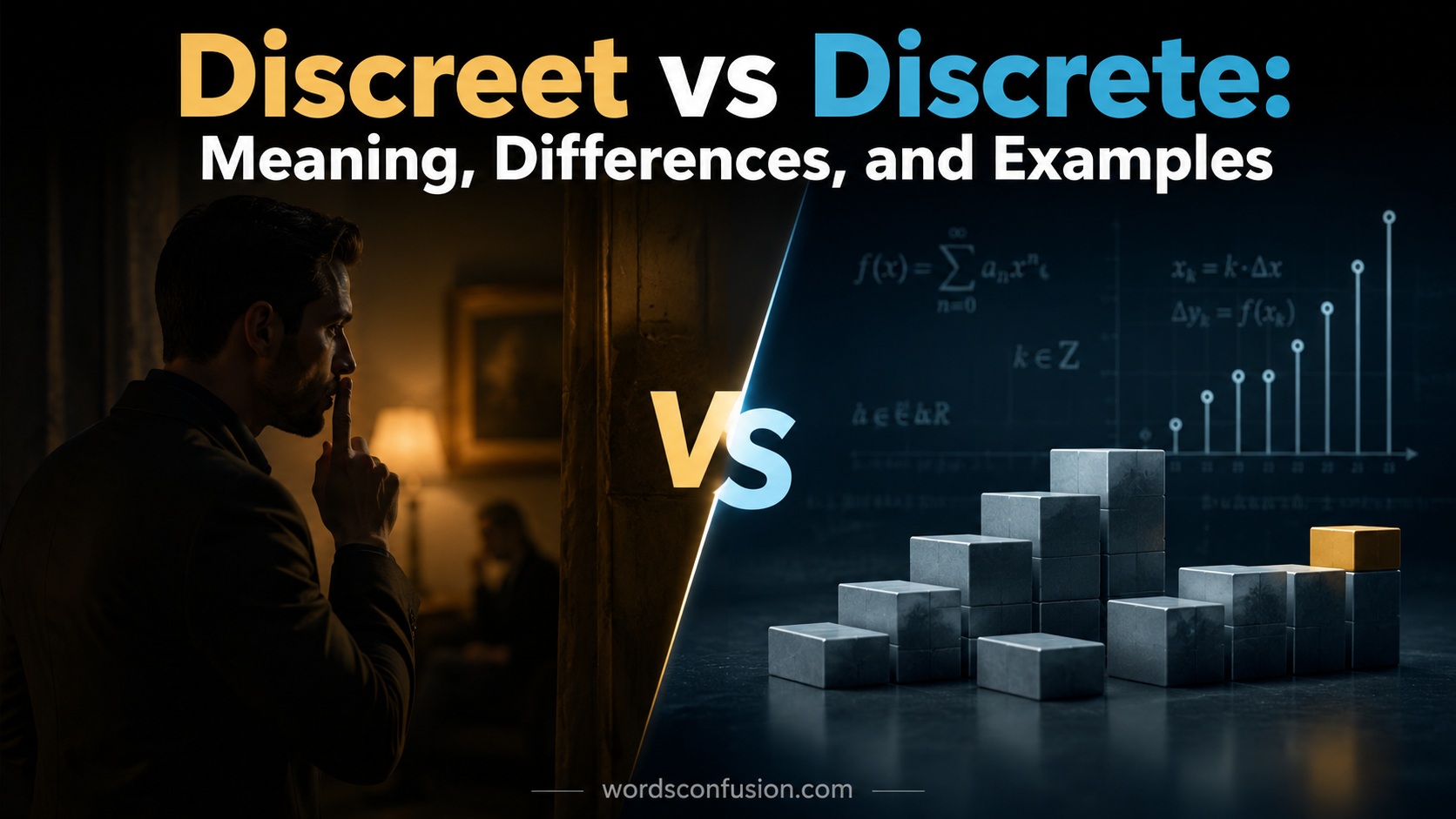
At first glance, discreet and discrete look like two spellings of the same word. They even sound exactly alike in standard American English. However, their meanings have split in two very different directions.
One word describes tactful, careful, and private behavior. The other describes separate, distinct, and individually identifiable things.
That tiny extra e can completely change your sentence.
If you want to remember the difference quickly, use this rule: A discreet person knows how to keep a secret. Discrete things exist as separate units.
Quick Answer: Discreet vs Discrete
| Word | Meaning | Common Uses | Example |
| Discreet | Careful, tactful, private, or unobtrusive | Behavior, speech, information, actions | She was discreet about the confidential conversation. |
| Discrete | Separate, distinct, or individually identifiable | Objects, categories, data, systems, units | The study divided participants into three discrete groups. |
The simplest way to remember the difference
- Discreet = tactful or private
- Discrete = separate or distinct
Think of a person who quietly handles sensitive information. That person is discreet.
Now imagine several boxes sitting separately on a shelf. Those boxes are discrete units.
The two words share a historical origin. Modern English, however, uses them for different ideas. Major dictionaries define discreet as careful or unobtrusive while discrete generally means separate or individually distinct.
What Does “Discreet” Mean?
Discreet is an adjective that describes someone or something careful, tactful, restrained, or unlikely to attract unnecessary attention.
When a person acts discreetly, they usually understand that a situation requires judgment and restraint. They don’t reveal private information loudly. They don’t embarrass other people. They also don’t draw attention to something that should remain quiet.
For example:
The assistant was discreet when discussing the executive’s private meeting.
The assistant wasn’t necessarily hiding the meeting completely. Instead, the assistant handled the information carefully.
Discreet can describe privacy
One of the most common meanings of discreet involves keeping something private or confidential.
Consider these examples:
- Please be discreet about the company’s upcoming announcement.
- She made a discreet inquiry about the job opening.
- The doctor handled the sensitive matter in a discreet manner.
- He was discreet about his friend’s personal problems.
In each sentence, discreet relates to careful conduct. The focus rests on how someone behaves or handles information.
Discreet can also mean unobtrusive
The word can describe something that avoids attracting attention.
For example:
- The hotel provided discreet security for the guests.
- She gave him a discreet signal from across the room.
- The cables were discreetly placed behind the wall.
- He stood at a discreet distance from the conversation.
Here, the idea isn’t always secrecy. Sometimes the object or action simply stays quiet, subtle, or out of the spotlight.
Merriam-Webster includes meanings connected with good judgment, caution when revealing information, and unobtrusive behavior. Cambridge similarly connects discreet with avoiding embarrassment or excessive attention.
Common words that appear with discreet
You will often see discreet used with words such as:
- discreet behavior
- discreet conversation
- discreet inquiry
- discreet investigation
- discreet service
- discreet signal
- discreet manner
- discreet distance
- discreet arrangement
- discreet handling
These combinations all carry the same general idea: careful, tactful, or unobtrusive conduct.
What Does “Discrete” Mean?
Discrete means separate, distinct, or individually identifiable.
If something is discrete, you can distinguish it from other things around it. It exists as its own unit, category, stage, component, or value.
For example:
The company operates through four discrete divisions.
The divisions are separate from one another. They may work toward the same broad goal. However, each one remains an identifiable unit.
Other examples include:
- The report contains five discrete sections.
- The machine has several discrete components.
- The researcher studied three discrete stages of development.
- The software organizes information into discrete categories.
The key idea is separation.
Discrete describes separate units
Imagine a bowl of mixed fruit. If you can identify the apples, oranges, and bananas as separate types, those categories are discrete.
Likewise:
- separate departments can be discrete units
- distinct neighborhoods can be discrete areas
- separate stages can be discrete phases
- individual values can be discrete data points
- distinct categories can be discrete groups
Cambridge defines discrete as clearly separate or different in shape or form. Merriam-Webster also uses the ideas of separate entities, individual distinction, and noncontinuous elements.
Discrete in Mathematics and Statistics
The word discrete has a particularly important technical meaning in mathematics and statistics.
Discrete data consists of separate, countable values. These values usually come from counting rather than measuring.
Examples of discrete data
- Number of students in a classroom
- Number of books on a shelf
- Number of cars in a parking lot
- Number of emails received
- Number of goals scored in a game
You can have 0, 1, 2, 3, or 4 cars in a parking lot. You generally can’t have 2.47 cars.
That makes the number of cars a classic example of discrete data.
Discrete versus continuous data
| Type of Data | Meaning | Example |
| Discrete | Separate, countable values | Number of employees |
| Continuous | Values that can vary along a range | Employee height |
A person’s height might be 170 centimeters. With more precise measurement, it could be 170.2 centimeters or 170.25 centimeters.
The number of people in a room works differently. You can count 20 people or 21 people. You can’t normally count 20.6 people.
That distinction explains why statistics and mathematics use discrete in a precise technical sense.
Discrete in Technology and Science
In technology, science, and engineering, discrete often refers to separate components, values, signals, or stages.
For example:
- A system may contain discrete components.
- A research project may follow discrete stages.
- A computer system may process discrete values.
- A scientific model may examine discrete events.
The meaning remains consistent. The parts exist as distinguishable units.
This is one reason the word appears frequently in technical writing. Technical fields often need to distinguish between something that operates as separate units and something that exists as one continuous flow.
Discreet vs Discrete: The Main Difference
The easiest way to separate these words is to ask what the adjective describes.
Discreet describes behavior or handling
Use discreet when the meaning involves:
- tact
- privacy
- restraint
- secrecy
- careful speech
- avoiding attention
- protecting sensitive information
Example:
The manager was discreet about the employee’s personal situation.
The manager acted carefully. That’s why discreet is correct.
Discrete describes separate things
Use discrete when the meaning involves:
- distinct objects
- separate groups
- independent units
- individual categories
- countable values
- clearly divided stages
Example:
The researchers divided the participants into four discrete groups.
The groups are separate from one another. Therefore, discrete is the correct word.
Side-by-side comparison
| Feature | Discreet | Discrete |
| Core meaning | Careful, tactful, private | Separate, distinct |
| Main focus | Behavior or handling | Objects, categories, units, or values |
| Common context | Privacy and manners | Science, mathematics, data, and organization |
| Example | She was discreet about the matter. | The data contains discrete values. |
| Related noun | Discretion | Discreteness |
| Common synonym | Tactful | Separate |
Discreet vs Discrete Examples in Sentences
Seeing the words in context makes the difference much easier to remember.
Examples of discreet
- The journalist made a discreet inquiry before publishing the story.
- Please be discreet when discussing the client’s private information.
- She gave him a discreet nod across the crowded room.
- The company handled the complaint in a discreet manner.
- He tried to be discreet while leaving the meeting.
- The assistant was discreet and never repeated confidential conversations.
- The security team maintained a discreet presence at the event.
Every example involves careful behavior, privacy, subtlety, or restraint.
Examples of discrete
- The report divides the results into five discrete categories.
- Each department functions as a discrete business unit.
- The experiment involved several discrete stages.
- The software stores each value as a discrete data point.
- The machine contains several discrete components.
- The city consists of several discrete neighborhoods.
- The researcher analyzed the events as discrete occurrences.
Every example involves separation or distinct identity.
Common Mistakes With Discreet and Discrete
These words often cause trouble because they sound identical. The spelling difference can easily disappear when you hear them aloud.
Mistake: “Please be discrete about this secret.”
Incorrect:
Please be discrete about this secret.
Correct:
Please be discreet about this secret.
Why? The sentence describes careful behavior and privacy. The person needs to avoid revealing information.
Mistake: “The study contains discreet categories.”
Incorrect:
The study contains five discreet categories.
Correct:
The study contains five discrete categories.
Why? The categories are separate and distinct.
Mistake: “The machine has discreet parts.”
Incorrect:
The machine has several discreet parts.
Correct:
The machine has several discrete parts.
The parts exist as separate components. They aren’t behaving tactfully or trying to avoid attention.
Mistake: “She was discrete about the confidential information.”
Incorrect:
She was discrete about the confidential information.
Correct:
She was discreet about the confidential information.
The person handled private information carefully. Therefore, discreet fits the meaning.
Discreet vs Discrete Memory Tricks
A strong memory trick can save you from this spelling trap.
Remember: discreet has two e’s
The word discreet contains two e’s.
You can connect those two e’s with eyes.
A discreet person knows when to keep their eyes and mouth under control. They notice what should remain private. They also know when silence beats unnecessary commentary.
This isn’t a formal rule of English. It’s simply a useful memory device.
Remember: discrete means separate
The word discrete contains the letters -crete.
Think of separate concrete blocks. Each block stands as its own unit.
That mental image works well for:
- discrete objects
- discrete categories
- discrete groups
- discrete data
- discrete stages
The best one-line memory rule
Discreet people keep things quiet. Discrete things stay separate.
If you remember that sentence, you can usually choose the right spelling within seconds.
Discreet vs Discrete and Their Word Origins
The confusion between these words makes more sense when you look at their history.
Both words developed from the same Latin root, discretus, which connected with ideas such as separating, distinguishing, and discerning. The words entered English through related historical forms. Over time, their spellings and meanings gradually separated.
Merriam-Webster notes that discrete and discreet were historically connected and that their spelling distinction became more consistent over time. The two words therefore have a genuine family connection. Modern usage, however, treats them as separate words with different meanings.
That history explains why the pair feels so confusing. They aren’t random look-alikes. They actually share linguistic ancestry.
Read More: Convince vs Persuade: Meaning, Differences, and Examples
Discreet vs Discrete in Different Contexts
In business and the workplace
Use discreet for confidential matters:
The HR manager was discreet when handling the employee complaint.
Use discrete for separate business units:
The company operates through three discrete divisions.
The first sentence describes conduct. The second describes organizational structure.
In science and research
Use discreet when describing careful handling of sensitive information:
The researcher was discreet about the participant’s identity.
Use discrete when describing separate categories or stages:
The study identified four discrete stages in the process.
In technology and data
Use discreet when something operates quietly or unobtrusively:
The device was discreetly installed beneath the desk.
Use discrete when something consists of separate units or values:
The system processes discrete data points.
In everyday conversation
Use discreet when someone acts tactfully:
She was discreet and didn’t mention the embarrassing mistake.
Use discrete when objects or ideas remain separate:
The boxes contained discrete collections of documents.
Discreet vs Discrete vs Discretion
A third related word can create another layer of confusion: discretion.
| Word | Part of Speech | Meaning | Example |
| Discreet | Adjective | Tactful, careful, or private | She was discreet about the information. |
| Discrete | Adjective | Separate or distinct | The system has discrete components. |
| Discretion | Noun | Good judgment or careful conduct | He handled the matter with discretion. |
Discreet and discretion
Discreet describes a person, action, or manner.
She was discreet.
Discretion names the quality or ability itself.
She showed great discretion.
The relationship resembles other adjective-noun pairs:
- prudent → prudence
- intelligent → intelligence
- discreet → discretion
However, discrete follows a completely different meaning path in modern English.
A Practical Case Study: Choosing the Right Word
Imagine a company investigating a confidential data breach.
The security team divides the investigation into four separate stages. Each stage has its own purpose and timeline.
At the same time, the communications manager carefully avoids revealing sensitive details to the public.
Which word belongs where?
The investigation involved four discrete stages. The communications manager remained discreet about the confidential details.
This example shows the distinction perfectly:
- Discrete describes the separate stages.
- Discreet describes the manager’s careful behavior.
One investigation can contain both words because the words describe completely different ideas.
Another Case Study: Data and Privacy
Suppose a hospital organizes patient information into separate categories for analysis. The categories might include age groups, treatment types, or appointment types.
Those categories are discrete because they remain distinct.
Now imagine a staff member discussing a patient’s private information.
The staff member should be discreet.
The database contains several discrete categories. Staff members must remain discreet when discussing confidential patient information.
The spelling difference is small. The conceptual difference is enormous.
FAQs:
Can “discreet” describe an object?
Yes. Discreet can describe an object when the object is designed to avoid attention or remain unobtrusive.
For example:
The security camera has a discreet design.
This means the camera doesn’t attract much attention.
However, discrete would describe an object that exists as a separate unit:
The system contains several discrete cameras.
Here, the cameras are separate components. The meaning has shifted from unobtrusive to separate.
What does “discreetly” mean?
Discreetly is the adverb form of discreet. It means doing something carefully, tactfully, privately, or without attracting unnecessary attention.
For example:
She discreetly left the room.
The employee discreetly informed the manager about the problem.
In both sentences, the action happens quietly or carefully.
The word discretely also exists as an adverb related to discrete. It means in separate or distinct units. However, it appears much more often in technical or specialized contexts.
Is “discreet” related to “discretion”?
Yes. Discreet and discretion are closely related.
- Discreet is an adjective.
- Discretion is a noun.
Compare these examples:
She was discreet about the confidential matter.
She handled the confidential matter with discretion.
Both sentences describe tact and careful judgment. The grammatical role changes.
Can “discrete” mean “different”?
Yes. Discrete can mean clearly separate or distinct from something else.
For example:
The researchers identified two discrete patterns in the data.
The patterns differ enough to be recognized as separate categories.
However, discrete usually emphasizes separation or individuality. It doesn’t simply mean that two things have minor differences.
Why are discreet and discrete so easy to confuse?
The words look almost identical and sound the same in standard English. They also share a historical origin.
Their meanings, however, developed in different directions:
- Discreet became associated with tact, caution, and privacy.
- Discrete became associated with separation and distinct identity.
That combination makes them a classic spelling and vocabulary trap. When you hear either word, you must rely on the sentence’s meaning to choose the correct spelling.
Conclusion:
The difference between discreet and discrete comes down to one central idea.
Discreet describes careful behavior. It suggests tact, privacy, restraint, or a desire to avoid unnecessary attention. If someone handles confidential information carefully or acts without drawing attention, discreet is the right choice.
Discrete, on the other hand, describes separation. It refers to things that exist as distinct units, categories, stages, values, or components.

Andrew Wilson is an experienced language researcher and content writer specializing in WordsConfusion topics. He helps readers understand commonly confused English words, spelling differences, grammar rules, word meanings, and proper usage through clear explanations, practical examples, and easy-to-follow language guides. His goal is to make English learning simple, accurate, and accessible for students, writers, professionals, and everyday learners.