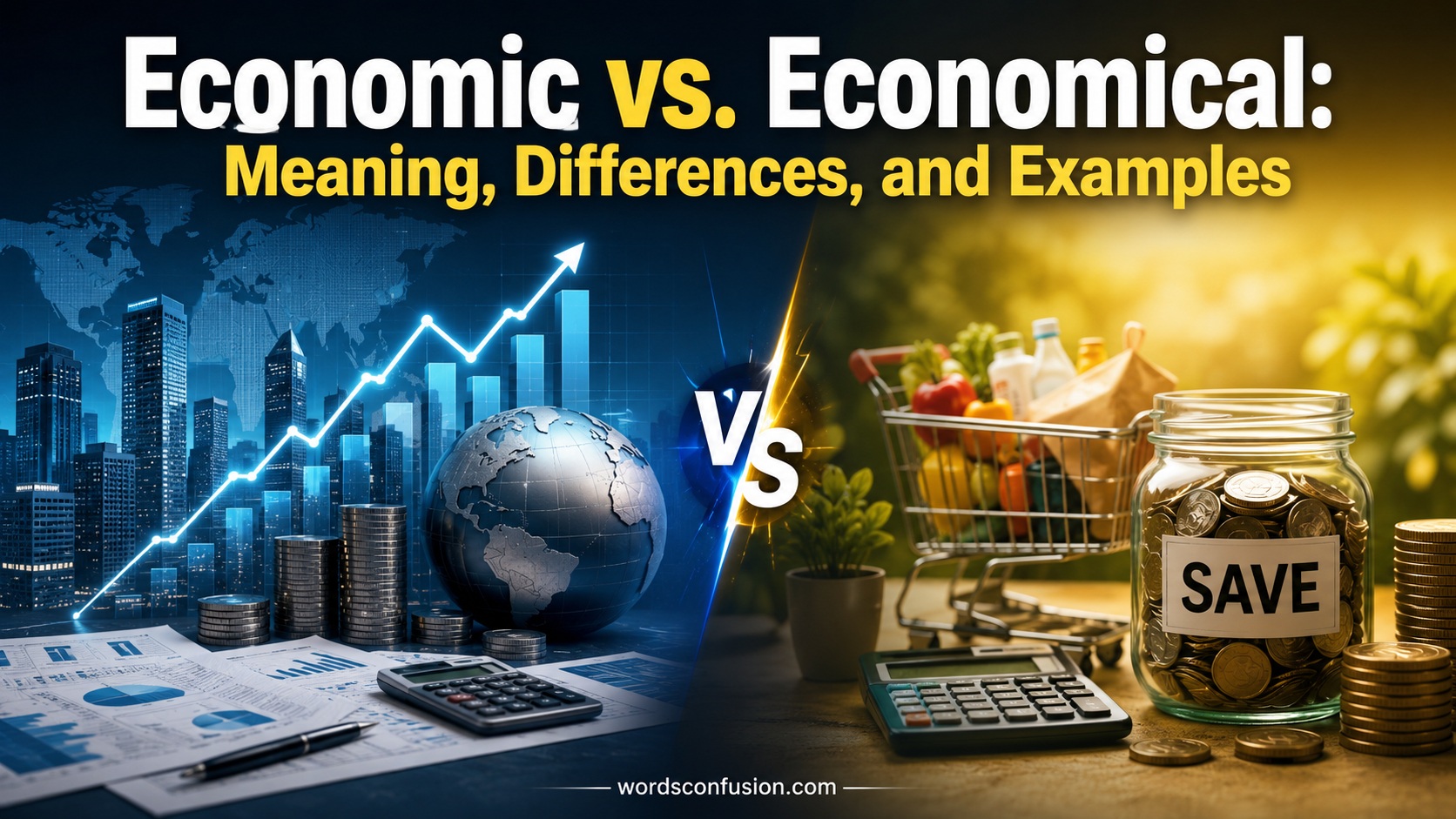
Economic vs. economical is a common English word confusion because both adjectives come from the same word family. They share a connection with economy, money, and resources, yet they usually point in different directions.
The easiest distinction is simple:
- Economic usually means related to the economy, business, finance, trade, or economics.
- Economical usually means using money or resources carefully and efficiently.
So, a country can face an economic crisis, while a fuel-efficient car can be an economical car. The words look like close relatives because they are. However, they don’t always do the same job in a sentence.
Quick Answer: Economic vs. Economical
Economic describes something connected to the economy or the production, distribution, and consumption of goods and services.
The country is experiencing serious economic problems.
Economical describes something that avoids waste and uses money, fuel, time, energy, or other resources efficiently.
This car is economical because it uses very little fuel.
| Word | Main Meaning | Example |
| Economic | Related to the economy or economics | The government introduced new economic policies. |
| Economical | Efficient and not wasteful | This is an economical way to heat the house. |
Memory trick: Economic = economy-related. Economical = resource-saving.
Although the distinction is useful, English has some overlap. Economic can occasionally mean profitable or cost-effective. Still, economical remains the more natural choice when you mean “thrifty,” “efficient,” or “not expensive to operate.”
What Does Economic Mean?
Economic is an adjective that usually relates to an economy or to the broader systems through which goods and services are produced, distributed, bought, and consumed.
The word commonly appears in discussions about:
- National economies
- Business
- Trade
- Employment
- Inflation
- Economic growth
- Government policy
- Production and consumption
- Financial conditions
- Economic theory
When a subject concerns the financial or commercial life of a country, region, industry, or society, economic usually fits.
Examples of Economic
- The country experienced strong economic growth.
- The government announced new economic reforms.
- High inflation can create serious economic pressure.
- The report examines economic inequality.
- The company studied the economic impact of the new law.
- Several industries are facing difficult economic conditions.
In each example, the word refers to a broader financial or economic system. The focus isn’t simply on saving money. Instead, the sentence discusses how money, production, trade, employment, or resources function within a larger system.
Common Collocations With Economic
Certain word combinations appear so frequently that they are worth learning as complete phrases:
- Economic growth
- Economic development
- Economic crisis
- Economic policy
- Economic conditions
- Economic impact
- Economic activity
- Economic theory
- Economic inequality
- Economic stability
- Economic recovery
- Economic forecast
- Economic opportunity
- Economic system
For example, economic growth refers to growth in the production and value of goods and services within an economy. Economic policy refers to government decisions that influence areas such as taxation, spending, employment, inflation, and growth.
What Does Economical Mean?
Economical describes something that uses resources carefully and avoids unnecessary waste. Those resources might include money, fuel, time, energy, materials, space, or even words.
The word often carries the idea of getting good value without using more than necessary.
Examples of Economical
- This car is economical on fuel.
- Buying in bulk can be economical for a large family.
- The new heating system is economical to run.
- We need an economical solution to the problem.
- She found an economical way to complete the project.
- The printer makes economical use of ink.
Notice the central idea: efficiency.
An economical product or method doesn’t necessarily have the lowest purchase price. A more expensive appliance might become the more economical choice if it uses far less electricity over several years. In other words, the initial price and the long-term cost aren’t always the same thing.
Common Collocations With Economical
- Economical car
- Economical choice
- Economical solution
- Economical method
- Economical option
- Economical use of resources
- Economical fuel consumption
- Economical design
- Economical way
- Economical to run
- Economical on fuel
- Economical with water
For example:
Solar panels may require a large initial investment, yet they can become an economical energy choice over time.
The sentence focuses on long-term efficiency and cost. Therefore, economical works naturally.
Economic vs. Economical: The Main Difference
The most important difference comes down to what the adjective describes.
Economic usually describes the economy or matters connected to it.
Economical usually describes the efficient use of resources.
| Feature | Economic | Economical |
| Basic meaning | Related to the economy | Efficient and not wasteful |
| Main focus | Finance, trade, business, and economic systems | Saving money or resources |
| Common subjects | Policies, growth, crises, conditions | Cars, methods, choices, appliances |
| Describes national financial matters? | Yes | Usually not |
| Describes fuel efficiency? | Usually not | Yes |
| Example | Economic development | Economical solution |
A quick comparison makes the difference clearer:
Economic problems can affect an entire country.
Economical choices can reduce your personal expenses.
One concerns the wider financial system. The other concerns efficient personal or practical choices.
Economic vs. Economical Examples in Sentences
The following examples show how the two words behave in real sentences.
Examples With Economic
- The government is trying to encourage economic development.
- The economic crisis affected businesses across the country.
- The university offers several courses in economic theory.
- The report analyzes the economic effects of rising prices.
- Economic conditions influence consumer spending.
- The company hired an economic adviser to study the market.
- The new industry could create significant economic opportunities.
- The country needs long-term economic stability.
Examples With Economical
- This compact car is economical to operate.
- We chose an economical method of transporting the equipment.
- The new appliance is more economical because it uses less electricity.
- Buying a reusable bottle is an economical choice over time.
- The company developed an economical packaging system.
- She is economical with her spending.
- The building uses an economical heating system.
- This recipe is economical because it requires inexpensive ingredients.
The contrast is clear. Economic often looks outward toward a financial system. Economical often looks at how efficiently something uses available resources.
Economic vs. Economical in Different Contexts
Business and Finance
Business writing frequently uses economic for broad financial matters.
- Economic forecasts influence investment decisions.
- The company is studying current economic trends.
- Economic uncertainty can affect consumer confidence.
However, economical works when a business focuses on reducing waste or operating costs.
- The company adopted an economical production method.
- The new software offers an economical solution for small businesses.
Think of it this way: economic describes the financial environment. Economical describes an efficient response to costs or resources.
Cars and Fuel
This area creates a particularly common confusion.
Use economic when discussing the broader financial effect of transportation:
The automotive industry has a major economic impact.
Use economical when describing a car that uses less fuel or costs less to operate:
This car is economical on fuel.
The car itself may be economical. The industry surrounding it may have economic importance.
Household Spending
When you discuss a decision that saves money or reduces waste, economical usually works best.
- Cooking at home is often an economical choice.
- LED bulbs can be economical to use because they consume less energy.
- Repairing the appliance may be more economical than replacing it.
However, economic fits a larger financial context:
Economic conditions have changed how many families manage their budgets.
The first examples concern individual efficiency. The final example concerns wider financial conditions.
Government and Public Policy
Government policies often have economic effects.
- The government introduced a new economic policy.
- The law could have significant economic consequences.
- Economic development remains a national priority.
However, the method used to achieve a goal can be economical.
The city found an economical way to improve public transportation.
The policy itself may be economic. The cost-saving method may be economical.
Time and Other Resources
Economical doesn’t apply only to money.
You can use the word for:
- Water
- Fuel
- Energy
- Space
- Time
- Materials
- Words
- Effort
Examples include:
- The machine is economical with water.
- This process makes economical use of raw materials.
- Her writing is clear and economical.
- The new design uses space economically.
Here, the underlying idea remains the same: use what you have without unnecessary waste.
Economic vs. Economical: Common Mistakes
Mistake: “Economical Problems” for National Financial Problems
A common sentence is:
The country is facing economical problems.
In most contexts, the better choice is:
The country is facing economic problems.
Why? The sentence discusses the country’s financial and economic condition. It doesn’t describe a problem that saves money.
Other natural examples include:
- Economic crisis
- Economic recession
- Economic instability
- Economic challenges
Mistake: Using Economic to Mean Cheap
Consider this sentence:
This washing machine is economic to operate.
Although economic can sometimes carry a cost-effective meaning, economical is usually the clearer and more natural choice in everyday American English:
This washing machine is economical to operate.
The sentence focuses on operating costs and resource efficiency.
Mistake: Assuming Economical Always Means Cheap
Economical doesn’t simply mean “cheap.”
A cheap product may have a low purchase price yet waste electricity, break quickly, or require expensive repairs. An economical product may cost more initially while saving money over time.
For example:
The expensive refrigerator proved more economical because it used far less electricity.
This distinction matters. Cheap focuses mainly on price. Economical focuses on overall efficiency and value.
Mistake: Confusing Economic With Economy
These words belong to the same family, but they have different grammatical roles.
| Word | Part of Speech | Meaning | Example |
| Economy | Noun | A financial system or careful use of resources | The economy is growing. |
| Economics | Noun | The study of economic systems | She studies economics. |
| Economic | Adjective | Related to the economy | Economic growth is rising. |
| Economical | Adjective | Efficient and not wasteful | This is an economical option. |
| Economize | Verb | To reduce spending or waste | We need to economize. |
Understanding the word family makes the difference easier to remember.
Read More: Discreet vs Discrete: Meaning, Differences, and Examples
Can Economic and Economical Be Interchanged?
Usually, no.
The words overlap in a few contexts. In fact, dictionaries recognize that economic can sometimes mean profitable or cost-effective. However, the most common modern distinction remains useful:
- Economic → related to the economy or economics.
- Economical → efficient, thrifty, or resource-saving.
Compare these sentences:
The economic impact of the factory was substantial.
The sentence discusses the factory’s effect on the broader economy.
The factory adopted an economical production system.
The sentence discusses the factory’s efficient use of resources.
Replacing one word with the other would shift the meaning. That’s the key point.
Economic vs. Economical: A Practical Decision Guide
When you’re unsure which word to choose, ask yourself a few quick questions.
Is the Sentence About the Economy?
If the answer is yes, use economic.
Examples:
- Economic policy
- Economic growth
- Economic crisis
- Economic conditions
- Economic development
Is Something Saving Money or Resources?
If the answer is yes, use economical.
Examples:
- Economical car
- Economical solution
- Economical method
- Economical appliance
- Economical use of water
Are You Describing a Broad System or an Efficient Choice?
This question solves many confusing cases.
Broad system or financial conditions:
The economic situation remains uncertain.
Efficient choice or resource-saving method:
This is the most economical solution.
The distinction is almost like comparing a map with a bicycle. Economic looks at the larger landscape. Economical asks how efficiently you move through it.
Economic vs. Economical Memory Trick
Use this simple rule:
Economic talks about the economy. Economical helps you economize.
Another way to remember it:
- Economic = economy-related
- Economical = efficient and thrifty
Try connecting the endings with their meanings:
Economic → economy
Economical → economize
This isn’t a perfect rule for every historical or specialized use. Still, it works remarkably well for everyday writing.
Economic vs. Economical in Formal and Everyday English
Economic appears frequently in formal writing because economists, governments, businesses, and journalists often discuss financial systems.
Common examples include:
- Economic indicators
- Economic policy
- Economic research
- Economic forecasts
- Economic performance
Economical appears often in consumer advice and practical discussions.
Common examples include:
- An economical vehicle
- An economical solution
- An economical way to travel
- An economical use of energy
Both words work in formal writing. The important thing is choosing the word that matches your meaning.
Economic vs. Economical: A Short Case Study
Imagine a city wants to reduce transportation costs.
The city’s overall financial situation might be described this way:
The city’s economic conditions have made transportation funding more difficult.
Here, economic refers to broader financial circumstances.
Now imagine the city chooses smaller buses that consume less fuel:
The city adopted a more economical transportation system.
Here, economical describes the system’s efficient use of resources.
The same project can involve both words because the words describe different angles of the situation.
Economic vs. Economical: Practice Quiz
Choose economic or economical in each sentence.
- The country is experiencing rapid ______ growth.
- This vehicle is highly ______ because it uses little fuel.
- The government announced new ______ reforms.
- We need an ______ way to reduce energy consumption.
- Rising prices are creating serious ______ pressure.
- Buying this appliance may be more ______ in the long run.
- The report examines the ______ impact of the new industry.
- The company developed an ______ packaging method.
- The central bank released its latest ______ forecast.
- This heating system is extremely ______ to run.
Answer Key
- Economic — The sentence concerns national growth.
- Economical — The vehicle uses fuel efficiently.
- Economic — The reforms concern the economy.
- Economical — The method reduces resource use.
- Economic — The pressure relates to broader financial conditions.
- Economical — The focus is long-term value and cost.
- Economic — The sentence concerns an industry’s effect on the economy.
- Economical — The packaging method reduces waste or expense.
- Economic — A forecast concerns economic conditions.
- Economical — The heating system uses energy efficiently.
FAQs:
Is economic the same as economical?
No. Economic usually means related to the economy or economics. Economical usually means efficient, thrifty, or not wasteful.
Should you say “economic problem” or “economical problem”?
Use economic problem when discussing financial or economic difficulties.
The country faces serious economic problems.
Use economical when describing a solution that saves money or resources.
We need an economical solution to the problem.
Is an economical car necessarily cheap?
No. An economical car may have a higher purchase price yet cost less to operate because it uses less fuel or requires fewer resources.
Which word should you use for fuel efficiency?
Economical is usually the natural choice.
This car is economical on fuel.
You can also say:
This car is fuel-efficient.
Can economical describe a person?
Yes. It can describe someone who uses money or resources carefully.
She is economical with her spending.
However, frugal, thrifty, or careful with money may sound more natural when describing someone’s personal habits.
Is “economic choice” ever correct?
Yes, but context matters. Economic can sometimes mean profitable or cost-effective. Still, when you mean “saving money” or “using resources efficiently,” economical is usually the clearer choice.
What is the difference between economic and economical in one sentence?
Economic relates to the economy or economics while economical describes something that uses money or resources efficiently.
Conclusion:
The confusion between economic vs. economical comes from their shared origin and similar appearance. However, their everyday meanings are usually distinct.
Use economic when you’re talking about the economy, finance, business, trade, production, or broader financial conditions:
The country is facing economic challenges.
Use economical when something uses money, fuel, time, energy, or other resources efficiently:

Andrew Wilson is an experienced language researcher and content writer specializing in WordsConfusion topics. He helps readers understand commonly confused English words, spelling differences, grammar rules, word meanings, and proper usage through clear explanations, practical examples, and easy-to-follow language guides. His goal is to make English learning simple, accurate, and accessible for students, writers, professionals, and everyday learners.