
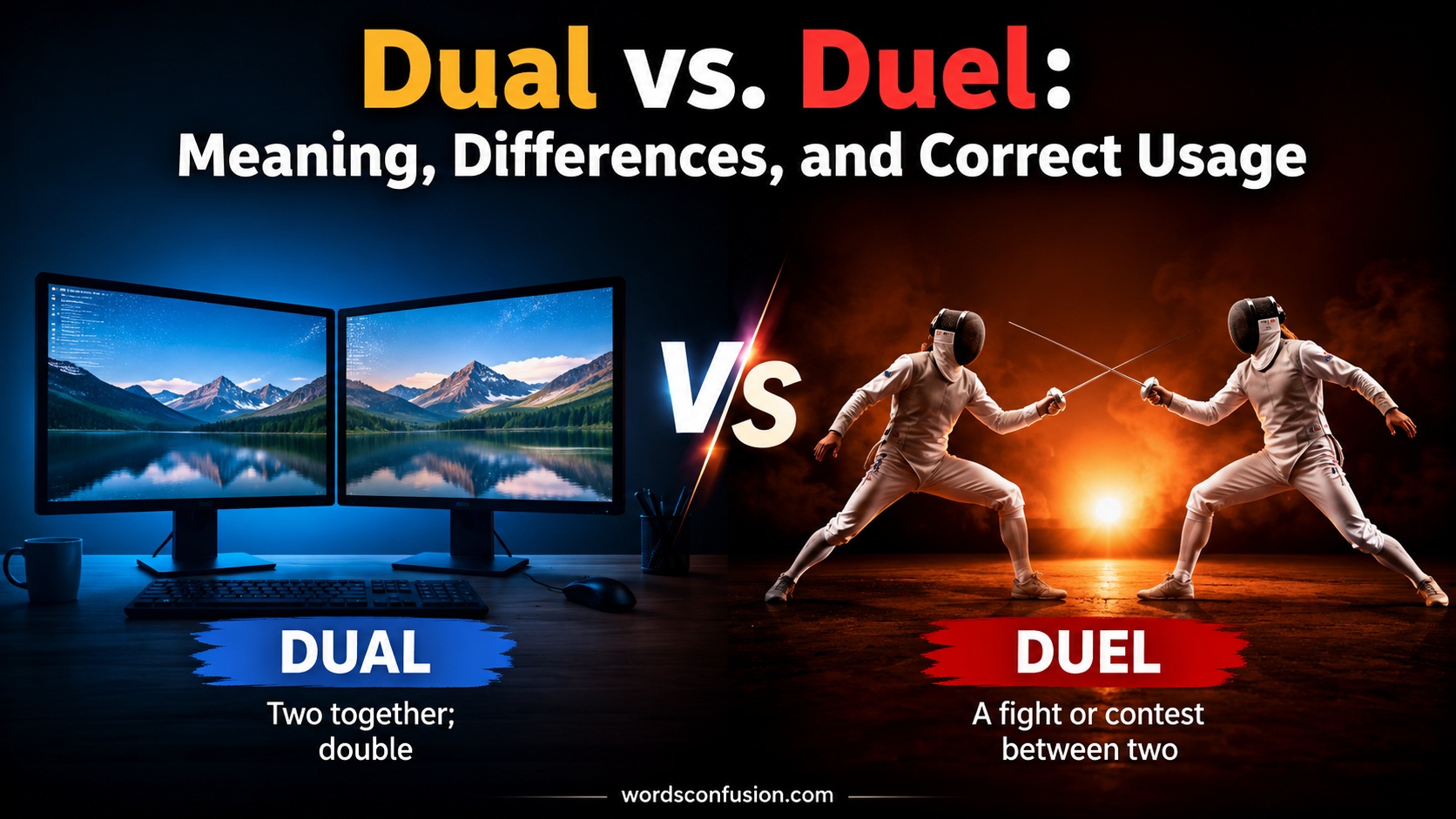
Have you ever typed “duel purpose” when you meant “dual purpose”? Or perhaps you’ve seen “dual” and “duel” used interchangeably because they sound almost identical? You’re not alone. These two words create confusion because their pronunciation is very similar in American English, yet their meanings are worlds apart.
The difference becomes much easier once you connect each word with its central idea. Dual relates to two parts, functions, roles, or aspects, while duel describes a fight, contest, or competition between two sides.
Think of it this way: a smartphone with two SIM cards has a dual-SIM function. Two athletes competing intensely against each other may engage in a duel. One word describes having two; the other describes two sides facing off.
Although the spelling differs by only one letter, choosing the wrong word can completely change your sentence. Understanding dual vs. duel will help you write more accurately in school assignments, professional communication, articles, emails, and everyday conversations.
Quick Answer
Dual means involving two parts, features, roles, purposes, or aspects. It usually works as an adjective.
Duel means a fight, contest, or intense competition between two people or sides. It can work as both a noun and a verb.
Easy memory trick:
Dual = two
Duel = fight or competition
For example:
- The car has dual airbags.
- The two players engaged in a fierce duel.
- She has a dual role as a teacher and researcher.
- The two candidates dueled over the issue during the debate.
The key question is simple: Are you talking about two things existing together or two sides competing against each other?
If they’re simply combined or present in pairs, choose dual. If they’re confronting one another, choose duel.
Comparison Overview
| Feature | Dual | Duel |
| Basic meaning | Involving two parts or aspects | A fight, contest, or competition between two sides |
| Main part of speech | Adjective | Noun and verb |
| Main idea | Two | Conflict or competition |
| Requires conflict? | No | Usually involves opposition |
| Common examples | Dual citizenship, dual purpose, dual role | Sword duel, verbal duel, political duel |
| Example sentence | The machine has dual controls. | The rivals fought a duel. |
| Memory clue | Dual = two | Duel = fight |
The distinction looks simple, but context matters.
For instance, dual citizenship means that someone legally holds citizenship in two countries. Nothing about the phrase suggests a conflict.
On the other hand, a duel between two candidates describes a competitive encounter. The candidates aren’t simply two people. They’re opposing sides in a contest.
That difference is the heart of dual vs. duel.
Main Differences Between Dual vs. Duel
The biggest difference between dual and duel is what each word emphasizes.
Dual emphasizes two parts or aspects. It tells you that something has two components, functions, identities, or characteristics.
Duel emphasizes opposition between two sides. It describes a contest, confrontation, fight, or struggle.
Consider these two sentences:
The device has dual functions.
Here, the word simply tells you that the device performs two functions.
The two competitors entered a duel.
Now the focus shifts to competition between two opponents.
The number two appears in both ideas, but the relationship between the two is completely different.
Dual Means Two Parts or Aspects
When you use dual, you’re generally describing something that contains, involves, or combines two elements.
For example:
- dual purpose means having two purposes.
- dual citizenship means citizenship in two countries.
- dual role means having two roles.
- dual controls means having two sets of controls.
- dual identity means having two identities or aspects of identity.
- dual function means serving two functions.
Notice something important: these examples don’t describe competition.
Two things can exist side by side without fighting, competing, or opposing each other. That’s where dual fits.
Duel Means Competition or Conflict
A duel, in its traditional sense, was a formal fight between two people. Historically, duels could involve weapons and followed particular rules or customs.
Modern English also uses duel figuratively.
A sports commentator might describe two outstanding players as being locked in a duel. Two political candidates might engage in a verbal duel during a debate. Two companies might be described as being in a duel for market dominance.
In these cases, nobody necessarily pulls out a sword.
The word emphasizes opposition.
Dual Doesn’t Mean a Fight
One of the easiest mistakes is assuming that because dual contains the idea of two, it can describe any situation involving two people.
That’s not correct.
For example:
The company has a dual leadership structure.
This means two people share leadership responsibilities.
But:
The two leaders engaged in a duel over the company’s future.
Now the relationship has changed. The sentence describes conflict or intense disagreement.
The number hasn’t changed. The relationship has.
That’s why context matters more than simply counting how many people or things appear in a sentence.
What Does Dual Mean?
Dual is primarily an adjective that describes something involving two parts, aspects, functions, roles, or components.
The word often appears before a noun.
Common structures include:
- dual + purpose
- dual + role
- dual + function
- dual + system
- dual + citizenship
- dual + identity
- dual + controls
- dual + responsibility
For example:
The building serves a dual purpose.
The building has two purposes.
She has a dual role in the organization.
She performs two different roles.
The phone supports dual SIM functionality.
The phone supports two SIM cards.
In each case, dual describes a two-part arrangement.
Common Uses of Dual
The word dual appears across many areas of modern life.
Dual Citizenship
Dual citizenship refers to a person’s legal citizenship in two countries.
For example:
He holds dual citizenship in the United States and Canada.
The phrase doesn’t mean that the two countries are competing. It simply identifies two citizenships.
Dual Purpose
A dual-purpose object serves two functions.
For example:
This room has a dual purpose as an office and guest room.
The room performs two jobs.
Dual Role
A person can have a dual role when they perform two different functions.
For example:
She has a dual role as a manager and trainer.
The person isn’t fighting two roles. They’re carrying both responsibilities.
Dual Function
A product or system has a dual function when it performs two functions.
For example:
The device has a dual function: it records sound and measures temperature.
Again, there’s no conflict involved.
Examples of Dual in a Sentence
Here are several natural examples:
- The new laptop has a dual-screen design.
- She plays a dual role in the organization.
- The building has a dual purpose.
- The country permits dual citizenship under certain conditions.
- The camera uses dual sensors.
- The program has a dual focus on education and research.
- The machine comes with dual controls.
- His job requires a dual skill set.
- The policy serves a dual objective.
- The vehicle has dual airbags.
The common thread is obvious: dual describes two components or functions working within the same arrangement.
What Does Duel Mean?
A duel is a contest or confrontation between two opponents.
Traditionally, the word referred to a formal fight between two people. Historical duels often involved weapons and followed established rules.
Today, the word has a much broader use.
A duel can be:
- Physical
- Verbal
- Political
- Athletic
- Intellectual
- Competitive
- Figurative
For example:
The two tennis stars engaged in a thrilling duel.
Nobody needs to assume that the players physically attacked each other. The sentence uses duel as a metaphor for intense competition.
Duel as a Noun
As a noun, duel names the contest or confrontation itself.
Examples:
The two swordsmen fought a duel.
The match turned into a duel between two talented goalkeepers.
The candidates engaged in a verbal duel during the debate.
In each sentence, duel refers to the confrontation.
Duel as a Verb
Duel can also function as a verb.
Examples:
The two players dueled for the championship.
The candidates dueled over economic policy.
The rivals dueled throughout the final round.
As a verb, duel means to engage in a duel or figurative contest.
Examples of Duel in a Sentence
Here are several examples:
- The two knights prepared for a duel.
- The rivals fought a dramatic duel.
- The two players dueled for first place.
- The candidates engaged in a verbal duel.
- The pitchers had a remarkable duel during the game.
- The two companies are locked in a competitive duel.
- The chess match became an intellectual duel.
- The two athletes dueled until the final seconds.
- The debate became a political duel.
- The movie ends with a dramatic duel between the two characters.
These examples show why duel isn’t limited to historical sword fights.
Dual vs. Duel Examples Side by Side
Seeing the words together makes the distinction much clearer.
| Dual | Duel |
| The car has dual airbags. | The two drivers engaged in a duel on the track. |
| She has a dual role. | The two candidates had a political duel. |
| The phone supports dual SIM cards. | The two players dueled for the title. |
| The building has a dual purpose. | The warriors prepared for a duel. |
| He holds dual citizenship. | The debate became a verbal duel. |
| The machine has dual controls. | The teams entered a fierce duel. |
| The project has a dual objective. | The rivals dueled throughout the match. |
The pattern becomes easy to spot.
Dual describes the existence or combination of two things.
Duel describes the interaction between two opposing sides.
Dual vs. Duel: Detailed Examples
Let’s examine a few examples more closely.
Example: Dual Purpose
The hall has a dual purpose as a classroom and meeting room.
The hall serves two functions. The two functions don’t compete with one another.
Therefore, dual is correct.
Example: Duel Between Rivals
The two athletes entered a fierce duel for the championship.
The athletes are competing against each other.
Therefore, duel is correct.
Example: Dual Identity
The character struggles with a dual identity.
The phrase describes two aspects of the character’s identity. It doesn’t necessarily mean those identities are fighting.
Therefore, dual works.
Example: Verbal Duel
The politicians engaged in a heated verbal duel.
Here, the politicians are confronting each other through words.
Therefore, duel works.
Example: Dual Leadership
The organization operates under a dual leadership structure.
Two people share leadership responsibilities.
Therefore, dual is correct.
Example: Political Duel
The election became a political duel between the two leading candidates.
The candidates aren’t simply two political figures. They’re competing against one another.
Therefore, duel is correct.
Read More: Coarse vs. Course: Meaning, Examples, and Correct Usage
Common Mistakes With Dual and Duel
Because the words sound similar, spelling mistakes are common.
The most frequent errors happen with familiar phrases.
Mistake: Duel Purpose
Incorrect:
The product has a duel purpose.
Correct:
The product has a dual purpose.
Why? The product serves two purposes. It isn’t fighting anyone.
Mistake: Dual Between Two Opponents
Incorrect:
The two boxers entered a dual.
Correct:
The two boxers entered a duel.
Why? The sentence describes a confrontation between opponents.
Mistake: Duel Citizenship
Incorrect:
She has duel citizenship.
Correct:
She has dual citizenship.
Why? She holds citizenship in two countries. There’s no contest involved.
Mistake: Dual Between Rivals
Incorrect:
The two candidates had a dual during the debate.
Correct:
The two candidates had a duel during the debate.
Why? The sentence describes an intense verbal confrontation.
Common Errors at a Glance
| Incorrect | Correct | Explanation |
| duel purpose | dual purpose | Two purposes |
| duel citizenship | dual citizenship | Two citizenships |
| duel role | dual role | Two roles |
| dual between rivals | duel between rivals | Competition |
| dual for the championship | duel for the championship | Contest |
| verbal dual | verbal duel | Verbal confrontation |
Dual vs. Duel Pronunciation
One reason these words cause so much confusion is their pronunciation.
In American English, dual and duel are commonly pronounced very similarly, often as /ˈduːəl/.
That means spelling becomes especially important when you’re writing.
When you hear:
“They had a ___ purpose.”
You need to understand the context before choosing the spelling.
The phrase dual purpose is correct because the meaning involves two purposes.
Likewise:
“The two rivals engaged in a ___.”
The correct word is duel because the sentence describes a confrontation.
Why Pronunciation Can Be Misleading
English contains many homophones and near-homophones. These words can sound identical or nearly identical while having unrelated meanings.
Dual vs. duel is a good example.
When speaking, listeners usually rely on context. When writing, you must choose the correct spelling.
That’s why memorizing the meaning is more useful than memorizing the pronunciation alone.
Is Dual an Adjective or a Noun?
Dual is most commonly used as an adjective.
It modifies a noun and tells you that something has two parts or aspects.
Examples include:
- dual purpose
- dual citizenship
- dual role
- dual function
- dual system
- dual controls
For example:
The program has a dual purpose.
Here, dual modifies purpose.
In specialized contexts, dual can also appear as a verb. However, that use is far less common in everyday writing.
For most readers, the safest rule is simple:
Use dual as an adjective when you’re describing something involving two parts or aspects.
Is Duel an Adjective or a Noun?
Duel commonly works as both a noun and a verb.
As a noun:
The two fighters fought a duel.
As a verb:
The two fighters dueled for several minutes.
The noun identifies the contest.
The verb describes the action.
Related forms include:
- duel
- duels
- dueled
- dueling
- duelist
In American English, dueled and dueling are standard spellings.
FAQs:
What is the difference between dual and duel?
Dual means involving two parts, aspects, functions, or roles. Duel means a fight, contest, or intense competition between two opponents or sides.
Does dual mean two?
Yes. Dual generally describes something involving two distinct parts, features, functions, or aspects.
For example:
The system has a dual purpose.
That means it serves two purposes.
Does duel always mean a physical fight?
No. Historically, a duel referred to a formal fight between two people. Modern English also uses duel figuratively for intense competition or confrontation.
For example:
The two candidates engaged in a verbal duel.
No physical fight is necessary.
Is dual a noun or adjective?
Dual is primarily an adjective.
For example:
The machine has dual controls.
It can appear in other grammatical roles in specialized contexts, but its adjective use is by far the most common.
Is duel a noun or verb?
Duel can be both a noun and a verb.
As a noun:
They fought a duel.
As a verb:
They dueled for the championship.
Conclusion:
The words dual and duel may sound almost identical, but their meanings couldn’t be more different. Use dual when you’re talking about two parts, functions, roles, features, identities, or aspects. Common examples include dual citizenship, dual purpose, dual role, and dual controls.
Use duel when you’re describing a fight, contest, rivalry, or confrontation between two sides. Examples include sword duel, verbal duel, political duel, and duel for the championship.
