Have you ever typed “to that affect” and wondered whether it should actually be “to that effect”? You’re not alone. These two words sound similar, look deceptively alike, and regularly cause confusion in everyday writing.
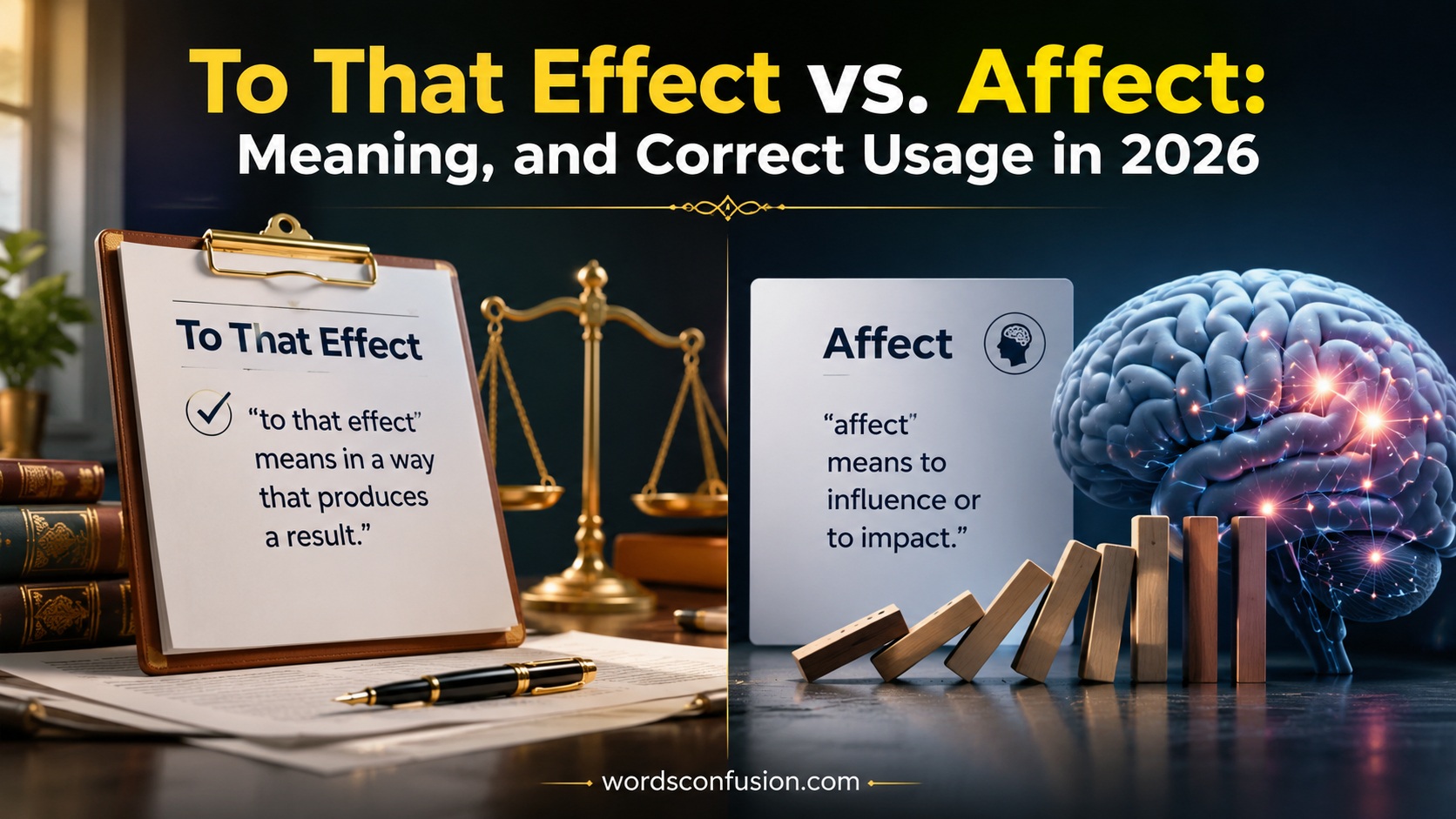
The good news is that the phrase has a clear standard form. When you want to say that someone expressed an idea, meaning, or message similar to something already mentioned, the correct expression is “to that effect.”
For example:
She didn’t use those exact words, but she said something to that effect.
Here, effect refers to the general meaning or substance of what she said. Affect doesn’t fit the expression.
The confusion becomes easier to understand once you separate the meanings and grammatical roles of affect and effect. Although both words have several meanings, their most common uses are quite different.
This guide explains to that effect vs. affect, shows you how the phrase works, examines common mistakes, and gives you practical examples you can use in conversation and writing.
Quick Answer
“To that effect” is correct. “To that affect” is not the standard form of the expression.
The phrase to that effect means “with that meaning,” “along those lines,” or “expressing a similar idea.”
For example:
- Correct: He said something to that effect.
- Incorrect: He said something to that affect.
The word affect usually functions as a verb meaning to influence or change something.
The criticism affected her confidence.
The word effect usually functions as a noun meaning a result, consequence, or outcome. In the expression to that effect, however, it refers to the general meaning or substance of a statement.
Quick rule: If you’re talking about the meaning of someone’s words, use effect in the phrase to that effect.
Comparison Overview
| Expression | Correct? | Meaning | Example |
| To that effect | Yes | With that meaning or along those lines | She said something to that effect. |
| To that affect | No | Not the standard English expression | She said something to that affect. |
| Words to that effect | Yes | Words expressing approximately the same idea | He used words to that effect. |
| To the effect that | Yes | Stating the general meaning of something | She wrote to the effect that she disagreed. |
| To this effect | Yes | Expressing the meaning just mentioned or being presented | He sent an email to this effect. |
The important distinction is simple: effect belongs to the established expression.
Main Differences Between To That Effect vs. Affect
The biggest difference comes down to meaning and grammatical function.
Affect most commonly works as a verb. It means to influence something or cause a change.
Lack of sleep can affect your concentration.
Effect most commonly works as a noun. It refers to a result or consequence.
Lack of sleep can have a negative effect on your concentration.
But there’s another meaning of effect that matters here. The word can refer to the meaning, impression, or substance produced by something. That’s the sense behind the established phrase to that effect.
To That Effect
To that effect means that something was said or written with approximately the same meaning.
The manager said that the company would make changes, or words to that effect.
The sentence doesn’t claim that the manager used those exact words. Instead, it summarizes the general idea.
Affect
Affect usually means to influence or have an impact on something.
Rising prices affect household budgets.
You wouldn’t normally use it after to that to describe the meaning of someone’s statement.
Effect
Effect usually means a result or consequence.
The new policy had an immediate effect on sales.
In to that effect, the word takes a related sense connected with the meaning or substance of a statement.
The Core Difference at a Glance
| Word or phrase | Typical function | Meaning | Example |
| Affect | Verb | Influence or change | The news affected him. |
| Effect | Noun | Result or consequence | The news had an effect on him. |
| To that effect | Fixed expression | With that meaning | She said something to that effect. |
Once you understand this distinction, the spelling becomes much easier to remember.
What Does “To That Effect” Mean?
To that effect means “with approximately that meaning” or “along those lines.”
Imagine that someone gives a five-minute explanation. Later, you tell another person what happened. You don’t remember every sentence word for word, but you remember the main point.
You might say:
He said something to that effect.
You’re signaling that your version captures the general meaning, not necessarily the exact wording.
This distinction matters because it prevents you from presenting a paraphrase as a direct quotation.
“To That Effect” and Approximate Meaning
Consider this example:
Sarah said, “I don’t think I’ll be able to attend the meeting because I have another appointment.”
If you don’t remember her exact words, you could say:
Sarah said something to that effect.
That tells the listener that you’re communicating the substance of Sarah’s statement rather than quoting her precisely.
“To That Effect” Doesn’t Mean Exact Words
This is one of the most useful points to remember.
If someone says:
“The project needs another week.”
And you report:
He said something to that effect.
You’re not claiming that “The project needs another week” was the exact wording. You’re saying that this captures what he meant.
That’s why the phrase frequently appears alongside expressions such as something, words, or said.
Why Is It “To That Effect” and Not “To That Affect”?
The answer becomes clearer when you look at the traditional meanings of the two words.
Affect generally describes an influence or change.
The weather affected our travel plans.
Effect generally describes a result.
The weather had an effect on our travel plans.
In to that effect, however, effect refers to the meaning or substance conveyed by the statement.
Think of it this way:
Someone speaks → their words convey an idea → you summarize that idea → you say they spoke “to that effect.”
The phrase developed as an established English construction. You don’t create it by choosing between two interchangeable words.
That’s why “to that affect” sounds plausible to many people but doesn’t work as the standard idiom.
To That Effect vs. To That Affect: Correct and Incorrect Examples
The easiest way to settle the confusion is to see the expressions in context.
| Incorrect | Correct | Explanation |
| She said something to that affect. | She said something to that effect. | The standard phrase uses effect. |
| He made a comment to that affect. | He made a comment to that effect. | You’re referring to the meaning of his comment. |
| They issued a statement to that affect. | They issued a statement to that effect. | Effect belongs in the established expression. |
| I heard words to that affect. | I heard words to that effect. | The standard expression is words to that effect. |
| She wrote something to that affect. | She wrote something to that effect. | The phrase refers to the substance of her writing. |
The pattern doesn’t change just because the subject or context changes.
Example: Everyday Conversation
“Did Mark say he was quitting?”
You could respond:
“Not exactly, but he said something to that effect.”
This sounds natural because you’re explaining the general message.
Example: Workplace Communication
The director made a statement to that effect during the meeting.
The sentence means that the director made a statement expressing that general idea.
Example: Writing
The article argues that technology has changed how people communicate, or makes a point to that effect.
Again, the writer doesn’t necessarily reproduce the original argument word for word.
How to Use “To That Effect” Correctly
The phrase works especially well when you want to summarize something without pretending that you’re giving an exact quotation.
When You Don’t Remember the Exact Words
This is perhaps the most common situation.
I can’t remember exactly what she said, but it was something to that effect.
The phrase gives you room to paraphrase.
When You’re Summarizing Someone’s Statement
You can use it after reporting an idea:
The coach said that everyone needed to work harder, or words to that effect.
This tells readers that the wording is approximate.
When Referring to Written Material
The expression also works with letters, reports, emails, announcements, and other documents.
The company sent an email to that effect.
In this context, the email expressed the relevant idea.
When You Want to Avoid a False Direct Quote
This is especially useful in journalism, academic discussion, business communication, and ordinary conversation.
Compare these:
The manager said, “The project will finish next week.”
This presents an exact quotation.
Now compare:
The manager said something to that effect.
This indicates that the wording isn’t necessarily exact.
That small distinction can make your writing much more accurate.
“Words to That Effect” vs. “Words to That Affect”
“Words to that effect” is correct. “Words to that affect” is not the standard expression.
This version appears frequently because people use it when paraphrasing someone’s statement.
For example:
He told us to stop making excuses, or used words to that effect.
The phrase doesn’t require you to remember every word. You only need to convey the general message accurately.
Another example:
She warned that the deadline wouldn’t be extended, using words to that effect.
The writer isn’t claiming that those were her exact words.
Why Does “Words to That Effect” Sound So Natural?
English contains many established phrases whose meanings aren’t always obvious from individual words.
Words to that effect functions as a unit. Once you recognize it as a fixed expression, the spelling becomes much easier.
It’s similar to learning expressions such as:
- by and large
- in the long run
- at the end of the day
- in other words
You don’t normally rebuild these expressions word by word. You learn the established form.
“To That Effect” vs. “To the Effect That”
These phrases are closely related, but they aren’t identical in structure.
To That Effect
To that effect usually points back to an idea that has already been mentioned.
The company wants to reduce expenses. The CEO made a statement to that effect.
Here, that refers back to the previously mentioned idea.
To the Effect That
To the effect that can introduce the specific general meaning of a statement.
The made a statement to the effect that expenses needed to be reduced.
The second construction lets you explain the substance of the statement more explicitly.
Comparison
| Expression | Typical use | Example |
| To that effect | Refers back to an idea | She made a statement to that effect. |
| To the effect that | Introduces the general meaning | She made a statement to the effect that prices would rise. |
Both constructions are grammatical. The choice depends on how much information you want to provide.
“To That Effect” vs. “To This Effect”
That and this can create another small point of confusion.
To that effect commonly refers to an idea already mentioned.
The company plans to expand overseas. The made a statement to that effect.
To this effect can refer to an idea being presented in the immediate context.
The wants the company to expand overseas. He sent an email to this effect.
In ordinary writing, the distinction can depend heavily on context. Don’t force a rigid rule where natural usage allows some flexibility.
The important point is that effect, not affect, appears in both expressions.
Common Mistakes With To That Effect
Several mistakes repeatedly appear in this area.
Mistake: Writing “To That Affect”
This is the biggest error.
He said something to that affect.
Use:
He said something to that effect.
The incorrect version often appears because affect is strongly associated with the verb affect and sounds similar to effect.
Mistake: Thinking Affect and Effect Are Interchangeable
They’re not interchangeable in most sentences.
The new rule will effect employees.
The new rule will affect employees.
Now consider:
The new rule had a major affect on employees.
The new rule had a major effect on employees.
The grammatical pattern often gives you a useful clue.
Mistake: Treating “To That Effect” as an Exact Quote
Suppose a manager says:
“We need to finish this project before Friday because the client has changed the deadline.”
You later say:
The manager said something to that effect.
That’s fine.
But writing:
The manager said, “We need to finish this project before Friday.”
would suggest that those are the manager’s exact words.
Use quotation marks for exact wording. Use “to that effect” when you’re summarizing.
Mistake: Assuming Effect Only Means a Result
Many learners remember:
Effect = result
That’s a useful starting point, but it isn’t the whole story.
Effect has several meanings. In to that effect, it relates to the meaning or substance conveyed by something.
That broader understanding explains why the phrase uses effect.
Read More: Dual vs. Duel: Meaning, Differences, and Correct Usage
Affect vs. Effect: The Bigger Grammar Picture
Because to that effect contains effect, it’s worth understanding the larger affect-versus-effect distinction.
Affect as a Verb
The most common use of affect is as a verb meaning to influence.
Exercise can affect your mood.
A power outage affected thousands of customers.
The decision could affect future hiring.
A useful test is to replace affect with influence.
The decision influenced hiring.
That works, so affected is probably correct.
Effect as a Noun
The most common use of effect is as a noun meaning result or consequence.
The medicine had a noticeable effect.
The new policy produced unexpected effects.
The storm had a devastating effect on local roads.
A useful test is to ask:
What was the result?
If you’re naming the result, effect is often the right choice.
A Simple Cause-and-Result Pattern
A useful sentence pattern is:
Something affects something → it produces an effect.
For example:
Lack of sleep affects concentration and can have a serious effect on productivity.
This pattern won’t solve every grammatical question, but it gives you a strong foundation.
Less Common Uses of Affect and Effect
A complete explanation should also acknowledge that both words have less common grammatical roles.
Effect as a Verb
Effect can function as a verb meaning to bring about, cause, or accomplish.
For example:
The new policy could effect significant changes.
This use is more formal than the everyday noun effect.
It doesn’t change the rule for the expression to that effect.
Affect as a Noun
In psychology and related fields, affect can function as a noun describing a person’s observable emotional expression.
For example, a clinical description might discuss a person’s flat affect.
This specialized meaning differs from the everyday verb affect.
For general writing, the most useful distinction remains:
- Affect = usually influence
- Effect = usually result
- To that effect = expressing a similar meaning
FAQs:
Is “to that affect” grammatically correct?
No, not as the standard English expression. The established phrase is to that effect.
Correct: She said something to that effect.
Incorrect: She said something to that affect.
What does “to that effect” mean?
It means with approximately that meaning or along those lines. You use it when you’re describing the general substance of someone’s words rather than quoting them exactly.
Is “words to that effect” correct?
Yes. Words to that effect is a standard expression.
He told us to leave immediately, or used words to that effect.
It means that the speaker communicated approximately that idea.
Can “affect” ever be a noun?
Yes. In psychology, affect can describe a person’s observable emotional expression. This specialized use differs from the much more common verb affect, meaning to influence.
Can “effect” be a verb?
Yes. Effect can mean to bring about or accomplish something.
The new policy could effect major changes.
This use is more formal than the common noun meaning of effect.
Conclusion:
The difference between to that effect vs. affect becomes much easier once you focus on meaning rather than pronunciation. To that effect is the correct expression when you mean “with that meaning,” “along those lines,” or “expressing a similar idea.” The phrase to that affect isn’t the standard form.

Andrew Wilson is an experienced language researcher and content writer specializing in WordsConfusion topics. He helps readers understand commonly confused English words, spelling differences, grammar rules, word meanings, and proper usage through clear explanations, practical examples, and easy-to-follow language guides. His goal is to make English learning simple, accurate, and accessible for students, writers, professionals, and everyday learners.