Have you ever paused while typing embarrass because you couldn’t remember whether it has one r or two? You’re not alone. Thousands of people search for “Embarrass vs Embarass” every month because this is one of the most commonly misspelled words in English.
The confusion usually comes from the word’s unusual spelling. It contains double “r” and double “s”, which makes many writers accidentally remove one of the letters. As a result, “embarass” appears frequently in emails, social media posts, school assignments, and even professional documents.
The good news is that the rule is simple once you understand it.
In this guide, you’ll learn the correct spelling, why people often make this mistake, how to remember the word forever, its origin, pronunciation, real-life examples, common mistakes, and much more.
Quick Answer
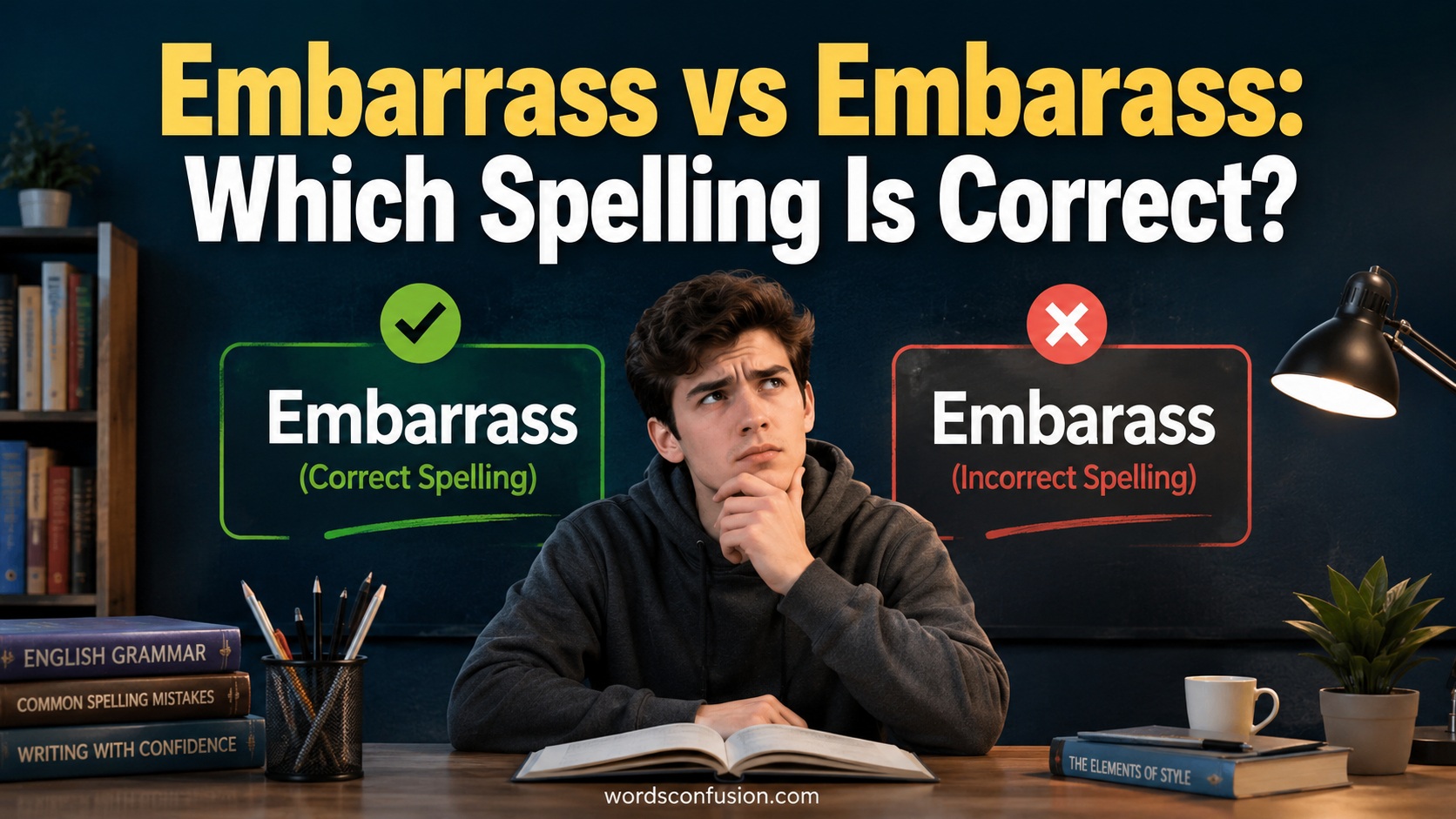
The correct spelling is embarrass.
The spelling embarass is incorrect and isn’t recognized as a standard English word.
| Word | Correct? | Meaning |
| Embarrass | Yes | To make someone feel awkward, self-conscious, ashamed, or uncomfortable. |
| Embarass | No | A common misspelling of embarrass. |
Example:
Correct: I didn’t mean to embarrass you during the meeting.
Incorrect: I didn’t mean to embarass you during the meeting.
If you’re writing in American English or British English, the spelling remains exactly the same: embarrass.
Why People Confuse “Embarrass” and “Embarass”
The word embarrass has a reputation for being difficult to spell. Even experienced writers occasionally stop to double-check it.
Unlike many English words that follow simple spelling patterns, embarrass contains two consecutive doubled letters. That unusual structure makes it easy to accidentally leave one out.
Several factors contribute to this confusion:
- The pronunciation doesn’t strongly emphasize both double letters.
- English contains many words with only one r or one s.
- Fast typing increases the chance of dropping a letter.
- Spellcheck often fixes the mistake automatically, so many people never learn the correct spelling.
For example, someone might type:
- embarass
- embaras
- embarras
- embarrass
Only embarrass is correct.
The Double Letter Rule Explained
The correct spelling follows this pattern:
E + M + B + A + R + R + A + S + S
Notice two important details:
- RR
- SS
Both pairs are required.
If either pair loses a letter, the spelling becomes incorrect.
Think of it like this:
Embarrass has two R’s because one isn’t enough, and two S’s because one won’t do.
Although this isn’t an official grammar rule, it serves as a helpful memory trick.
Why This Misspelling Is So Common
Some words naturally cause spelling problems because they don’t look exactly like they sound.
When people pronounce embarrass, they often hear something close to:
“em-ba-rass.”
That pronunciation doesn’t clearly signal that both r and s should appear twice.
Other commonly misspelled words have similar issues:
| Correct | Common Misspelling |
| Accommodation | Accomodation |
| Occurred | Occured |
| Separate | Seperate |
| Receive | Recieve |
| Embarrass | Embarass |
These words frequently appear on lists of the most misspelled English words because they contain doubled letters or uncommon spelling patterns.
Is “Embarass” Ever Correct?
No.
Embarass is never considered the correct spelling in standard English.
Major dictionaries recognize only embarrass.
Whether you’re writing:
- an academic paper,
- a business email,
- a social media post,
- a novel,
- or a legal document,
you should always use embarrass.
Spellcheck programs usually underline embarass because it isn’t part of standard English vocabulary.
There are no regional exceptions either.
| English Variety | Correct Spelling |
| American English | Embarrass |
| British English | Embarrass |
| Canadian English | Embarrass |
| Australian English | Embarrass |
Every major English-speaking country uses the same spelling.
What Does “Embarrass” Mean?
The verb embarrass means to make someone feel awkward, uncomfortable, ashamed, or self-conscious.
Embarrassment is usually emotional rather than physical. It happens when someone feels exposed, judged, or socially uncomfortable.
For example:
- Forgetting a speech may embarrass a student.
- Calling someone by the wrong name can embarrass both people.
- Tripping in front of a crowd might embarrass anyone.
Sometimes embarrassment is minor and lasts only a few seconds. Other times, it can stay in someone’s memory for years.
Definition
According to leading English dictionaries, embarrass means:
To cause someone to feel awkward, ashamed, or uncomfortable, especially in front of other people.
The word can also mean making a situation difficult or creating complications, although this meaning appears less often today.
Pronunciation
The standard pronunciation is:
/ɪmˈbær.əs/
You can break it into syllables like this:
im • BAR • us
Notice that the pronunciation doesn’t clearly reveal the doubled letters, which explains why spelling mistakes are so common.
Part of Speech
Embarrass functions as a verb.
Examples include:
- Please don’t embarrass your sister.
- His joke embarrassed everyone.
- She never tries to embarrass anyone.
- They were embarrassed by the mistake.
The word changes form depending on tense and grammar, yet every form keeps the same RR and SS pattern.
How to Spell “Embarrass” Correctly
Many people memorize this word through repetition, but understanding its structure makes it much easier to remember.
Here’s the correct spelling again:
Embarrass
Break it into smaller parts:
Em + barr + ass
Although the final part isn’t related to the animal or slang usage, dividing the word into chunks makes it easier to remember.
You can also write it several times:
- embarrass
- embarrass
- embarrass
Repeating the correct version helps build muscle memory for typing and handwriting.
Easy Memory Tricks
Simple memory tricks often work better than memorizing dictionary entries.
Here are a few reliable methods:
Remember “Double R, Double S.”
Whenever you think of embarrass, remind yourself:
Two R’s. Two S’s.
Picture the word visually.
Many people remember spelling by seeing the word rather than sounding it out.
Practice with related words.
Since all related forms share the same spelling pattern, learning one helps reinforce the others.
For example:
- embarrassed
- embarrassing
- embarrassment
- embarrasses
Common Spelling Pattern
Notice how every related word begins with:
Embarr-
That beginning never changes.
Then different endings are added:
| Base Word | Related Word |
| Embarrass | Embarrassed |
| Embarrass | Embarrassing |
| Embarrass | Embarrasses |
| Embarrass | Embarrassment |
Learning the family of words makes future spelling mistakes much less likely.
Mnemonics That Actually Work
Here are several memorable tricks:
- Two R’s because you’re really embarrassed.
- Two S’s because the situation is super awkward.
- Embarrass never travels alone—it always keeps RR and SS together.
These aren’t official grammar rules, yet they’re surprisingly effective because they connect spelling with meaning.
Embarrass in Everyday English
The verb embarrass appears in everyday conversations, workplaces, schools, social media posts, and formal writing. People use it whenever they want to describe a situation that makes someone feel awkward, self-conscious, or uncomfortable.
Although the word often refers to small social mistakes, it can also describe more serious situations that affect a person’s confidence.
Here are a few common situations where people use embarrass:
- Forgetting someone’s name at a party.
- Tripping while walking into a meeting.
- Answering a phone that wasn’t yours.
- Sharing incorrect information in front of coworkers.
- Telling an inappropriate joke during a presentation.
Each example describes an event that could make someone feel uncomfortable without causing physical harm.
Formal Writing
In professional writing, embarrass usually appears when discussing reputation, public image, diplomacy, or communication.
Examples:
- The company apologized to avoid embarrassing its customers.
- The spokesperson tried not to embarrass the organization during the interview.
- The manager handled the issue privately instead of embarrassing the employee.
Using the word carefully in formal settings helps maintain a respectful tone.
Casual Conversations
Friends and family often use embarrass in lighthearted conversations.
Examples:
- Don’t embarrass me in front of my friends.
- Dad always embarrasses us with his jokes.
- I can’t believe I embarrassed myself again.
In these situations, the word usually describes harmless or funny moments rather than serious problems.
Academic Writing
Students frequently encounter embarrass in essays, psychology papers, and literature.
For example:
- Public speaking can embarrass students who experience social anxiety.
- Researchers studied situations that embarrass teenagers more than adults.
- The novel explores how shame and embarrassment influence decision-making.
Academic writing often uses the noun embarrassment alongside the verb embarrass.
Business Communication
Professional communication requires tact. Instead of embarrassing someone publicly, effective leaders address mistakes privately.
Consider these examples:
Appropriate:
- The supervisor corrected the report without embarrassing the employee.
Less Appropriate:
- The supervisor embarrassed the employee during the meeting.
This small difference can affect workplace morale and trust.
Read More: Discipline vs Disipline: Which Spelling Is Correct?
Correct Usage Examples
Seeing words in context is one of the fastest ways to remember them correctly.
Here are examples using embarrass in different situations.
Sentences Using “Embarrass”
- I didn’t want to embarrass anyone.
- Please don’t embarrass your younger brother.
- His comment didn’t embarrass her at all.
- That mistake could embarrass the entire team.
- Teachers should never embarrass students in front of the class.
- She smiled instead of letting the situation embarrass her.
- Winning the award didn’t embarrass him. It surprised him.
Examples in Questions
- Did I embarrass you yesterday?
- Why would anyone embarrass a friend on purpose?
- Does public speaking embarrass you?
- Can one mistake really embarrass a company?
Examples in Negative Sentences
- I won’t embarrass you.
- They didn’t embarrass themselves.
- The teacher never embarrasses students.
- Our goal isn’t to embarrass anyone.
Examples Across Different Tenses
| Tense | Example |
| Present | I never embarrass my friends. |
| Present Continuous | She is embarrassing herself by arguing loudly. |
| Past | He embarrassed himself during the interview. |
| Past Continuous | They were embarrassing the guest without realizing it. |
| Present Perfect | She has embarrassed herself before. |
| Future | Don’t worry. I won’t embarrass you. |
Using the word in different tenses helps reinforce both spelling and grammar.
Common Mistakes to Avoid
Even skilled writers occasionally misspell embarrass. Fortunately, most mistakes follow predictable patterns.
Dropping One “R”
This is the most common mistake.
Incorrect
- Embarass
Correct
- Embarrass
Always remember that the word contains RR.
Dropping One “S”
Some writers remember the double R but forget the second S.
Incorrect
- Embarras
Correct
- Embarrass
The ending must always be SS.
Mixing It With Similar Words
People sometimes confuse embarrass with words that express similar emotions.
| Word | Meaning |
| Embarrass | Make someone feel awkward or self-conscious. |
| Humiliate | Cause deep shame or loss of dignity. |
| Shame | Cause guilt or disgrace. |
| Ashamed | Feeling guilty or embarrassed. |
| Awkward | Feeling uncomfortable or uneasy. |
Although these words overlap, they aren’t interchangeable in every situation.
For example:
- Forgetting your wallet may embarrass you.
- Public ridicule may humiliate someone.
Humiliation is usually much stronger than embarrassment.
Embarrass vs Embarass: Side-by-Side Comparison
The easiest way to remember the correct spelling is to compare both versions directly.
| Feature | Embarrass | Embarass |
| Correct English spelling | Yes | No |
| Found in dictionaries | Yes | No |
| Accepted in school writing | Yes | No |
| Accepted in business writing | Yes | No |
| Used in books and newspapers | Yes | No |
| Recognized by spellcheck | Yes | Usually flagged as incorrect |
| Contains double R | Yes | No |
| Contains double S | Yes | Yes |
Whenever you’re unsure, choose embarrass.
FAQs:
Is “embarass” a correct spelling?
No. Embarass is always incorrect. The only accepted spelling in standard English is embarrass, with two “r”s and two “s”s.
How can I remember the correct spelling of “embarrass”?
A simple trick is to remember: Double R, Double S. You can also think of the phrase, “Being really embarrassed deserves two R’s and two S’s.” Repeating the correct spelling several times will help you remember it.
Is “embarrass” spelled differently in British and American English?
No. Both American English and British English use the same spelling: embarrass. There are no regional spelling variations for this word.
What is the difference between “embarrass” and “humiliate”?
Although both words involve making someone feel uncomfortable, embarrass usually refers to a temporary feeling of awkwardness. Humiliate is much stronger and means causing someone to lose dignity or self-respect, often in front of others.
What are the most common forms of the word “embarrass”?
The most common forms include:
- Embarrass (verb)
- Embarrassed (adjective/past tense)
- Embarrassing (adjective)
- Embarrassment (noun)
- Embarrasses (third-person singular verb)
- Embarrassingly (adverb)
All of these words keep the same spelling pattern with double “r” and double “s.”
Conclusion:
Understanding the difference between Embarrass vs Embarass is straightforward once you know the rule. Embarrass is the only correct spelling in English, while embarass is simply a common misspelling caused by dropping one of the two “r” letters. Whether you’re writing an academic paper, a business email, or a social media post, always use embarrass with double “r” and double “s.”
A good way to avoid future mistakes is to practice the word along with its related forms, such as embarrassed, embarrassing, and embarrassment. The more often you see and use the correct spelling, the more natural it becomes. Remember the simple phrase “Double R, Double S”, and you’ll rarely second-guess yourself again. By mastering this commonly confused word, you’ll improve both your spelling accuracy and your confidence in written English.

Andrew Wilson is an experienced language researcher and content writer specializing in WordsConfusion topics. He helps readers understand commonly confused English words, spelling differences, grammar rules, word meanings, and proper usage through clear explanations, practical examples, and easy-to-follow language guides. His goal is to make English learning simple, accurate, and accessible for students, writers, professionals, and everyday learners.