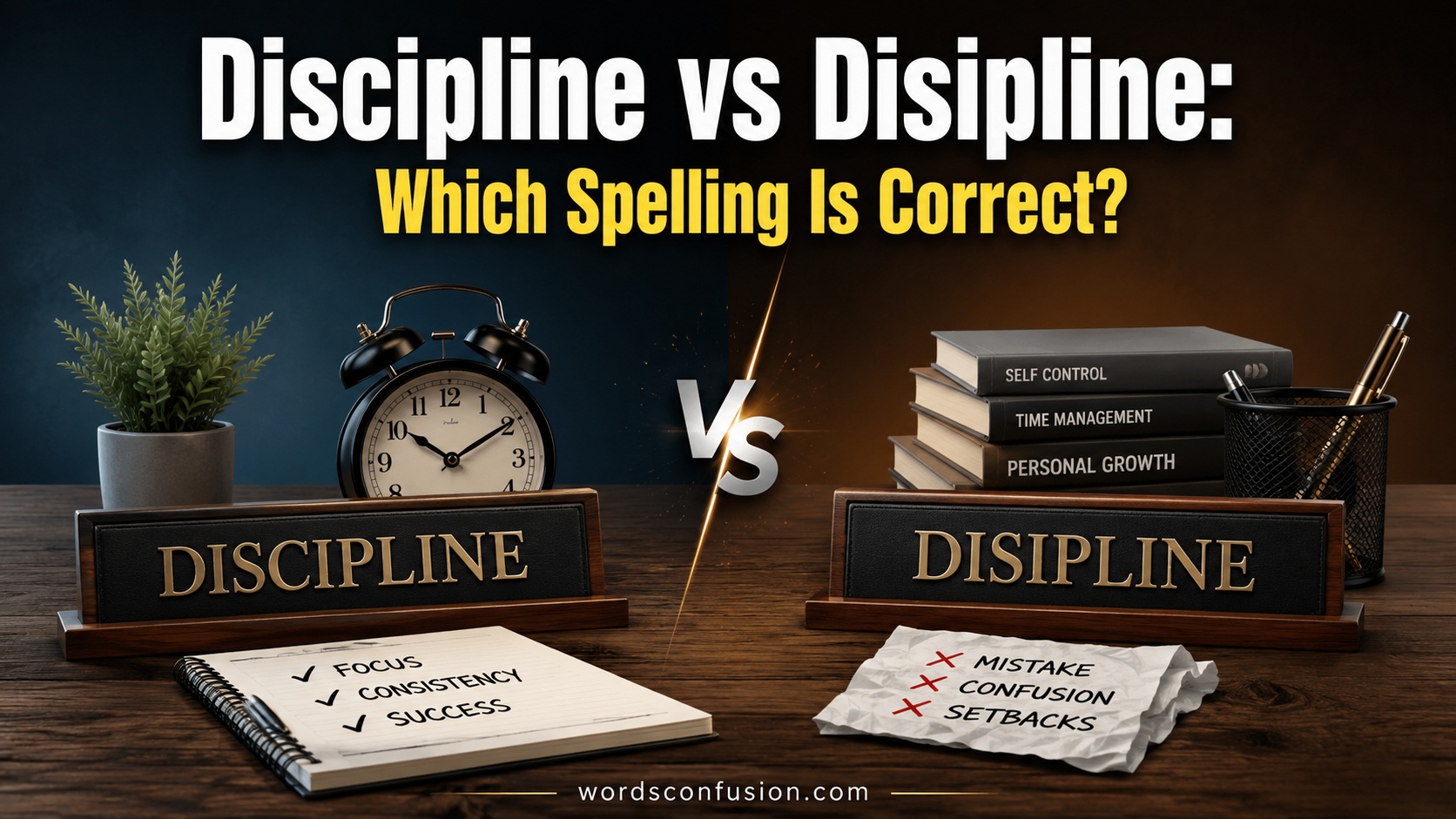
Choosing the correct spelling matters more than many people realize. A single missing letter can change how others view your writing, whether you’re sending a job application, submitting schoolwork, publishing a blog post, or writing an email. One of the most common spelling mistakes in English involves Discipline vs Disipline.
Many people type disipline because it sounds almost identical to the correct word when spoken quickly. However, only discipline is accepted in standard English. Dictionaries, grammar guides, educational institutions, and professional writing all recognize discipline as the correct spelling.
If you’ve ever wondered whether discipline or disipline is correct, you’re in the right place. This guide explains the difference, why people make the mistake, how to remember the correct spelling, and how to use the word confidently in everyday writing.
Quick Answer
Discipline is the correct spelling.
Disipline is an incorrect spelling and should never appear in formal or informal writing.
| Word | Correct? | Meaning |
| Discipline | Yes | Self-control, training, rules, or a field of study |
| Disipline | No | Misspelling of discipline |
If you’re writing an essay, email, resume, blog, or social media post, always use discipline.
Why People Confuse Discipline and Disipline
English spelling doesn’t always match pronunciation. That’s one reason so many words become difficult to spell.
The word discipline is pronounced:
/ˈdɪsəplɪn/
Notice that the letter c produces an s sound instead of a hard k sound. Because you don’t clearly hear the c, many writers accidentally remove it and type disipline.
Several other factors contribute to this confusion.
- Fast typing
- Mobile keyboard mistakes
- Pronunciation-based spelling
- Lack of proofreading
- Learning English as a second language
Even experienced writers occasionally make this typo. The good news is that once you understand why it happens, it’s much easier to avoid.
Is “Disipline” a Real Word?
The simple answer is no.
You won’t find disipline listed as a standard English word in trusted dictionaries such as:
- Merriam-Webster
- Oxford English Dictionary
- Cambridge Dictionary
- Collins Dictionary
- Dictionary.com
Whenever you write disipline, spell-check software usually flags it because it isn’t recognized as a legitimate English word.
The Correct Spelling
The correct spelling is:
Discipline
This spelling has remained consistent for centuries and appears in academic writing, business communication, government documents, newspapers, books, and professional publications.
Examples include:
- Good discipline leads to long-term success.
- Parents should teach discipline through positive guidance.
- Military discipline requires commitment and responsibility.
- Financial discipline helps people save money consistently.
Each sentence uses the correct spelling.
Why “Disipline” Is Incorrect
The incorrect spelling removes an important letter from the original word.
Compare them carefully.
| Incorrect | Correct |
| Disipline | Discipline |
The missing c completely changes the spelling, even though pronunciation stays almost the same.
Think of it this way:
You wouldn’t write receve instead of receive simply because the pronunciation sounds similar. The same rule applies here.
What Does Discipline Mean?
The word discipline has several related meanings depending on the situation. Although the context changes, every definition centers around learning, control, responsibility, or organized behavior.
Discipline as Self-Control
Perhaps the most common meaning today is self-control.
Self-discipline means controlling your actions, emotions, and habits even when motivation disappears.
Examples include:
- Exercising every morning.
- Saving money instead of overspending.
- Finishing homework before watching television.
- Avoiding distractions while studying.
People often say that success depends more on discipline than motivation.
Motivation comes and goes.
Discipline stays.
Discipline as Training
Discipline also refers to structured training that develops better habits or skills.
Schools, sports teams, military organizations, and workplaces all rely on discipline.
Examples:
- Athletic discipline improves performance.
- Military discipline builds teamwork.
- Classroom discipline creates a better learning environment.
- Professional discipline increases productivity.
Training teaches people to act consistently, even during difficult situations.
Discipline as Rules and Order
Another meaning describes systems of rules that maintain order.
Schools establish classroom discipline.
Companies create workplace discipline.
Parents teach household discipline.
Without reasonable rules, organizations become chaotic and less productive.
Examples:
- School discipline helps students focus.
- Workplace discipline improves efficiency.
- Team discipline reduces mistakes.
Discipline as an Academic Subject
In education, discipline can also mean a branch of knowledge.
For example:
- Biology is a scientific discipline.
- Economics is an academic discipline.
- Psychology has become one of the fastest-growing disciplines worldwide.
Here, discipline simply means an area of study.
Discipline: Pronunciation and Word Origin
Understanding where the word comes from makes the spelling much easier to remember.
Pronunciation
The standard pronunciation is:
DIS-uh-plin
Written phonetically:
/ˈdɪsəplɪn/
Notice again that the c sounds like an s.
That’s why many people accidentally leave it out.
Etymology
The word discipline comes from the Latin word disciplina, meaning:
- Teaching
- Instruction
- Knowledge
- Training
The Latin word comes from discipulus, meaning student or learner.
Over time, English adopted the spelling while preserving much of its original form.
Knowing this history explains why the letter c belongs in the word.
Why the Spelling Doesn’t Match the Sound
English borrowed vocabulary from Latin, French, Greek, Germanic languages, and many others.
As pronunciation evolved over hundreds of years, spelling often remained unchanged.
That’s why words like these don’t sound exactly as they’re written.
| Word | Pronunciation Difference |
| Science | The c sounds like s |
| Fascinate | Soft c sound |
| Discipline | Soft c sound |
| Special | Soft c sound |
Once you recognize this pattern, discipline becomes much easier to spell correctly.
Discipline vs Disipline: Side-by-Side Comparison
The table below highlights every important difference.
| Feature | Discipline | Disipline |
| Correct English spelling | Yes | No |
| Listed in dictionaries | Yes | No |
| Accepted in academic writing | Yes | No |
| Used in professional communication | Yes | No |
| Common typing mistake | No | Yes |
| Recommended by grammar checkers | Yes | No |
| Safe to use in exams | Yes | No |
The conclusion is straightforward.
Always choose discipline.
Why People Misspell “Discipline”
Misspellings happen for understandable reasons. Knowing those reasons helps you avoid repeating the mistake.
Pronunciation Confusion
Most people spell words based on what they hear.
Since the c produces a soft s sound, many writers don’t realize it exists.
This creates the incorrect spelling:
Disipline
Missing the “C”
This is by far the most common mistake.
Compare the spellings slowly.
Correct:
Discipline
Incorrect:
Disipline
Only one letter changes, yet the spelling becomes incorrect.
Fast Typing Errors
Typing quickly often causes fingers to skip letters.
Small keyboards make this problem even worse.
Many spelling mistakes occur simply because writers don’t proofread before publishing.
Autocorrect and Mobile Keyboards
Autocorrect isn’t perfect.
Sometimes it misses errors.
Other times it changes correctly spelled words into something unexpected.
That’s why proofreading remains essential.
Examples of “Discipline” in Sentences
Learning through examples is one of the fastest ways to remember correct spelling.
Everyday Conversations
- Good discipline helps you make smarter decisions.
- Children learn discipline through consistent guidance.
- Discipline creates habits that last a lifetime.
- Building discipline takes patience and practice.
- Strong discipline often beats natural talent.
School and Education
- Teachers encourage discipline in every classroom.
- Students with strong discipline usually complete assignments on time.
- Classroom discipline allows everyone to learn without distractions.
- Academic discipline improves study habits.
- Good discipline increases academic success.
Workplace Examples
- Professional discipline improves teamwork.
- Employees appreciate managers who encourage discipline fairly.
- Financial discipline helps businesses grow steadily.
- Workplace discipline reduces costly mistakes.
- Successful leaders demonstrate discipline every day.
Sports and Fitness
- Athletes depend on discipline to improve their performance.
- Daily training builds physical and mental discipline.
- Fitness goals require consistency and discipline.
- Coaches reward discipline as much as talent.
- Olympic athletes develop extraordinary discipline throughout their careers.
Common Incorrect Examples and Corrections
One of the easiest ways to avoid spelling mistakes is to compare incorrect sentences with their corrected versions. Reading both side by side helps your brain recognize the right pattern.
| Incorrect Sentence | Correct Sentence |
| Disipline is important for success. | Discipline is important for success. |
| He has great disipline. | He has great discipline. |
| Parents should teach disipline early. | Parents should teach discipline early. |
| Self disipline leads to better habits. | Self-discipline leads to better habits. |
| Good disipline improves teamwork. | Good discipline improves teamwork. |
| Financial disipline helps people save money. | Financial discipline helps people save money. |
| The coach praised the team’s disipline. | The coach praised the team’s discipline. |
| Classroom disipline affects learning. | Classroom discipline affects learning. |
A useful proofreading habit is to search your document for “disipline.” If you find it, replace it with “discipline.”
Common Words People Misspell Like “Discipline”
The English language contains many words that people spell incorrectly because pronunciation doesn’t always match spelling.
Here are some of the most common examples.
| Incorrect | Correct |
| Disipline | Discipline |
| Recieve | Receive |
| Seperate | Separate |
| Goverment | Government |
| Occured | Occurred |
| Publically | Publicly |
| Untill | Until |
| Accomodate | Accommodate |
| Definately | Definitely |
| Writting | Writing |
These mistakes appear frequently in emails, assignments, resumes, and social media posts. Fortunately, each one becomes easy to remember after repeated exposure.
Self-Discipline vs Discipline
Although these expressions are closely related, they don’t always mean the same thing.
What Is Discipline?
Discipline has several meanings.
It may refer to:
- Rules
- Training
- Order
- Self-control
- An academic subject
Examples:
- School discipline has improved this year.
- Military discipline requires commitment.
- Biology is a scientific discipline.
What Is Self-Discipline?
Self-discipline refers specifically to controlling your own actions without someone forcing you.
Instead of relying on motivation, self-discipline helps you continue working even when tasks become difficult.
Examples include:
- Studying every day.
- Exercising regularly.
- Saving money consistently.
- Avoiding procrastination.
- Limiting screen time.
In simple terms:
Every self-disciplined person has discipline, but not every use of the word discipline refers to self-control.
Discipline vs Self-Discipline Comparison
| Discipline | Self-Discipline |
| Can describe rules or training | Refers only to personal self-control |
| May involve other people enforcing rules | Comes from your own choices |
| Used in education, sports, business, and academics | Used in personal development and habit building |
| Broader meaning | More specific meaning |
Common Phrases With “Discipline”
Native English speakers frequently use the word discipline in everyday conversation.
Learning these common phrases helps you sound more natural.
Self-Discipline
The ability to control your own behavior.
Example:
Self-discipline helps people achieve long-term goals.
Financial Discipline
Managing money wisely.
Example:
Financial discipline allowed the family to buy a home sooner than expected.
Classroom Discipline
Maintaining order in schools.
Example:
Good classroom discipline creates a positive learning environment.
Military Discipline
Following rules with consistency and precision.
Example:
Military discipline teaches responsibility and teamwork.
Work Discipline
Maintaining professionalism at work.
Example:
Strong work discipline often leads to promotions.
Personal Discipline
Developing healthy routines.
Example:
Personal discipline helped her finish college while working full-time.
Synonyms and Related Words
Depending on the context, several words can replace discipline.
Synonyms
| Synonym | Best Used When |
| Self-control | Managing emotions or actions |
| Restraint | Avoiding temptation |
| Order | Organization and structure |
| Regulation | Rules and procedures |
| Control | Managing behavior |
| Training | Developing skills |
| Consistency | Building habits |
| Determination | Staying committed |
| Perseverance | Continuing despite challenges |
| Responsibility | Accepting accountability |
Related Words
These words aren’t exact synonyms but often appear alongside discipline.
- Habit
- Routine
- Commitment
- Focus
- Dedication
- Persistence
- Accountability
- Organization
- Leadership
- Productivity
Using these related terms naturally improves your writing without repeating the same word over and over.
Read More: Cemetery vs Cemetary: Which Spelling Is Correct?
Memory Tricks to Spell “Discipline” Correctly
Simple memory techniques can prevent this spelling mistake forever.
Remember the Letter “C”
The biggest mistake people make is forgetting the c.
Visualize the word like this:
Dis + C + ipline
Never skip the c.
Break the Word Into Parts
Instead of memorizing one long word, divide it into smaller sections.
Dis • ci • pline
Smaller chunks are easier to remember.
Think of “Disc”
The beginning of discipline shares the letters disc.
Examples include:
- Disc
- Disciple
- Discipline
Recognizing this pattern reinforces the correct spelling.
Read Before You Submit
Whether you’re writing an email or publishing an article, spend one minute proofreading.
Many spelling mistakes disappear during a final review.
Grammar Tips for Using “Discipline” Correctly
Spelling is only one part of using this word correctly. Grammar matters too.
Discipline as a Noun
This is the most common use.
Examples:
- Discipline builds confidence.
- Good discipline leads to better results.
- Success requires discipline.
Discipline as a Verb
Less commonly, discipline functions as a verb.
It means to train, to teach, or to correct behavior.
Examples:
- Parents should discipline children with patience and consistency.
- Coaches discipline athletes through structured practice.
- Teachers discipline students fairly and respectfully.
Self-Discipline Uses a Hyphen
When referring to personal control, use the hyphenated form.
Correct:
- Self-discipline improves productivity.
- Building self-discipline takes time.
Incorrect:
- Self discipline improves productivity.
The hyphen joins the two words into a single compound noun.
Real-Life Case Study: How One Letter Can Affect Professional Writing
Imagine two job applicants applying for the same position.
The first applicant writes:
“I believe my disipline and commitment make me an excellent candidate.”
The second applicant writes:
“I believe my discipline and commitment make me an excellent candidate.”
Both applicants may have identical qualifications. However, hiring managers often notice spelling errors immediately. A simple typo can suggest carelessness, especially in professional communication.
The second sentence creates a stronger first impression because it uses the correct spelling.
This example highlights why proofreading matters. Small details often shape how others perceive your writing.
Quick Tips to Never Misspell “Discipline” Again
Keep these tips in mind whenever you write:
- Always include the letter c after dis.
- Remember that discipline is the only correct spelling.
- Use spell-check, but don’t rely on it completely.
- Read important documents before sending them.
- Practice writing the word correctly a few times.
- Learn common spelling patterns from similar English words.
- Save difficult words in your personal vocabulary list.
The more often you use the correct spelling, the more natural it becomes.
FAQs:
Is “disipline” ever correct?
No. Disipline is never considered correct in standard English. Always write discipline.
Why do people spell discipline as disipline?
Most people spell it incorrectly because the c has a soft sound that blends into the pronunciation. Fast typing and lack of proofreading also contribute to the mistake.
Is discipline a noun or a verb?
It can be both. As a noun, it refers to self-control, training, rules, or a field of study. As a verb, it means to train or correct someone’s behavior.
How do you remember the correct spelling of discipline?
Break the word into smaller parts:
Dis • ci • pline
Remember that the c always comes before the i.
What is the difference between discipline and self-discipline?
Discipline has several meanings, including rules, training, and academic subjects. Self-discipline specifically refers to controlling your own actions and maintaining good habits without outside pressure.
Conclusion:
When comparing Discipline vs Disipline, the answer is simple. Discipline is the only correct spelling in English, while disipline is a common misspelling that should never appear in professional or academic writing.
Although the two words sound nearly identical, their spelling is not interchangeable. The correct form comes from the Latin word disciplina, which explains why the letter c belongs in the word. Remembering this small detail can help you avoid a mistake that many writers make.
Whether you’re writing a school assignment, a business email, a blog post, or a social media update, using discipline correctly improves the quality and credibility of your writing. With regular practice, careful proofreading, and the memory tips shared in this guide, you’ll spell discipline correctly every time.

Andrew Wilson is an experienced language researcher and content writer specializing in WordsConfusion topics. He helps readers understand commonly confused English words, spelling differences, grammar rules, word meanings, and proper usage through clear explanations, practical examples, and easy-to-follow language guides. His goal is to make English learning simple, accurate, and accessible for students, writers, professionals, and everyday learners.