Have you ever paused while writing because you couldn’t remember whether eminent or imminent was the right word? You’re not alone. These two words look remarkably similar, yet they describe completely different ideas. Swapping one for the other can confuse your readers and even change the meaning of your sentence.
For example, saying “an imminent scientist” suggests the scientist is about to happen, which doesn’t make sense. On the other hand, describing someone as “an eminent scientist” tells readers that the person is highly respected and recognized in their field.
The confusion comes from their nearly identical spelling and pronunciation. However, once you understand what each word means and when to use it, choosing the correct one becomes much easier.
This comprehensive guide explains the difference between eminent vs imminent, shows real-world examples, highlights common mistakes, and provides practical memory tricks that will help you remember the correct word every time.
Quick Answer
The difference between eminent and imminent is simple:
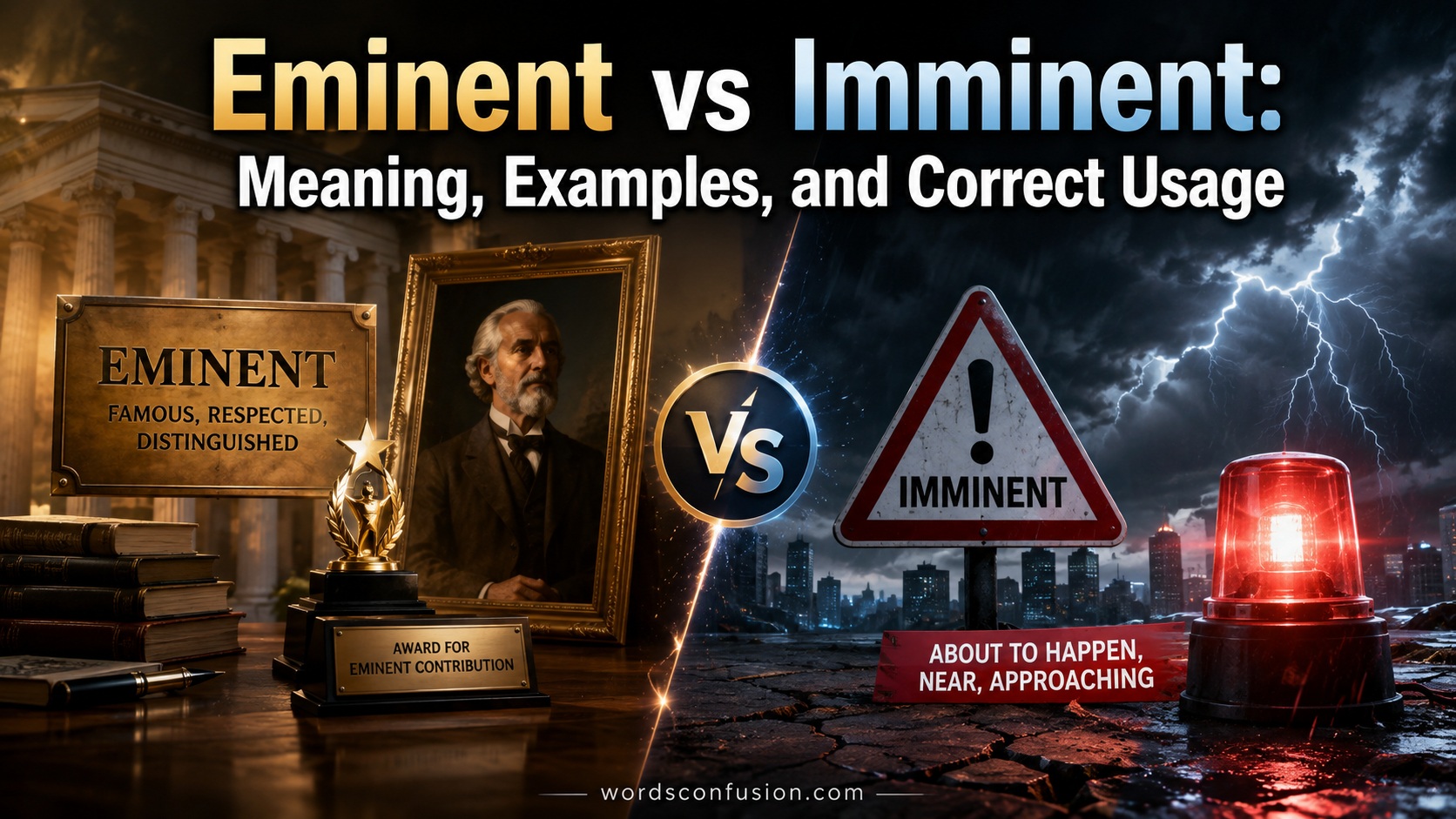
- Eminent means well-known, respected, or distinguished because of achievements or status.
- Imminent means about to happen very soon.
Here’s a quick comparison.
| Word | Meaning | Part of Speech | Used For |
| Eminent | Famous, respected, distinguished | Adjective | People with outstanding achievements |
| Imminent | About to happen soon | Adjective | Events, situations, or actions |
Examples
- Marie Curie was an eminent scientist.
- A severe storm is imminent.
If you’re describing a person’s reputation, use eminent.
If you’re describing an event that is about to occur, use imminent.
Comparison Overview
| Feature | Eminent | Imminent |
| Meaning | Famous and highly respected | About to happen very soon |
| Refers To | People, experts, professionals | Events, situations, changes |
| Part of Speech | Adjective | Adjective |
| Positive or Negative | Usually positive | Neutral, but often used for warnings |
| Common Usage | Eminent doctor, eminent judge, eminent professor | Imminent danger, imminent arrival, imminent deadline |
| Memory Tip | Eminent people earn recognition | Imminent events are incoming |
Main Differences Between Eminent vs Imminent
Although the words differ by only one letter, they serve entirely different purposes.
Eminent describes reputation
Use eminent when talking about someone who has gained recognition through talent, knowledge, leadership, or accomplishments.
Examples include:
- An eminent surgeon
- An eminent historian
- An eminent lawyer
- An eminent author
The word emphasizes respect and distinction.
Imminent describes timing
Use imminent when something is expected to happen very soon.
Examples include:
- Imminent rainfall
- Imminent departure
- Imminent launch
- Imminent danger
The word emphasizes that something is close in time.
One refers to people. The other refers to events.
A useful shortcut is this:
- People become eminent.
- Events become imminent.
That simple distinction solves most confusion.
Eminent Meaning
Definition of Eminent
Eminent means widely respected, distinguished, notable, or famous because of exceptional ability, achievements, or character.
It usually describes individuals who have earned admiration within their profession or community.
Pronunciation
Eminent
/ˈem.ə.nənt/
Origin and Etymology
The word comes from the Latin eminere, meaning to stand out or to project above.
That history perfectly matches today’s meaning because eminent people stand out from others due to excellence.
When to Use Eminent
Use eminent whenever you’re referring to a person’s outstanding reputation.
Common situations include:
- Academic writing
- Medical fields
- Scientific research
- Legal professions
- Politics
- Literature
- Arts
- Business leadership
Examples of Eminent
- The university invited an eminent professor to deliver the keynote speech.
- She became an eminent architect after decades of innovative work.
- The hospital hired an eminent heart surgeon.
- An eminent economist explained the causes of inflation.
Common Phrases with Eminent
- Eminent scholar
- Eminent scientist
- Eminent physician
- Eminent lawyer
- Eminent leader
- Eminent authority
- Eminent researcher
Imminent Meaning
Definition of Imminent
Imminent means likely to happen very soon or about to occur.
It often describes situations where something is expected almost immediately.
Pronunciation
Imminent
/ˈɪm.ə.nənt/
Origin and Etymology
The word originates from the Latin imminere, meaning to overhang or to threaten.
Over time, its meaning shifted to describe events that are very close to happening.
When to Use Imminent
Use imminent when discussing future events that are expected shortly.
Typical contexts include:
- Natural disasters
- Business announcements
- Travel
- Technology releases
- Government decisions
- Financial markets
- Emergency situations
Examples of Imminent
- The weather service warned that flooding was imminent.
- The company announced an imminent merger.
- Rescue teams prepared for the imminent storm.
- Scientists predicted an imminent volcanic eruption.
Common Phrases with Imminent
- Imminent danger
- Imminent threat
- Imminent collapse
- Imminent launch
- Imminent arrival
- Imminent decision
- Imminent deadline
Eminent vs Imminent: Side-by-Side Comparison
| Feature | Eminent | Imminent |
| Meaning | Distinguished and respected | About to happen soon |
| Describes | People | Events |
| Focus | Reputation | Timing |
| Common Context | Careers and achievements | Future events |
| Example | An eminent doctor | An imminent storm |
| Synonyms | Distinguished, renowned | Approaching, impending |
How to Remember the Difference
Many learners struggle because the words differ by only one letter. Fortunately, a few memory tricks can help.
The Letter Trick
Eminent begins with E, which can remind you of Expert and Excellence.
Imminent begins with I, which can remind you of Incoming.
Visual Memory Technique
Imagine a famous professor standing on a stage receiving an award.
That person is eminent.
Now imagine dark clouds rapidly moving toward a city.
The storm is imminent.
Everyday Analogy
Think of a celebrity walking into a room.
The celebrity is eminent.
Think of a train that’s only one minute away.
Its arrival is imminent.
Mnemonic You’ll Actually Remember
Eminent people earn respect. Imminent events are incoming.
This short sentence captures both meanings perfectly.
Eminent and Imminent in Real-Life Examples
News Headlines
Correct:
- An eminent economist discusses global inflation.
- Officials warn of imminent flooding.
- The court honored an eminent judge.
- Residents prepared for an imminent hurricane.
Academic Writing
Researchers often describe respected experts as eminent scholars.
For example:
Several eminent linguists contributed to the study.
Workplace Communication
Correct email:
Our company has invited an eminent cybersecurity expert to speak.
Another example:
Product testing is complete, and the launch is imminent.
Everyday Conversations
- My grandfather was an eminent teacher.
- The guests’ arrival is imminent.
- We consulted an eminent lawyer.
- Rain seems imminent.
Common Mistakes People Make
Even experienced writers occasionally mix these words.
Mistake One
The eminent storm forced people to evacuate.
The imminent storm forced people to evacuate.
Storms don’t become famous.
They become imminent.
Mistake Two
She is an imminent scientist.
She is an eminent scientist.
Scientists can become respected.
They cannot be “about to happen.”
Mistake Three
Using the words based only on spelling similarity.
Always ask yourself one question:
Am I describing a person or an event?
That question usually reveals the correct answer.
Why Spellcheck Doesn’t Catch the Error
Both words are spelled correctly.
Grammar software often won’t identify the mistake because each word exists in English.
Only understanding their meanings prevents the error.
Eminent vs Imminent in Grammar
Part of Speech
Both words are adjectives.
They modify nouns.
Examples:
- An eminent author
- An imminent deadline
Can They Replace Each Other?
No.
Although they look similar, they are never interchangeable.
Changing one word changes the sentence’s meaning.
Sentence Position
Both adjectives usually appear before nouns.
Examples:
- An eminent physician
- An imminent announcement
They may also appear after linking verbs.
Examples:
- The professor is eminent.
- The deadline is imminent.
Read More: Elicit vs Illicit: Meaning, Differences, and Examples
Synonyms and Antonyms
Synonyms of Eminent
- Distinguished
- Renowned
- Prestigious
- Celebrated
- Prominent
- Acclaimed
- Influential
- Respected
Antonyms of Eminent
- Unknown
- Ordinary
- Obscure
- Unrecognized
- Insignificant
- Anonymous
Synonyms of Imminent
- Approaching
- Near
- Impending
- Looming
- Forthcoming
- Expected
- Upcoming
Antonyms of Imminent
- Distant
- Remote
- Unlikely
- Delayed
- Far-off
- Future
Similar Words People Often Confuse
Eminent vs Prominent
Both describe respected people.
However, prominent often refers to someone who is well-known or noticeable, while eminent suggests exceptional distinction and authority.
Imminent vs Immediate
Immediate means something happens now or without delay.
Imminent means it is expected very soon but hasn’t happened yet.
Eminent vs Distinguished
These words are close in meaning.
However, eminent often carries stronger recognition within a profession.
Immanent vs Imminent
This is another commonly confused pair.
- Immanent means existing within or inherent.
- Imminent means about to happen.
Example:
- Many philosophers discuss the immanent nature of reality.
- The announcement is imminent.
Practice Quiz
Choose the correct word.
- The hospital hired an ________ surgeon.
- Meteorologists warned that flooding was ________.
- She became an ________ author after publishing several bestselling books.
- The company expects an ________ product launch.
- We consulted an ________ legal expert.
- The volcano showed signs of an ________ eruption.
- An ________ historian spoke at the conference.
- The deadline is ________.
- An ________ researcher received the national award.
- The danger became ________ after heavy rainfall.
Answers
- Eminent
- Imminent
- Eminent
- Imminent
- Eminent
- Imminent
- Eminent
- Imminent
- Eminent
- Imminent
Practice Exercise
Complete each sentence.
- The judge is one of the most __________ legal experts in the country.
- Everyone prepared because the storm was __________.
- The university welcomed an __________ professor.
- Engineers completed the final checks because launch was __________.
- An __________ scientist received international recognition.
Answer Key
- eminent
- imminent
- eminent
- imminent
- eminent
FAQs:
Is eminent always used for people?
Mostly, yes. It commonly describes people with exceptional achievements or reputation. Occasionally, it can describe institutions or works associated with excellence, but people remain its primary use.
Does imminent always describe something bad?
No. Although it often appears in warnings such as imminent danger or imminent flooding, it can also describe positive events like an imminent promotion, imminent wedding, or imminent product launch.
Can a person be imminent?
No. A person cannot be imminent because the word describes events or situations that are about to happen.
Can an event be eminent?
No. Events are not eminent. They can be important or historic, but eminent describes respected people or organizations.
Why are eminent and imminent so often confused?
The words have similar spellings, similar pronunciations, and the same grammatical role as adjectives. However, their meanings are completely unrelated.
What is the easiest way to remember the difference?
Remember this simple phrase:
Eminent people earn respect. Imminent events are incoming.
That one sentence helps you choose the correct word almost every time.
Conclusion:
Understanding the difference between eminent vs imminent becomes much easier once you focus on what each word describes. Eminent refers to people who have earned respect, recognition, and distinction through their accomplishments. Imminent, by contrast, describes events or situations that are expected to happen very soon.
Although the words look alike, they are never interchangeable. A respected professor is eminent, while a deadline or storm is imminent. Keeping this distinction in mind will improve your writing, strengthen your vocabulary, and help you avoid one of the most common word-choice mistakes in English.

Andrew Wilson is an experienced language researcher and content writer specializing in WordsConfusion topics. He helps readers understand commonly confused English words, spelling differences, grammar rules, word meanings, and proper usage through clear explanations, practical examples, and easy-to-follow language guides. His goal is to make English learning simple, accurate, and accessible for students, writers, professionals, and everyday learners.