
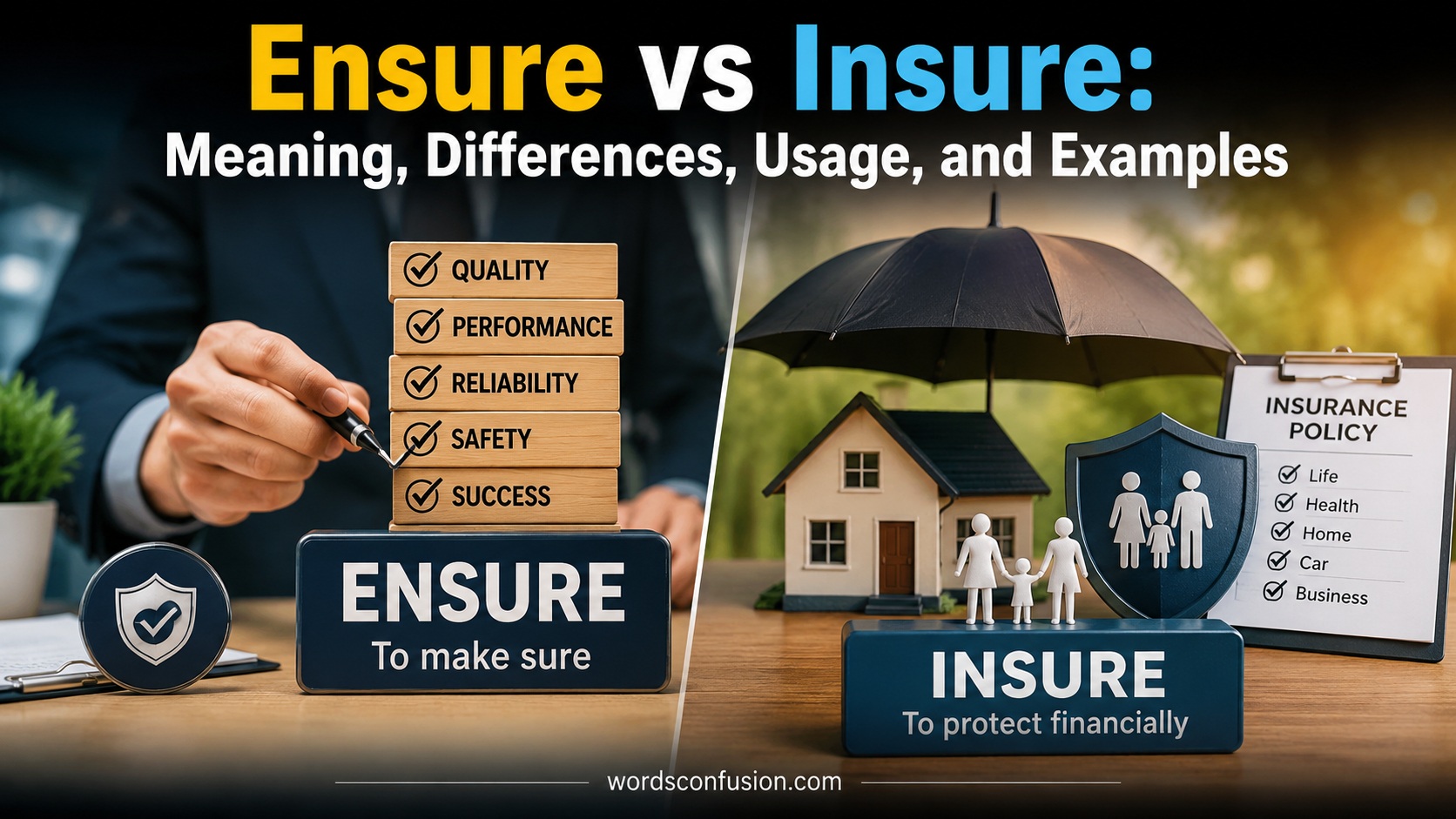
Have you ever paused while writing because you weren’t sure whether to use ensure or insure? You’re not alone. These two words look almost identical, sound similar, and even share related meanings in some situations. Yet they aren’t interchangeable in most cases.
Using the wrong word can change the meaning of your sentence. Imagine writing, “This checklist will insure quality.” While many readers may understand what you mean, the sentence isn’t technically correct because insure refers to insurance coverage, not guaranteeing a result.
Understanding the difference between ensure vs insure helps you write with confidence. Whether you’re drafting a business email, completing an academic assignment, creating website content, or simply improving your English, knowing when to use each word makes your writing clearer and more professional.
This guide explains the meanings, differences, grammar rules, examples, and memory tricks that make these commonly confused words easy to remember.
Quick Answer
The difference between ensure and insure is simple:
- Ensure means to make certain, guarantee, or make sure something happens.
- Insure means to provide or obtain insurance against financial loss or damage.
Quick Comparison
| Word | Meaning | Best Used For | Example |
| Ensure | To make certain | Guarantees and certainty | We checked everything to ensure success. |
| Insure | To provide insurance coverage | Insurance policies and financial protection | You should insure your car before driving it. |
Easy Rule to Remember:
- If an insurance policy is involved, use insure.
- If you simply mean make sure, use ensure.
Most modern writing follows this distinction because it improves clarity and avoids confusion.
Comparison Overview
Before diving deeper, here’s a complete overview of ensure vs insure.
| Feature | Ensure | Insure |
| Primary Meaning | Make certain | Provide insurance coverage |
| Purpose | Guarantee a result | Protect against financial loss |
| Common Context | Everyday writing, education, business | Insurance companies, legal contracts, finance |
| Object | An action or outcome | A person, vehicle, house, business, or property |
| Industry | General English | Insurance industry |
| Formality | Standard in all writing | Mainly financial and legal writing |
| Synonym | Guarantee, secure, make certain | Cover, protect, underwrite |
| Example | Please ensure the doors are locked. | We insured our home against fire damage. |
Although both words come from similar historical roots, modern English assigns them different roles.
Main Differences Between Ensure vs Insure
Many English learners—and even native speakers—confuse these words because they both relate to protection in some way. However, the type of protection each word describes is very different.
Ensure Means You Guarantee Something
When you ensure something, you take steps to make sure an event happens or a condition exists.
You aren’t buying protection. Instead, you’re preventing problems before they occur.
For example:
- Double-check your work to ensure accuracy.
- Good planning ensures better results.
- Exercise regularly to ensure long-term health.
- Strong passwords help ensure online security.
In each sentence, ensure expresses certainty rather than insurance.
Insure Means You Buy or Provide Insurance
Insure belongs to the financial world.
When you insure something, you purchase or provide an insurance policy that protects against financial loss if something unexpected happens.
Examples include:
- Insure your house before hurricane season.
- The company insures commercial buildings.
- Many families insure valuable jewelry.
- Drivers must insure their vehicles in many states.
Here, insure always relates to insurance coverage.
The Simplest Difference
Think of it this way:
- Ensure protects outcomes.
- Insure protects money.
That one sentence explains almost every situation correctly.
What Does “Ensure” Mean?
The verb ensure means to make certain that something happens or exists.
It focuses on creating confidence that a desired result will occur.
Unlike insure, it has nothing to do with insurance companies or financial protection.
Definition
Ensure means:
- To make certain
- To guarantee
- To secure a result
- To make sure something happens
You can think of it as taking action before a problem appears.
Origin and Etymology
The word ensure entered English through Anglo-French and Middle English. It originally shared roots with words meaning “to make safe” or “to secure.”
Over time, English speakers began using ensure mainly for guaranteeing results, while insure became associated with financial insurance.
Although the two words developed from the same historical family, modern English clearly separates their meanings.
When to Use Ensure
Use ensure whenever you mean make certain.
Common situations include:
- Following instructions
- Completing projects
- Improving quality
- Achieving goals
- Preventing mistakes
- Confirming accuracy
- Meeting deadlines
- Protecting safety through actions
For example:
- Read every question carefully to ensure correct answers.
- Regular maintenance ensures your car lasts longer.
- Good communication ensures successful teamwork.
- Proper training ensures workplace safety.
Notice that none of these examples involve insurance policies.
Common Situations Where Ensure Fits
You’ll often see ensure in everyday English because people constantly talk about making things happen successfully.
It appears in many settings.
Business
Businesses use ensure when discussing quality, customer satisfaction, deadlines, and productivity.
Examples:
- Managers ensure projects stay on schedule.
- Quality checks ensure customer satisfaction.
- Daily meetings ensure everyone understands their responsibilities.
Education
Teachers frequently use ensure.
Examples include:
- Practice helps ensure better exam scores.
- Teachers ensure students understand the lesson.
- Schools ensure classrooms remain safe.
Healthcare
Hospitals and clinics often use the word.
Examples:
- Doctors ensure patients receive proper treatment.
- Nurses ensure medications are given correctly.
- Regular screenings help ensure early diagnosis.
Technology
Software developers also rely on the word.
Examples:
- Updates ensure better security.
- Testing ensures the application works properly.
- Backups ensure important files remain safe.
Common Collocations with Ensure
Native English speakers naturally pair ensure with certain words.
Some of the most common combinations include:
- Ensure accuracy
- Ensure compliance
- Ensure quality
- Ensure safety
- Ensure fairness
- Ensure consistency
- Ensure success
- Ensure transparency
- Ensure efficiency
- Ensure reliability
- Ensure customer satisfaction
- Ensure equal opportunity
- Ensure accountability
- Ensure accessibility
- Ensure proper functioning
Learning these word pairs will help your English sound much more natural.
Real-Life Examples of Ensure
Here are practical examples from everyday situations.
Workplace
The manager reviewed every report to ensure there were no errors.
School
The teacher explained the lesson twice to ensure every student understood.
Travel
Arrive early to ensure you don’t miss your flight.
Cooking
Use a food thermometer to ensure the chicken is fully cooked.
Sports
Coaches ensure players warm up before every match.
Technology
Two-factor authentication helps ensure account security.
These examples show that ensure always focuses on certainty rather than financial protection.
What Does “Insure” Mean?
Unlike ensure, the word insure belongs almost entirely to the world of insurance and finance.
When you insure something, you protect it with an insurance policy. If the insured item suffers damage, loss, theft, or another covered event, the insurance company may pay part or all of the financial cost according to the policy terms.
In simple words, insure means to arrange financial protection against future risk.
Definition
Insure means:
- To provide insurance coverage.
- To obtain an insurance policy.
- To protect financially against loss, damage, or liability.
- To compensate for covered risks through an insurance agreement.
Unlike ensure, this verb always involves insurance or financial risk management.
Origin and Etymology
The word insure comes from the same Latin root as ensure, meaning “to make safe.” Over time, English speakers narrowed its meaning. Today, insure almost always refers to insurance contracts and financial protection.
Modern dictionaries and style guides recommend using insure only when discussing insurance, while ensure covers the broader idea of making something certain.
When to Use Insure
Use insure whenever an insurance policy, insurer, or financial protection is involved.
This includes protecting:
- Homes
- Cars
- Businesses
- Health
- Life
- Travel
- Valuable belongings
- Commercial property
- Professional liability
If money could be reimbursed through an insurance company, insure is almost always the correct choice.
Examples
- You should insure your new car before driving it.
- The company insured its warehouse against fire damage.
- Many travelers insure expensive vacations.
- Banks often require homeowners to insure their property.
- The museum insured the painting for several million dollars.
In every example, insurance coverage exists.
Types of Insurance Related to “Insure”
Understanding the different types of insurance makes the meaning of insure even clearer.
Health Insurance
Health insurance helps pay medical expenses, including doctor visits, hospital stays, surgeries, and prescription medications.
Example
Many employers insure their workers through group health plans.
Auto Insurance
Auto insurance protects drivers from financial losses after accidents, theft, or vehicle damage.
Example
State law requires every driver to insure their vehicle.
Home Insurance
Homeowners insurance covers damage caused by fire, storms, theft, and other covered events.
Example
We decided to insure our house before hurricane season.
Life Insurance
Life insurance provides financial support to beneficiaries after the policyholder’s death.
Example
Parents often insure themselves to protect their family’s future.
Business Insurance
Businesses insure buildings, equipment, inventory, and employees to reduce financial risk.
Example
Every successful business should insure its major assets.
Common Collocations with Insure
Native speakers frequently combine insure with these words:
- Insure a vehicle
- Insure a home
- Insure property
- Insure equipment
- Insure cargo
- Insure valuables
- Insure employees
- Insure a business
- Fully insured
- Properly insured
- Insured driver
- Insured property
- Insurance coverage
- Insurance policy
- Insurance provider
Learning these combinations helps you sound more natural when discussing insurance.
Real-Life Examples of Insure
Here are practical situations where insure is the correct choice.
Buying a New Car
Sarah insured her new SUV before taking it on the highway.
Starting a Business
The owner insured the office against fire and flood damage.
Traveling Abroad
We insured our trip because unexpected cancellations can be expensive.
Shipping Valuable Goods
The company insured every package worth more than $5,000.
Owning a Home
They insured their home after completing major renovations.
Each sentence involves financial protection through an insurance policy.
Ensure vs Insure: The Main Difference
At first glance, these words appear almost identical. However, their meanings serve different purposes.
Think of ensure as preventing problems through action, while insure protects you financially if problems happen anyway.
Meaning Comparison
| Word | Main Meaning |
| Ensure | Make certain something happens. |
| Insure | Protect financially through insurance. |
One focuses on certainty.
The other focuses on financial risk.
Context Comparison
| Situation | Correct Word |
| Making sure instructions are followed | Ensure |
| Buying home insurance | Insure |
| Guaranteeing product quality | Ensure |
| Protecting a vehicle with an insurance policy | Insure |
| Confirming a project finishes on time | Ensure |
| Covering business property against theft | Insure |
Read More: Eminent vs Imminent: Meaning, Examples, and Correct Usage
Grammar and Sentence Structure
Both words are verbs, but they take different types of objects.
Ensure usually takes:
- Success
- Safety
- Accuracy
- Compliance
- Quality
- Fairness
- Completion
Examples:
- Good planning ensures success.
- Testing ensures quality.
- Communication ensures teamwork.
Insure usually takes:
- House
- Car
- Building
- Property
- Life
- Business
- Equipment
Examples:
- We insured our office.
- They insured the building.
- She insured her jewelry.
The nouns that follow each verb often tell you immediately which word belongs.
Why People Confuse These Words
Several reasons explain the confusion.
They Look Nearly Identical
Only one letter separates the two words.
Many readers don’t notice the difference during casual writing.
They Share Historical Roots
Centuries ago, ensure, insure, and assure overlapped more than they do today.
Modern English gradually assigned each word a more specialized meaning.
They Both Suggest Protection
Both words involve protecting something.
The difference lies in how that protection works.
- Ensure protects through preparation.
- Insure protects through financial coverage.
Some Older Publications Used Them Interchangeably
Historically, many writers used insure to mean “make certain.”
Today, most respected dictionaries and style guides recommend keeping the meanings separate because it improves clarity.
Ensure vs Insure Comparison Table
The following table summarizes every major difference.
| Aspect | Ensure | Insure |
| Part of Speech | Verb | Verb |
| Core Meaning | Make certain | Provide insurance coverage |
| Purpose | Guarantee a result | Protect against financial loss |
| Common Industry | General English | Insurance and finance |
| Used in Daily Conversation | Very often | Mostly when discussing insurance |
| Related To | Certainty | Insurance policies |
| Typical Object | Success, safety, quality | House, car, property, business |
| Common Synonyms | Guarantee, secure, make certain | Cover, protect, underwrite |
| Example | Exercise ensures good health. | We insured our home last year. |
FAQs:
Is ensure the same as insure?
No. Although the words look and sound similar, they have different meanings. Ensure means to make certain that something happens, while insure means to protect someone or something with an insurance policy. If no insurance policy is involved, ensure is usually the correct choice.
Can I use insure instead of ensure?
In modern American English, it’s best not to. Most dictionaries and style guides recommend using ensure when you mean make sure and insure only when referring to insurance coverage. Keeping this distinction makes your writing clearer and more professional.
What’s the difference between ensure, insure, and assure?
Each word has a different purpose:
- Ensure means to make certain that something happens.
- Insure means to provide or obtain insurance against financial loss.
- Assure means to give someone confidence or remove their doubts.
Examples:
- We ensured the project finished on time.
- We insured our house against flood damage.
- She assured her friend that everything would be fine.
How can I remember the difference between ensure and insure?
A simple memory trick is to focus on the word insurance.
- If the sentence involves an insurance policy, use insure.
- If it means make sure or guarantee, use ensure.
For example:
- Ensure everyone receives the meeting agenda.
- Insure your car before driving it.
Is it grammatically incorrect to use insure instead of ensure?
In some older texts, insure was used to mean ensure. However, modern American English treats them as separate words. Using ensure for certainty and insure for insurance is the standard recommended by major dictionaries and style guides. Following this rule helps you avoid confusion and communicate your message more accurately.
Conclusion:
Understanding the difference between ensure vs insure is easier than it first appears. While the two words share similar origins, they now serve distinct purposes in modern English.
Use ensure whenever you want to express the idea of making certain, guaranteeing, or making sure that something happens. Whether you’re writing an email, preparing a report, or completing an academic assignment, ensure is the right choice when the focus is on achieving a desired outcome.
Use insure only when you’re talking about insurance coverage or financial protection. Homes, vehicles, businesses, travel plans, and valuable possessions are all things you can insure against potential loss or damage.

Andrew Wilson is an experienced language researcher and content writer specializing in WordsConfusion topics. He helps readers understand commonly confused English words, spelling differences, grammar rules, word meanings, and proper usage through clear explanations, practical examples, and easy-to-follow language guides. His goal is to make English learning simple, accurate, and accessible for students, writers, professionals, and everyday learners.