Have you ever typed “Goodmorning” and wondered whether it should actually be “Good morning”? You’re not alone. This small spelling difference causes surprising confusion because English contains many compound words that look as though they should be written together.
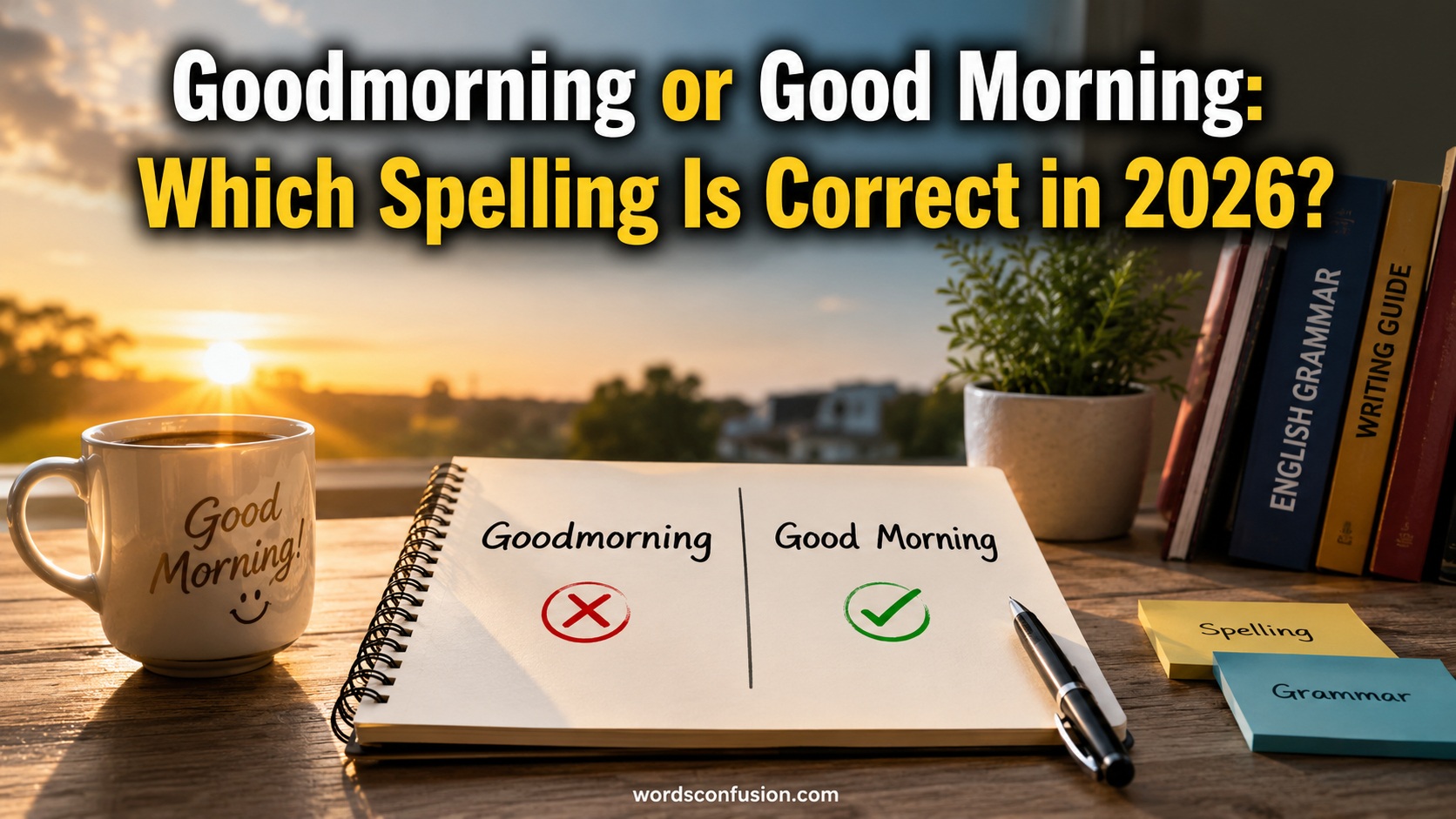
The correct form for the everyday greeting is “good morning” — two separate words. Whether you’re greeting a friend, opening a business email, speaking to a class, or welcoming a customer, the standard spelling keeps good and morning separate.
However, there’s more to this question than simply adding a space. You also need to know when to capitalize the phrase, where to place a comma, how to use it in professional writing, and why you may occasionally see “goodmorning” online.
This guide breaks down Goodmorning or Good Morning with clear rules, examples, comparisons, and practical explanations.
Quick Answer
“Good morning” is the correct standard spelling when you use the phrase as a greeting.
The phrase contains two words:
- Good — an adjective describing something positively.
- Morning — a noun referring to the early part of the day.
So, write:
Good morning, Sarah!
Not:
Goodmorning, Sarah!
And normally not:
Good-morning, Sarah!
The one-word spelling “goodmorning” may appear in usernames, hashtags, informal posts, branding, or other creative contexts. Those uses don’t make it the standard spelling in ordinary English sentences.
The easiest rule to remember is simple:
Greeting someone in the morning? Write “good morning” as two words.
Comparison Overview
The following table gives you the quickest way to distinguish the common forms.
| Form | Standard English? | Main Use | Example |
| good morning | Yes | Standard greeting | Good morning, everyone. |
| Good morning | Yes | Beginning of a sentence or greeting | Good morning, James. |
| GOOD MORNING | Yes | Emphasis, signs, or stylistic writing | GOOD MORNING! |
| goodmorning | No for the ordinary greeting | Informal digital or creative use | Goodmorning, everyone. |
| good-morning | Generally no | Not the normal greeting form | Good-morning, John. |
| a good morning | Yes | Describing a morning | We had a good morning. |
The important distinction is between standard spelling and creative or informal usage. Seeing goodmorning on social media doesn’t mean dictionaries or standard writing conventions have adopted it as the normal greeting.
Main Differences Between Goodmorning or Good Morning
The biggest difference is word separation. Standard English treats the greeting as good morning, not goodmorning.
| Feature | Good morning | Goodmorning |
| Words | Two | One |
| Standard greeting | Yes | No |
| Used in formal writing | Yes | No |
| Used in professional emails | Yes | Generally avoid |
| Used in casual texts | Yes | Sometimes appears |
| Used in hashtags | Usually becomes #GoodMorning | Not the standard grammatical form |
| Dictionary-style greeting | Yes | Not the ordinary modern greeting |
| Recommended spelling | Yes | No |
Think of the space as part of the spelling. Just as good evening normally contains two words, good morning does too.
The fact that the phrase has a familiar meaning doesn’t automatically turn it into a compound word.
What Does “Good Morning” Mean?
“Good morning” is a greeting used during the morning. You can say it when you meet someone, begin a conversation, enter a classroom, start a meeting, or open an email.
For example:
- Good morning! How are you?
- Good morning, David.
- Good morning, everyone.
- Good morning, Professor.
- Good morning, team.
The phrase can also appear inside a larger sentence.
For example:
I said good morning to my neighbor before leaving.
Here, the words don’t function as a standalone greeting. Instead, the sentence describes the act of giving someone a morning greeting.
What Does “Good” Mean in Good Morning?
Good works as an adjective. It expresses a positive quality or wish.
In the greeting “Good morning,” it carries the sense of wishing someone a pleasant or favorable morning.
You don’t need to interpret the phrase literally every time you use it. Like many common greetings, it has become a conventional expression in English.
Compare:
- Good morning
- Good afternoon
- Good evening
All three follow a similar pattern.
Why Is “Good Morning” Written as Two Words?
The phrase remains two words because good and morning perform separate grammatical roles.
Good is an adjective.
Morning is a noun.
Together, they create a phrase that works as a greeting.
For example:
Good morning, Maria.
The adjective good modifies the noun morning. English doesn’t normally combine these two words into a single spelling.
This distinction matters because English has plenty of genuine compound words. Consider:
- bedroom
- notebook
- sunflower
- toothbrush
- football
These words have established single-word forms. Good morning hasn’t developed the same standard spelling for the everyday greeting.
Why “Goodmorning” Looks Tempting
The confusion makes sense. English contains thousands of compound words, and people sometimes assume that frequently used expressions eventually become single words.
That doesn’t always happen.
For example:
- good night remains two words in its normal greeting/farewell use.
- good afternoon remains two words.
- good evening remains two words.
- good morning remains two words.
Frequency alone doesn’t determine spelling.
Is “Goodmorning” Correct?
For standard modern English, goodmorning isn’t the recommended spelling of the ordinary greeting.
If you’re writing an article, school assignment, business email, formal message, or professional document, use:
Good morning.
Avoid:
Goodmorning.
The distinction becomes especially important in professional communication. A single missing space won’t usually prevent someone from understanding your meaning, but standard spelling makes your writing look polished and deliberate.
Why Do People Write “Goodmorning”?
You may encounter goodmorning online for several reasons.
First, informal typing can lead people to remove spaces. Text messages and social posts often contain shortened or unconventional forms.
Second, usernames frequently don’t allow spaces. Someone who wants a username related to “Good Morning” may write something such as GoodMorningDaily.
Third, branding can change normal word spacing. A company, social account, or creative project might deliberately combine words.
Fourth, hashtags don’t permit ordinary spaces. That’s why you’ll see:
#GoodMorning
The hashtag is a platform-specific format. It doesn’t change the standard spelling of the phrase in ordinary prose.
Is “Goodmorning” Ever Seen as a Word?
Yes. Specialized or historical sources may record goodmorning in particular contexts. That fact requires an important distinction.
A word appearing somewhere doesn’t automatically make it the preferred spelling for every use.
For everyday English, especially when you’re greeting someone, good morning remains the clear standard choice.
Is “Good-Morning” Correct?
If you’re using the expression as a greeting, good-morning isn’t the normal spelling.
Write:
Good morning, everyone.
Not:
Good-morning, everyone.
The hyphen isn’t needed because good morning functions naturally as a two-word expression.
Hyphens do have important jobs in English. They can connect words that work together as a compound modifier in certain contexts. However, you shouldn’t insert a hyphen simply because two words frequently appear next to each other.
A Simple Hyphen Rule
When you’re greeting someone, remember:
Good + morning = two separate words.
Examples:
- Good morning, class.
- Good morning, Mr. Jones.
- Good morning!
- I wished her good morning.
No hyphen is necessary.
Should “Good Morning” Be Capitalized?
Capitalization depends on where the phrase appears.
At the beginning of a sentence, capitalize Good because English sentences begin with a capital letter.
Good morning, everyone.
When the phrase appears in the middle of a sentence, lowercase is usually appropriate.
She wished me good morning before leaving.
Both words aren’t automatically capitalized simply because they’re part of a greeting.
Capitalization at the Beginning of a Greeting
When you begin a message with the greeting, capitalize the first word:
Good morning, Sarah.
Good morning, team.
Good morning, everyone!
The second word, morning, normally stays lowercase.
So this is standard:
Good morning, everyone.
Not:
Good Morning, everyone.
That second version may still appear in titles, designs, signs, or stylistic writing. In ordinary sentence-style writing, however, lowercase morning is the normal choice.
What About “Good Morning” in a Title?
Titles follow their own capitalization conventions.
For example:
Good Morning: A Guide to Morning Greetings
Here, both Good and Morning may be capitalized because title-style capitalization can capitalize important words.
That doesn’t mean good morning has become one word.
The spelling stays the same:
good morning
Only capitalization changes.
How to Use “Good Morning” in a Sentence
Knowing the correct spelling is only half the battle. You also need to know how the phrase works grammatically.
As a Direct Greeting
The most common use is a direct greeting.
Good morning!
Good morning, Emma.
Good morning, everyone.
The phrase can stand alone as a complete greeting.
Inside a Sentence
You can also incorporate the expression into a longer sentence.
I said good morning to my teacher.
She wished everyone good morning.
He forgot to say good morning when he arrived.
Here, the phrase doesn’t stand alone. It functions within a larger grammatical structure.
With “A”
The phrase can also become part of a noun phrase.
I hope you have a good morning.
We had a good morning at the park.
This use is slightly different from the standalone greeting.
Compare:
Good morning, Lisa.
This is a greeting.
Now compare:
I hope you have a good morning.
This describes or expresses a wish for someone’s morning.
The spelling remains good morning in both cases.
The Comma in “Good Morning”
One of the most common punctuation questions involves the comma.
When you directly address someone by name, use a comma to separate the greeting from the name.
Good morning, John.
Good morning, Sarah!
Good morning, everyone.
The comma helps the reader recognize that John, Sarah, or everyone is the person or group being addressed.
Without a Name
When the greeting stands alone, no comma is needed after morning.
Good morning!
Good morning.
You don’t need to write:
Good morning,!
That punctuation is incorrect.
Greeting Plus a Second Sentence
You can also separate the greeting from what follows.
Good morning, everyone. Let’s get started.
Good morning, James. How are you today?
This structure sounds natural in both conversation and professional communication.
“Good Morning” in Professional Emails
A professional email often begins with a greeting. Good morning works particularly well when you know the message will reach the recipient during the morning.
Examples include:
Good morning, Mr. Davis,
Good morning, Ms. Johnson,
Good morning, team,
Good morning, everyone,
The greeting creates a polite opening without sounding excessively formal.
Read More: Nosey or Nosy: Correct Spelling With Examples for 2026
Is “Goodmorning” Professional?
No. If you’re writing professionally, stick with good morning.
Consider these two openings:
Standard:
Good morning, Mr. Khan,
Nonstandard:
Goodmorning, Mr. Khan,
The first version follows conventional English spelling. The second looks like a typing error.
That distinction may seem minor, but polished writing often depends on small details.
“Good Morning” in Text Messages and Social Media
Digital communication is more flexible than formal writing. People frequently shorten words, remove punctuation, and combine terms.
You might see:
Goodmorning everyone!
Or:
goodmorning ☀️
These forms are easy to understand. Still, understandable doesn’t mean standard.
If you’re chatting casually with a close friend, unconventional spelling usually causes little trouble. If you’re writing an article, email, application, school assignment, or business message, use the standard form.
What About #GoodMorning?
Hashtags create a special case because spaces aren’t allowed within a hashtag.
For example:
#GoodMorning
This is perfectly normal as a hashtag.
The hashtag format doesn’t mean the ordinary phrase should be written as:
Goodmorning
Instead, think of the hashtag as a technical format used by a social platform.
FAQs:
Is “Goodmorning” one word or two?
The standard spelling is “good morning”, written as two separate words. When you use the expression as a greeting, keep a space between good and morning.
Correct: Good morning, everyone.
Incorrect in standard English: Goodmorning, everyone.
You may see the one-word form in usernames, hashtags, branding, or casual online writing. However, those special uses don’t change the standard spelling.
Is “Good Morning” capitalized correctly?
Usually, only Good is capitalized when the phrase begins a sentence or greeting.
For example:
Good morning, Sarah.
When the phrase appears in the middle of a sentence, lowercase is generally appropriate:
She wished me good morning before leaving.
In a title or heading, Good Morning may have both words capitalized because title capitalization follows different rules.
Do you need a comma after “Good Morning”?
Use a comma when you directly address a person or group.
Good morning, John.
Good morning, everyone.
When the greeting stands alone, you don’t need a comma.
Good morning!
You can also follow the greeting with a period and begin another sentence:
Good morning, everyone. Let’s start the meeting.
Is “Good-morning” correct?
“Good-morning” isn’t the standard spelling of the ordinary greeting. You normally don’t need a hyphen between good and morning.
Write:
Good morning, class.
Rather than:
Good-morning, class.
The two words already work naturally together as a standard greeting, so adding a hyphen serves no useful purpose in this context.
Can you use “Good morning” in a professional email?
Yes. “Good morning” is a polite and natural professional email greeting. You can use it when addressing a colleague, customer, manager, professor, or business contact.
Examples include:
Good morning, Mr. Smith,
Good morning, team,
Good morning, everyone,
For formal correspondence, the two-word spelling is the appropriate choice. Avoid “goodmorning” because it can look like a typing or spelling error.
Conclusion:
The correct choice between Goodmorning or Good Morning is straightforward: “good morning” is the standard two-word form. Use it when greeting someone in person, writing an email, starting a message, addressing a class, or opening a professional conversation. Keep good and morning separate.
Capitalization depends on context, while a comma often separates the greeting from a person’s name or group. When in doubt, stick with the simple rule: If you’re greeting someone in the morning, write “Good morning.”
