
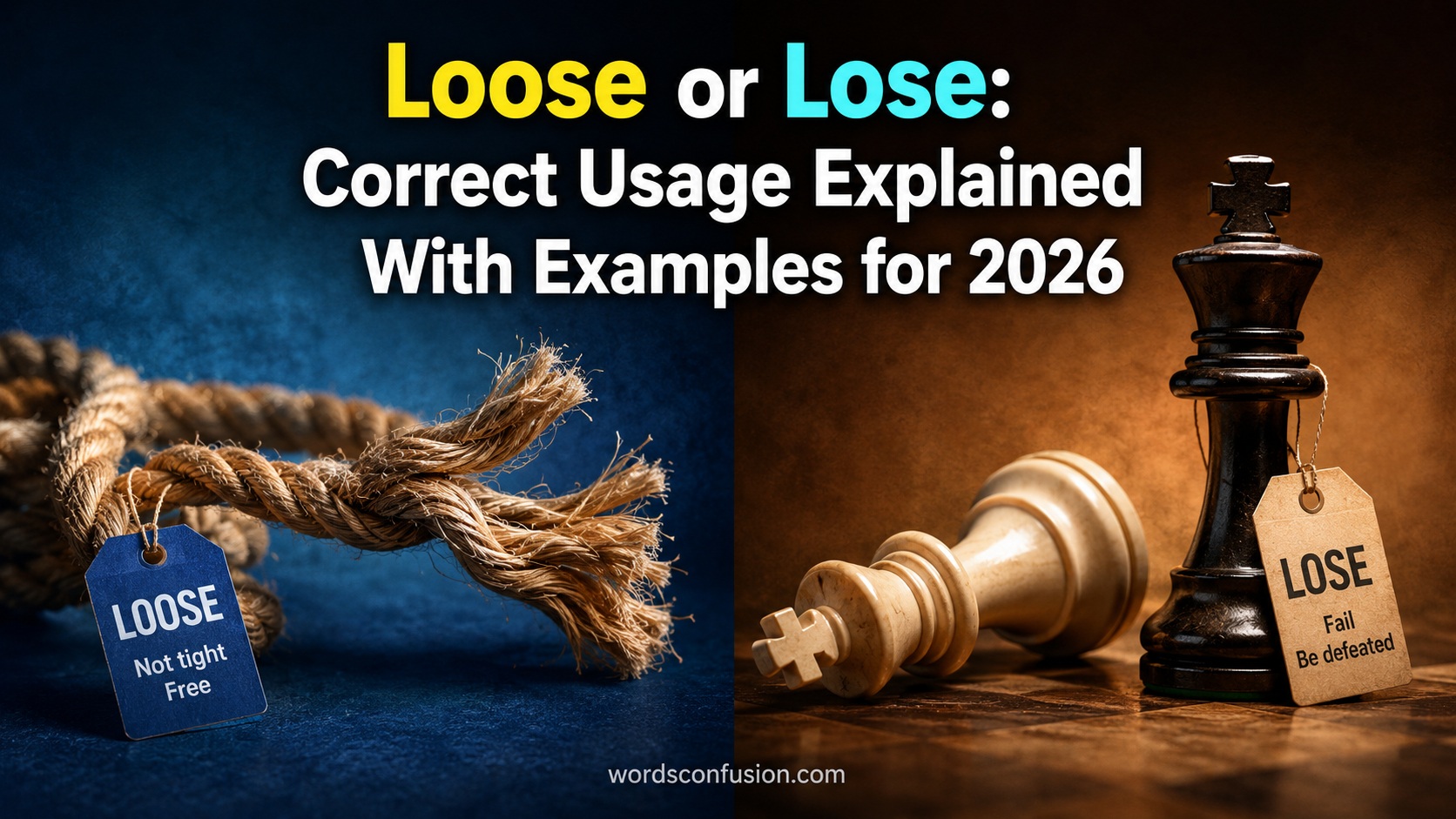
If you’ve ever paused while writing “loose” or “lose,” you’re not alone. These two words look almost identical, yet they carry completely different meanings. One usually describes something that isn’t tight, while the other refers to misplacing something, failing to win, or no longer having something.
The extra “o” in loose makes this pair especially easy to mix up. A single letter can change the entire meaning of your sentence.
For example, compare these two sentences:
- I don’t want to lose my keys.
- My keys are loose in my pocket.
In the first sentence, lose means you might misplace your keys. In the second, loose describes something that isn’t held tightly.
Once you understand the basic distinction, the confusion becomes much easier to avoid. This guide explains loose vs. lose with clear definitions, pronunciation tips, grammar rules, examples, common mistakes, and practical memory tricks.
Quick Answer
Lose is a verb that usually means to misplace something, fail to win, stop having something, or experience a reduction. Loose usually works as an adjective meaning not tight, not firmly attached, free, or not strictly controlled.
- Lose = misplace, fail, or no longer have
- Loose = not tight, free, or not firmly attached
- Loosen = make something less tight
Examples
- Don’t lose your wallet.
- Our team could lose the game.
- This shirt is too loose.
- The screw is loose.
- The dog got loose.
- You should loosen the knot.
A simple memory trick is this: lose has one “o” because something is gone, while loose has two “o”s because something has extra room.
Comparison Overview
The easiest way to understand loose or lose is to compare their meanings, grammatical roles, and pronunciation.
| Word | Part of Speech | Main Meaning | Example |
| Lose | Verb | Misplace or no longer have something | I don’t want to lose my phone. |
| Lose | Verb | Fail to win | They could lose the match. |
| Lose | Verb | Experience a reduction | She wants to lose weight. |
| Loose | Adjective | Not tight | These pants are loose. |
| Loose | Adjective | Not firmly attached | The handle is loose. |
| Loose | Adjective | Free or unrestrained | The dog is loose. |
| Loose | Adjective | Not exact or strict | It’s a loose translation. |
| Loose | Verb | Release or set free | He loosed the horse. |
| Loosen | Verb | Make less tight | Loosen the screw. |
The biggest difference is grammatical.
Lose commonly functions as a verb.
Loose most commonly functions as an adjective.
That distinction alone can solve many confusing sentences.
Main Differences Between Loose or Lose
The most important difference between loose or lose comes down to what you want to communicate.
Lose describes an action or change. You lose something, lose a competition, lose control, or lose interest.
Loose describes a condition. Something can be loose because it isn’t tight, secure, attached, or controlled.
Consider this contrast:
I don’t want to lose my shoe.
My shoe feels loose.
The first sentence describes the possibility of no longer having the shoe. The second describes how the shoe fits.
Lose Means to Misplace Something
When you can’t find something because you misplaced it, use lose.
- I always lose my keys.
- She lost her phone yesterday.
- Don’t lose the receipt.
- He doesn’t want to lose his wallet.
- We might lose the documents.
The word describes the disappearance of possession rather than the physical condition of the object.
You could lose your glasses even if they were perfectly secure before they disappeared.
Lose Means to Fail to Win
Lose also describes the opposite of winning.
You can lose a:
- game
- race
- match
- competition
- election
- contest
- argument
- bet
For example:
- Our team lost the game.
- She doesn’t want to lose the race.
- They lost the championship.
- The candidate lost the election.
- I don’t like to lose an argument.
Notice that loose wouldn’t make sense in any of these sentences.
Lose Means to Stop Having Something
You can also lose something that isn’t a physical object.
People can lose:
- confidence
- patience
- interest
- hope
- control
- motivation
- focus
- trust
- respect
Examples:
- He lost confidence after the mistake.
- She lost interest in the project.
- Don’t lose hope.
- I almost lost my patience.
- The company lost the trust of its customers.
Here, lose means that something you previously had is no longer available or present.
Lose Means to Reduce or Experience a Decline
The word lose can also describe a reduction in amount, value, time, weight, money, or other resources.
For example:
- He wants to lose weight.
- The business lost money last year.
- We can’t lose time waiting.
- The company lost customers during the downturn.
- The machine lost power.
This use often causes mistakes because the thing being lost isn’t necessarily an object.
What Does Loose Mean?
Loose generally describes something that isn’t tight, firmly fixed, closely controlled, or securely attached.
Think of a loose shoelace. It hasn’t disappeared. It simply isn’t tight.
The same idea appears in many different contexts.
Loose Means Not Tight
This is one of the most common meanings of loose.
- These jeans are loose.
- The knot is loose.
- My shoelaces are loose.
- The lid is loose.
- His shirt looks loose.
When something has extra space or doesn’t fit tightly, loose is usually the right word.
Compare:
- My shoes are loose.
They don’t fit tightly. - I might lose my shoes.
I might misplace them or no longer have them.
That’s a completely different idea.
Loose Means Not Firmly Attached
Something can also be loose when it isn’t securely connected or fixed.
Examples include:
- a loose screw
- a loose button
- a loose wire
- a loose handle
- a loose tile
- a loose tooth
For example:
The door handle is loose.
This doesn’t mean you’ve misplaced the handle. It means the handle isn’t firmly attached.
Loose Means Free or Unrestrained
Loose can describe something that has escaped restraint.
For example:
- The dog got loose.
- Several horses were running loose.
- The prisoner broke loose.
- Her hair hung loose around her shoulders.
The idea remains similar: something isn’t being held or controlled tightly.
Loose Means Not Strict or Exact
The meaning becomes more abstract in phrases such as loose translation and loose interpretation.
A loose translation communicates the general meaning without following every word or detail exactly.
For example:
The English version is a loose translation of the original poem.
Likewise, a loose interpretation doesn’t follow a rule or source with complete precision.
This meaning extends beyond physical looseness. The underlying idea is still a lack of strictness.
Loose or Lose Pronunciation
Pronunciation provides another useful way to separate these words.
- Lose sounds like “looz.”
- Loose sounds like “loos.”
The final consonant makes the difference.
Lose ends with a /z/ sound.
Loose ends with an /s/ sound.
A Simple Sound Comparison
| Word | Approximate Sound | Rhymes With |
| Lose | looz | choose |
| Loose | loos | goose |
This distinction can help when you’re speaking. However, spelling remains important because the two words can still create confusion in writing.
A useful trick is to remember:
Lose → choose
Loose → goose
The rhyme isn’t a grammar rule. It’s simply a memory aid.
Loose vs. Lose Examples in Everyday Sentences
Context makes the difference much easier to see.
At Home
- Don’t lose your house keys.
- The kitchen cabinet handle is loose.
- I don’t want to lose the remote.
- This drawer feels loose.
- The screw has become loose.
At School
- Don’t lose your homework.
- She could lose points for that mistake.
- The paper has a loose structure.
- He doesn’t want to lose his notebook.
At Work
- The company could lose valuable customers.
- We can’t afford to lose another day.
- The connection between the cables is loose.
- The report offers a loose summary of the findings.
In Sports
- Our team might lose the final.
- Nobody wants to lose the championship.
- The player chased the loose ball.
- The defender picked up a loose ball near the goal.
Sports provide an especially clear example. A loose ball is a ball that isn’t currently under firm possession or control.
Common Loose and Lose Mistakes
The spelling mistake usually happens because both words contain the same letters except for one extra o.
Here are some of the most common errors.
| Incorrect | Correct | Explanation |
| Don’t loose your keys. | Don’t lose your keys. | You’re talking about misplacing keys. |
| We don’t want to loose the game. | We don’t want to lose the game. | You’re talking about failing to win. |
| My shoes are lose. | My shoes are loose. | The shoes aren’t tight. |
| The dog is lose. | The dog is loose. | The dog isn’t restrained. |
| I always loose my phone. | I always lose my phone. | You mean misplace. |
| The screw is lose. | The screw is loose. | The screw isn’t secure. |
| Don’t loose your temper. | Don’t lose your temper. | This is an established expression using lose. |
Mistake: “Loose Weight”
This is one of the most common errors.
Incorrect:
I want to loose weight.
Correct:
I want to lose weight.
Why?
Lose acts as the verb meaning to reduce your weight. Loose doesn’t carry that meaning.
Mistake: “Loose the Game”
Incorrect:
Our team might loose the game.
Correct:
Our team might lose the game.
You lose a game because you fail to win it.
Mistake: “Lose Clothing”
Incorrect:
She prefers lose clothing.
Correct:
She prefers loose clothing.
Here, loose describes clothing that doesn’t fit tightly.
Lose, Loose, and Loosen: What’s the Difference?
Adding loosen to the comparison clears up another common source of confusion.
| Word | Function | Meaning | Example |
| Lose | Verb | Misplace or no longer have | Don’t lose your keys. |
| Loose | Adjective | Not tight or secure | The bolt is loose. |
| Loosen | Verb | Make less tight | Loosen the bolt. |
This distinction is easy to remember.
If something isn’t tight, it’s loose.
If you make something less tight, you loosen it.
If something becomes missing or unavailable, you lose it.
Examples With All Three
Consider a backpack strap.
The strap is loose.
This describes its condition.
Loosen the strap.
This tells someone to make it less tight.
Now consider the backpack itself:
Don’t lose your backpack.
This means don’t misplace it.
Three similar-looking words. Three different jobs.
Is Loose a Verb?
Yes. Loose can function as a verb, although this use is less common in everyday American English than the adjective.
As a verb, loose can mean to release, let go, or set free.
Examples include:
- The rider loosed the horse.
- The hunters loosed the dogs.
- He loosed the arrow.
- She loosed her grip.
This verb has a somewhat formal, literary, or traditional feel in many modern contexts.
For ordinary situations, release, let go, or loosen may sound more natural depending on the intended meaning.
Don’t confuse the verb loose with loosen.
Loose as a verb can mean release.
Loosen means make less tight.
Read More: Goodmorning or Good Morning: Which Spelling Is Correct in 2026?
Common Expressions With Lose
You’ll encounter lose in many familiar expressions.
Lose Your Temper
This means to become angry or stop controlling your emotions.
He lost his temper during the argument.
Lose Your Way
This means to become unable to find the correct direction.
We lost our way in the unfamiliar neighborhood.
Lose Interest
This means to stop being interested in something.
She lost interest in the project.
Lose Control
This means to stop controlling yourself or a situation.
The driver lost control of the vehicle.
Lose Sleep
This expression usually means to worry about something.
Don’t lose sleep over a small mistake.
Lose Weight
This means to reduce body weight.
He plans to lose weight through regular exercise.
FAQs:
Is it “lose” or “loose” your keys?
The correct phrase is “lose your keys.” Lose means to misplace or no longer have something.
Is it “lose” or “loose” weight?
The correct phrase is “lose weight.” Lose functions as the verb meaning to reduce your weight.
Is it “lose” or “loose” a game?
Use lose: “lose a game.” It means fail to win the game.
Is it “loose” or “lose” clothing?
Use loose: “loose clothing.” The adjective describes clothing that doesn’t fit tightly.
Is it “lose” or “loose” your temper?
Use lose: “lose your temper.” The expression means to become angry or stop controlling your emotions.
Conclusion:
Understanding loose or lose doesn’t have to be confusing. Although these words look nearly identical, they serve different purposes and express different ideas. Use lose when you mean to misplace something, fail to win, no longer have something, or experience a reduction. For example, you might lose your keys, lose a game, or lose interest in a project. Use loose when something isn’t tight, secure, attached, or restrained. You might wear loose clothing, notice a loose screw, or see a dog running loose.
