Have you ever paused while typing and wondered whether grammar or grammer is the correct spelling? You’re not alone. Thousands of people search for “Grammar vs Grammer” every month because the two words sound almost identical when spoken. However, only one spelling is accepted in English.
Spelling mistakes happen to everyone. Some occur because of pronunciation while others result from habit or typing too quickly. The confusion between grammar and grammer falls into the first category. Since the ending sounds like “-mer,” many writers mistakenly replace -mar with -mer.
Although this looks like a small mistake, it can affect your credibility. Whether you’re writing an email, a school assignment, a blog post, or a resume, using the correct spelling shows attention to detail and a solid understanding of English.
This guide explains everything you need to know about Grammar vs Grammer. You’ll learn the correct spelling, discover why people make this mistake, see real examples, compare the two side by side, and pick up simple tricks that will help you remember the correct word forever.
Quick Answer
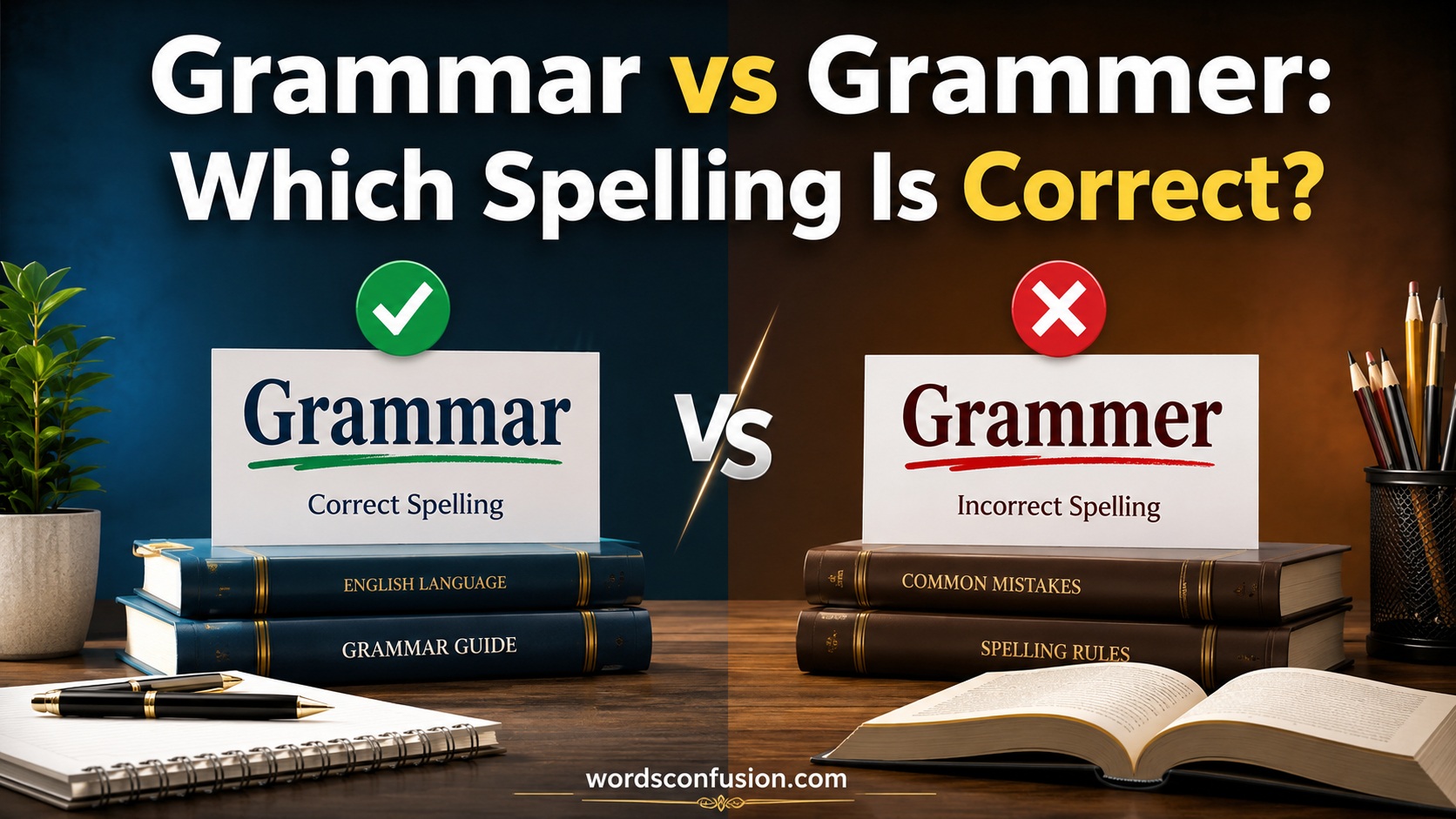
Grammar is the correct spelling.
Grammer is an incorrect spelling and is not recognized as a standard English word in dictionaries such as Merriam-Webster, Cambridge, or Oxford.
| Word | Correct? | Meaning |
| Grammar | Yes | The system of rules that governs a language. |
| Grammer | No | A common misspelling of “grammar.” |
In short: Always write grammar, never grammer.
Grammar vs Grammer at a Glance
The quickest way to understand the difference is through a simple comparison.
| Feature | Grammar | Grammer |
| Correct spelling | Yes | No |
| Found in dictionaries | Yes | No |
| Accepted in academic writing | Yes | No |
| Used in professional documents | Yes | No |
| Meaning | Rules of a language | None |
| Recommended usage | Always | Never |
The comparison makes the answer clear. Grammar is the only spelling you should use in formal and informal writing.
What Does “Grammar” Mean?
Grammar is the collection of rules that explains how a language works. These rules determine how words combine into sentences so readers and listeners can understand the intended meaning.
Grammar covers much more than spelling. It includes sentence structure, punctuation, word order, verb tenses, clauses, and agreement between subjects and verbs.
Without grammar, communication quickly becomes confusing.
For example:
- Correct: She is reading a book.
- Incorrect: She reading book is.
Both sentences use similar words. However, only the first follows English grammar rules.
Definition of Grammar
Most English dictionaries define grammar as the study or system of rules governing how words are used to create meaningful sentences.
Grammar includes areas such as:
- Sentence structure
- Verb tenses
- Parts of speech
- Subject-verb agreement
- Pronouns
- Articles
- Punctuation
- Capitalization
Together, these rules help people communicate ideas clearly.
Why Grammar Matters
Many people think grammar only matters in school. In reality, it affects almost every part of daily life.
Good grammar helps you:
- Communicate ideas clearly.
- Avoid misunderstandings.
- Build professional credibility.
- Write persuasive emails.
- Improve academic performance.
- Rank better with high-quality online content.
- Make a strong first impression.
Imagine receiving these two emails.
Example 1
We have completed your project and attached the final report.
Example 2
We completed project attached final report please check.
The first message is easier to read because it follows proper grammar.
Different Types of Grammar
Grammar isn’t just one set of rules. Linguists divide it into several categories.
Descriptive Grammar
Descriptive grammar explains how people naturally use a language in everyday life.
Instead of telling speakers what they should say, it describes actual language use.
For example:
People commonly say:
I’m gonna call you later.
Although informal, descriptive grammar recognizes that native speakers frequently use this expression.
Prescriptive Grammar
Prescriptive grammar focuses on rules considered correct in formal writing and education.
Schools usually teach this form because it promotes consistency.
Examples include:
- Use who for people.
- Capitalize proper nouns.
- Avoid sentence fragments.
- Maintain subject-verb agreement.
English Grammar
English grammar refers specifically to the grammatical rules of the English language.
It includes topics such as:
- Nouns
- Pronouns
- Verbs
- Adjectives
- Adverbs
- Prepositions
- Conjunctions
- Interjections
Mastering these topics improves both writing and speaking skills.
Grammar in Everyday Communication
Grammar isn’t limited to classrooms.
You use it every day when:
- Sending text messages
- Writing emails
- Posting on social media
- Creating resumes
- Writing reports
- Publishing blog articles
- Speaking during meetings
Even casual conversations rely on grammar to communicate ideas effectively.
What Does “Grammer” Mean?
This is where many people become confused.
The truth is simple.
Grammer has no accepted meaning in standard English.
It does not appear as a dictionary entry because it is simply a misspelling of grammar.
Whenever you type grammer, spelling tools usually underline it in red or automatically replace it with grammar.
Is “Grammer” a Real Word?
No.
Major dictionaries do not recognize grammer as a correct English word.
Instead, dictionary websites usually suggest:
Did you mean grammar?
If you submit an academic paper containing grammer, your teacher will almost certainly mark it as a spelling mistake.
Likewise, grammar-checking software identifies it as an error.
Why People Spell “Grammar” as “Grammer”
Although grammer is incorrect, it’s easy to understand why people make this mistake.
Several factors contribute to the confusion.
Pronunciation Confusion
English pronunciation doesn’t always match spelling.
The final syllable of grammar sounds similar to -mer, encouraging writers to spell it incorrectly.
Typing Mistakes
Fast typing often produces accidental spelling errors.
Someone writing quickly may not notice the missing a before finishing the document.
Early Learning Errors
Children frequently write words exactly as they hear them.
Since grammar sounds close to grammer, many students develop this spelling habit before learning the correct version.
Autocorrect Doesn’t Always Save You
Modern spell-checkers are helpful, yet they aren’t perfect.
If autocorrect is disabled or the mistake appears in software without spell checking, grammer may remain unnoticed.
That’s why proofreading still matters.
Grammar vs Grammer: The Key Differences
Although these words differ by only one letter, their meanings are completely different.
| Aspect | Grammar | Grammer |
| Standard English | Yes | No |
| Dictionary entry | Yes | No |
| Correct spelling | Yes | No |
| Academic acceptance | Yes | Never |
| Business writing | Yes | Never |
| Meaning | Language rules | None |
The safest rule is easy to remember:
If you’re referring to the rules of language, always write “grammar.”
How to Remember the Correct Spelling
Many people repeat the same spelling mistake for years simply because they never learn an easy memory trick.
Fortunately, remembering grammar is easier than you might think.
Memory Trick One
Think about the word:
Grammar = Grammar Rules
Both words contain multiple A letters.
The repeated A can remind you that grammar also contains -mar, not -mer.
Memory Trick Two
Associate the word with school.
Whenever you think about English class, picture:
Grammar Book
Not
Grammer Book
Seeing the correct spelling repeatedly helps your brain build long-term memory.
Memory Trick Three
Read more.
People who read books regularly encounter the correct spelling thousands of times.
Over time, your brain begins recognizing the correct form automatically.
Memory Trick Four
Practice writing.
Write five simple sentences using the word grammar.
For example:
- Grammar helps people communicate clearly.
- Good grammar improves readability.
- My teacher explained English grammar today.
- Grammar mistakes can confuse readers.
- Learning grammar takes practice.
Small exercises like this strengthen spelling recall.
Correct Examples Using “Grammar”
Seeing the word used correctly makes it much easier to remember.
Everyday Examples
- I need to improve my grammar before the exam.
- Good grammar makes writing easier to understand.
- She downloaded a grammar checker for her laptop.
- The teacher explained English grammar very clearly.
- Your grammar has improved a lot this year.
Academic Examples
- Students should review grammar before submitting assignments.
- The professor teaches advanced English grammar.
- Correct grammar improves academic writing.
- Strong grammar supports clear research papers.
Professional Examples
- Employers appreciate applicants with strong grammar skills.
- Every business email should use correct grammar.
- Editors check grammar before publishing articles.
- Clear grammar builds trust with readers and clients.
Incorrect Examples Using “Grammer”
Understanding incorrect usage is just as important as learning the correct spelling. Many people continue making the same mistake because they never compare the wrong version with the correct one.
The word grammer should never appear in formal writing, academic papers, business emails, resumes, or professional documents.
Here are some common mistakes and their corrections.
| Incorrect Sentence | Correct Sentence |
| My grammer needs improvement. | My grammar needs improvement. |
| She teaches English grammer. | She teaches English grammar. |
| I downloaded a grammer checker. | I downloaded a grammar checker. |
| Good grammer helps communication. | Good grammar helps communication. |
| The exam tests your grammer. | The exam tests your grammar. |
If you notice grammer in your writing, replace it with grammar immediately.
Why the Mistake Matters
At first glance, the difference looks tiny. However, readers often judge writing quality based on small details.
A spelling mistake in a casual text message may not matter much. The same mistake in a resume, proposal, or university assignment can leave a poor impression.
For example:
Resume Statement
Excellent written communication and strong grammar skills.
Now compare it with:
Excellent written communication and strong grammer skills.
The second version weakens your credibility because it misspells the very skill it claims to possess.
Common Words People Misspell Like Grammar
Grammar isn’t the only English word people struggle to spell. English contains many confusing words because pronunciation doesn’t always match spelling.
Here are several examples.
| Correct Word | Common Misspelling |
| Grammar | Grammer |
| Separate | Seperate |
| Government | Goverment |
| Calendar | Calender |
| Embarrass | Embarass |
| Occurred | Occured |
| Receive | Recieve |
| Discipline | Disipline |
| Foreign | Forein |
| Accommodate | Accomodate |
Most of these mistakes happen because people spell words the way they sound.
Why English Spelling Is Difficult
English borrowed vocabulary from Latin, Greek, French, German, and many other languages.
As a result:
- Similar sounds often have different spellings.
- Silent letters appear frequently.
- Pronunciation doesn’t always match written words.
- Many spelling patterns have exceptions.
That’s why even native English speakers occasionally make spelling mistakes.
Read More: Foreign vs Forein: Which Spelling Is Correct?
Common Phrases That Use “Grammar”
The word grammar appears in many everyday expressions.
Learning these phrases helps you remember the correct spelling naturally.
Grammar Rules
Grammar rules explain how words work together to form clear sentences.
Example:
Learning grammar rules improved my writing.
Grammar Checker
A grammar checker identifies spelling, punctuation, and grammar mistakes.
Example:
I always run my article through a grammar checker before publishing.
English Grammar
This phrase refers to the complete system of English language rules.
Example:
English grammar becomes easier with regular practice.
Grammar Mistakes
Grammar mistakes include problems with sentence structure, punctuation, verb tense, and word order.
Example:
Reading your work twice helps you catch grammar mistakes.
Grammar Lessons
Schools, universities, and online courses teach grammar lessons.
Example:
Our teacher assigned two grammar lessons this week.
Grammar Book
Grammar books explain language rules with examples and exercises.
Example:
Every English learner should own a good grammar book.
Grammar School
This phrase has different meanings depending on the country.
- In the United Kingdom, a grammar school is a selective secondary school.
- Historically, the term referred to schools that focused heavily on Latin grammar.
In this context, grammar still uses the same correct spelling.
Why Correct Spelling Improves Communication
Correct spelling does more than make writing look polished. It improves clarity, builds trust, and prevents misunderstandings.
Even a single spelling mistake can distract readers from your main message.
Imagine reading a business proposal with dozens of spelling errors. You might begin questioning the writer’s attention to detail.
Now imagine reading a clean, well-written document with accurate spelling and grammar. It feels more professional and easier to trust.
Academic Benefits
Students who use correct spelling often produce stronger assignments.
Proper spelling helps because it:
- Makes essays easier to read.
- Demonstrates attention to detail.
- Improves exam performance.
- Supports better grades.
- Creates clearer arguments.
Teachers focus on ideas first. However, frequent spelling mistakes can make those ideas harder to understand.
Professional Benefits
Employers expect professional communication.
Correct spelling can improve:
- Business emails
- Reports
- Presentations
- Job applications
- Client communication
- Marketing materials
Small mistakes sometimes create large consequences.
For example, a company brochure containing several spelling errors may appear less trustworthy to potential customers.
Benefits for Bloggers and Content Writers
For bloggers and website owners, correct spelling supports both readers and search performance.
Well-written content often:
- Keeps visitors engaged longer.
- Builds authority.
- Encourages shares.
- Increases reader confidence.
- Reduces confusion.
Although search engines don’t rank pages based solely on perfect spelling, readers are more likely to stay on pages they find easy to read.
FAQs:
Is grammar or grammer correct?
Grammar is the correct spelling. It refers to the rules that govern a language. Grammer is a common misspelling and should not be used in academic, professional, or everyday writing.
Why do people spell grammar as grammer?
Many people spell grammar as grammer because the two words sound similar when spoken. Others make the mistake while typing quickly or because they haven’t seen the correct spelling often enough. Since English pronunciation doesn’t always match spelling, this confusion is common.
Is “grammer” a real word?
No. Grammer is not a standard English word. Major dictionaries, including Merriam-Webster, Cambridge, and Oxford, recognize grammar as the correct spelling. If you type grammer, most spell-check tools will suggest grammar instead.
How can I remember the correct spelling of grammar?
A simple way to remember it is to think of the phrase “grammar rules.” The word grammar always ends with -mar, not -mer. Reading regularly and writing the word correctly in sentences will also help reinforce the correct spelling.
Does using “grammer” affect professional writing?
Yes. Using grammer in resumes, business emails, reports, or academic assignments can make your writing look careless and unprofessional. Even a small spelling mistake can reduce your credibility, especially when you’re discussing language or writing skills.
Conclusion:
The debate over Grammar vs Grammer has a simple answer: grammar is the only correct spelling, while grammer is a misspelling that should always be avoided. Although the words sound alike, only grammar appears in dictionaries and is accepted in schools, workplaces, and professional writing.
Understanding this difference helps you write with greater confidence and accuracy. It also improves the quality of your communication, whether you’re drafting an email, completing a school assignment, creating website content, or preparing a job application.

Andrew Wilson is an experienced language researcher and content writer specializing in WordsConfusion topics. He helps readers understand commonly confused English words, spelling differences, grammar rules, word meanings, and proper usage through clear explanations, practical examples, and easy-to-follow language guides. His goal is to make English learning simple, accurate, and accessible for students, writers, professionals, and everyday learners.