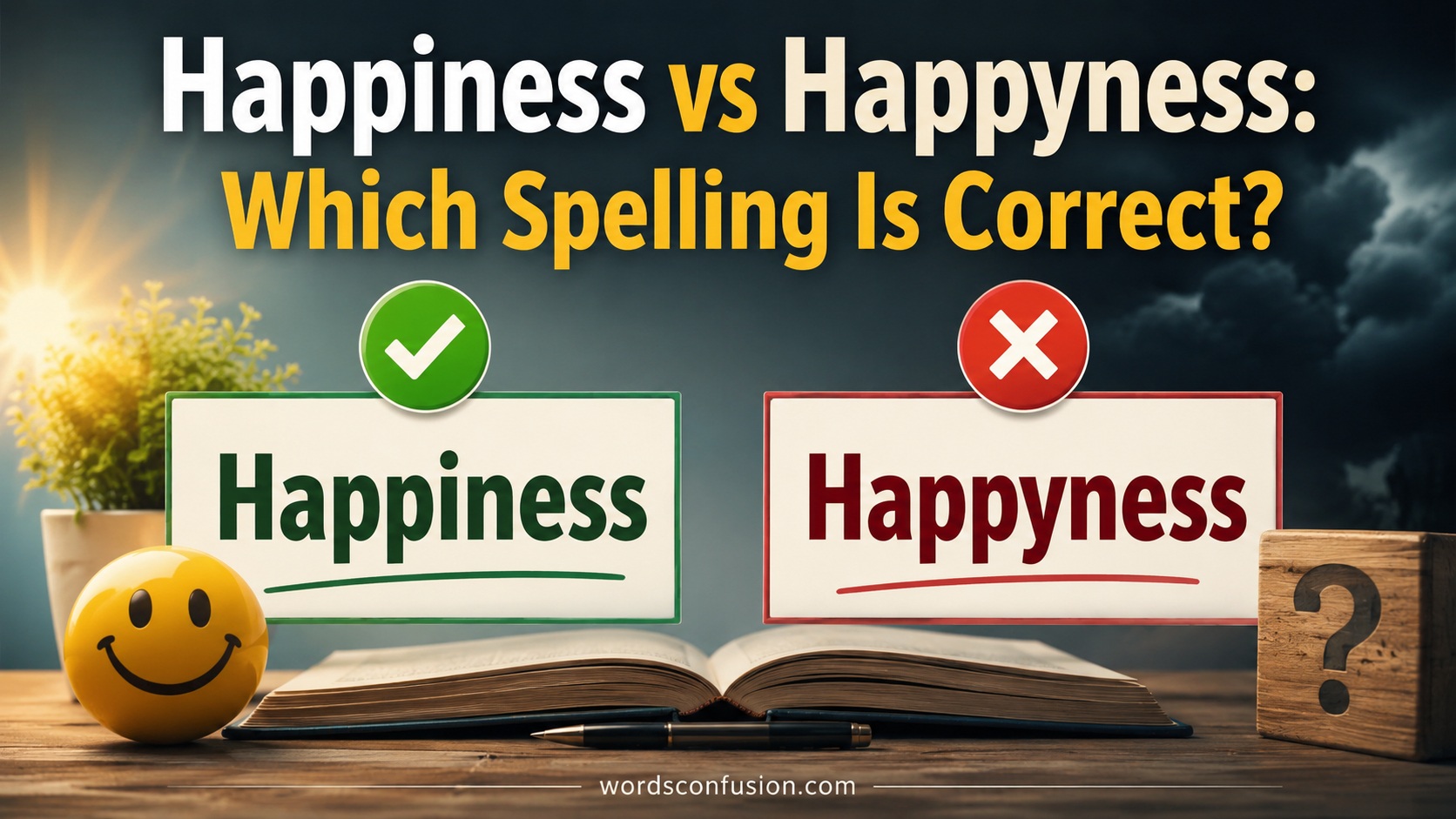
If you’ve ever typed “Happyness” instead of “Happiness,” you’re not alone. Thousands of people search for Happiness vs Happyness every month because the two words look similar. However, only one spelling is correct in standard English.
The confusion often begins with the word happy. Since it ends with the letter y, many people naturally assume adding -ness creates happyness. English doesn’t work that way. A simple spelling rule changes the y to i, resulting in the correct word: happiness.
There’s another reason people get confused. The popular 2006 film The Pursuit of Happyness intentionally uses the incorrect spelling in its title. That creative choice has caused many people to wonder whether Happyness is also an acceptable English word.
In this guide, you’ll learn the difference between Happiness vs Happyness, why only one spelling is correct, the grammar rule behind the word, common mistakes to avoid, and the one famous exception everyone should know.
Quick Answer
Happiness is the correct spelling in English.
Happyness is a misspelling and should not appear in academic, professional, or everyday writing.
The only widely recognized exception is the movie The Pursuit of Happyness, where the incorrect spelling was used intentionally as part of the story.
| Word | Correct? | Should You Use It? |
| Happiness | Yes | Yes, in all writing |
| Happyness | No | Only when referring to The Pursuit of Happyness |
Happiness vs Happyness: Side-by-Side Comparison
Understanding the difference becomes much easier when you compare the two spellings directly.
| Feature | Happiness | Happyness |
| Standard English spelling | Yes | No |
| Found in dictionaries | Yes | No |
| Accepted in schools and universities | Yes | No |
| Used in business writing | Yes | No |
| Grammatically correct | Yes | No |
| Appears in The Pursuit of Happyness | No | Yes |
The comparison leaves little room for doubt. If you’re writing an essay, email, blog post, social media update, or business document, always choose happiness.
What Does “Happiness” Mean?
Happiness is a noun that describes a state of joy, satisfaction, pleasure, or contentment. It refers to positive emotions that make life enjoyable and meaningful.
Unlike temporary excitement, happiness often describes a deeper feeling of well-being. It can come from relationships, achievements, good health, meaningful work, or simply appreciating everyday moments.
Dictionary Definition
Most major English dictionaries define happiness in similar ways.
- Merriam-Webster: A state of well-being and contentment.
- Cambridge Dictionary: The feeling of being happy.
- Oxford Languages: The state of being happy.
Although the wording differs slightly, every trusted dictionary recognizes happiness as the correct spelling.
Origin and Word Formation
The word happiness comes from the adjective happy.
When forming nouns ending in -ness, English often changes the final y to i if the y follows a consonant.
Here’s the process:
- Happy
- Remove y
- Add i
- Add -ness
- Result: Happiness
This spelling pattern has existed in English for centuries and follows standard grammar rules.
Pronunciation
Happiness is pronounced:
/ˈhæp.i.nəs/
It has three syllables:
HAP • pee • ness
The pronunciation doesn’t change because of the spelling rule.
Common Synonyms
Depending on the situation, these words may have similar meanings:
- Joy
- Delight
- Pleasure
- Cheerfulness
- Contentment
- Satisfaction
- Bliss
- Well-being
- Gladness
- Fulfillment
Each synonym has a slightly different shade of meaning. For example, bliss suggests extreme joy, while contentment refers to peaceful satisfaction.
Common Antonyms
Words opposite to happiness include:
- Sadness
- Misery
- Depression
- Sorrow
- Unhappiness
- Grief
- Gloom
- Distress
- Despair
- Melancholy
Choosing the right opposite depends on the context and emotional intensity.
Is “Happyness” Ever Correct?
For almost every situation, the answer is no.
You shouldn’t write happyness in:
- School assignments
- College papers
- Business emails
- Articles
- Books
- News reports
- Professional documents
- Everyday communication
Spell-check tools, dictionaries, and grammar checkers all recognize happyness as an error.
Why Some People Spell It This Way
Several factors contribute to this common mistake.
First, people often spell words based on how they sound. Since happy ends in y, it’s easy to assume the next form simply adds -ness.
Second, English spelling rules aren’t always obvious. Many learners don’t realize that the final y changes to i before certain suffixes.
Third, fast typing and autocorrect mistakes sometimes produce incorrect spellings that go unnoticed.
Finally, internet searches expose users to misspelled words more often than ever. Once someone repeatedly sees happyness, it begins to look familiar even though it’s incorrect.
The Famous Exception: The Pursuit of Happyness
One notable exception exists.
The 2006 film The Pursuit of Happyness, starring Will Smith and Jaden Smith, intentionally spells the word as Happyness.
This wasn’t a grammatical mistake.
The unusual spelling comes directly from the true story of Chris Gardner. Early in the film, the main character notices the word Happyness painted incorrectly on the wall of a daycare center. Later, the same spelling becomes part of the movie’s title.
The filmmakers kept the incorrect spelling because it symbolizes struggle, imperfection, and the difficult journey toward achieving happiness.
Outside this title, standard English still requires the spelling happiness.
Why the Movie Intentionally Uses the Wrong Spelling
The misspelling carries symbolic meaning.
It reminds viewers that life isn’t perfect. People often chase happiness while making mistakes, facing hardships, and overcoming obstacles.
The incorrect spelling reflects that imperfect journey.
Rather than representing poor grammar, it serves as a storytelling device that reinforces the movie’s central message about persistence and hope.
Why People Misspell Happiness
Even native English speakers occasionally write happyness.
Understanding why this happens makes it easier to avoid the mistake.
Confusion Between “-y” and “-i” Before “-ness”
The biggest reason is the spelling rule itself.
When a word ends with a consonant followed by y, the y usually changes to i before adding certain suffixes.
Examples include:
| Base Word | Correct Form |
| Happy | Happiness |
| Busy | Business |
| Crazy | Craziness |
| Lazy | Laziness |
| Easy | Easiness |
This rule appears throughout English vocabulary.
Similar English Spelling Patterns
English contains many words that follow identical patterns.
Examples include:
- Happy → Happier
- Happy → Happiest
- Beauty → Beautiful
- Duty → Dutiful
- Mercy → Merciful
Recognizing these patterns strengthens spelling accuracy over time.
Typing and Autocorrect Errors
Modern technology can also create mistakes.
A rushed email, mobile keyboard, or overlooked typo may produce happyness even if the writer knows the correct spelling.
Always proofread important documents before sending them.
Reading your work aloud often helps catch spelling mistakes that your eyes skip during silent reading.
Why “Happy” Becomes “Happiness”
The transformation follows one of English’s most common spelling rules.
When a word ends in consonant + y, change the y to i before adding suffixes such as:
- -ness
- -er
- -est
- -ly
Here’s how it works:
| Step | Result |
| Base word | Happy |
| Remove y | Happ |
| Add i | Happi |
| Add -ness | Happiness |
Without this rule, English spelling would become inconsistent and harder to standardize.
The English Spelling Rule
Remember this simple guideline:
If a word ends with a consonant followed by “y,” change the “y” to “i” before adding “-ness.”
This rule applies in most situations, although English has a few exceptions involving vowel + y endings.
Learning this one rule helps you spell dozens of English words correctly.
Other Words That Follow the Same Rule
Many everyday words follow exactly the same pattern.
| Base Word | Correct Word |
| Happy | Happiness |
| Busy | Business |
| Crazy | Craziness |
| Lazy | Laziness |
| Ugly | Ugliness |
| Lonely | Loneliness |
| Worthy | Worthiness |
| Holy | Holiness |
Once you recognize the pattern, remembering happiness becomes much easier.
Examples of “Happiness” in Sentences
Seeing the word used naturally helps reinforce the correct spelling.
Everyday Conversations
- True happiness comes from spending time with the people you love.
- She couldn’t hide her happiness after hearing the good news.
- Money may buy comfort, yet happiness often comes from meaningful experiences.
- The children’s laughter filled the house with happiness.
- He wished everyone a lifetime of happiness.
Academic Writing
- Researchers continue to study the relationship between happiness and mental well-being.
- Several surveys suggest that strong social connections contribute to greater happiness.
- Positive psychology focuses on understanding the factors that increase happiness and life satisfaction.
- Long-term happiness depends on multiple psychological and social factors.
- The study measured participants’ happiness before and after the intervention.
Incorrect Examples Using “Happyness”
Many people write happyness because they assume adding -ness to happy doesn’t change the spelling. However, every example below contains a spelling mistake.
| Incorrect Sentence | Correct Sentence |
| I wish you happyness. | I wish you happiness. |
| Her happyness inspired everyone. | Her happiness inspired everyone. |
| Happiness is the key to happyness. | Happiness is the key to a fulfilling life. |
| We all deserve happyness. | We all deserve happiness. |
| Their happyness lasted for years. | Their happiness lasted for years. |
If you’re writing for school, work, or publication, always replace happyness with happiness unless you’re referring to the movie The Pursuit of Happyness.
Happiness in Grammar and Style Guides
Every respected English style guide and dictionary recognizes happiness as the standard spelling.
AP Style
The Associated Press (AP) Stylebook follows standard English spelling. Journalists, editors, and news organizations use happiness in articles, headlines, and reports.
If you mention the film The Pursuit of Happyness, preserve the original title because titles should remain exactly as published.
Chicago Manual of Style
The Chicago Manual of Style follows dictionary spellings for standard English words. That means happiness is correct in books, academic publications, and professional manuscripts.
Only use Happyness when quoting the official movie title or another proper noun that intentionally uses that spelling.
Merriam-Webster
Merriam-Webster lists happiness as the accepted noun formed from happy.
You won’t find happyness listed as a standard English word because it isn’t recognized as correct spelling.
Cambridge Dictionary
The Cambridge Dictionary defines happiness as the feeling of being happy. It doesn’t recognize happyness as an alternative spelling.
This consistency across major dictionaries removes any doubt about which version you should use.
Read More: Grammar vs Grammer: Which Spelling Is Correct?
Happiness vs Happyness in Google Search Trends
Although happiness is the correct spelling, thousands of users still search for happyness every year.
This happens because spelling mistakes are common in search engines. People often type words the way they sound instead of following grammar rules.
Which Term People Search More?
The correct spelling happiness receives dramatically more searches than happyness.
Searches for happyness usually come from:
- People checking whether the spelling is correct.
- Fans searching for The Pursuit of Happyness.
- English learners practicing spelling.
- Users who accidentally typed the wrong word.
Why Misspelled Keywords Still Receive Traffic
Search engines understand that users make mistakes.
When someone searches for happyness, Google often displays results about happiness because it recognizes the intended word.
That’s why spelling-comparison articles like Happiness vs Happyness remain valuable. They answer the user’s question immediately while explaining the grammar rule behind the correction.
What Writers Should Know
If you’re creating educational content, keep these best practices in mind.
- Use Happiness as the primary spelling throughout your article.
- Mention Happyness naturally when explaining the common mistake.
- Never force the incorrect spelling into normal sentences.
- Explain the exception for The Pursuit of Happyness clearly.
- Optimize for user intent rather than keyword stuffing.
This approach improves readability and helps readers trust your content.
Common Words People Misspell Like Happiness
Happiness isn’t the only English word that causes confusion. Many commonly used words have similar spelling mistakes.
| Correct Spelling | Common Misspelling |
| Happiness | Happyness |
| Business | Buisness |
| Separate | Seperate |
| Embarrass | Embarass |
| Government | Goverment |
| Accommodation | Accomodation |
| Receive | Recieve |
| Definitely | Definately |
| Occurred | Occured |
| Discipline | Disipline |
Learning these words together makes it easier to recognize spelling patterns across English.
Tips to Remember the Correct Spelling
You don’t need to memorize dozens of grammar rules to remember happiness. A few simple techniques will help the correct spelling stick.
Remember the “Y Changes to I” Rule
Think of this sentence:
Consonant + Y becomes I before adding -ness.
Since happy ends with py, change the y to i before adding -ness.
Happy → Happiness
Think About Similar Words
Your brain remembers patterns more easily than isolated facts.
Compare these words:
- Happy → Happiness
- Lazy → Laziness
- Ugly → Ugliness
- Lonely → Loneliness
They all follow the same spelling rule.
Read More Quality English
Books, newspapers, and trusted websites repeatedly expose you to the correct spelling.
The more often you see happiness, the less likely you’ll write happyness by mistake.
Use Spell Check Carefully
Spell-check tools catch many errors, although they aren’t perfect.
Always proofread your writing before publishing it or sending it to someone else.
Practice With Sentences
Writing the word in context strengthens your memory.
For example:
- Happiness grows when people appreciate small moments.
- Good relationships often increase happiness.
- Kindness brings happiness to both the giver and the receiver.
The more you use the correct spelling, the more natural it becomes.
FAQs:
Is Happyness a real word?
No. Happyness is not a recognized English word in standard dictionaries. The correct spelling is happiness. The only well-known exception is the movie title The Pursuit of Happyness, where the misspelling was intentional.
Why is The Pursuit of Happyness spelled incorrectly?
The title uses Happyness on purpose. It reflects a misspelled sign shown in the movie and symbolizes the imperfect journey toward achieving happiness. The spelling is part of the story and should not be copied in normal writing.
Why does happy become happiness instead of happyness?
English follows a spelling rule that changes the final y to i when a word ends in a consonant followed by y before adding the suffix -ness.
- Happy → Happiness
- Lazy → Laziness
- Ugly → Ugliness
That’s why happiness is correct and happyness is not.
Should I ever use Happyness in school or business writing?
No. In essays, emails, reports, blog posts, and professional documents, always use happiness. The only time you should write Happyness is when referring to the official title of The Pursuit of Happyness or quoting it exactly.
How can I remember the correct spelling of happiness?
A simple memory trick is to remember this rule:
Change the “y” to “i” before adding “-ness.”
If you remember how words like laziness, ugliness, and loneliness are spelled, you’ll naturally remember happiness as well.
Conclusion:
The debate over Happiness vs Happyness has a clear answer. Happiness is the only correct spelling in standard English and should be used in academic writing, professional communication, business documents, and everyday conversations.
The confusion usually comes from the spelling rule that changes the final y in happy to i before adding -ness. Another reason is the popularity of The Pursuit of Happyness, which intentionally uses the incorrect spelling as part of its story. Outside that movie title, Happyness is considered a misspelling.

Andrew Wilson is an experienced language researcher and content writer specializing in WordsConfusion topics. He helps readers understand commonly confused English words, spelling differences, grammar rules, word meanings, and proper usage through clear explanations, practical examples, and easy-to-follow language guides. His goal is to make English learning simple, accurate, and accessible for students, writers, professionals, and everyday learners.