
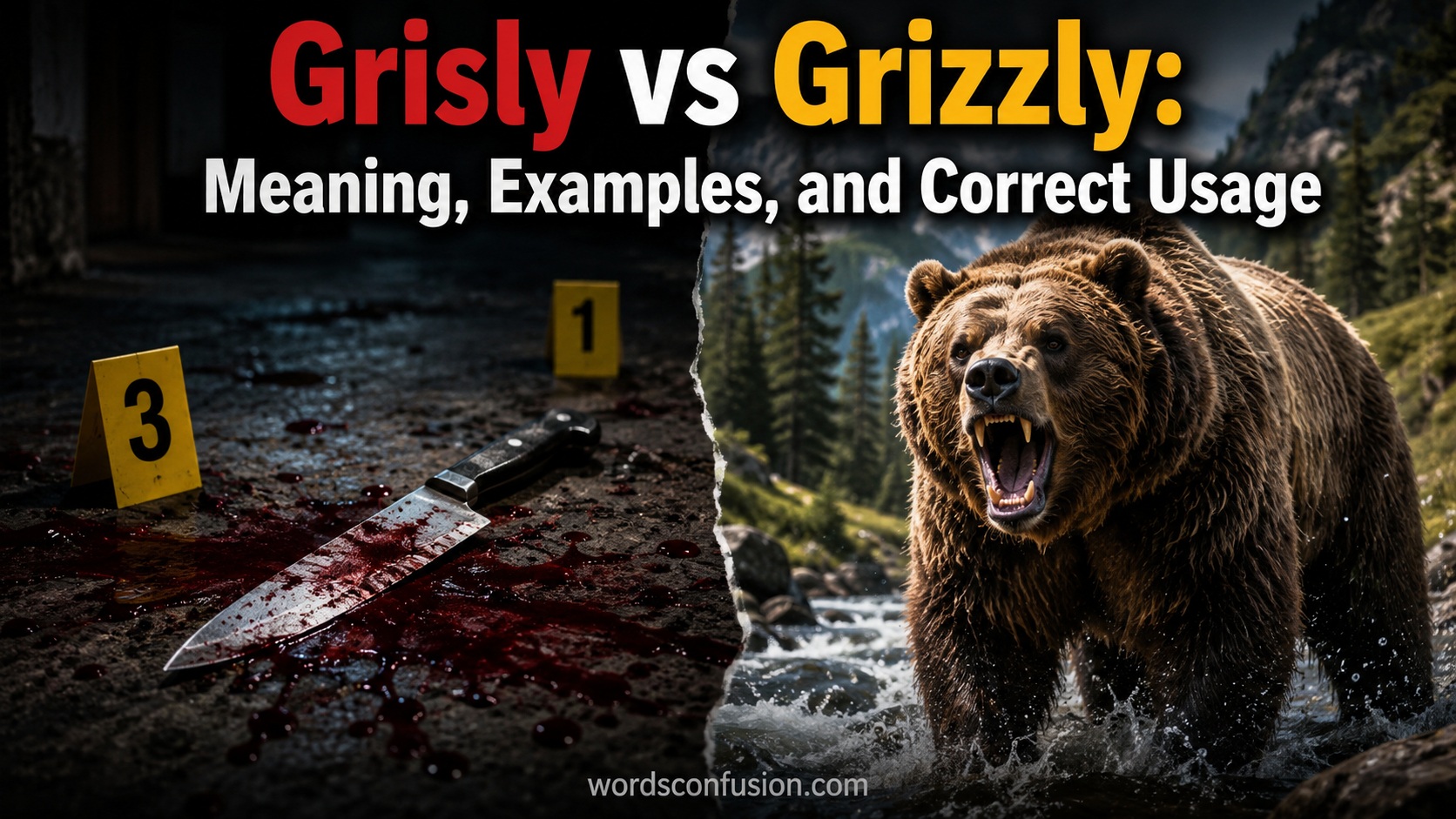
Have you ever paused while writing because you couldn’t remember whether a grisly crime or a grizzly crime was correct? You’re not alone. These two words look almost identical, and they sound similar enough that even experienced writers occasionally mix them up.
Despite their similar spelling, grisly and grizzly have completely different meanings. One describes something horrifying or shocking, while the other is most commonly associated with one of North America’s largest bears. Confusing the two can change the meaning of your sentence and make your writing look less polished.
In this guide, you’ll learn the exact difference between grisly vs grizzly, when to use each word, how to remember the distinction, and plenty of real-world examples. By the end, you’ll never hesitate over these commonly confused words again.
Quick Answer
The difference between grisly and grizzly is simple:
- Grisly means horrifying, gruesome, shocking, or causing fear or disgust.
- Grizzly usually refers to a grizzly bear, a large brown bear found mainly in North America. It can also describe someone or something with gray or streaked hair.
Examples:
- The detective investigated a grisly murder scene.
- We spotted a grizzly bear while hiking in Montana.
A quick memory trick:
- Grisly = Grim (both describe something terrible).
- Grizzly = Bear (think of the famous grizzly bear).
Comparison Overview
| Feature | Grisly | Grizzly |
| Meaning | Horrifying, gruesome, terrifying | A species of bear or gray-haired |
| Part of Speech | Adjective | Noun and adjective |
| Common Usage | Crimes, accidents, horror stories | Wildlife, nature, physical appearance |
| Emotional Tone | Negative and disturbing | Neutral unless describing danger |
| Common Phrase | Grisly murder | Grizzly bear |
| Common Mistake | Writing “grizzly accident” | Writing “grisly bear” |
The easiest way to avoid confusion is to look at the context. If you’re talking about something frightening or gruesome, grisly is almost always correct. If you’re talking about a bear or gray hair, choose grizzly.
Main Differences Between Grisly vs Grizzly
Although these words differ by only two letters, their meanings belong to completely different categories.
Grisly Describes Something Horrifying
Use grisly when describing events or scenes that are shocking, gruesome, or deeply disturbing.
You’ll often see this word in:
- Crime reports
- News articles
- Horror novels
- Historical accounts
- Accident reports
- Medical emergencies
Examples:
- Police discovered a grisly crime scene.
- The documentary included grisly details about the disaster.
- Witnesses described the accident as grisly.
The word focuses on the emotional reaction it creates. It suggests fear, horror, or disgust.
Grizzly Refers to a Bear
Grizzly most commonly refers to the grizzly bear, one of North America’s best-known wild animals.
Examples include:
- A grizzly crossed the hiking trail.
- Rangers warned visitors about nearby grizzly bears.
- The photographer spent weeks capturing images of a wild grizzly.
Unlike grisly, this word has nothing to do with horror. It simply names an animal, although encountering one in the wild can certainly be frightening.
Grizzly Can Also Describe Gray Hair
A less common meaning of grizzly is gray, streaked with gray, or grizzled in appearance.
For example:
- The old sailor had a grizzly beard.
- His grizzly hair reflected years of experience.
Today, most writers prefer the word grizzled for this meaning because it sounds more natural in modern English.
The Meanings Never Overlap
One of the biggest mistakes writers make is assuming the words are interchangeable.
They aren’t.
Compare these sentences:
| Incorrect | Correct | Reason |
| The police found a grizzly crime scene. | The police found a grisly crime scene. | Crime scenes are horrifying, not bears. |
| We saw a grisly bear in Yellowstone. | We saw a grizzly bear in Yellowstone. | The sentence refers to an animal. |
| The novel begins with a grizzly murder. | The novel begins with a grisly murder. | Murders can be grisly, not grizzly. |
| Rangers tracked a grisly through the forest. | Rangers tracked a grizzly through the forest. | They tracked a bear. |
At a Glance
| Question | Grisly | Grizzly |
| Related to horror? | Yes | ✘ No |
| Refers to a bear? | ✘ No | Yes |
| Used in crime reports? | Frequently | ✘ Rarely |
| Used in wildlife articles? | ✘ No | Frequently |
| Means gruesome? | Yes | ✘ No |
Why the Confusion Happens
Several factors explain why these words are often confused.
Their spellings are almost identical.
Only two letters separate them, making typing errors common.
Their pronunciation is similar.
Many English speakers pronounce them so similarly that the distinction becomes difficult to hear during casual conversation.
Both have historical roots connected to fear.
The word grisly comes from an Old English word meaning dreadful or terrifying. Grizzly likely developed because early explorers described the bear’s gray-tipped fur, although some historical sources also connected the name to its fearsome nature. Over time, the meanings became completely separate.
Spell check won’t always help.
Since both words are correctly spelled English words, most spell checkers won’t flag the mistake. That’s why context matters more than spelling alone.
When to Choose Grisly
Use grisly when you’re describing something that:
- Is gruesome
- Causes horror
- Is violent
- Is disturbing
- Creates fear
- Is shocking
Examples:
- a grisly discovery
- a grisly murder
- a grisly accident
- a grisly warning
- a grisly photograph
When to Choose Grizzly
Use grizzly when referring to:
- the animal
- wildlife
- national parks
- forests
- gray or streaked hair (less common)
Examples:
- grizzly bear
- grizzly habitat
- grizzly population
- grizzly cub
- grizzly tracks
A Simple Memory Trick
If the word reminds you of grim, choose grisly.
If it reminds you of a bear, choose grizzly.
Another helpful trick is this:
- Grisly contains “is”—think “This is horrifying.”
- Grizzly contains “zz”—imagine a large sleeping bear making a deep “zzz” sound.
These simple associations make it much easier to remember the correct spelling when writing quickly.
What Does Grisly Mean?
Definition
Grisly is an adjective that describes something horrifying, gruesome, shocking, or extremely unpleasant to see or think about. It often refers to scenes involving violence, death, severe injuries, or events that create fear and disgust.
The word doesn’t simply mean “bad.” Instead, it emphasizes the disturbing nature of an event or image.
Dictionary meaning:
- Horrifying in a gruesome way
- Causing horror or disgust
- Terribly unpleasant to witness
Pronunciation
Grisly is pronounced:
GRIZ-lee (/ˈɡrɪzli/)
Although it sounds very similar to grizzly, the meanings are completely different.
Origin and Etymology
The word grisly comes from the Old English word grislic, which meant terrifying, dreadful, or inspiring fear. It has existed in English for centuries and has always been associated with frightening or horrifying situations.
Unlike many modern words, its meaning has remained remarkably consistent over time.
When to Use Grisly
Use grisly whenever you’re describing something that causes horror, fear, or disgust.
Common situations include:
- Violent crimes
- Serious accidents
- Horror stories
- War reports
- Medical emergencies
- Disaster coverage
- Historical tragedies
The word creates a vivid mental image, so writers often use it carefully to highlight the severity of an event.
Examples of Grisly in Sentences
- Detectives investigated a grisly murder scene.
- The documentary revealed grisly details from the battlefield.
- Reporters avoided showing the most grisly photographs.
- Everyone was shocked by the grisly accident.
- The horror novel opens with a grisly discovery.
Common Phrases with Grisly
You’ll frequently encounter grisly in these expressions:
- grisly murder
- grisly crime
- grisly discovery
- grisly accident
- grisly scene
- grisly evidence
- grisly remains
- grisly injuries
- grisly details
These phrases commonly appear in newspapers, documentaries, true crime books, and legal reporting.
Synonyms of Grisly
Depending on the context, you can replace grisly with words such as:
- Gruesome
- Ghastly
- Horrific
- Macabre
- Gory
- Frightening
- Disturbing
- Terrifying
- Nightmarish
- Horrendous
Each synonym has a slightly different nuance, but all suggest something deeply unpleasant.
When Not to Use Grisly
Avoid using grisly to describe ordinary unpleasant situations.
For example:
The meeting was grisly.
The meeting was boring.
I had a grisly math exam.
I had a difficult math exam.
Reserve grisly for situations involving genuine horror or graphic violence.
What Does Grizzly Mean?
Definition
Grizzly most commonly refers to the grizzly bear, a large subspecies of the brown bear native to North America.
The word can also function as an adjective describing something that resembles a grizzly bear or, in older usage, something that is gray or streaked with gray.
Pronunciation
Grizzly is pronounced:
GRIZ-lee (/ˈɡrɪzli/)
Notice that its pronunciation is almost identical to grisly. This similarity explains why many people confuse the two words in writing.
Origin and Etymology
The word grizzly dates back to the late 18th century.
Its name likely comes from the bear’s gray-tipped (“grizzled”) fur, which gives it a slightly silver appearance.
Although early explorers often described the bear as fierce, the modern word refers specifically to the animal rather than anything gruesome.
When to Use Grizzly
Use grizzly when referring to:
- Grizzly bears
- Wildlife
- National parks
- Forest ecosystems
- Animal behavior
- Gray-haired appearance (rare)
Examples of Grizzly in Sentences
- We watched a grizzly catch salmon in the river.
- Rangers warned hikers about nearby grizzly bears.
- The photographer spent months studying grizzly behavior.
- Yellowstone is famous for its grizzly population.
- A grizzly wandered across the mountain trail.
Facts About Grizzly Bears
Understanding the animal makes the meaning even easier to remember.
| Fact | Information |
| Scientific name | Ursus arctos horribilis |
| Family | Brown bear |
| Average weight | 400–790 pounds (males), though some exceed 1,000 pounds |
| Height | Up to 8 feet when standing |
| Habitat | Alaska, western Canada, parts of the northwestern United States |
| Diet | Omnivore (berries, fish, roots, insects, mammals) |
| Lifespan | Around 20–25 years in the wild |
These impressive animals play an important role in maintaining healthy ecosystems.
Grizzly as an Adjective
Although uncommon today, grizzly can describe someone with gray or streaked hair.
Examples:
- The fisherman had a grizzly beard.
- His grizzly eyebrows gave him a distinguished look.
Modern English usually favors grizzled instead.
Read More: Flaunt vs Flout: Meaning, Examples, and Correct Usage
Grisly vs Grizzly in Grammar and Usage
Although both words are adjectives in many situations, they belong to very different semantic categories.
| Word | Part of Speech | Typical Context |
| Grisly | Adjective | Horror, crime, disasters |
| Grizzly | Noun and adjective | Bears, wildlife, gray hair |
The easiest way to choose the correct word is to ask yourself one question:
Am I describing something horrifying or am I talking about a bear?
If the answer is horror, choose grisly.
If the answer is wildlife, choose grizzly.
Common Writing Mistakes
Many spelling errors happen because writers rely on sound rather than meaning.
Here are some of the most common mistakes.
Mistake: Using Grizzly for Horrific Events
The newspaper reported a grizzly murder.
The newspaper reported a grisly murder.
A murder is horrifying, not bear-related.
Mistake: Using Grisly for Wildlife
We photographed a grisly bear.
We photographed a grizzly bear.
Here, you’re talking about an animal.
Mistake: Trusting Spell Check
Spell check won’t flag either word because both are correctly spelled.
Consider this sentence:
The detective described the grizzly crime scene.
Every word is spelled correctly, yet the sentence is still wrong.
Always proofread for meaning, not just spelling.
Commonly Confused Sentences
| Incorrect Sentence | Correct Sentence | Explanation |
| It was a grizzly accident. | It was a grisly accident. | The accident was horrifying. |
| Rangers spotted a grisly near camp. | Rangers spotted a grizzly near camp. | They saw a bear. |
| The movie contains several grizzly scenes. | The movie contains several grisly scenes. | The scenes are gruesome. |
| A grisly bear chased the hikers. | A grizzly bear chased the hikers. | The sentence refers to wildlife. |
| Police uncovered grizzly evidence. | Police uncovered grisly evidence. | The evidence was disturbing. |
| We admired the grisly cubs. | We admired the grizzly cubs. | Cubs belong to bears. |
Real-Life Context Examples
Understanding the context makes the distinction much easier.
News Reporting
Journalists often write:
- Police uncovered grisly evidence.
- Investigators released few details about the grisly crime.
- The explosion left behind a grisly scene.
The focus is on shocking events.
Wildlife Reporting
Nature magazines often write:
- Scientists tracked several grizzly bears.
- Conservation efforts increased the grizzly population.
- Tourists safely observed a grizzly from a distance.
The focus is entirely on animals.
These real-world contexts reinforce the fact that grisly belongs to stories about horror or tragedy, while grizzly belongs to discussions about wildlife and, less commonly, gray-haired appearances.
FAQs:
Is there a difference between grisly and grizzly?
Yes. Grisly means horrifying, gruesome, or shocking, while grizzly refers to a species of brown bear found primarily in North America. Although the words sound alike, they have completely different meanings.
Can grizzly describe something frightening?
Not in modern English. Grizzly is used mainly for the grizzly bear or, less commonly, to describe someone with gray or grizzled hair. If you’re describing a horrifying event, grisly is the correct word.
Why do people confuse grisly and grizzly?
People confuse them because they are pronounced almost the same and differ by only two letters. Since both are correctly spelled English words, spell check usually won’t detect the mistake. Understanding the context is the best way to choose the right word.
How can I remember the difference between grisly and grizzly?
A simple memory trick is:
- Grisly = Grim or Gruesome (both begin with Gr and describe something horrifying).
- Grizzly = Bear (think of a grizzly bear in the wilderness).
This association makes it much easier to remember which spelling to use.
Which word is correct: grisly murder or grizzly murder?
The correct phrase is grisly murder because a murder is horrifying or gruesome. The phrase grizzly murder is incorrect unless you’re describing a murder involving a grizzly bear, which is a completely different context.
Conclusion:
The debate over grisly vs grizzly comes down to understanding context rather than memorizing spellings. Grisly describes something horrifying, gruesome, or deeply disturbing, making it the right choice for crime reports, accidents, horror stories, and tragic events. Grizzly, on the other hand, refers to the famous North American bear or, in less common usage, something with gray or streaked hair.
Whenever you’re unsure, ask yourself a simple question: Am I talking about something terrifying or about a bear? If it’s a frightening event, use grisly. If it’s wildlife, use grizzly.

Andrew Wilson is an experienced language researcher and content writer specializing in WordsConfusion topics. He helps readers understand commonly confused English words, spelling differences, grammar rules, word meanings, and proper usage through clear explanations, practical examples, and easy-to-follow language guides. His goal is to make English learning simple, accurate, and accessible for students, writers, professionals, and everyday learners.