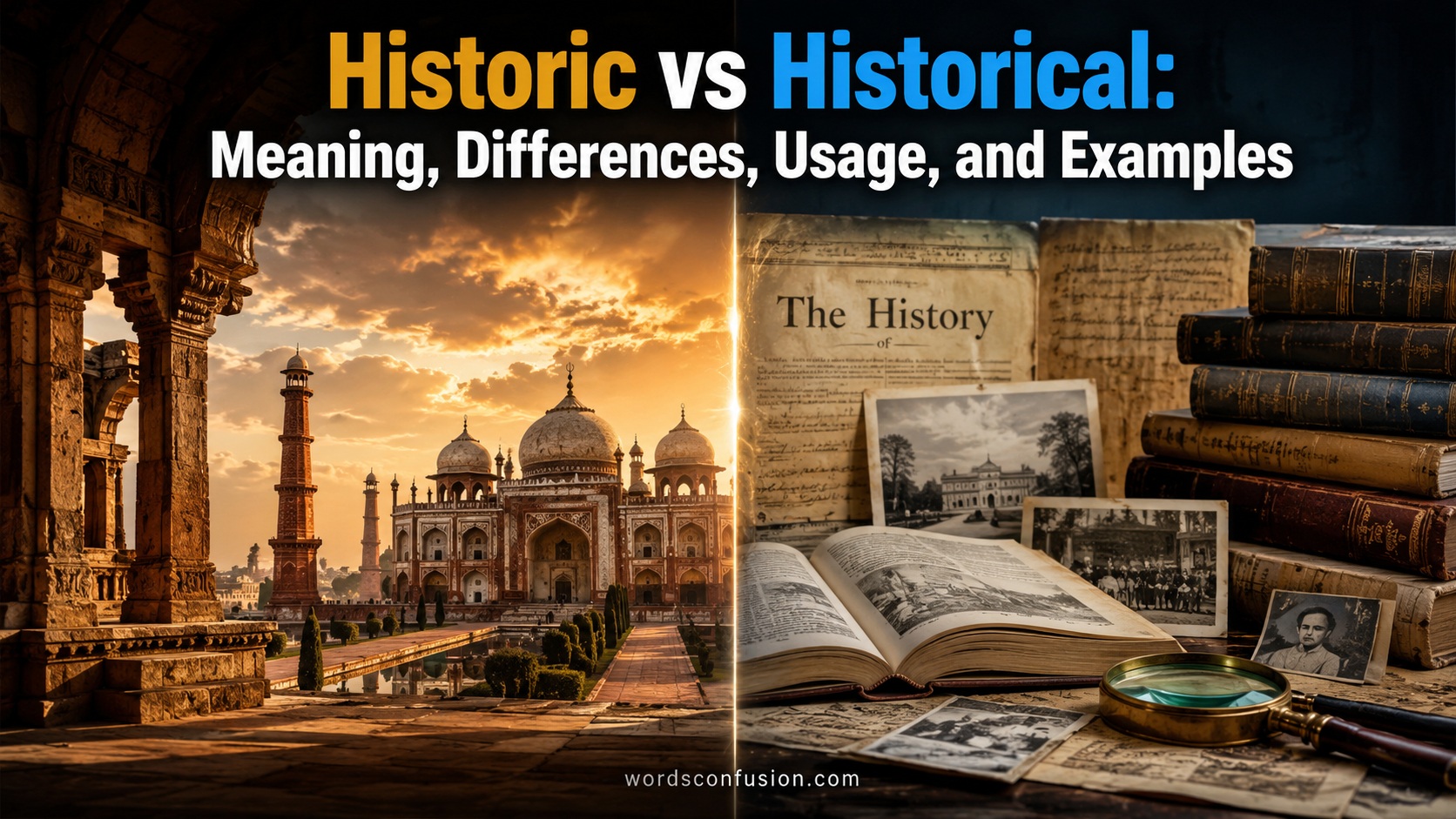
Choosing between historic and historical can feel surprisingly tricky. Both words relate to history, which is why many people use them interchangeably. However, they don’t mean the same thing. One describes something that made history, while the other simply describes something connected to history.
If you use the wrong word, your sentence may still sound correct to many readers. Yet in academic writing, journalism, business communication, and formal English, the distinction matters. Understanding the difference will help you write more accurately and speak with greater confidence.
Think about these two sentences:
- The moon landing was a historic achievement.
- The museum contains historical documents from the Civil War.
The first sentence highlights an event that changed history. The second simply describes documents related to history. That small difference changes the meaning completely.
This guide explains Historic vs Historical in plain English. You’ll learn the definitions, differences, grammar rules, real-world examples, common mistakes, and simple memory tricks that make choosing the correct word easy every time.
Quick Answer
The difference between historic and historical is simple.
- Historic describes something important enough to be remembered in history.
- Historical describes anything related to history, whether it is important or not.
Examples
- The signing of the peace treaty was a historic moment.
- The library preserves historical newspapers from the nineteenth century.
A simple rule to remember is this:
If something made history, use “historic.” If something relates to history, use “historical.”
Comparison Overview
| Feature | Historic | Historical |
| Meaning | Important in history | Related to history |
| Focus | Significance and impact | Connection to the past |
| Suggests Importance | Yes | Not necessarily |
| Common Usage | Historic event, historic victory, historic agreement | Historical records, historical research, historical documents |
| Tone | Highlights importance | Neutral and descriptive |
| Example | The first successful moon landing was historic. | The museum displays historical artifacts. |
Main Differences Between Historic vs Historical
Although these adjectives come from the same root word, they serve different purposes.
| Aspect | Historic | Historical |
| Main Idea | Something that changed history | Something connected with history |
| Importance | Very important | May or may not be important |
| Common Context | Major events, achievements, landmarks | Books, documents, research, museums |
| Reader’s Impression | Memorable and significant | Informative and factual |
| Example | A historic election | A historical novel |
The easiest way to understand the difference is to imagine a history book.
Every event inside the book is historical because it belongs to history.
Only a few events are historic because they changed history or had a lasting impact.
For example, a small town meeting from 1890 is historical because it happened in the past. The signing of the United States Declaration of Independence is historic because it changed the course of history.
What Does Historic Mean?
Definition
Historic is an adjective that describes something important, influential, or memorable in history.
It is used when an event, place, achievement, or decision has exceptional historical significance.
When to Use Historic
Use historic when you want to emphasize that something deserves a special place in history.
You should use it for:
- Major political decisions
- Groundbreaking scientific discoveries
- Record-breaking achievements
- Famous speeches
- Landmark court rulings
- Significant cultural moments
- Important buildings
- Historic agreements
Characteristics of Something Historic
A historic event usually has several qualities.
- It changed history.
- People remember it for generations.
- It influenced society.
- It marked a turning point.
- It received widespread recognition.
Not every old object becomes historic. Age alone isn’t enough.
Examples of Historic
- The moon landing was a historic achievement.
- The peace agreement marked a historic breakthrough.
- Scientists celebrated a historic medical discovery.
- The nation witnessed a historic election.
- Her Olympic gold medal was a historic victory.
Common Collocations with Historic
English speakers frequently pair historic with these nouns.
| Historic + Noun | Example |
| Historic event | The conference became a historic event. |
| Historic victory | The team secured a historic victory. |
| Historic decision | The court announced a historic decision. |
| Historic speech | The president delivered a historic speech. |
| Historic agreement | Leaders signed a historic agreement. |
| Historic moment | Fans celebrated the historic moment. |
| Historic landmark | Tourists visited the historic landmark. |
| Historic achievement | The mission became a historic achievement. |
These combinations appear regularly in newspapers, television broadcasts, government announcements, and history books.
What Does Historical Mean?
Definition
Historical means related to history or the study of history.
Unlike historic, it does not suggest that something changed history. It simply identifies a connection with the past.
When to Use Historical
Choose historical when discussing:
- History books
- Historical documents
- Historical research
- Historical evidence
- Historical maps
- Historical records
- Historical museums
- Historical photographs
- Historical analysis
These things help us understand history, but they are not necessarily famous or significant on their own.
Characteristics of Historical
Historical items usually:
- Belong to the past.
- Help explain historical events.
- Provide evidence.
- Support academic research.
- Preserve historical knowledge.
Examples of Historical
- Researchers examined historical records.
- The university published a historical study.
- Archaeologists uncovered historical artifacts.
- Students learned from historical documents.
- The film contains several historical inaccuracies.
Notice that none of these examples claim the items changed history. They simply relate to historical study.
Common Collocations with Historical
| Historical + Noun | Example |
| Historical records | Historians examined historical records. |
| Historical documents | The archive stores historical documents. |
| Historical evidence | New historical evidence changed researchers’ opinions. |
| Historical research | She specializes in historical research. |
| Historical society | The historical society restored the building. |
| Historical archive | The archive preserves valuable manuscripts. |
| Historical perspective | A historical perspective helps explain modern events. |
| Historical novel | He enjoys reading historical novels. |
| Historical context | Understanding the historical context improves interpretation. |
| Historical data | Analysts compared historical data with recent figures. |
Historic vs Historical: Understanding the Difference Through Examples
Examples often make grammar rules much easier to remember.
Example One
Incorrect:
- Abraham Lincoln gave a historical speech.
Correct:
- Abraham Lincoln gave a historic speech.
His speech became part of history because of its importance.
Example Two
Incorrect:
- The museum contains historic letters.
Correct:
- The museum contains historical letters.
The letters relate to history, but they may not have changed history themselves.
Example Three
Incorrect:
- Researchers analyzed historic records.
Correct:
- Researchers analyzed historical records.
The records provide information about the past.
Example Four
Correct:
- The company reached a historic milestone after one hundred years.
The achievement represents an important moment in the company’s history.
Example Five
Correct:
- The documentary explains the historical background of the conflict.
The documentary provides historical information rather than describing a world-changing event.
Why People Confuse Historic and Historical
The confusion happens for several reasons.
First, both words come from the same root: history.
Second, both describe something connected with the past.
Third, many people assume older automatically means historic. That isn’t true.
Imagine visiting an old farmhouse built in 1880.
It is certainly historical because it belongs to the past.
However, unless something important happened there, it may not be historic.
Age alone doesn’t create historical significance.
Importance does.
A Simple Test Before Choosing the Right Word
Ask yourself one question.
Did this thing change history or become especially important in history?
If the answer is yes, use historic.
If the answer is no, but it simply relates to history, use historical.
This quick test works almost every time.
Historic vs Historical in News Writing
Journalists carefully choose between these words because they shape how readers interpret events.
For example, a newspaper may describe:
- A historic election because it changed politics.
- Historical voting records when comparing previous elections.
The first sentence emphasizes significance.
The second provides background information.
That distinction makes reporting more precise and credible.
Historic vs Historical in Academic Writing
Academic writing requires precision. Professors, researchers, and editors expect writers to choose the correct adjective because each word carries a different meaning.
Use historic only when discussing events, discoveries, or decisions that had a lasting impact on history.
Use historical when describing sources, evidence, research, or anything connected to the past.
For example:
- The American Revolution was a historic event.
- Scholars continue to examine historical evidence from the American Revolution.
The revolution changed history. The evidence simply helps us understand it.
Examples in Academic Sentences
| Correct Sentence | Why It Is Correct |
| Researchers analyzed historical census records. | The records relate to history. |
| The invention of the printing press was a historic achievement. | It transformed communication worldwide. |
| Students examined historical maps during class. | The maps belong to history. |
| The court issued a historic ruling. | The decision had lasting significance. |
| The professor explained the historical background of World War II. | The lesson focused on historical context. |
Historic vs Historical in Everyday English
Outside classrooms and newsrooms, these words appear in everyday conversations more often than many people realize.
Imagine you’re planning a vacation.
You might say:
- We visited a historic battlefield.
- The guide shared historical facts about the soldiers.
The battlefield became famous because of an important event. The facts simply describe what happened there.
Here are more everyday examples.
At School
- Students read historical biographies.
- The Civil Rights Movement was a historic period in American history.
At a Museum
- The museum displays historical artifacts.
- The building itself is a historic landmark.
At Work
- The company achieved a historic sales record.
- Managers reviewed historical sales data before planning next year’s budget.
While Traveling
- Rome contains many historic monuments.
- Visitors learn about the city’s historical development through guided tours.
Read More: Grisly vs Grizzly: Meaning, Examples, and Correct Usage
Historic vs Historical in Business Writing
Businesses often use these words in reports, marketing materials, and press releases.
Choosing the right one improves clarity and professionalism.
Use Historic When Highlighting Major Achievements
Examples include:
- A historic merger
- A historic investment
- A historic expansion
- A historic profit milestone
These phrases emphasize exceptional importance.
Use Historical When Referring to Past Information
Examples include:
- Historical revenue data
- Historical market trends
- Historical customer behavior
- Historical pricing information
These examples simply describe past records.
Historic vs Historical in Literature
Writers also distinguish between these two adjectives.
Historic Literature
A book may describe a historic event because the event changed history.
Example:
The novel tells the story of the historic Apollo 11 Moon landing.
Historical Literature
A historical novel is fiction set in the past.
The events may be fictional, but the setting reflects a real historical period.
Examples include novels set during:
- Ancient Rome
- Medieval England
- The American Civil War
- World War II
- The Renaissance
Notice that publishers almost always use historical novel, not historic novel.
Historic vs Historical Landmarks
This topic creates confusion because people often assume every old building is historic.
That’s not true.
A building can be very old without being historically significant.
Historic Landmark
A historic landmark played an important role in history.
Examples include:
- Independence Hall
- The Alamo
- The Lincoln Memorial
- The Statue of Liberty
These places represent major historical events or national identity.
Historical Building
A historical building is simply a building from the past.
It may have architectural value or local interest without changing history.
Comparison
| Historic Landmark | Historical Building |
| Significant in history | Connected to history |
| Often nationally recognized | May only have local importance |
| Changed or influenced history | Preserves historical heritage |
| Famous events occurred there | Simply built in an earlier period |
Historic vs Historical Events
Not every historical event is historic.
This is one of the easiest rules to remember.
Every historic event becomes historical because it belongs to history.
However, not every historical event becomes historic.
Historic Events
- The first Moon landing
- The signing of the Declaration of Independence
- The fall of the Berlin Wall
- The invention of the World Wide Web
These events changed history.
Historical Events
- A local town meeting in 1885
- An ordinary election from decades ago
- A farmer’s diary from 1902
- Census reports from the early twentieth century
These belong to history but didn’t necessarily change it.
FAQs:
What is the difference between historic and historical?
The main difference is that historic describes something important enough to be remembered in history, while historical describes anything related to history. A historic event changes history, whereas a historical event simply belongs to the past.
Can something be historical but not historic?
Yes. In fact, most things connected to the past are historical but not historic. For example, an old census record or a family photograph from the 1800s is historical because it relates to history, but it isn’t necessarily historic unless it has exceptional historical importance.
Is every historic event also historical?
Yes. Every historic event is also historical because it becomes part of history. However, not every historical event is historic. Only events with lasting significance or major impact earn the label historic.
Is it correct to say “a historic” or “an historic”?
In modern American English, “a historic” is the preferred and most widely accepted form because the h in historic is pronounced. Although “an historic” still appears occasionally in British English and older writing, it is much less common today.
How can I easily remember when to use historic or historical?
A simple memory trick is:
- Use historic if something made history or changed the course of events.
- Use historical if something simply relates to history or helps explain the past.
If you ask yourself, “Did this make history?”, you’ll usually know which word to choose.
Conclusion:
Understanding the difference between historic vs historical becomes much easier once you focus on one simple idea: importance versus connection. A historic event, place, or achievement stands out because it shaped history or left a lasting impact. In contrast, historical refers to anything associated with history, whether it’s a document, photograph, building, record, or piece of research.

Andrew Wilson is an experienced language researcher and content writer specializing in WordsConfusion topics. He helps readers understand commonly confused English words, spelling differences, grammar rules, word meanings, and proper usage through clear explanations, practical examples, and easy-to-follow language guides. His goal is to make English learning simple, accurate, and accessible for students, writers, professionals, and everyday learners.