
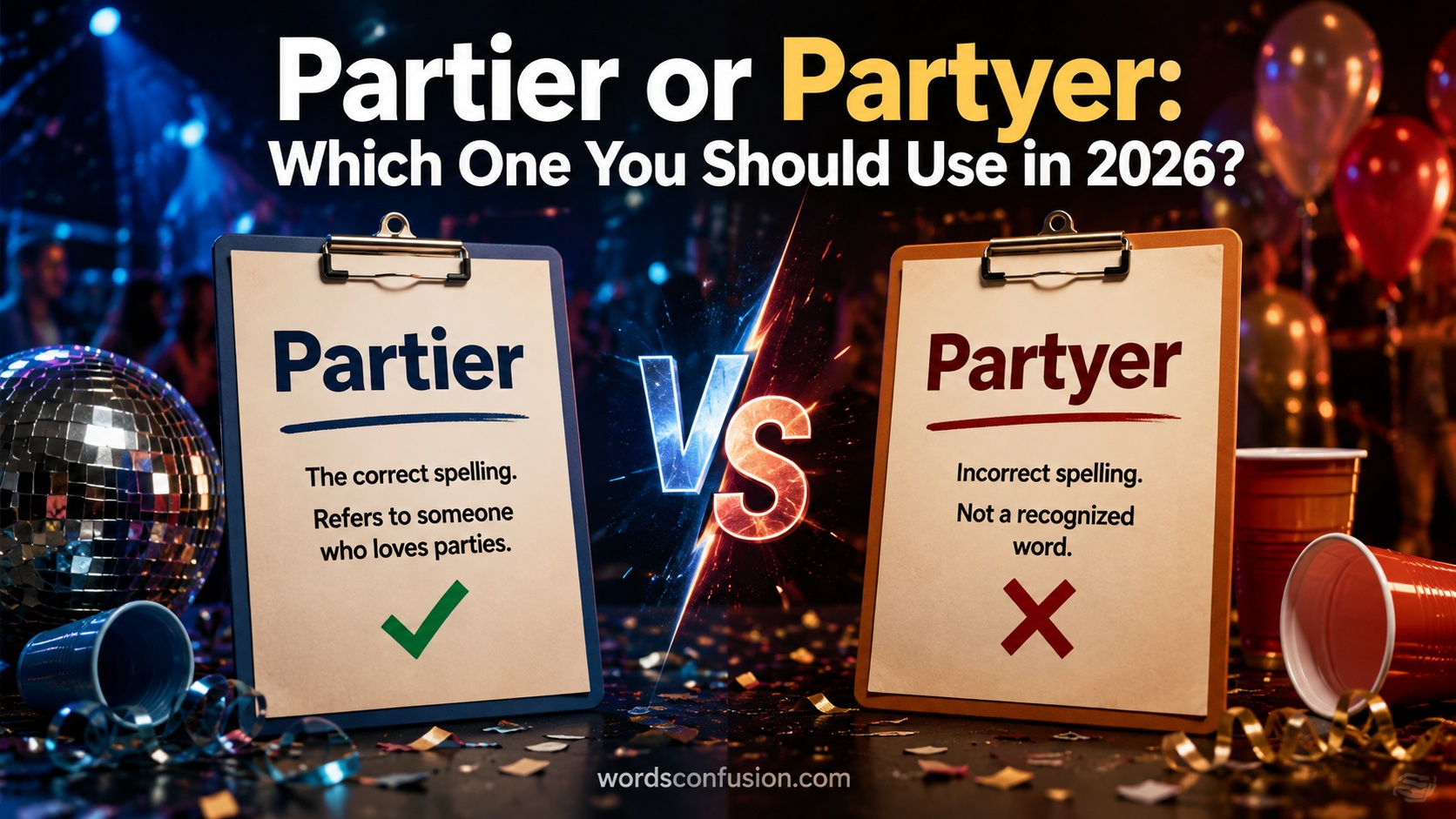
If you’ve ever wondered whether partier or partyer is the correct spelling, you’re not alone. The two words look almost identical, sound the same, and carry the same basic meaning. That makes the choice surprisingly tricky.
The confusion usually comes from a common assumption about English spelling. Since the verb is party, some writers expect the noun describing a person who parties to follow one particular spelling pattern. Others naturally write partyer because they see it as party + -er.
Here’s the important part: both partier and partyer are recognized English spellings. They aren’t two words with different meanings. Instead, they’re variant forms used to describe someone who parties.
That doesn’t mean you have to flip a coin every time you write the word. Dictionary treatment, audience, editorial style, and consistency can help you make the better choice.
Quick Answer
Partier and partyer are both correct and have the same basic meaning: a person who parties. Major dictionaries recognize both spellings. Merriam-Webster lists partyer as the main entry and identifies partier as a less common variant, while other major dictionaries also record the two forms.
For everyday writing, partier may look more familiar to many readers. However, partyer is not a spelling mistake. If your style guide or preferred dictionary uses partyer, you can use it confidently.
The safest rule is simple: choose one spelling and use it consistently.
Comparison Overview
| Feature | Partier | Partyer |
| Basic meaning | A person who parties | A person who parties |
| Part of speech | Noun | Noun |
| Pronunciation | Generally the same | Generally the same |
| Meaning difference | None | None |
| Recognized spelling | Yes | Yes |
| Variant status | Variant form | Established dictionary form |
| Singular | Partier | Partyer |
| Plural | Partiers | Partyers |
| Appropriate for general writing | Yes | Yes |
| Main difference | Spelling | Spelling |
The central point is easy to miss: the difference is primarily orthographic, not semantic. In other words, the letters change, but the basic meaning doesn’t.
Main Differences Between Partier and Partyer
There isn’t a major difference in meaning between partier and partyer. Both describe someone who parties.
The real difference lies in spelling and dictionary preference. Partyer follows a straightforward interpretation of the verb party plus the suffix -er. Partier, meanwhile, uses a spelling pattern that changes the final y to i before adding -er.
Consider these examples:
- She’s a frequent partier who rarely misses a weekend event.
- He’s known as a dedicated partyer among his friends.
Both sentences describe essentially the same kind of person.
Meaning of Partier
A partier is a person who parties. The word often suggests someone who enjoys social gatherings, nightlife, celebrations, or frequent recreational events.
Depending on context, partier can sound neutral, informal, humorous, or slightly critical.
For example:
Jake was a serious partier during his college years.
This doesn’t necessarily mean Jake attended one specific party. It suggests that partying was a regular part of his lifestyle.
Another example:
The hotel attracts young partiers during the summer.
Here, the word refers to people who enjoy nightlife and social entertainment.
Meaning of Partyer
Partyer has the same basic meaning as partier. It refers to someone who parties or enjoys partying.
For example:
Maria became a regular partyer after moving to the city.
The word can describe someone who attends parties frequently or participates actively in a party lifestyle.
Although partyer may look unusual to some readers, that doesn’t make it incorrect. It’s a recognized spelling.
Are Partier and Partyer Pronounced the Same?
In ordinary English speech, partier and partyer are generally pronounced the same.
The spelling difference doesn’t create a meaningful difference in pronunciation. That’s one reason the two forms can cause confusion when people encounter them in writing.
If you hear someone say the word without seeing it written down, you probably won’t know which spelling they intended.
Is Partier or Partyer Correct?
Both are correct.
That’s the most important fact to remember.
Some online explanations incorrectly treat partyer as a misspelling of partier. The dictionary evidence doesn’t support such an absolute claim.
Merriam-Webster recognizes partyer and also lists partier as a less common variant. Other established dictionaries recognize partier as a variant of partyer.
So the relationship works in both directions:
Partier ↔ Partyer
They’re variant spellings of the same noun.
Why Some Writers Prefer Partier
Many writers prefer partier because it looks familiar. English contains numerous words in which a final y changes to i when a suffix is added.
For example:
- happy → happier
- easy → easier
- busy → busier
Because of these familiar patterns, partier can feel natural to readers.
There’s also a visual similarity between partier and words such as happier and busier. That familiarity can make the spelling seem more intuitive.
However, English spelling isn’t a perfectly tidy mathematical system.
Why Partyer Is Also Correct
Partyer can be understood as a direct formation from party + -er.
The suffix -er commonly creates nouns describing people who perform an action:
- teach → teacher
- run → runner
- dance → dancer
- sing → singer
- work → worker
Therefore, someone can reasonably interpret partyer as:
party + er = partyer
That formation has become established enough to appear in major dictionaries.
So although partyer may look less familiar to some readers, it isn’t simply an accidental spelling.
Partier vs Partyer: Dictionary Evidence
Dictionary evidence matters because online spelling advice can spread quickly without checking authoritative sources.
| Dictionary | Partier | Partyer | What the evidence shows |
| Merriam-Webster | Recognized | Recognized | Partyer is listed as the main form while partier is identified as a less common variant |
| Dictionary.com | Recognized | Recognized | Both forms are documented |
| Collins | Recognized | Recognized | Both forms appear as variants |
| Other English references | Found | Found | Usage varies by source and context |
This evidence gives you a more accurate answer than a simple “one is right and one is wrong” rule.
What Merriam-Webster Shows
Merriam-Webster’s treatment is particularly useful because it doesn’t erase either spelling.
It gives partyer as the principal form while also recording partier as a less common variant.
That distinction is valuable.
It tells you that the forms aren’t necessarily equally preferred in every dictionary. However, it also confirms that partier isn’t an invented spelling.
What Other Dictionaries Show
Other major English dictionaries also recognize the two forms.
This matters because dictionary entries reflect established usage rather than someone’s personal spelling preference.
When several reputable sources document a spelling, calling that spelling an outright error becomes difficult to justify.
Partier or Partyer in American English
In American English, you’ll encounter both partier and partyer.
Neither spelling creates a different meaning. The choice often depends on the writer’s preference or the style used by a particular publication.
If you’re writing an article, essay, website, or social media post, either form can work.
However, consistency matters.
Imagine reading this:
The festival attracted hundreds of partyers. Later, the partiers gathered near the main stage.
The sentence isn’t necessarily grammatically wrong, but switching forms for the same meaning looks careless.
A cleaner version would use one form consistently:
The festival attracted hundreds of partyers. Later, the partyers gathered near the main stage.
Or:
The festival attracted hundreds of partiers. Later, the partiers gathered near the main stage.
The reader gets the same meaning either way.
Partier or Partyer in British English
The distinction isn’t as simple as saying one spelling belongs to American English and the other belongs to British English.
Both forms appear in broader English usage.
That’s important because spelling differences between American and British English often involve clear patterns:
- color / colour
- center / centre
- traveled / travelled
Partier and partyer don’t fit neatly into that kind of US-versus-UK spelling divide.
Instead, they’re better understood as variant spellings.
If you’re writing for a British audience, check the publication’s preferred dictionary or house style. The same advice applies to American publications.
How to Use Partier in a Sentence
The word partier works best when the sentence clearly indicates that someone regularly enjoys parties or nightlife.
Examples With Partier
- He was a famous partier during his college years.
- The resort attracts partiers from around the country.
- She isn’t much of a partier these days.
- The city becomes crowded with partiers during the festival.
- As a young partier, he rarely stayed home on weekends.
- The club became popular with local partiers.
Notice that the word doesn’t necessarily mean someone is attending a particular party.
It often describes a person’s broader social habits.
Examples With Partyer
The same contexts work with partyer:
- He was a well-known partyer in college.
- The resort attracts partyers every summer.
- She’s not really a partyer.
- The event brought together thousands of partyers.
- He’s become less of a partyer since starting his new job.
The meaning remains essentially unchanged.
Partier and Partyer Plural Forms
The plural forms follow their respective spellings.
| Singular | Plural |
| partier | partiers |
| partyer | partyers |
Examples:
The partiers filled the downtown streets.
The partyers stayed at the venue until midnight.
Don’t switch the singular spelling while forming the plural.
If you choose partier, use partiers.
If you choose partyer, use partyers.
Why Does Partier Have an “I” Instead of a “Y”?
This is where English spelling gets interesting.
The word partier can be understood as a derivative of party in which the final y changes to i before the suffix.
Similar patterns appear elsewhere:
- happy → happier
- busy → busier
- lazy → lazier
- noisy → noisier
This might make partier look like the obvious choice.
But there’s a catch.
Not every English derivative follows the exact same spelling process. English has absorbed words from many languages and developed spelling conventions over centuries. As a result, related words don’t always behave with perfect consistency.
That’s why partyer can exist alongside partier.
Why Doesn’t Party Always Follow the Same Spelling Rule?
A common mistake is assuming that one spelling rule controls every derivative.
English doesn’t work that neatly.
Compare:
- party → parties
- party → partied
- party → partying
- party → partyer
- party → partier
The spelling changes depend partly on the suffix and established usage.
For example, the plural noun parties changes y to ies. Meanwhile, partying retains the y and adds -ing.
This shows why you shouldn’t rely on a single rule such as “words ending in y always change y to i.”
The actual spelling depends on the specific formation.
Partier vs Partyer vs Partygoer
Sometimes the best answer isn’t to choose between partier and partyer.
Sometimes partygoer is the clearer word.
| Word | Basic meaning | Main emphasis |
| Partier | Someone who parties | Partying as an activity or habit |
| Partyer | Someone who parties | Same basic meaning |
| Partygoer | Someone who goes to parties | Attendance at parties |
| Reveler | Someone who celebrates enthusiastically | Festive or lively celebration |
These words overlap, but they’re not always interchangeable.
Read More: Loose or Lose: Correct Usage Explained With Examples for 2026
When Partygoer Is Better
Suppose you want to describe someone who attended a single event.
You could write:
Thousands of partygoers attended the New Year’s celebration.
That’s very natural.
Calling all of them partiers could suggest something broader about their lifestyle or behavior.
The distinction is subtle but useful.
Partygoer focuses on attending a party.
Partier often focuses on the person’s tendency to party.
For example:
The concert attracted thousands of partygoers.
This tells you about the event.
Meanwhile:
He’s a frequent partier.
This tells you about the person’s habits.
Common Mistakes With Partier and Partyer
Mistake: Calling Partyer a Spelling Error
This is probably the biggest mistake.
Because partier looks more familiar to many people, they may assume partyer must be wrong.
It isn’t.
Major dictionaries recognize partyer.
Mistake: Assuming Partier and Partyer Have Different Meanings
They don’t have a meaningful difference in basic definition.
Both describe someone who parties.
The difference is primarily spelling and dictionary preference.
Mistake: Applying One Spelling Rule to Every Word
English spelling contains patterns, but those patterns aren’t absolute laws.
Treating every derivative as though it follows one formula can lead to incorrect conclusions.
Mistake: Mixing Both Forms
Using both spellings randomly can make polished writing look inconsistent.
Choose one form for your article and stick with it.
Mistake: Using Partier When Partygoer Is More Precise
Sometimes another word communicates your meaning better.
If you’re describing people who attended one particular celebration, partygoers may be more precise.
If you’re describing someone who frequently enjoys partying, partier or partyer may fit better.
Partier vs Partyer: Real-World Usage
Consider a simple editorial scenario.
Case Study: A Lifestyle Article
Suppose a lifestyle writer is discussing changing social habits among young adults.
The writer could say:
Many former partiers now prefer quiet weekends at home.
That sentence describes a lifestyle pattern.
Replacing partiers with partygoers would subtly change the emphasis:
Many former partygoers now prefer quiet weekends at home.
The second version sounds more like those people attended parties. The first sounds more like partying formed part of their lifestyle.
Now consider partyers:
Many former partyers now prefer quiet weekends at home.
This works too. The meaning remains clear.
The lesson is straightforward: word choice can affect nuance even when spelling variants don’t change meaning.
When Should You Use Partier?
Choose partier when:
- You prefer its appearance.
- Your audience is familiar with the spelling.
- Your publication’s style guide favors it.
- You’re following a dictionary that lists it as a variant.
- You want to maintain consistency with existing content.
For many general readers, partier may feel immediately familiar.
That’s a practical advantage, especially in casual online writing.
FAQs:
Is partier or partyer correct?
Both are correct. Major dictionaries recognize both spellings. Their basic meaning is the same.
Is partyer a real word?
Yes. Partyer is a recognized English word meaning a person who parties.
Is partier a real word?
Yes. Partier is also a recognized English word and functions as a variant spelling of partyer.
Do partier and partyer mean the same thing?
Yes. Both generally mean a person who parties, especially someone who enjoys or frequently participates in parties.
What is the plural of partier?
The plural is partiers.
Example:
The partiers stayed out until late.
Conclusion:
The partier vs partyer debate doesn’t have a simple “right versus wrong” answer. Both spellings are legitimate. The two forms describe someone who parties, and neither spelling creates a fundamentally different meaning. The main distinction comes from spelling conventions and dictionary preference. If partier looks more natural to you, use it. If your preferred reference or editorial style favors partyer, use that instead.

Andrew Wilson is an experienced language researcher and content writer specializing in WordsConfusion topics. He helps readers understand commonly confused English words, spelling differences, grammar rules, word meanings, and proper usage through clear explanations, practical examples, and easy-to-follow language guides. His goal is to make English learning simple, accurate, and accessible for students, writers, professionals, and everyday learners.