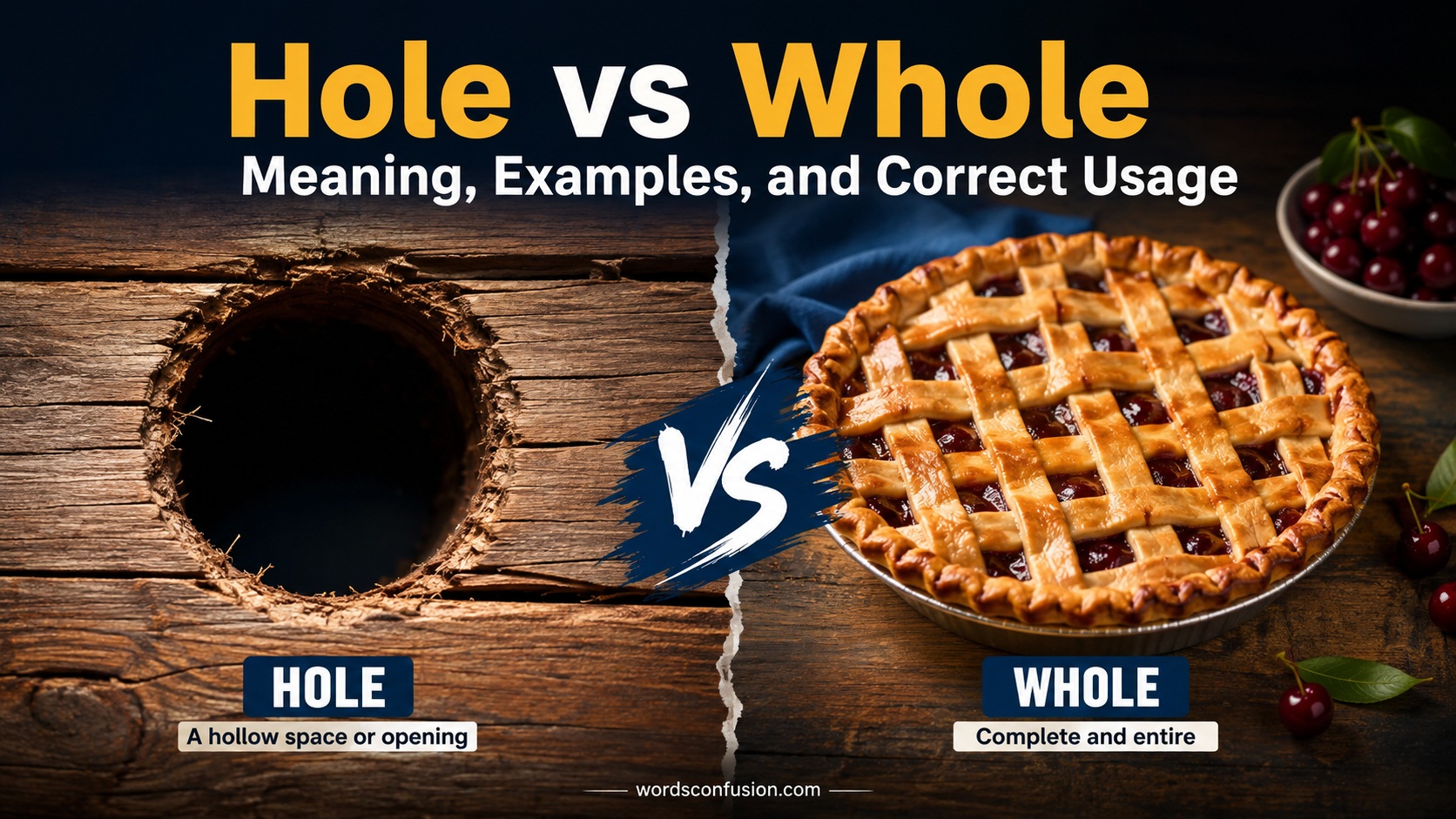
English has many words that sound exactly alike but carry completely different meanings. Hole vs whole is one of the most common examples. Since both words are pronounced the same, many writers accidentally use the wrong spelling. This mistake can confuse readers and weaken the clarity of your writing.
The good news is that the difference between hole and whole is simple once you understand what each word means and how it fits into a sentence. One refers to an opening or empty space. The other describes something that is complete or entire.
Whether you’re a student, content writer, professional, or English learner, knowing when to use hole and whole will help you write with confidence. In this guide, you’ll learn their meanings, grammar, examples, common expressions, memory tricks, and practical tips that make the distinction easy to remember.
Quick Answer
The difference between hole and whole is straightforward.
- Hole means an opening, gap, hollow place, or cavity.
- Whole means complete, entire, or all of something.
Although they sound identical, they have completely different meanings and spellings.
| Word | Meaning | Part of Speech | Example |
| Hole | An opening or hollow space | Noun | There is a hole in my jacket. |
| Whole | Complete or entire | Adjective, Noun | She watched the whole movie. |
A simple trick is to remember that whole begins with “wh,” just like “complete” begins with a unique sound that represents an entire thing. A hole, on the other hand, is simply an empty space.
Comparison Overview
| Feature | Hole | Whole |
| Meaning | An opening, gap, or hollow space | Complete, entire, or all |
| Pronunciation | /hoʊl/ | /hoʊl/ |
| Word Type | Noun | Adjective, Noun |
| Function | Describes an empty space | Describes completeness |
| Common Usage | Hole in a wall, golf hole | Whole family, whole cake |
| Opposite | Filled surface | Partial, incomplete |
| Common Mistake | Used instead of whole | Used instead of hole |
Main Differences Between Hole vs Whole
Although hole and whole sound exactly alike, they perform different jobs in English grammar.
Hole
- Refers to an opening or empty space.
- Always functions as a noun.
- Describes something missing or hollow.
Whole
- Means complete or entire.
- Usually functions as an adjective.
- Can also work as a noun to describe an entire amount or entity.
Here is an easy comparison.
| Hole | Whole |
| Hole in the road | Whole road |
| Hole in your sock | Whole sock |
| Dig a hole | Read the whole book |
| Bullet hole | Whole class |
| Rabbit hole | Whole world |
If you’re talking about something missing, use hole.
If you’re talking about everything together, use whole.
What Does “Hole” Mean?
The word hole refers to an opening, hollow area, cavity, or gap in a surface or object. It always functions as a noun and describes an empty space that is surrounded by material.
You can find holes almost everywhere in daily life. A hole can appear naturally, such as a cave opening, or people can create one intentionally by drilling, digging, or cutting.
Definition of Hole
Hole (noun): An opening, hollow place, gap, or cavity in something solid.
Common Uses of Hole
People use hole in many different situations.
- A hole in a shirt
- A hole in the wall
- A hole in the ground
- A hole in the road
- A hole in a tooth (cavity)
- A golf hole
- A hole punched through paper
Example Sentences Using Hole
- The dog dug a hole in the backyard.
- There’s a hole in my pocket.
- Workers repaired the hole in the road.
- She accidentally burned a hole in the blanket.
- The rabbit disappeared into a hole beneath the tree.
- A small hole in the pipe caused the leak.
- The mechanic found a hole in the exhaust system.
Common Collocations with Hole
These word combinations appear frequently in spoken and written English.
| Collocation | Meaning |
| Black hole | A region in space with extremely strong gravity |
| Hole in the wall | A very small shop or restaurant |
| Drill a hole | Create an opening using a drill |
| Dig a hole | Make an opening in the ground |
| Bullet hole | A hole made by a bullet |
| Pothole | A hole in a road |
| Hole punch | A tool for making holes in paper |
Facts About the Word “Hole”
- It has been part of English for centuries.
- It always refers to an opening or hollow space.
- It never means “complete” or “entire.”
- It is one of the most commonly confused homophones in English.
What Does “Whole” Mean?
The word whole means complete, entire, or all of something without anything missing. Unlike hole, this word usually functions as an adjective.
You use whole whenever you want to emphasize completeness.
Definition of Whole
Whole (adjective): Complete, entire, or containing every part.
It can also function as a noun.
Whole (noun): Something considered as one complete unit.
Common Uses of Whole
- The whole family
- The whole cake
- The whole story
- The whole country
- The whole truth
- The whole class
- A whole day
Example Sentences Using Whole
- We spent the whole afternoon at the beach.
- She ate the whole pizza herself.
- The whole team celebrated the victory.
- I finally understand the whole situation.
- The museum remained open the whole weekend.
- Read the whole article before forming an opinion.
- The whole building was renovated last year.
Common Collocations with Whole
| Collocation | Meaning |
| Whole life | Entire lifetime |
| Whole family | Every family member |
| Whole number | A number without fractions or decimals |
| Whole world | Everyone or everything worldwide |
| Whole truth | Complete truth |
| Whole grain | Grain containing every edible part |
| Whole milk | Milk with its natural fat content |
Facts About the Word “Whole”
- It describes completeness rather than an object.
- It usually appears before nouns.
- It often replaces words such as entire, complete, and full.
- It has the same pronunciation as hole, making the pair a classic homophone.
Hole vs Whole in Everyday English
Understanding the meanings is only part of the story. The real challenge is using the correct word in everyday conversations and writing.
Let’s look at common situations.
At School
Students often confuse these words because they sound identical.
Correct Examples
- There is a hole in the science project.
- Read the whole chapter before class.
- The teacher explained the whole lesson.
- Someone punched a hole in the cardboard.
At Work
Professional communication requires accurate spelling.
Correct Examples
- The engineer found a hole in the pipeline.
- Please read the whole report.
- The manager thanked the whole department.
- A tiny hole caused the equipment to fail.
During Conversations
Native speakers use both words naturally.
Examples include:
- I watched the whole movie.
- There’s a hole in your shoe.
- We walked around the whole park.
- The mouse escaped through a hole in the wall.
In News and Media
Journalists also use both words frequently.
Examples include:
- Scientists discovered a massive black hole.
- The whole city celebrated the championship.
- Crews repaired a large hole in the highway.
- The whole community supported the charity event.
Common Expressions Using “Hole”
English contains many popular idioms that use hole.
Black Hole
A region in space where gravity is so powerful that even light cannot escape.
Example
Scientists continue studying how a black hole affects nearby stars.
Rabbit Hole
A situation that becomes increasingly complicated or distracting.
Example
He started researching history and quickly went down a rabbit hole.
Hole in One
A golf shot that enters the hole with a single stroke.
Example
She celebrated her first hole in one.
Hole in the Wall
A small business, restaurant, or shop that may look ordinary but offers excellent quality.
Example
That little hole in the wall serves incredible tacos.
Burn a Hole in Your Pocket
To make someone eager to spend money.
Example
The bonus was burning a hole in his pocket.
Pick Holes in Something
To criticize every small detail.
Example
The editor kept picking holes in the proposal.
Common Expressions Using “Whole”
The word whole appears in many everyday phrases.
Whole Truth
The complete truth without leaving anything out.
Example
Please tell me the whole truth.
Whole World
Everyone or everything on Earth.
Example
The event attracted attention from the whole world.
On the Whole
Generally speaking.
Example
On the whole, the project was successful.
Wholeheartedly
With complete commitment or enthusiasm.
Example
She wholeheartedly supported the decision.
Whole Number
A mathematical term describing numbers without fractions or decimals.
Examples include:
- 1
- 25
- 100
- 500
Whole Grain
Grain that retains all essential parts of the kernel.
Examples include:
- Whole wheat
- Brown rice
- Oats
- Barley
Common Mistakes Writers Make
Even experienced writers sometimes confuse hole and whole because spellcheck won’t catch the mistake if the incorrect word is still spelled correctly.
Here are some common errors.
| Incorrect | Correct |
| Read the hole book. | Read the whole book. |
| There is a whole in my shirt. | There is a hole in my shirt. |
| The hole family arrived. | The whole family arrived. |
| Dig a whole in the garden. | Dig a hole in the garden. |
| She spent the hole day studying. | She spent the whole day studying. |
Why Do These Mistakes Happen?
Several factors contribute to the confusion.
- Both words sound exactly alike.
- Spellcheck doesn’t identify correctly spelled homophones.
- Writers often type quickly.
- Context isn’t always reviewed during proofreading.
How to Avoid the Mistake
- Think about the meaning before choosing the word.
- Ask yourself whether you’re describing an opening or something complete.
- Read the sentence aloud.
- Proofread slowly before publishing or submitting your work.
Read More: Historic vs Historical: Meaning, Differences, Usage, and Examples
Memory Tricks to Remember the Difference Between Hole vs Whole
A simple memory trick can save you from making this common mistake.
Think About the Meaning
Ask yourself one question:
Am I talking about an opening or something complete?
- If it’s an opening, choose hole.
- If it’s complete or entire, choose whole.
Picture the Object
Visualization makes spelling easier.
- Imagine a hole in the ground. You can see the empty space.
- Imagine a whole pizza. Nothing is missing.
The image instantly tells you which word fits.
Remember the Letter “W”
The W in whole can remind you of words like:
- Whole world
- Whole family
- Whole book
- Whole cake
They all describe everything together.
Quick Memory Table
| If You Mean… | Use This Word |
| An opening | Hole |
| A gap | Hole |
| A hollow space | Hole |
| Complete | Whole |
| Entire | Whole |
| All of something | Whole |
Hole vs Whole in Grammar
Understanding grammar makes it much easier to choose the correct word.
Part of Speech Differences
The biggest grammatical difference is how each word functions.
| Word | Part of Speech |
| Hole | Noun |
| Whole | Adjective, Noun |
A hole names something.
A whole usually describes something.
Using “Hole” in a Sentence
Since hole is a noun, it often follows an article.
Examples include:
- A hole appeared in the roof.
- The child dug a hole.
- They filled the hole with soil.
Using “Whole” in a Sentence
As an adjective, whole comes before a noun.
Examples include:
- The whole family came.
- She spent the whole evening reading.
- We visited the whole museum.
Whole as a Noun
Sometimes whole represents an entire unit.
Examples:
- The committee considered the project as a whole.
- You should view the situation as a whole rather than focusing on one detail.
Hole vs Whole in American and British English
Unlike many English words, hole and whole have the same spelling and meaning in both American and British English.
There are no regional spelling differences.
| Feature | American English | British English |
| Hole | Hole | Hole |
| Whole | Whole | Whole |
| Meaning | Same | Same |
| Pronunciation | Same | Same |
Whether you’re writing for readers in the United States, Canada, the United Kingdom, or Australia, you can use these words exactly the same way.
Synonyms of Hole
Sometimes another word fits your sentence better than hole.
Common Synonyms
| Synonym | Best Used When |
| Opening | General opening |
| Gap | Space between objects |
| Hollow | Empty inside |
| Pit | Deep hole in the ground |
| Cavity | Medical or enclosed hollow |
| Aperture | Scientific or technical writing |
| Crack | Narrow split |
| Tunnel | Long underground passage |
Example Sentences
- The workers repaired the gap in the fence.
- The dentist filled the cavity.
- Sunlight entered through a small opening.
- They climbed out of the pit.
Although these words are related, they don’t always replace hole perfectly. Always consider the context.
FAQs:
Is it hole or whole?
It depends on the meaning. Use hole when referring to an opening or hollow space. Use whole when referring to something complete or entire.
Why do hole and whole sound the same?
They are homophones, which are words that share the same pronunciation but have different spellings and meanings.
Can whole be used as a noun?
Yes. Although whole most commonly functions as an adjective, it can also be a noun that refers to something viewed as one complete unit.
Example: Consider the proposal as a whole.
What is the easiest way to remember the difference?
Remember this simple rule:
- Hole = Opening
- Whole = Entire
If you’re talking about something missing, use hole. If nothing is missing, use whole.
Are hole and whole homophones?
Yes. Hole and whole are perfect homophones because they have the same pronunciation but different spellings, meanings, and grammatical functions.
Conclusion:
Understanding the difference between hole vs whole is easier than it first appears. Even though both words sound identical, they serve completely different purposes in English.
Use hole whenever you’re referring to an opening, gap, hollow space, or cavity. Use whole when you mean complete, entire, or all of something. The meaning of the sentence will almost always tell you which spelling is correct.

Andrew Wilson is an experienced language researcher and content writer specializing in WordsConfusion topics. He helps readers understand commonly confused English words, spelling differences, grammar rules, word meanings, and proper usage through clear explanations, practical examples, and easy-to-follow language guides. His goal is to make English learning simple, accurate, and accessible for students, writers, professionals, and everyday learners.