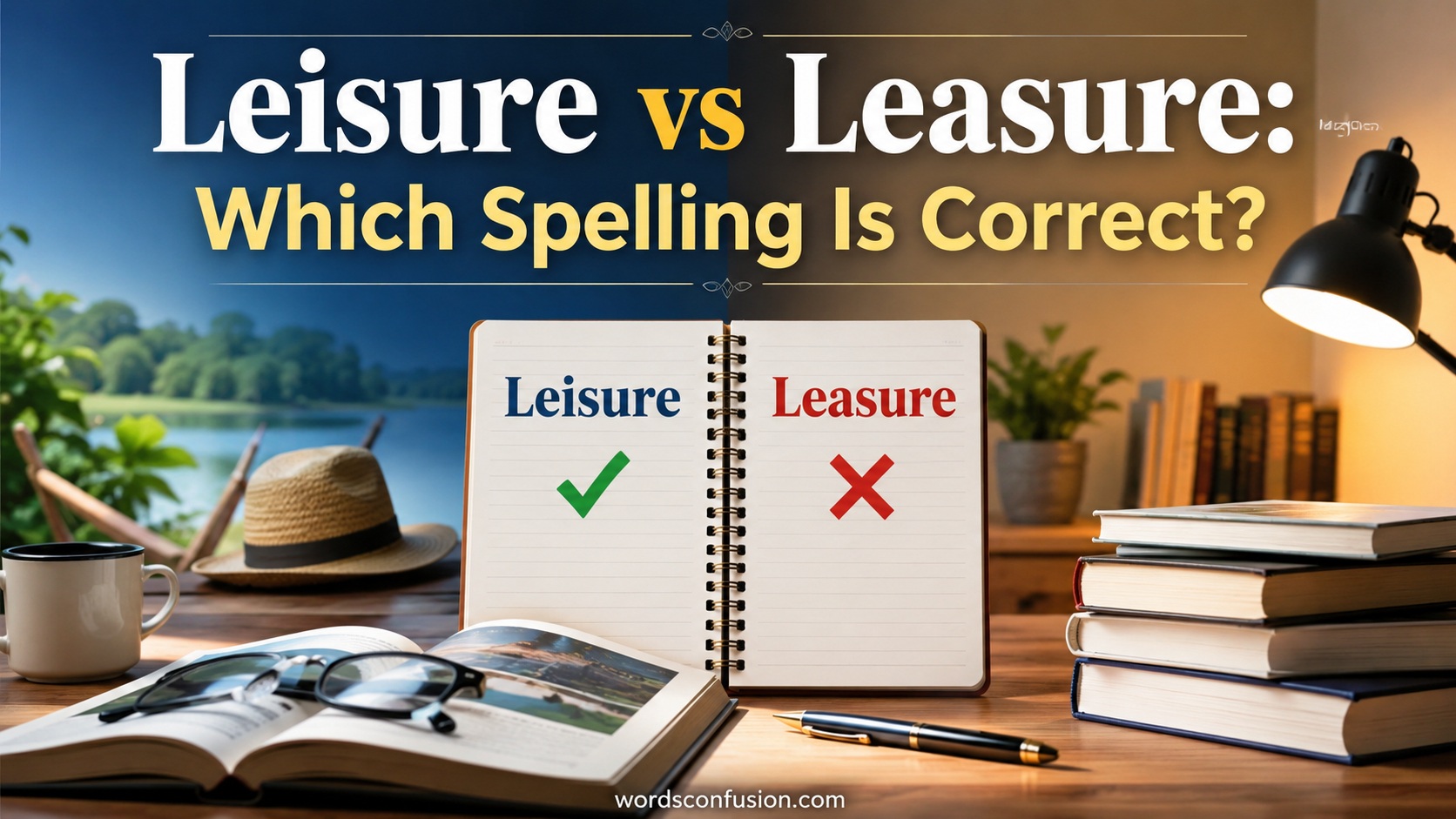
Have you ever stopped while writing and wondered whether “leisure” or “leasure” is the correct spelling? You’re not alone. Thousands of people search for Leisure vs Leasure every month because the words sound similar. However, only one spelling is accepted in standard English.
Spelling mistakes can affect emails, essays, business documents, blog posts, and even social media content. Using the wrong spelling may make your writing appear less polished. Fortunately, this is an easy mistake to fix once you understand why it happens.
In this guide, you’ll learn the correct spelling, the meaning of the word, its pronunciation, common mistakes, memory tricks, real-life examples, and the differences between similar words. By the end, you’ll know exactly when and how to use leisure with confidence.
Quick Answer
Leisure is the correct spelling.
Leasure is a common misspelling and is not recognized as a standard English word.
| Word | Correct? | Meaning |
| Leisure | Yes | Free time when you are not working or studying |
| Leasure | No | Incorrect spelling of leisure |
Correct example:
- I enjoy reading books during my leisure time.
- We traveled for leisure, not business.
Incorrect example:
- I enjoy reading books during my leasure time.
- We traveled for leasure.
If you want accurate and professional writing, always choose leisure.
Leisure vs Leasure: The Correct Spelling at a Glance
At first glance, leisure and leasure seem almost identical. The only visible difference is the letter combination ei versus ea. That tiny difference changes everything because only one spelling exists in English dictionaries.
The confusion often comes from pronunciation. Many English learners expect the spelling to match the way the word sounds. Since the pronunciation isn’t completely phonetic, people naturally replace ei with ea.
Here’s a quick comparison.
| Feature | Leisure | Leasure |
| Correct spelling | Yes | No |
| Found in dictionaries | Yes | No |
| Accepted in formal writing | Yes | No |
| Used by native English speakers | Yes | No |
| Common online misspelling | No | Yes |
The safest rule is simple:
Whenever you’re talking about free time, relaxation, or recreation, always write “leisure.”
Leisure vs Leasure Comparison Table
The table below summarizes everything you need to remember.
| Category | Leisure | Leasure |
| Status | Correct English word | Misspelling |
| Part of speech | Noun | Not a standard word |
| Meaning | Free time away from work | No meaning in English |
| Dictionary entry | Yes | No |
| Academic writing | Accepted | Incorrect |
| Professional writing | Accepted | Incorrect |
| Business communication | Accepted | Incorrect |
| Exams | Correct answer | Marked wrong |
| Everyday writing | Correct | Avoid |
Key takeaway:
Whenever you type leasure, replace it with leisure before submitting your work.
What Does “Leisure” Mean?
Leisure refers to the time when you are free from work, school, or other responsibilities. It’s the period you can spend relaxing, enjoying hobbies, traveling, exercising, or doing activities you genuinely like.
Unlike vacation, leisure doesn’t have to involve traveling. Even spending an hour reading at home after work counts as leisure.
Definition
A simple definition is:
Leisure is free time used for rest, enjoyment, or personal activities.
Many dictionaries describe leisure as freedom from obligations, allowing someone to choose activities based on enjoyment rather than necessity.
Origin of the Word
The word leisure has a fascinating history.
It comes from the Old French word leisir, which meant “permission” or “free time.” That word traces back to the Latin verb licere, meaning “to be allowed.”
Over hundreds of years, the spelling evolved into the modern English word leisure, while its core idea remained the same: having time available to do what you choose.
This historical background also explains why the spelling doesn’t perfectly match modern pronunciation.
Pronunciation
Pronunciation varies slightly between regions.
American English
LEE-zher
British English
LEZH-uh
Although the pronunciation changes slightly, the spelling remains exactly the same in both American and British English.
Parts of Speech
Leisure functions primarily as a noun.
Examples:
- Reading is my favorite leisure activity.
- She enjoys painting during her leisure time.
- We finally had enough leisure to visit our grandparents.
The word also appears in common expressions such as:
- leisure time
- leisure activities
- leisure travel
- leisure center
- at your leisure
What Does “Leasure” Mean?
One of the most common questions people ask is whether leasure is actually a word.
The answer is straightforward.
No, it isn’t.
Is “Leasure” a Real Word?
Modern English dictionaries do not recognize leasure as a correct spelling.
If you search reputable dictionaries, you’ll usually be redirected to leisure, which confirms that leasure is simply a spelling mistake.
Professional editors, teachers, and grammar checkers all treat leasure as an error.
Why People Misspell “Leisure” as “Leasure”
Several factors contribute to this mistake.
Pronunciation Confusion
English spelling isn’t always phonetic.
Many words don’t sound exactly like they’re written. Since leisure sounds similar to words containing ea, writers naturally assume the spelling follows the same pattern.
Similar Words
English contains many words ending with similar sounds.
For example:
- measure
- pleasure
- treasure
Because these words contain ea, many people instinctively spell leisure as leasure.
However, leisure is an exception.
Fast Typing
Typing quickly often leads to letter substitutions.
Since ea appears frequently in English words, many keyboards record leasure simply because the writer doesn’t pause to verify the spelling.
Memory Errors
People usually remember sounds better than spelling patterns.
If someone has only heard the word in conversation, they may guess the spelling instead of learning the correct version.
Why “Leasure” Is Incorrect
Understanding why leasure is wrong helps prevent future mistakes.
The English language follows historical spelling conventions that don’t always align with pronunciation. Leisure inherited its spelling from earlier forms of French and Latin rather than modern English pronunciation.
That historical spelling became standardized centuries ago.
As dictionaries adopted the word, leisure became the accepted spelling across schools, businesses, publishers, and governments.
Because leasure never became part of standard English, it remains incorrect today.
Common Spelling Mistakes
People commonly confuse leisure with these incorrect spellings:
- Leasure
- Liesure
- Leisuree
- Leisur
- Lesure
Only leisure is correct.
Influence of Pronunciation
English contains many words whose spelling doesn’t match pronunciation perfectly.
Examples include:
| Word | Pronunciation |
| Colonel | Kernel |
| Yacht | Yot |
| Queue | Q |
| Leisure | LEE-zher |
This explains why pronunciation alone isn’t enough when learning English spelling.
Typing and Autocorrect Errors
Autocorrect software catches many mistakes, yet it isn’t perfect.
If your spell checker doesn’t flag leasure, don’t assume it’s correct.
Developing the habit of proofreading remains one of the best ways to eliminate spelling errors.
How to Remember the Correct Spelling of Leisure
Fortunately, remembering the correct spelling isn’t difficult once you use a few practical techniques.
Easy Memory Tricks
Think of this sentence:
Leisure begins with “Lei,” like a Hawaiian flower lei that people wear while relaxing on vacation.
The association between relaxation and leisure makes the spelling easier to remember.
Another trick:
Leisure has EI, not EA.
Repeat it several times until it becomes automatic.
Spelling Pattern Explained
Break the word into smaller parts:
Lei + sure
Although it isn’t pronounced exactly like those two words, visualizing the spelling this way helps reinforce the correct letter order.
Notice that the first part contains ei, not ea.
Mnemonic You Can Use
A memorable phrase is:
Enjoy Every Idle Moment = EI = Leisure.
The initials EI remind you of the correct spelling every time you write the word.
Another simple mnemonic is:
Leisure equals enjoyment during extra time.
Picture yourself relaxing on a beach while mentally highlighting the letters EI in the word.
The stronger the mental image, the easier the spelling becomes.
How to Use “Leisure” Correctly
Using leisure correctly is just as important as spelling it correctly.
In everyday English, the word usually refers to free time, relaxation, or enjoyable activities outside work or school. It often appears in conversations about hobbies, vacations, sports, entertainment, and personal well-being.
Leisure as a Noun
Since leisure is a noun, it names a state or period of free time.
Examples:
- I spend my leisure reading historical novels.
- She uses her leisure to learn new recipes.
- They enjoy hiking during their leisure hours.
- Gardening has become his favorite leisure activity.
- We finally have enough leisure to visit our friends after months of busy schedules.
Unlike verbs, nouns don’t describe actions. Instead, they identify things, ideas, or states. In this case, leisure represents the valuable time you have after completing your responsibilities.
Common Sentence Patterns
You will often see leisure used in familiar expressions such as:
- Leisure time
- Leisure activities
- Leisure travel
- Leisure industry
- At your leisure
Each phrase has a specific meaning. For example, leisure travel refers to trips taken for enjoyment rather than business, while at your leisure politely means “whenever it is convenient for you.”
How to Use “Leisure” Correctly
Formal vs Informal Usage
One reason leisure remains a popular English word is its flexibility. You can use it in both formal and informal situations without sounding awkward.
In formal writing, leisure often appears in reports, research papers, tourism studies, and business documents.
Examples:
- The city’s investment in leisure facilities increased tourism revenue.
- Modern employees value work-life balance and meaningful leisure time.
- The survey examined how adults spend their leisure hours.
In casual conversations, the word sounds just as natural.
Examples:
- What do you usually do in your leisure time?
- We spent the weekend enjoying some well-earned leisure.
- I prefer reading over watching TV during my leisure hours.
The key is simple: use “leisure” whenever you’re talking about free time or enjoyable activities outside work or responsibilities.
Read More: Knowledge vs Knowlege: Which Spelling Is Correct?
Example Sentences Using “Leisure”
Seeing a word in context makes it easier to remember. Below are examples from different situations.
Everyday Conversation
These examples reflect how people naturally use leisure in daily life.
- I usually read mystery novels during my leisure time.
- My parents enjoy gardening as a leisure activity.
- We finally had enough leisure to visit the beach.
- Playing chess has become my favorite leisure pastime.
- She spends her leisure learning Spanish online.
- We watched a movie during our leisure hours.
- He enjoys fishing whenever he has some leisure time.
- They filled their leisure with outdoor adventures.
Workplace Examples
Although work and leisure seem like opposites, the word often appears in professional settings.
- The company encourages employees to maintain healthy leisure activities.
- Flexible schedules give workers more leisure time with their families.
- The report analyzed spending in the leisure industry.
- Many businesses now support wellness and leisure programs.
- A balanced lifestyle includes both productive work and relaxing leisure.
Academic Examples
Researchers frequently study leisure because it affects health, happiness, education, and society.
- The research examined children’s leisure habits.
- Students who manage their leisure time effectively often report lower stress levels.
- The professor discussed the social value of leisure in modern society.
- Universities encourage healthy leisure activities outside the classroom.
- Time management includes balancing study and leisure.
Travel and Lifestyle Examples
The tourism industry commonly uses leisure to distinguish personal travel from business travel.
- We booked the trip for leisure, not business.
- The resort specializes in leisure travel.
- Many airlines offer vacation packages for leisure travelers.
- Coastal towns attract visitors seeking leisure and relaxation.
- National parks provide excellent opportunities for outdoor leisure.
Common Phrases and Expressions with “Leisure”
Native English speakers regularly use leisure in fixed expressions. Learning these phrases will make your English sound more natural.
| Phrase | Meaning | Example |
| Leisure time | Free time after work or school | I read during my leisure time. |
| At your leisure | Whenever convenient | Please review the report at your leisure. |
| Leisure activities | Hobbies and recreational pursuits | Swimming is one of my favorite leisure activities. |
| Leisure travel | Travel for enjoyment | Summer is peak season for leisure travel. |
| Leisure center | A public recreation facility | The new leisure center has a swimming pool and gym. |
| Leisure industry | Businesses providing entertainment and recreation | Tourism is a major part of the leisure industry. |
| Leisure pursuits | Personal hobbies | Painting is one of her leisure pursuits. |
| Leisure hours | Free hours | He spends his leisure hours playing guitar. |
Quote
“Leisure is not the absence of work. It’s the presence of freedom.”
This simple idea explains why leisure plays such an important role in a balanced life.
Synonyms of Leisure
Depending on the context, several words can replace leisure. Each has a slightly different meaning.
| Synonym | Best Used When | Example |
| Free time | Everyday conversation | I read in my free time. |
| Spare time | Casual writing | She paints in her spare time. |
| Downtime | Workplace discussions | Employees need downtime after busy projects. |
| Relaxation | Rest and recovery | Vacation provides relaxation. |
| Recreation | Sports and hobbies | Recreation improves mental health. |
| Time off | Work-related situations | I’ll use my time off to travel. |
| Rest | Physical recovery | Rest is essential after exercise. |
| Respite | Temporary relief | The weekend offered a welcome respite. |
Although these words share similarities, leisure focuses on freedom to choose enjoyable activities, not simply taking a break.
Antonyms of Leisure
The opposite of leisure involves obligations, work, or responsibility.
| Antonym | Meaning |
| Work | Paid employment or duties |
| Labor | Physical or mental effort |
| Duty | Required responsibilities |
| Business | Professional activities |
| Employment | Regular work |
| Busyness | Being occupied |
| Obligation | Something you must do |
| Responsibility | Tasks requiring attention |
Understanding antonyms helps clarify the meaning of leisure even further.
FAQs:
Is leisure or leasure the correct spelling?
Leisure is the correct spelling. Leasure is a common misspelling and is not recognized as a standard English word. Whenever you’re referring to free time or recreational activities, always use leisure.
Why do so many people spell leisure as leasure?
The mistake usually happens because of pronunciation. Words like pleasure, measure, and treasure contain the letter combination ea, so many people assume leisure follows the same pattern. In reality, leisure is an exception and is correctly spelled with ei.
Is leasure listed in any English dictionary?
No. Reputable dictionaries do not recognize leasure as a correct English word. If you search for it, you’ll typically be redirected to leisure, which is the accepted spelling in both American and British English.
How do you use leisure in a sentence?
Here are a few correct examples:
- I enjoy reading during my leisure time.
- They traveled abroad for leisure, not business.
- Walking in the park is one of her favorite leisure activities.
- We spent our leisure hours visiting local museums.
Each example uses leisure to describe free time or activities done for enjoyment.
Does the spelling of leisure change in British and American English?
No. The spelling leisure remains the same in both American and British English. The pronunciation differs slightly between the two varieties, but the spelling never changes.
Conclusion:
The debate over Leisure vs Leasure has one clear answer: leisure is the only correct spelling. While leasure is a frequent typo, it isn’t accepted in standard English and shouldn’t appear in professional, academic, or everyday writing.
Remember that leisure refers to the free time you spend relaxing, pursuing hobbies, traveling, or enjoying activities outside your regular responsibilities. Whether you’re writing an email, completing an assignment, or creating online content, using the correct spelling strengthens your credibility and helps your writing look polished.

Andrew Wilson is an experienced language researcher and content writer specializing in WordsConfusion topics. He helps readers understand commonly confused English words, spelling differences, grammar rules, word meanings, and proper usage through clear explanations, practical examples, and easy-to-follow language guides. His goal is to make English learning simple, accurate, and accessible for students, writers, professionals, and everyday learners.