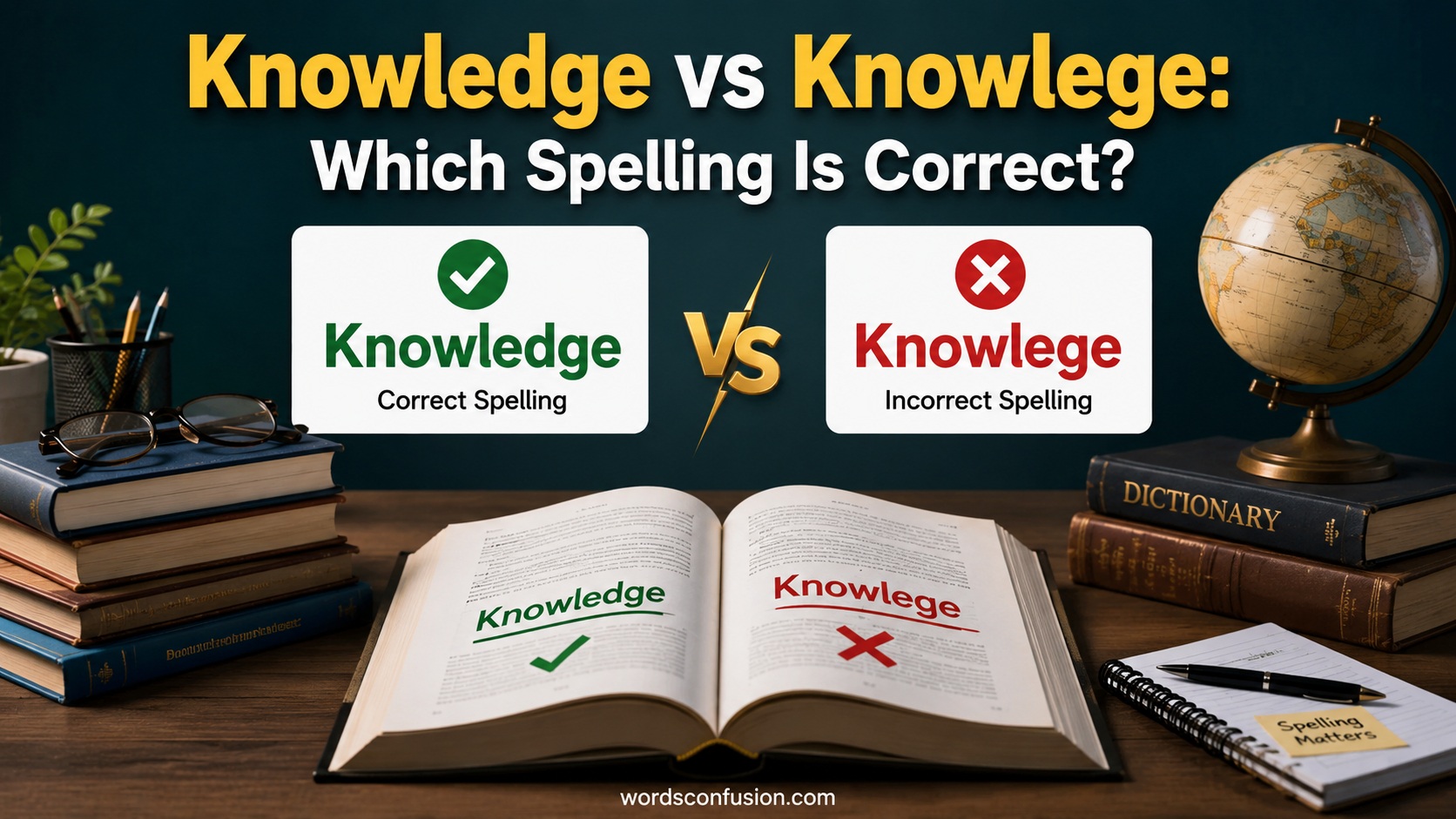
Have you ever paused while writing knowledge and wondered whether it should be spelled knowledge or knowlege? You’re not alone. Thousands of people search for Knowledge vs Knowlege every month because the word contains a silent D, making it easy to miss when typing quickly.
The good news is simple: knowledge is the only correct spelling in modern English. Knowlege is a common misspelling and doesn’t appear as a valid word in any reputable English dictionary.
Whether you’re writing an email, a school assignment, a resume, a business report, or social media content, using the correct spelling helps you appear more professional and credible. Even a small spelling mistake can distract readers and leave a poor impression.
This guide explains everything you need to know about Knowledge vs Knowlege, including the correct spelling, meaning, pronunciation, origin, grammar rules, common mistakes, memory tricks, examples, and practical writing tips.
Quick Answer
If you’re in a hurry, here’s the short answer.
| Word | Correct? | Meaning |
| Knowledge | Yes | Facts, information, skills, and understanding gained through learning or experience. |
| Knowlege | No | Incorrect spelling of knowledge. |
Correct: She has extensive knowledge of computer programming.
Incorrect: She has extensive knowlege of computer programming.
Remember: The word knowledge always contains the letter D, even though you don’t hear it when speaking.
Knowledge vs Knowlege at a Glance
Choosing between these two spellings is easy once you know the rule.
| Feature | Knowledge | Knowlege |
| Correct English spelling | Yes | No |
| Found in dictionaries | Yes | No |
| Accepted in academic writing | Yes | No |
| Accepted in business writing | Yes | No |
| Appears in spell check | Yes | No |
| Meaning | Facts, skills, and understanding | Misspelling |
Key Takeaways
- Knowledge is always correct.
- Knowlege is always incorrect.
- The silent D often causes the spelling mistake.
- Every major English dictionary recognizes only knowledge.
Is It “Knowledge” or “Knowlege”?
The correct spelling is knowledge.
The spelling knowlege is simply a typo or spelling error. Although you may see it in online comments, drafts, or social media posts, it isn’t accepted in formal or informal English.
Many English words contain silent letters. Since the D in knowledge isn’t pronounced clearly, people often leave it out while typing.
Think of it this way. English spelling doesn’t always match pronunciation. That’s why words like Wednesday, island, and knowledge contain letters that aren’t fully pronounced.
Why “Knowledge” Is the Correct Spelling
The spelling knowledge has been standardized for centuries. It appears in:
- English dictionaries
- Academic textbooks
- Government documents
- Newspapers
- Research papers
- Business reports
- Professional writing guides
If you’re writing for school, work, or publication, always use knowledge.
Why People Write “Knowlege”
Several reasons explain this common mistake.
- The D is silent.
- Fast typing causes letters to be skipped.
- English learners often spell words based on pronunciation.
- Mobile keyboards increase typing mistakes.
- Autocorrect doesn’t always catch every error before sending.
Fortunately, once you remember the silent D, the mistake becomes much easier to avoid.
What Does “Knowledge” Mean?
The word knowledge refers to the facts, information, understanding, and skills a person gains through education, observation, study, or experience.
In simple terms, knowledge is what you know.
Dictionary Meaning
Knowledge means:
Information, understanding, or skill gained through education, study, observation, or experience.
Unlike random information, knowledge involves understanding and the ability to use what you’ve learned.
Simple Everyday Meaning
Imagine learning how to ride a bicycle.
Reading about bicycles gives you information.
Actually practicing and becoming good at riding gives you knowledge.
That’s the difference.
Common Contexts Where “Knowledge” Is Used
You’ll frequently encounter the word in many situations.
Education
Students gain knowledge through classes, books, and research.
Example:
- Reading history books increases historical knowledge.
Workplace
Employees use knowledge to solve problems and improve performance.
Example:
- Her knowledge of accounting helped the company reduce errors.
Technology
Knowledge is essential for software development, cybersecurity, and artificial intelligence.
Example:
- Technical knowledge makes troubleshooting much easier.
Everyday Life
Cooking, driving, gardening, and parenting all require knowledge gained through practice.
Why “Knowlege” Is Incorrect
English dictionaries recognize knowledge, not knowlege.
Removing the letter D creates a spelling that has never been accepted as standard English.
The Missing Letter “D”
The silent D belongs to the word’s historical spelling.
Although it isn’t strongly pronounced, it remains part of the correct spelling.
That’s why writing knowlege is considered an error.
Spell Check Recognizes It as a Mistake
Most writing tools immediately flag knowlege because it isn’t part of the English language.
Examples include:
- Microsoft Word
- Google Docs
- Grammarly
- Apple Pages
- LanguageTool
These programs automatically recommend knowledge.
Is “Knowlege” Ever Accepted?
No.
There are no modern English dialects, dictionaries, universities, or style guides that accept knowlege as a correct spelling.
Regardless of whether you’re writing American English or British English, the spelling remains:
Knowledge
Pronunciation of “Knowledge”
One reason people misspell this word is that pronunciation doesn’t clearly reveal every letter.
IPA Pronunciation
American English
/ˈnɑːlɪdʒ/
British English
/ˈnɒlɪdʒ/
Notice something interesting.
The D isn’t clearly heard even though it’s written.
How to Say It Correctly
Most speakers pronounce it similarly to:
NOL-ij
The silent D disappears during normal speech.
That explains why many people accidentally type knowlege.
Why Pronunciation Causes Confusion
English contains many silent letters.
Here are a few examples.
| Word | Silent Letter |
| Knowledge | D |
| Wednesday | D |
| Knife | K |
| Island | S |
| Thumb | B |
| Honest | H |
These silent letters reflect the history of English rather than modern pronunciation.
Etymology of “Knowledge”
Understanding where a word comes from often makes its spelling easier to remember.
The word knowledge developed from the Old English verb cnāwan, meaning to know.
Over time, English evolved through Middle English into Modern English.
The noun knowledge eventually became the standard form representing understanding gained through learning or experience.
Although pronunciation changed over hundreds of years, the spelling remained remarkably stable.
That’s why today’s spelling still includes the silent D.
Historical Development
| Period | Form |
| Old English | Cnāwan |
| Middle English | Knowleche |
| Early Modern English | Knowledge |
| Modern English | Knowledge |
The spelling has remained unchanged for centuries.
Read More: Judgment vs Judgement: Which Spelling Is Correct?
When to Use “Knowledge”
You can use knowledge whenever you’re talking about understanding, expertise, awareness, learning, or information gained through experience.
Academic Writing
Knowledge appears frequently in schools, colleges, and research papers.
Examples:
- Scientific knowledge continues to grow.
- Students should apply their knowledge during examinations.
- Reading develops critical knowledge.
Business Communication
Professional documents often include the word.
Examples:
- Product knowledge improves customer service.
- Industry knowledge gives companies a competitive advantage.
- Financial knowledge helps managers make better decisions.
Everyday Conversation
People also use knowledge naturally in daily life.
Examples:
- My grandfather has incredible farming knowledge.
- She shared her cooking knowledge with everyone.
- His travel knowledge helped us plan our vacation.
Professional Documents
You’ll often see knowledge in:
- Resumes
- Cover letters
- Job descriptions
- Training manuals
- Company policies
- Technical documentation
Example:
Strong knowledge of Microsoft Excel required.
Examples of “Knowledge” in Sentences
Seeing the word in context is one of the best ways to remember its correct spelling. Notice that every example uses knowledge, never knowlege.
Beginner Examples
- She has good knowledge of English grammar.
- Reading books increases your knowledge every day.
- His knowledge of history impressed the teacher.
- You can gain knowledge by asking thoughtful questions.
- Practice turns information into useful knowledge.
Workplace Examples
- The company values employees with technical knowledge.
- Product knowledge helps sales representatives answer customer questions.
- Her legal knowledge saved the client both time and money.
- Strong market knowledge allows businesses to make better decisions.
- The training program improved everyone’s knowledge of workplace safety.
Academic Examples
- Scientific knowledge changes as new evidence becomes available.
- Students should demonstrate their knowledge through practical projects.
- Background knowledge helps readers understand difficult topics.
- Teachers encourage students to apply their knowledge, not just memorize facts.
- Research expands human knowledge in every field.
Formal Writing Examples
- The applicant demonstrated extensive knowledge of cybersecurity principles.
- This report reflects current knowledge of environmental policies.
- The committee reviewed all available knowledge before making its decision.
- Professional knowledge should always be updated through continuous learning.
Common Phrases and Collocations with “Knowledge”
Native English speakers often use knowledge in fixed expressions. Learning these combinations will make your writing sound more natural.
| Phrase | Meaning | Example |
| General knowledge | Broad understanding of many topics | She has excellent general knowledge. |
| Prior knowledge | Information learned before | Prior knowledge makes learning easier. |
| Background knowledge | Existing understanding of a topic | Background knowledge improves reading comprehension. |
| Practical knowledge | Skills gained through experience | Practical knowledge often matters more than theory. |
| Working knowledge | Basic but usable understanding | He has a working knowledge of Spanish. |
| Extensive knowledge | Deep expertise | She has extensive knowledge of finance. |
| Subject knowledge | Expertise in one field | Teachers need strong subject knowledge. |
| Common knowledge | Widely known fact | It’s common knowledge that exercise improves health. |
| First-hand knowledge | Personal experience | He has first-hand knowledge of the industry. |
| Knowledge base | Organized collection of information | The company updated its online knowledge base. |
Common Verbs Used with “Knowledge”
You don’t just “have” knowledge. English uses many natural verb combinations.
- Gain knowledge
- Acquire knowledge
- Expand knowledge
- Share knowledge
- Apply knowledge
- Build knowledge
- Improve knowledge
- Develop knowledge
- Demonstrate knowledge
- Transfer knowledge
Using these combinations makes your writing more fluent.
Knowledge vs Knowlege: Side-by-Side Comparison
Although the answer is straightforward, comparing the two spellings helps remove any remaining confusion.
| Feature | Knowledge | Knowlege |
| Correct spelling | Yes | No |
| Found in dictionaries | Yes | No |
| Accepted in schools | Yes | No |
| Used in business writing | Yes | No |
| Used in academic papers | Yes | No |
| Appears in official documents | Yes | No |
| Recognized by spell check | Yes | No |
| Meaning | Facts, understanding, and skills | Misspelling |
Which One Should You Use?
Always write knowledge.
Never write knowlege unless you’re intentionally showing a spelling mistake as an example.
FAQs:
Is “knowlege” a real English word?
No. Knowlege is not a real English word. It is a common misspelling of knowledge. Every major English dictionary recognizes knowledge as the correct spelling.
Why is “knowledge” spelled with a silent D?
The silent D comes from the word’s historical development in English. Over time, pronunciation changed while the traditional spelling remained the same. Today, the D is written but not clearly pronounced.
How can I remember the correct spelling of “knowledge”?
A simple trick is to remember the phrase “Don’t Drop the D in Knowledge.” Even though the D is silent, it always belongs in the word. Reading and writing the word regularly will also help reinforce the correct spelling.
Is “knowledge” countable or uncountable?
In most situations, knowledge is an uncountable noun, so you don’t say “a knowledge” or “knowledges.”
Correct examples:
- She has extensive knowledge of biology.
- Knowledge is essential for success.
However, in rare academic or philosophical contexts, knowledges may appear to describe different systems or forms of knowledge. This usage is uncommon in everyday English.
How should I use “knowledge” in a sentence?
Use knowledge when referring to facts, understanding, skills, or expertise gained through learning or experience.
Examples:
- His knowledge of history is impressive.
- Reading books expands your knowledge.
- Practical knowledge often comes from experience.
Conclusion:
The debate over Knowledge vs Knowlege has a simple answer. Knowledge is the only correct spelling in English, while knowlege is always a spelling mistake. Although the silent D causes confusion, it remains an essential part of the word and should never be omitted.
Understanding the correct spelling is more than a grammar rule. It helps you communicate clearly, build credibility, and present yourself professionally in school, the workplace, and everyday writing. Whether you’re preparing an assignment, updating your resume, writing an email, or creating online content, using knowledge correctly leaves a stronger impression on your readers.

Andrew Wilson is an experienced language researcher and content writer specializing in WordsConfusion topics. He helps readers understand commonly confused English words, spelling differences, grammar rules, word meanings, and proper usage through clear explanations, practical examples, and easy-to-follow language guides. His goal is to make English learning simple, accurate, and accessible for students, writers, professionals, and everyday learners.