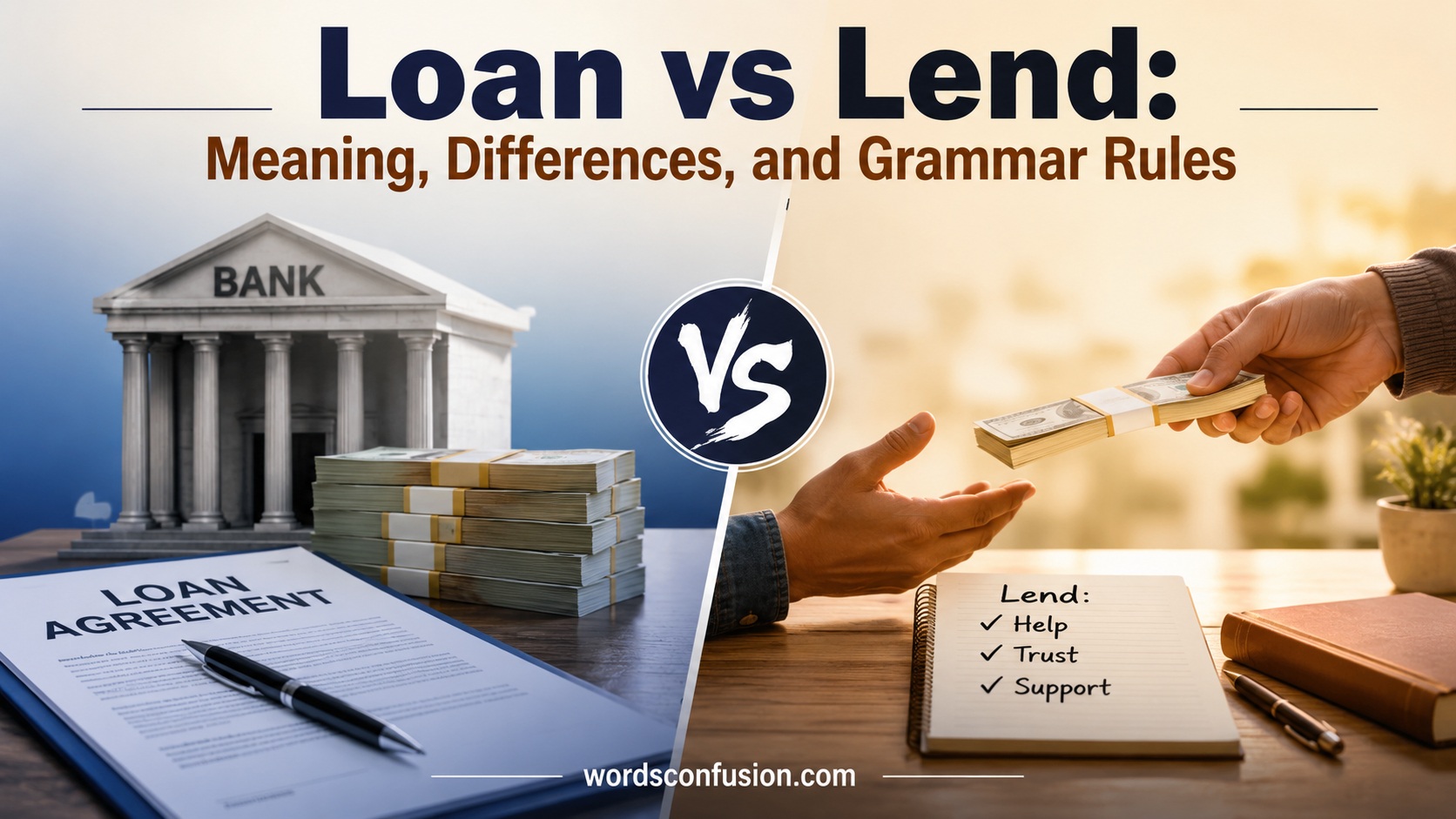
Loan vs lend is a common English confusion because both words relate to giving something temporarily. You might lend a friend your car, take out a loan from a bank, or hear someone say that a bank loaned money to a customer. The meanings overlap, but the grammar and usage aren’t always the same.
The easiest way to understand the difference is to focus on the role each word plays. Lend usually describes the action of giving something temporarily. Loan most often refers to the money, property, or financial arrangement itself. However, in American English, loan can also function as a verb.
Once you understand that distinction, the confusion becomes much easier to untangle.
Quick Answer
Lend is mainly a verb that means to give someone money or something temporarily with the expectation that it will be returned.
- Can you lend me your pen?
- My brother lent me $100.
- The bank lent the company money.
Loan is mainly a noun that refers to money or property given temporarily or the financial agreement connected to it.
- She applied for a home loan.
- He paid off his student loan.
- The loan has a five-year repayment period.
However, loan can also be a verb, especially in American English:
- The bank loaned him $20,000.
- The museum loaned the painting to another gallery.
The simplest rule
You lend something, you borrow something, and you take out a loan.
| Word | Main meaning | Example |
| Lend | Give something temporarily | Can you lend me your book? |
| Loan | Money, property, or a financial arrangement given temporarily | She applied for a loan. |
| Borrow | Receive something temporarily | Can I borrow your book? |
What Does “Loan” Mean?
Loan most commonly functions as a noun. It refers to money or property that one person, bank, business, or organization provides to another person for temporary use.
In most financial situations, the borrower must repay the money according to agreed terms. Those terms might include the repayment period, interest rate, fees, and payment schedule.
For example:
- I took out a loan to buy a car.
- The bank approved her loan.
- He still has $8,000 left on his loan.
- The company secured a business loan.
In these sentences, loan names the financial arrangement or the money provided.
Common Types of Loans
You’ll often see loan used in these expressions:
- Personal loan
- Home loan
- Mortgage loan
- Student loan
- Auto loan
- Business loan
- Emergency loan
- Short-term loan
- Long-term loan
For example, someone might say:
She took out a personal loan to pay for an unexpected home repair.
Here, loan refers to the money she received. It doesn’t describe the act of giving that money.
Loan as a Verb
Although many people learn loan as a noun, it can also function as a verb.
As a verb, loan means to give money or something temporarily with the expectation that it will be returned.
Examples include:
- The bank loaned him $50,000.
- She loaned me her car for the weekend.
- The museum loaned the painting to another institution.
This use is especially common in American English. In everyday conversation, however, many speakers prefer lend when talking about ordinary personal exchanges.
For example:
- Can you lend me your charger? sounds very natural.
- Can you loan me your charger? is grammatically possible in American English, although it may sound more formal or less common to some speakers.
What Does “Lend” Mean?
Lend is a verb. It means to give someone money, an object, or another form of help temporarily.
The person who gives the item lends it. The person who receives it borrows it.
Consider this example:
Maria lent David her bicycle.
Maria gives the bicycle temporarily. Therefore, Maria lent the bicycle. David borrowed it.
More examples include:
- Can you lend me your notes?
- I lent my friend $20.
- She lent her car to her sister.
- The bank lent the business enough money to expand.
The Forms of “Lend”
Lend is an irregular verb.
| Verb form | Word | Example |
| Present | lend | I lend my books to friends. |
| Past | lent | She lent me her umbrella. |
| Past participle | lent | He has lent us the equipment. |
| Present participle | lending | The organization is lending money to small businesses. |
One important point deserves attention: the past tense of lend is lent, not lended.
Incorrect:
She lended me her laptop.
Correct:
She lent me her laptop.
Loan vs Lend: The Main Difference
The core difference between loan and lend often comes down to grammar and emphasis.
Lend usually emphasizes the action of giving something temporarily.
Could you lend me your phone?
The sentence focuses on the act of giving the phone for temporary use.
Loan usually functions as a noun that identifies the money, item, or agreement involved.
I applied for a loan.
The sentence focuses on the financial arrangement.
However, loan can also be a verb:
The bank loaned the company $100,000.
So the difference isn’t always a strict meaning distinction. In some contexts, loan and lend can describe the same basic action.
A Simple Comparison
| Word | What it usually emphasizes | Example |
| Lend | The action of giving temporarily | She lent me her camera. |
| Loan | The money, property, or agreement | She took out a loan. |
| Loan as a verb | Giving something temporarily | The bank loaned him money. |
Think of it this way: lend is often the action while loan is often the arrangement.
Loan vs Lend Sentence Patterns
Understanding sentence structure makes these words much easier to use.
Common Patterns With “Lend”
One common structure is:
lend + person + thing
Examples:
- She lent me her book.
- He lent his brother some money.
- Can you lend me your pen?
Another structure is:
lend + thing + to + person
Examples:
- She lent her book to me.
- He lent his car to his brother.
- The bank lent money to the company.
Both structures are correct.
Common Patterns With “Loan”
As a noun, loan commonly appears in expressions such as:
- take out a loan
- apply for a loan
- get a loan
- receive a loan
- repay a loan
- pay off a loan
- secure a loan
- approve a loan
Examples:
- They took out a loan to purchase a house.
- She applied for a business loan.
- He paid off his car loan.
As a verb, loan can follow patterns similar to lend:
- The bank loaned him the money.
- The bank loaned money to the business.
- The museum loaned the artwork to the gallery.
Loan vs Lend When Talking About Money
Money is where this confusion appears most often.
Use lend when you want to describe the action of giving money temporarily:
Could you lend me $50 until Friday?
Use loan as a noun when you mean the financial arrangement:
I took out a loan to pay for the repairs.
You can also use loan as a verb:
The bank loaned him $10,000.
All three sentences relate to money. However, the grammatical role changes.
Compare These Sentences
- My uncle lent me $500.
- My uncle loaned me $500.
- I received a $500 loan from my uncle.
The first two sentences describe the act of giving money. The third sentence names the money or financial arrangement.
In casual American English, lent often sounds more natural for personal situations:
Can you lend me some money?
In banking and financial writing, loan appears far more frequently as a noun:
The loan carries a fixed interest rate.
Loan vs Lend When Talking About Objects
You can use lend for everyday objects:
- Can you lend me your charger?
- She lent me her jacket.
- I lent my neighbor a ladder.
You can also use loan as a verb:
- The museum loaned the painting to another gallery.
- The university loaned the equipment to the research team.
The choice often depends on context.
Lend feels natural in ordinary personal conversations. Loan often sounds more formal or institutional when used as a verb.
Compare:
Can you lend me your headphones?
with:
The museum loaned the sculpture to the exhibition.
Both sentences describe temporary use. The context changes the most natural word.
Loan vs Lend in American English
American English commonly uses loan as both a noun and a verb.
Examples:
- The bank loaned her the money.
- The company loaned equipment to the school.
- The museum loaned the painting to a gallery.
At the same time, lend remains extremely common:
- Can you lend me your pen?
- She lent me her car.
- He lent his support to the project.
Therefore, it isn’t accurate to say that loan is only a noun. That rule is too rigid for modern American English.
A better explanation is this:
Loan is commonly a noun and can also be a verb. Lend is a verb that describes giving something temporarily.
Read More: Like vs As: Meaning, and How to Use Them Correctly
Loan vs Lend in British English
In British English, lend remains the traditional everyday verb for giving something temporarily.
For example:
- Could you lend me your umbrella?
- The bank lent him the money.
- She lent her friend a book.
Loan remains very common as a noun:
- He applied for a bank loan.
- She paid off the loan.
- The loan agreement lasts five years.
The verb loan also appears in British English in certain formal or specialized contexts. However, lend often sounds more natural in ordinary conversation.
Loan vs Lend vs Borrow
Many people confuse loan and lend because they also mix up borrow.
The three words describe different parts of the same exchange.
The Direction of the Action
Person A → lends or loans → Person B
Person B → borrows → from Person A
For example:
Alex lent Sam his bicycle.
Alex gives the bicycle temporarily. Sam receives and uses it temporarily.
Therefore:
- Alex lent the bicycle.
- Sam borrowed the bicycle.
- The bicycle was temporarily on loan.
Comparison Table
| Word | Meaning | Example |
| Lend | Give temporarily | I lent him my laptop. |
| Loan | Money or property provided temporarily | She took out a loan. |
| Borrow | Receive and use temporarily | He borrowed my laptop. |
A useful memory trick is:
Lend means something moves away from you. Borrow means something comes to you.
Common Mistakes With Loan and Lend
Using “Borrow” Instead of “Lend”
Incorrect:
Can you borrow me your pen?
Correct:
Can you lend me your pen?
The speaker wants the other person to give the pen. Therefore, lend is the correct word.
The speaker could also say:
Can I borrow your pen?
Now the speaker focuses on receiving the pen. Therefore, borrow works.
Using “Lend” as a Noun
Incorrect:
I got a lend from the bank.
Correct:
I got a loan from the bank.
Loan is the noun used for the money or financial arrangement.
Using “Lended”
Incorrect:
He lended me his car.
Correct:
He lent me his car.
The verb lend changes to lent in both the past tense and past participle.
Assuming “Loan” Can Never Be a Verb
This rule is outdated.
Correct:
The bank loaned her the money.
In American English, loan can function as a verb. It can mean the same basic thing as lend in certain contexts.
FAQs:
Is “loan” a verb or a noun?
Loan can be both a noun and a verb.
As a noun:
She applied for a loan.
As a verb:
The bank loaned her the money.
The verb use is especially common in American English.
Is “lend” the same as “loan”?
They can have similar meanings when they describe giving something temporarily.
However, lend is primarily a verb. Loan is most commonly a noun that refers to money, property, or a financial arrangement.
In some contexts, loan also works as a verb.
Is “loan me your pen” correct?
Yes. Loan me your pen is grammatically correct in American English.
However, lend me your pen usually sounds more natural in casual conversation.
What is the past tense of “lend”?
The past tense is lent.
Correct:
She lent me her umbrella.
Incorrect:
She lended me her umbrella.
Is “lended” a word?
Lended isn’t the standard past tense or past participle of lend.
Use lent instead:
- I lent him my book.
- She has lent me her car.
Should you say “lend me money” or “loan me money”?
Both can be correct.
Lend me money is very common in everyday English.
Loan me money is also correct, especially in American English.
For example:
- Could you lend me $100?
- Could you loan me $100?
Conclusion:
The difference between loan vs lend becomes much clearer once you focus on grammar and direction. Lend is primarily a verb that means to give something temporarily:
She lent me her laptop.
Loan is primarily a noun that refers to money, property, or a financial arrangement provided temporarily:
She took out a loan.
However, loan can also function as a verb in American English:
The bank loaned him the money.

Andrew Wilson is an experienced language researcher and content writer specializing in WordsConfusion topics. He helps readers understand commonly confused English words, spelling differences, grammar rules, word meanings, and proper usage through clear explanations, practical examples, and easy-to-follow language guides. His goal is to make English learning simple, accurate, and accessible for students, writers, professionals, and everyday learners.