Like vs. as is one of those grammar topics that looks simple until you start building real sentences. Both words can create comparisons. Both can describe behavior. Both can appear in expressions about manner and similarity. That overlap causes plenty of confusion.
Should you say “She looks like her mother” or “She looks as her mother”? The answer is clear: like.
What about “Do it like I told you” and “Do it as I told you”? Both appear in English, but they differ in style and traditional grammar.
The key is to look at what comes after the word and what you actually mean. Once you understand that distinction, choosing between like and as becomes much easier.
Quick Answer: Like vs As
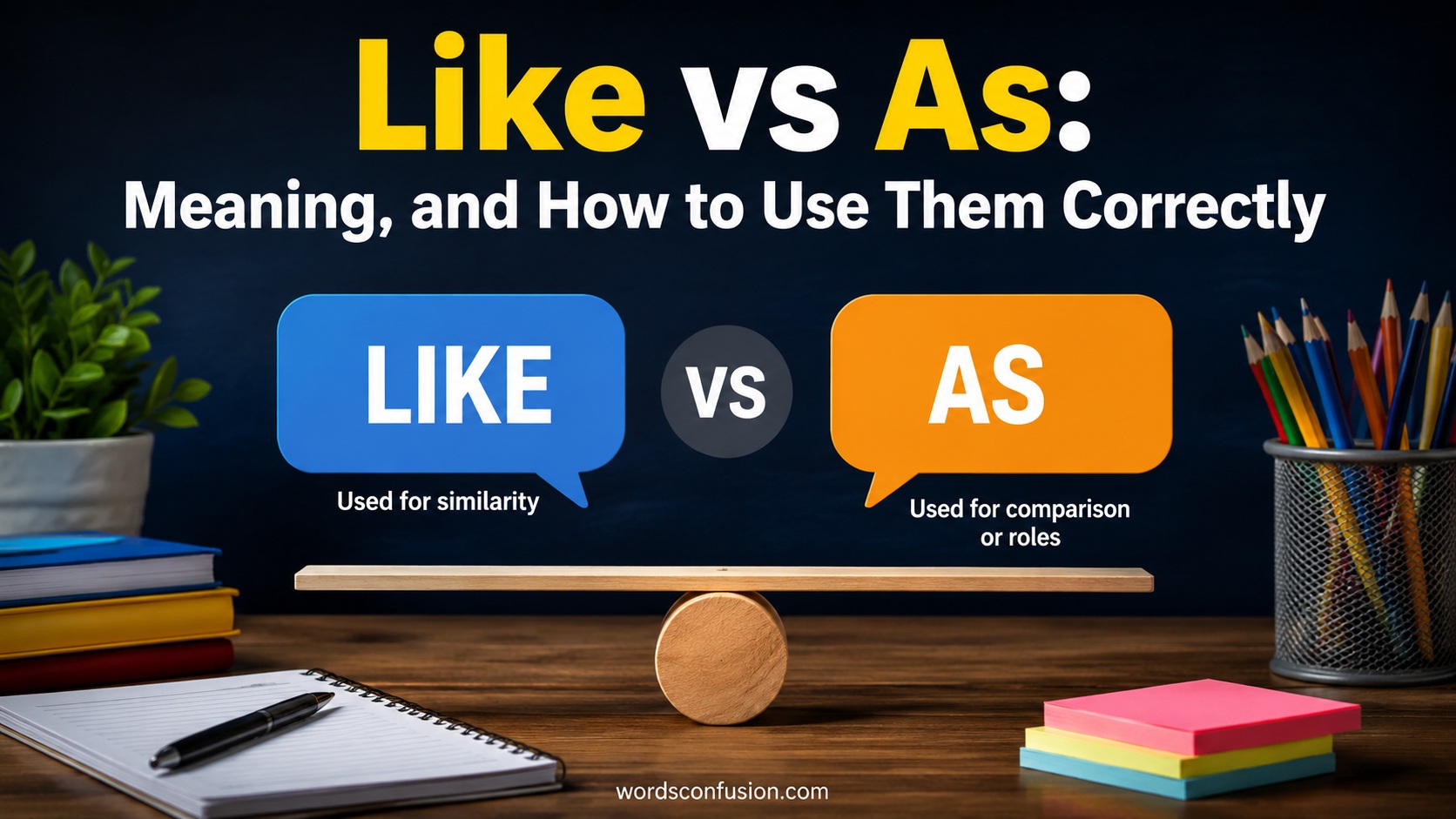
Like usually means “similar to” and commonly comes before a noun or pronoun.
- She looks like her sister.
- He runs like a professional athlete.
- This tastes like chocolate.
As commonly introduces a clause, shows how something happens, or identifies a role or function.
- Do as I say.
- She sings as her mother does.
- He works as a teacher.
The easiest rule to remember is:
Like + noun or pronoun
As + subject + verb
However, English has a few important exceptions. As can come before a noun when it means “in the role of”:
- She works as a nurse.
Also, modern informal English often uses like before a clause:
- It looks like he is tired.
Formal writing may prefer:
- It looks as if he is tired.
So, the best choice depends on grammar, meaning, and context.
Like vs As: The Core Difference
The clearest way to understand like vs. as is to separate their main jobs.
Like usually compares one person or thing with another. It means similar to.
As often connects an action or situation to another action or situation. It can also mean in the role of.
Compare these sentences:
| Sentence | Meaning |
| He works like a teacher. | He works in a way that resembles a teacher. |
| He works as a teacher. | Teaching is his profession or role. |
| She looks like her mother. | She resembles her mother. |
| She acts as her mother did. | Her actions resemble the way her mother acted. |
The difference isn’t merely a matter of style. The word you choose can change the meaning of the sentence.
Like Usually Means “Similar To”
When like functions as a preposition, it introduces a noun or pronoun.
- He looks like his father.
- The baby sleeps like an angel.
- That sounds like a great idea.
- The water feels like ice.
In each sentence, like creates a comparison.
The sentence “He runs like a cheetah” doesn’t mean he literally becomes a cheetah. It means his running resembles the speed or style associated with a cheetah.
As Often Connects Clauses
A clause contains a subject and a verb.
- as I said
- as she expected
- as they planned
- as he explained
For example:
Do as I told you.
The phrase “I told you” contains a subject, I, and a verb, told. That structure explains why as works naturally here.
Compare it with:
Do it like this.
Here, this is a pronoun. Like shows similarity to a method or example.
When to Use Like
Use Like Before a Noun or Pronoun
This is the most useful rule for understanding like vs. as.
Use like when you compare one noun or pronoun with another.
Examples:
- She looks like her sister.
- He talks like a politician.
- The fabric feels like silk.
- This smells like fresh bread.
- Your idea sounds like mine.
The structure is usually:
like + noun/pronoun
You can think of like as a comparison bridge. It connects one thing to another based on appearance, behavior, sound, taste, smell, or some other quality.
Use Like to Show Similarity
Like can compare almost any recognizable quality.
Appearance
- He looks like his grandfather.
- The cloud looks like a giant ship.
Behavior
- She behaves like a professional.
- The child acted like a little comedian.
Sound
- That sounds like a warning.
- The machine sounds like a motorcycle.
Taste and Smell
- This tastes like lemon.
- The room smells like fresh paint.
Movement
- He runs like the wind.
- The bird flew like an arrow.
In every example, like points toward resemblance.
When to Use As
Use As Before a Subject and Verb
When as introduces a comparison involving a complete clause, it often sounds natural and grammatically precise.
- Do as I say.
- She sings as her mother did.
- He handled the problem as a professional would.
- As I expected, the meeting ended early.
The pattern is often:
as + subject + verb
For example:
Do as I explained.
The phrase “I explained” contains a subject and a verb. That makes as the traditional choice.
Use As to Show a Role or Function
This use causes a different kind of confusion because as can come directly before a noun.
When as means “in the role of” or “in the capacity of,” use as.
- She works as a doctor.
- He served as captain.
- The garage serves as a workshop.
- They used the box as a table.
- She acted as the team leader.
Here, as doesn’t mean “similar to.”
Consider this important difference:
He works like a teacher.
This means he works in a way that resembles a teacher.
He works as a teacher.
This means teaching is his job.
That tiny word changes the entire meaning.
Use As to Show Manner
As can describe the way something happens.
- Do as I instructed.
- Arrange the books as I showed you.
- Everything happened as we expected.
- She completed the task as her manager requested.
In these sentences, as means something close to “in the way that.”
Like vs As Comparison Table
| Use | Like | As |
| Show similarity | She looks like her mother. | Not normally used in this structure |
| Come before a noun comparison | He runs like a professional. | Usually not used |
| Introduce a clause | Common in informal speech | Traditional and formal choice |
| Show a job or role | Not standard | She works as a nurse. |
| Show manner | Common in informal expressions | Do as I say. |
| Introduce an imagined situation | Often replaced by as if or as though in formal writing | He acts as if he knows everything. |
Like vs As in Comparisons
The difference becomes easier when you compare the structures directly.
Like + Noun
He runs like a professional.
The word professional is a noun. The sentence compares his running with the way a professional might run.
She sings like an angel.
The word angel is a noun. Like means “in a way similar to an angel.”
As + Subject + Verb
He runs as a professional would.
The phrase “a professional would” contains a subject and a verb. The structure is more complete.
She sings as her mother does.
The phrase “her mother does” contains a subject and a verb.
The practical distinction looks like this:
Like + person or thing
She dances like a professional.
As + action or clause
She dances as a professional would.
Both sentences create a comparison. However, they use different grammatical structures.
Like vs As If and As Though
Many sentences that use like in everyday conversation can use as if or as though in more formal writing.
Compare:
- He acts like he owns the place.
- He acts as if he owns the place.
- He acts as though he owns the place.
All three sentences communicate a similar idea. The tone and grammatical structure differ.
Like in Conversational English
It looks like she’s tired.
This sentence sounds completely natural in everyday American English.
He talks like he knows everything.
Again, this is common in conversation.
As If and As Though in More Formal Writing
It looks as if she is tired.
He talks as though he knows everything.
As if and as though often sound more formal or deliberate. They work especially well when the comparison describes an imagined, hypothetical, or apparently true situation.
For example:
He spends money as if he were a millionaire.
The sentence doesn’t necessarily mean he is a millionaire. It means his spending behavior resembles that of a millionaire.
Like vs As in Formal and Informal English
One common mistake is to say that like is always informal and as is always formal. That rule is too simplistic.
The real situation is more nuanced.
In everyday American English, speakers commonly say:
- It looks like it’s going to rain.
- She talks like she knows the answer.
- Do it like I showed you.
In carefully edited formal writing, many writers prefer:
- It looks as if it is going to rain.
- She talks as though she knows the answer.
- Do it as I showed you.
However, like remains perfectly standard before nouns:
- He looks like his father.
- She works like a professional.
Likewise, as remains standard in many everyday expressions:
- As usual, he arrived late.
- As expected, the results were positive.
The important lesson is this:
Don’t choose between like and as based only on formality. First examine the sentence structure and intended meaning.
Read More: Later vs. Latter: Meaning, and Differences
Common Mistakes With Like and As
Mistake 1: Using As for a Simple Noun Comparison
Incorrect:
She looks as her sister.
Correct:
She looks like her sister.
Why? Her sister is a noun phrase that serves as the comparison. Like means “similar to.”
Mistake 2: Assuming Like Before a Clause Is Always Wrong
Many traditional grammar rules teach:
Like + noun
As + clause
That rule remains useful. However, modern English often uses like before a clause in informal speech.
For example:
It looks like he forgot.
This sentence is extremely common in everyday English.
A more formal alternative is:
It looks as if he forgot.
Therefore, calling the first sentence universally incorrect would ignore actual modern usage.
Mistake 3: Confusing a Role With a Similarity
Compare:
She works like a doctor.
She works in a manner similar to a doctor.
She works as a doctor.
She has the profession of a doctor.
This distinction matters in resumes, biographies, business writing, and professional communication.
Mistake 4: Confusing Like With As If
Compare:
He looks like his brother.
This means he resembles his brother.
He looks as if he is sick.
This means his appearance suggests illness.
The first sentence compares one person with another. The second describes an apparent condition.
Mistake 5: Using Like in Fixed Expressions That Require As
Some expressions are established with as.
Correct:
- as usual
- as always
- as expected
- as soon as possible
- as well as
- as long as
- as if
- as though
Examples:
- As usual, the store closed early.
- As expected, the team won.
- Call me as soon as possible.
- She sings as well as her sister.
Replacing as with like in these expressions would create awkward or incorrect English.
Like vs As: Meaning Can Change
Sometimes the choice between like and as changes the entire meaning.
“He Works Like a Teacher” vs “He Works as a Teacher”
He works like a teacher.
This describes behavior or style. Perhaps he explains everything carefully. Maybe he organizes his work like someone in education.
He works as a teacher.
This identifies his occupation.
The first sentence describes how he works. The second explains what job he has.
“She Looks Like a Professional” vs “She Acts as a Professional Would”
She looks like a professional.
She appears similar to a professional.
She acts as a professional would.
Her behavior matches the behavior expected from a professional.
The first comparison focuses on appearance. The second focuses on conduct.
“Do It Like This” vs “Do As I Say”
These sentences also differ.
Do it like this.
This points to a method, model, or example.
Do as I say.
This means follow my instructions.
A useful way to remember the distinction is:
- Like this = similar to this example
- As I say = in the way that I say
FAQs:
Is “like” or “as” correct before a noun?
Use like when you’re making a direct comparison between one person or thing and another.
- She looks like her mother.
- He runs like a professional.
- This tastes like chocolate.
Use as before a noun when you’re showing a role, job, purpose, or function.
- She works as a teacher.
- He served as captain.
- They used the room as an office.
The meaning changes depending on the word you choose. Like means “similar to,” while as often means “in the role of.”
Is “Do it like I told you” grammatically correct?
“Do it like I told you” is common in informal English and sounds natural in everyday conversation.
However, “Do it as I told you” is traditionally preferred in formal writing. The reason is that “I told you” is a complete clause containing a subject and a verb.
Compare:
- Informal: Do it like I told you.
- More formal: Do it as I told you.
Both versions appear in modern English. Your choice should depend on the context and level of formality.
What is the difference between “like” and “as if”?
Like usually shows similarity between people or things.
She looks like her sister.
This means she resembles her sister.
As if introduces an imagined, apparent, or hypothetical situation.
She looks as if she is tired.
This means her appearance suggests that she is tired.
Another example makes the distinction even clearer:
- He talks like a professor. — His speech resembles a professor’s speech.
- He talks as if he knows everything. — His behavior suggests that he believes he knows everything.
Should I use “like” or “as” in formal writing?
The answer depends on the sentence structure.
Use like for a direct comparison:
The material feels like silk.
Use as when showing a role:
She works as an engineer.
Use as, as if, or as though when introducing a clause in a formal context:
He acted as though he had never heard the news.
Although formal writing often prefers as in clause-based comparisons, like isn’t automatically wrong. Modern English accepts many uses that traditional grammar rules once discouraged.
What is the easiest way to remember the difference between “like” and “as”?
Use this simple memory trick:
Like = similar to
As = in the role of or in the way that
Examples:
- She looks like her mother. — She resembles her mother.
- She works as a doctor. — Being a doctor is her profession.
- Do as I say. — Do it in the way I say.
- Do it like this. — Copy this method or example.
When you’re unsure, look at the words that follow. A noun or pronoun often points toward like. A complete clause often points toward as.
Conclusion:
The difference between like vs. as isn’t as complicated as it first appears. The key lies in understanding both meaning and sentence structure.
Use like when you mean “similar to”:
He looks like his father.
Use as when you mean “in the role of”:
She works as a teacher.
Use as to connect an action with another clause:
Do as I instructed.
For imagined or apparent situations, as if and as though often provide a clearer choice:
He acts as if he knows the answer.
The simplest rule to remember is:
Like + noun or pronoun
As + subject + verb
As + noun when showing a role or function
However, real-world English isn’t always boxed into rigid grammar rules. In everyday American English, people commonly say “It looks like he’s tired” or “Do it like I showed you.” In formal writing, “as if” and “as” may sound more polished.
So, before choosing between like and as, ask yourself two questions: Am I showing similarity? What grammatical structure follows? Once you answer those questions, the correct choice becomes far easier to spot.

Andrew Wilson is an experienced language researcher and content writer specializing in WordsConfusion topics. He helps readers understand commonly confused English words, spelling differences, grammar rules, word meanings, and proper usage through clear explanations, practical examples, and easy-to-follow language guides. His goal is to make English learning simple, accurate, and accessible for students, writers, professionals, and everyday learners.