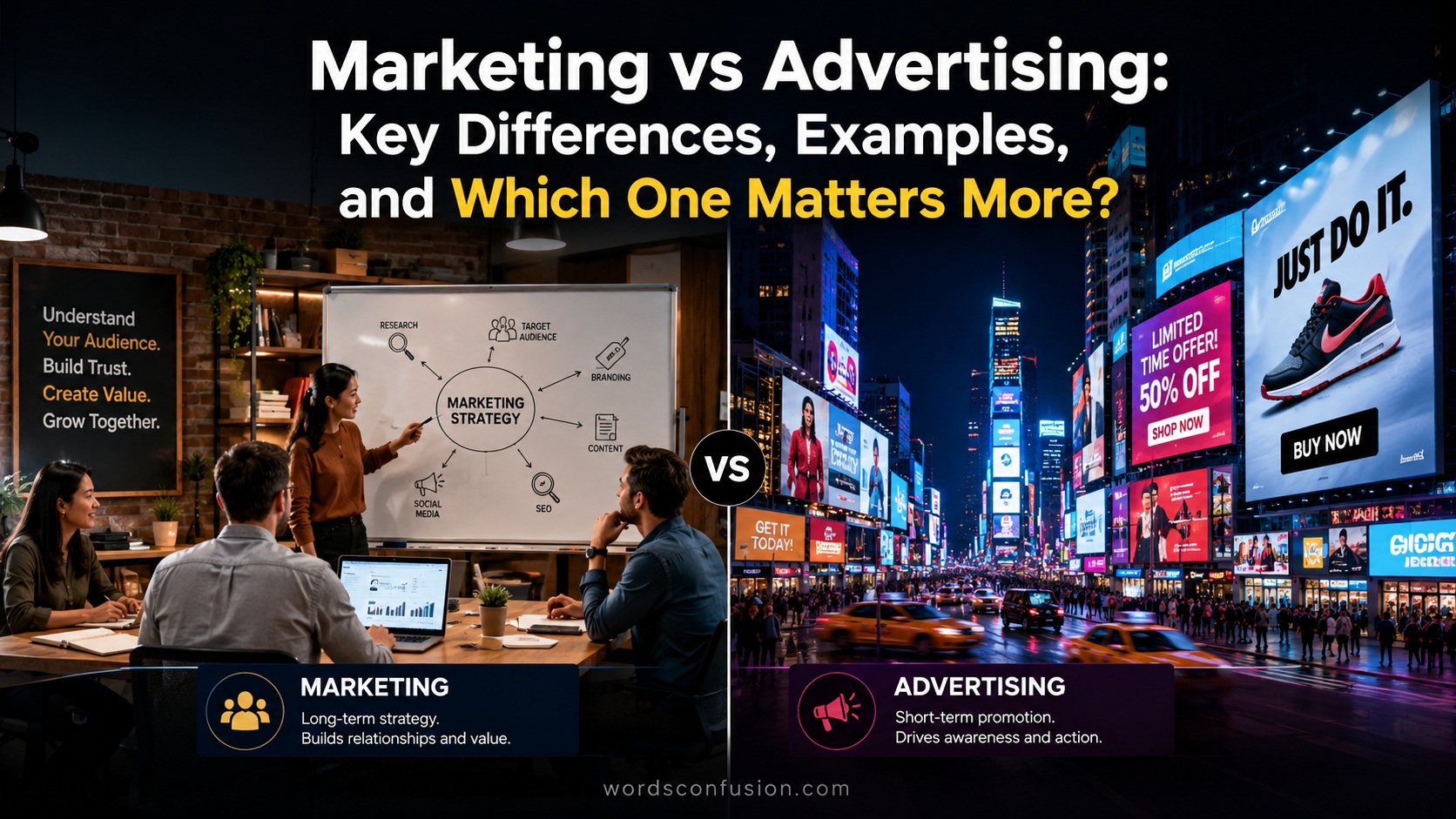
Many people use marketing and advertising as if they mean the same thing. But they are not the same. This is why the keyword Marketing vs Advertising is searched so often.
Business owners, students, job seekers, and content creators want to know the difference. They may wonder if marketing is just another word for advertising. Others want to understand which one helps a business grow faster. The confusion happens because advertising is a part of marketing, but marketing is much bigger.
Understanding the difference can help you make better business decisions. It can also help you choose the right career path, create stronger campaigns, and spend your budget wisely.
In this guide, you will learn the quick answer, the history behind both terms, their main differences, common mistakes people make, real-world examples, usage trends, and expert advice on when to focus on marketing or advertising. By the end, you’ll clearly understand Marketing vs Advertising and know how to use each strategy effectively.
Marketing vs Advertising – Quick Answer
Marketing is the complete process of attracting, engaging, and keeping customers.
Advertising is one part of marketing that promotes products or services through paid messages.
Simple Example
Imagine a coffee shop:
- Marketing includes market research, pricing, branding, customer service, social media, and promotions.
- Advertising includes running Facebook ads, Google Ads, radio commercials, or billboards.
Quick Difference
| Marketing | Advertising |
| Broad business strategy | Specific promotional activity |
| Includes research and branding | Focuses on promotion |
| Long-term customer relationships | Short-term awareness and sales |
| Can be paid or unpaid | Usually paid |
In short: Advertising is a tool within marketing.
The Origin of Marketing vs Advertising
The terms have different origins and histories.
Marketing
The word marketing comes from the word market, which refers to a place where goods are bought and sold.
The modern business meaning developed in the late 19th and early 20th centuries. As businesses grew, companies needed systems to understand customers, set prices, distribute products, and promote sales.
Advertising
The word advertising comes from the Latin word advertere, meaning “to turn toward” or “draw attention to.”
Advertising became popular during the Industrial Revolution when companies needed ways to reach large audiences through newspapers, posters, and later radio and television.
Why the Confusion Exists
People often see advertisements first. Because ads are highly visible, many assume advertising and marketing are identical. In reality, advertising is only one component of a larger marketing strategy.
British English vs American English Spelling
Unlike many English words, marketing and advertising are spelled the same in both British English and American English.
There is no spelling difference between the two regions.
Comparison Table
| Term | American English | British English |
| Marketing | Marketing | Marketing |
| Advertising | Advertising | Advertising |
| Digital Marketing | Digital Marketing | Digital Marketing |
| Online Advertising | Online Advertising | Online Advertising |
Examples
American English
- Our marketing team launched a new campaign.
- The company increased its advertising budget.
British English
- Our marketing team launched a new campaign.
- The company increased its advertising budget.
The spelling remains identical.
Which Spelling Should You Use?
Since there is no spelling variation, you can use the same words everywhere.
For US Audiences
Use:
- Marketing
- Advertising
For UK Audiences
Use:
- Marketing
- Advertising
For Commonwealth Countries
Countries such as:
- Canada
- Australia
- New Zealand
- South Africa
also use the same spellings.
For Global Content
Use the standard forms:
Marketing
Advertising
No localization changes are needed.
Common Mistakes with Marketing vs Advertising
Many people misunderstand these terms.
Mistake 1: Thinking They Are the Same
Marketing = Advertising
Advertising is part of marketing.
Mistake 2: Ignoring Branding
Marketing only means running ads.
Marketing includes branding, customer research, pricing, and customer relationships.
Mistake 3: Focusing Only on Advertising
More ads always mean more sales.
Strong marketing strategy often matters more than ad spending.
Mistake 4: Using the Terms Interchangeably
“Our advertising strategy includes pricing decisions.”
Pricing decisions belong to marketing, not advertising.
Mistake 5: Forgetting Organic Marketing
Marketing always costs money.
Marketing can include free methods such as, email newsletters, and content marketing.
Marketing vs Advertising in Everyday Examples
Understanding real-life usage makes the difference clear.
Email Example
Marketing
We are improving our customer experience and launching a loyalty program.
Advertising
Click here to get 20% off today.
News Example
Marketing
The company announced a new marketing strategy focused on younger customers.
Advertising
The company spent $5 million on television advertising.
Social Media Example
Marketing
Building a brand community through regular posts.
Advertising
Running paid Instagram promotions.
Formal Business Writing
Marketing
Our marketing plan includes research, branding, pricing, and promotion.
Advertising
Our advertising campaign will run for three months.
Read More: Income vs Revenue: Key Differences, Examples, and When to Use Each Term
Marketing vs Advertising – Google Trends & Usage Data
Search interest for Marketing vs Advertising remains strong because businesses continue investing in both areas.
Countries Showing High Interest
The topic is commonly searched in:
- United States
- United Kingdom
- Canada
- Australia
- India
Why People Search It
Different groups search for different reasons:
| Audience | Main Question |
| Students | What is the difference? |
| Business Owners | Where should I spend money? |
| Job Seekers | Which career path fits me? |
| Marketers | How do the roles connect? |
| Startups | Should I focus on branding or ads first? |
Current Usage Context
Today, marketing often refers to:
- Content marketing
- Email marketing
- Brand strategy
- Customer experience
Advertising commonly refers to:
- Google Ads
- Facebook Ads
- YouTube Ads
- TV commercials
- Billboard campaigns
Marketing vs Advertising Comparison Table
| Feature | Marketing | Advertising |
| Purpose | Build customer relationships | Promote products and services |
| Scope | Broad | Narrow |
| Focus | Entire customer journey | Awareness and sales |
| Cost | Can be paid or unpaid | Usually paid |
| Timeline | Long-term | Often short-term |
| Includes Research | Yes | No |
| Includes Branding | Yes | Sometimes |
| Includes Ads | Yes | Not applicable |
| Goal | Sustainable growth | Immediate visibility |
FAQs:
1. Is advertising part of marketing?
Yes. Advertising is one element of a broader marketing strategy.
2. Which is more important, marketing or advertising?
Marketing is generally more important because it includes advertising, branding, research, and customer relationships.
3. Can a business do marketing without advertising?
Yes. Businesses can use SEO, content marketing, email marketing, and referrals without paid advertising.
4. Can advertising work without marketing?
It can generate attention, but results are usually weaker without a clear marketing strategy.
5. Is social media marketing the same as social media advertising?
No. Social media marketing includes organic content, while social media advertising involves paid promotions.
6. Which costs more: marketing or advertising?
Advertising often requires direct spending. Marketing costs vary and may include both paid and organic activities.
7. What comes first, marketing or advertising?
Marketing comes first because it defines the strategy. Advertising follows to promote that strategy.
Conclusion:
The debate around Marketing vs Advertising often comes from the fact that the two terms are closely connected. However, they serve different purposes. Marketing is the complete strategy used to understand customers, build a brand, create value, and drive long-term growth. Advertising is one specific tool within that strategy that helps spread messages and attract attention through paid channels.
A useful way to remember the difference is this: marketing is the entire journey, while advertising is one vehicle used along the way. Businesses that focus only on advertising may gain short-term visibility, but businesses with strong marketing strategies often achieve more sustainable success.
Whether you are a student, entrepreneur, marketer, or business owner, understanding these differences can help you make smarter decisions. Use marketing to build relationships and create value. Use advertising to amplify your message and reach more people. When both work together, they become a powerful engine for business growth and customer engagement.

Andrew Wilson is an experienced language researcher and content writer specializing in WordsConfusion topics. He helps readers understand commonly confused English words, spelling differences, grammar rules, word meanings, and proper usage through clear explanations, practical examples, and easy-to-follow language guides. His goal is to make English learning simple, accurate, and accessible for students, writers, professionals, and everyday learners.