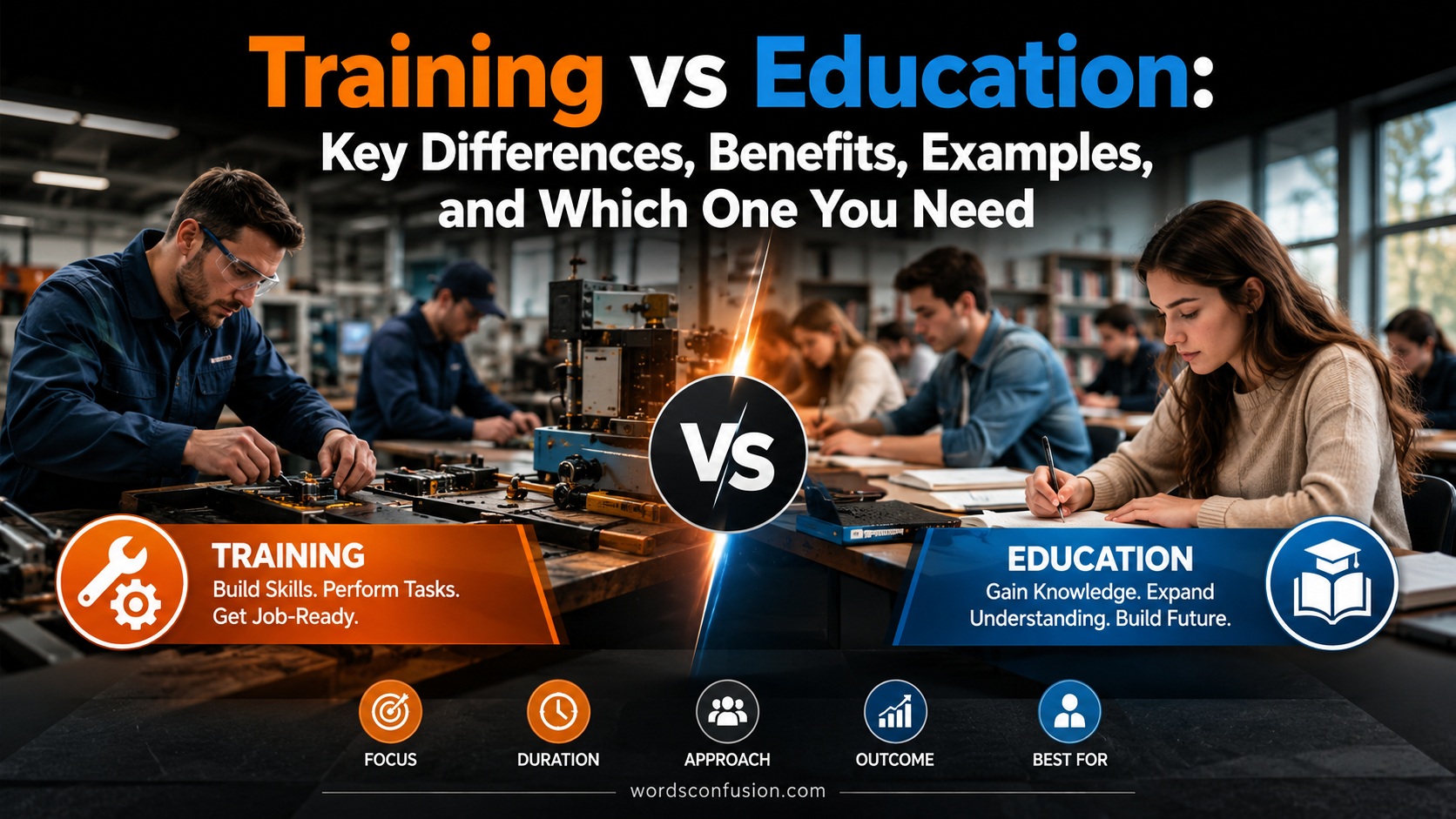
Training and education often get treated as if they mean the same thing. In everyday conversation, people use the terms interchangeably. However, they serve different purposes and produce different outcomes.
Understanding the difference matters more than ever. Employers want workers who can perform specific tasks effectively. At the same time, organizations need people who can think critically, solve problems, and adapt to change. That’s where the distinction between training and education becomes important.
Think about learning to drive a car. You can receive training that teaches you how to operate the vehicle, follow traffic rules, and park safely. Education, on the other hand, might help you understand transportation systems, road safety policies, or the engineering principles behind vehicles. Both forms of learning are valuable, yet they achieve different goals.
If you’re deciding between a certification program, a university degree, workplace training, or a professional development course, this guide will help you make an informed choice.
Training vs Education — Quick Answer
What Is Training?
Training is a structured process designed to teach a person a specific skill, task, or behavior.
Its primary goal is performance improvement. Training focuses on helping individuals perform a particular job or activity correctly and efficiently.
Examples include:
- Employee onboarding programs
- Software training courses
- Safety instruction
- Sales training workshops
- Equipment operation training
Training answers the question:
“How do I do this?”
What Is Education?
Education is a broader learning process that develops knowledge, understanding, reasoning, and critical thinking.
Instead of focusing on one task, education explores concepts, theories, and principles that help people understand the world around them.
Examples include:
- High school education
- College degrees
- Business studies
- Medical education
- Engineering programs
Education answers the question:
“Why does this work?”
The Core Difference in One Sentence
Training teaches you how to perform a specific task, while education helps you understand the knowledge and principles behind that task.
Training vs Education Comparison Table
| Factor | Training | Education |
| Primary Purpose | Develop specific skills | Develop knowledge and understanding |
| Focus | Job performance | Intellectual growth |
| Scope | Narrow and targeted | Broad and comprehensive |
| Duration | Usually short-term | Often long-term |
| Learning Method | Practical application | Theory and analysis |
| Outcome | Competence in a task | Understanding of concepts |
| Assessment | Demonstrations and practice | Exams, projects, research |
| Flexibility | Limited to specific tasks | Transferable across fields |
| Examples | Workplace training, certifications | Degrees, diplomas, academic programs |
| Goal | Immediate effectiveness | Lifelong learning |
What Is Training?
Training is one of the oldest forms of learning. For centuries, craftspeople taught apprentices how to perform specific tasks through observation, repetition, and practice.
Modern training follows the same principle.
The objective is simple: improve performance.
Definition of Training
Training is a planned learning activity designed to help people acquire the skills, knowledge, or behaviors required for a particular role or task.
Organizations invest heavily in training because it produces measurable results.
For example:
- A customer service representative learns how to handle complaints.
- A technician learns how to repair equipment.
- A pilot practices emergency procedures.
Each training program focuses on performance outcomes.
Main Characteristics of Training
Training typically includes:
- Skill development
- Practical exercises
- Immediate application
- Performance measurement
- Repetition and practice
- Task-oriented objectives
Unlike education, training often concentrates on a specific outcome rather than a broad understanding of a subject.
Common Types of Training
Employee Training
Organizations use employee training to improve workplace performance and productivity.
Examples:
- Orientation programs
- Customer service workshops
- Leadership development
Technical Training
Technical training teaches specialized skills.
Examples:
- Coding boot camps
- IT certifications
- Machine operation training
Compliance Training
Many industries require workers to complete mandatory training.
Examples:
- Workplace safety
- Data privacy regulations
- Anti-harassment programs
Leadership Training
Companies develop future leaders through targeted management training programs.
Topics may include:
- Team management
- Conflict resolution
- Strategic planning
Apprenticeships
Apprenticeships combine classroom instruction with hands-on experience.
They are common in:
- Construction
- Plumbing
- Electrical work
- Manufacturing
Real-Life Examples of Training
Consider a hospital.
A nursing student receives education about anatomy, physiology, and healthcare systems. After graduation, the nurse undergoes training on hospital procedures, medical equipment, and patient management systems.
The education provides knowledge.
The training develops practical competence.
What Is Education?
Education plays a broader role in personal and professional development.
While training prepares people for specific tasks, education helps individuals understand ideas, concepts, systems, and relationships.
Definition of Education
Education is a continuous process of acquiring knowledge, developing intellectual abilities, and expanding understanding.
Its purpose extends beyond employment.
Education helps people:
- Think critically
- Analyze information
- Make informed decisions
- Adapt to new situations
- Solve complex problems
Main Characteristics of Education
Education generally emphasizes:
- Conceptual understanding
- Critical thinking
- Intellectual growth
- Research and inquiry
- Long-term development
- Broad knowledge acquisition
These characteristics allow learners to apply knowledge across many different situations.
Common Types of Education
Primary Education
Provides foundational skills such as:
- Reading
- Writing
- Mathematics
- Communication
Secondary Education
Builds upon foundational knowledge and introduces specialized subjects.
Higher Education
Includes:
- Associate degrees
- Bachelor’s degrees
- Master’s degrees
- Doctoral programs
Professional Education
Designed for regulated professions.
Examples include:
- Medicine
- Law
- Engineering
- Accounting
Continuing Education
Supports lifelong learning through:
- Professional courses
- Online learning
- Executive education programs
Real-Life Examples of Education
An engineering student learns:
- Mathematics
- Physics
- Materials science
- Design principles
This educational foundation allows the graduate to work in multiple industries rather than performing only one narrowly defined task.
The Major Differences Between Training and Education
Purpose
Training improves performance.
Education develops understanding.
For example, training teaches a salesperson how to use customer relationship management software. Education teaches business principles that explain customer behavior and market dynamics.
Scope of Learning
Training is narrow and focused.
Education is broad and expansive.
A cybersecurity training program may teach a specific security tool. A computer science education explores programming, networking, algorithms, and system design.
Time Commitment
Training usually takes days, weeks, or months.
Education often requires years.
A software certification might take six weeks.
A computer science degree may take four years.
Learning Method
Training relies heavily on:
- Demonstrations
- Practice
- Simulations
- Hands-on activities
Education often includes:
- Lectures
- Research
- Discussions
- Analysis
Goal
Training aims for competence.
Education aims for understanding.
One develops performance.
The other develops judgment.
Assessment Style
Training assessments usually involve demonstrating skills.
Examples include:
- Practical tests
- Simulations
- Job performance evaluations
Education assessments often include:
- Exams
- Essays
- Research projects
- Presentations
Adaptability
Training is often task-specific.
Education creates knowledge that transfers across industries and careers.
Learning Environment
Training commonly occurs in:
- Workplaces
- Training centers
- Workshops
- Online platforms
Education primarily occurs in:
- Schools
- Colleges
- Universities
- Academic institutions
Instructor Role
A trainer acts as a coach.
An educator acts as a guide who helps learners explore ideas and concepts.
Career Impact
Training often improves short-term job performance.
Education typically influences long-term career opportunities and advancement.
Similarities Between Training and Education
Although they differ in many ways, training and education share several important characteristics.
Both Involve Learning
At their core, both processes help people acquire new knowledge or skills.
Both Require Guidance
Most successful learning experiences involve instructors, mentors, coaches, or teachers.
Both Improve Career Opportunities
Employers value candidates who continue learning throughout their careers.
Both Support Personal Development
Learning often improves:
- Confidence
- Communication
- Problem-solving
- Decision-making
Both Benefit From Continuous Improvement
The most successful professionals combine education and training throughout their lives.
When Is Training More Important Than Education?
Certain situations demand immediate skill development.
In these cases, training often provides the fastest and most effective solution.
Entering a Specific Job Quickly
Many careers prioritize practical skills over academic credentials.
Examples include:
- Commercial driving
- Equipment operation
- Technical support
- Skilled trades
Learning New Workplace Technology
Organizations regularly introduce new software and systems.
Employees need targeted training to remain productive.
Meeting Compliance Requirements
Industries often require mandatory training programs.
Examples include:
- Aviation safety
- Healthcare procedures
- Cybersecurity awareness
Improving Immediate Performance
When performance gaps appear, training delivers rapid improvements.
Case Study: Manufacturing Safety
A manufacturing company experienced frequent workplace accidents.
Management introduced intensive safety training.
Within six months:
- Accident rates decreased significantly.
- Employee confidence improved.
- Productivity increased.
The company achieved measurable results because training focused directly on workplace behavior.
When Is Education More Important Than Training?
Education becomes essential when long-term growth and adaptability matter.
Building Career Flexibility
Educational foundations allow people to transition between industries and roles.
For example, a business graduate might work in:
- Marketing
- Finance
- Consulting
- Operations
Developing Critical Thinking Skills
Many professional challenges require analysis rather than routine procedures.
Education strengthens:
- Logical reasoning
- Evaluation skills
- Problem-solving ability
Pursuing Professional Careers
Many professions require extensive education.
Examples include:
- Medicine
- Law
- Architecture
- Engineering
Understanding Complex Concepts
Education helps individuals understand systems, theories, and relationships that training alone cannot address.
Case Study: Medical Professionals
Doctors spend years studying anatomy, physiology, pathology, and pharmacology.
Without this educational foundation, they could not safely diagnose illnesses or make complex treatment decisions.
Can Training and Education Work Together?
The strongest learning systems combine both.
Education provides the foundation.
Training transforms knowledge into action.
Education Builds the Foundation
Education helps learners:
- Understand principles
- Develop judgment
- Analyze situations
- Think strategically
Training Builds Competence
Training helps learners:
- Apply knowledge
- Build confidence
- Improve accuracy
- Increase efficiency
Examples of Combined Learning Models
| Profession | Education | Training |
| Doctor | Medical school | Clinical rotations |
| Engineer | Engineering degree | Industry internships |
| Teacher | Education degree | Classroom practice |
| Software Developer | Computer science education | Coding boot camps and workplace training |
| Pilot | Aviation theory | Flight training |
The combination creates highly capable professionals.
Read More: Marketing vs Advertising: Key Differences, Examples, and Which One Matters More?
Training vs Education in the Workplace
Modern workplaces rely on both forms of learning.
How Employers Use Training
Organizations use training to:
- Increase productivity
- Improve performance
- Reduce errors
- Enhance safety
- Introduce new technology
Why Companies Still Value Education
Education often predicts a person’s ability to:
- Learn quickly
- Adapt to change
- Solve complex problems
- Communicate effectively
Upskilling and Reskilling Trends
Technological change has made continuous learning essential.
Upskilling involves improving existing skills.
Reskilling involves learning entirely new skills for different roles.
Both approaches frequently combine education and training.
The Growing Role of Continuous Learning
Today’s professionals rarely stop learning after graduation.
Career success increasingly depends on ongoing development.
Training vs Education for Career Growth
Choosing between training and education depends on your goals.
Which Offers Faster Results?
Training generally produces faster outcomes.
A certification program can improve job performance within weeks.
Which Provides Better Long-Term Opportunities?
Education often creates broader career possibilities over time.
Which Delivers Higher Earning Potential?
Research consistently shows that specialized training and formal education together often produce the strongest earning potential.
Education opens doors.
Training helps you excel once you’re inside.
How to Choose Based on Career Goals
| Goal | Recommended Path |
| Learn a specific skill quickly | Training |
| Enter the workforce rapidly | Training |
| Build broad expertise | Education |
| Pursue professional careers | Education |
| Improve current job performance | Training |
| Maximize career growth | Both |
| Adapt to future industry changes | Education plus continuous training |
Common Myths About Training and Education
Training and Education Are the Same Thing
They overlap but serve different purposes.
Training develops skills.
Education develops understanding.
Training Is Less Valuable Than Education
Many industries depend heavily on specialized training.
Skilled trades provide excellent examples.
Education Guarantees Success
Education creates opportunities.
Success still requires effort, practical skills, and experience.
Training Is Only for Beginners
Experienced professionals regularly participate in advanced training programs.
Learning Ends After School
The most successful professionals never stop learning.
Continuous development has become a competitive advantage.
How to Decide Between Training and Education
The right choice depends on your goals, timeline, resources, and career plans.
Consider Your Career Goals
Ask yourself:
- Do you need a specific skill?
- Do you want long-term career flexibility?
- Are professional credentials required?
Evaluate Your Timeline
If you need employment quickly, training may offer a faster path.
If you’re planning for decades of career growth, education may provide greater value.
Assess Your Budget
Training programs often cost less and require less time.
Educational programs usually involve larger investments.
Identify the Knowledge or Skills You Need
Some careers require both.
For example:
- Nurses need education and clinical training.
- Engineers need academic knowledge and practical experience.
- IT professionals benefit from degrees and certifications.
Decision Framework
| If You Want To | Best Choice |
| Learn a task quickly | Training |
| Gain broad knowledge | Education |
| Improve workplace performance | Training |
| Enter a licensed profession | Education |
| Build leadership potential | Education |
| Upgrade technical skills | Training |
| Maximize career success | Both |
FAQs:
Is Training a Form of Education?
Yes. Training is generally considered a specialized form of education focused on developing specific skills and competencies.
Which Is Better, Training or Education?
Neither is universally better.
The best choice depends on your goals, career requirements, and learning needs.
Can You Succeed With Training Without Formal Education?
Yes. Many skilled trades and technical careers rely heavily on training and practical experience.
Why Do Employers Train Educated Employees?
Education provides foundational knowledge.
Training teaches employees how to apply that knowledge within a specific organization.
Does Education Include Practical Training?
Many educational programs incorporate practical training through internships, laboratories, simulations, and field experiences.
What Is the Difference Between Vocational Training and Education?
Vocational training focuses on preparing individuals for specific occupations.
General education develops broader knowledge and intellectual skills.
Can Online Courses Be Considered Training or Education?
They can be either.
The classification depends on whether the course emphasizes practical skill development or broader conceptual understanding.
Which Is More Important for Career Advancement?
In most industries, combining education and training provides the greatest advantage.
Conclusion:
Training and education are not competitors. They are partners. Training equips you with the practical skills needed to perform tasks effectively. Education develops the knowledge, reasoning, and critical thinking required to understand complex concepts and adapt to changing circumstances.
If your goal is immediate job readiness, training often delivers the fastest results. If you want long-term career flexibility, deeper understanding, and broader opportunities, education offers substantial value.

Andrew Wilson is an experienced language researcher and content writer specializing in WordsConfusion topics. He helps readers understand commonly confused English words, spelling differences, grammar rules, word meanings, and proper usage through clear explanations, practical examples, and easy-to-follow language guides. His goal is to make English learning simple, accurate, and accessible for students, writers, professionals, and everyday learners.