Have you ever stopped while writing because you couldn’t remember whether it was necessary or neccessary? You’re not alone. This is one of the most commonly misspelled words in English. Students, professionals, bloggers, and even experienced writers occasionally hesitate before typing it.
The confusion usually comes from the word’s unusual letter pattern. Since many English words contain double letters, it’s easy to assume that necessary has two c’s instead of one. In reality, that assumption leads to a spelling mistake.
Knowing the correct spelling matters more than you might think. Whether you’re writing an email, an academic paper, a resume, or a social media post, spelling mistakes can affect your credibility. A single typo may distract readers or make your writing appear less polished.
This guide explains everything you need to know about Necessary vs Neccessary. You’ll learn the correct spelling, why people make this mistake, how to remember the word, common usage examples, grammar tips, and practical strategies that will help you avoid this error forever.
Quick Answer
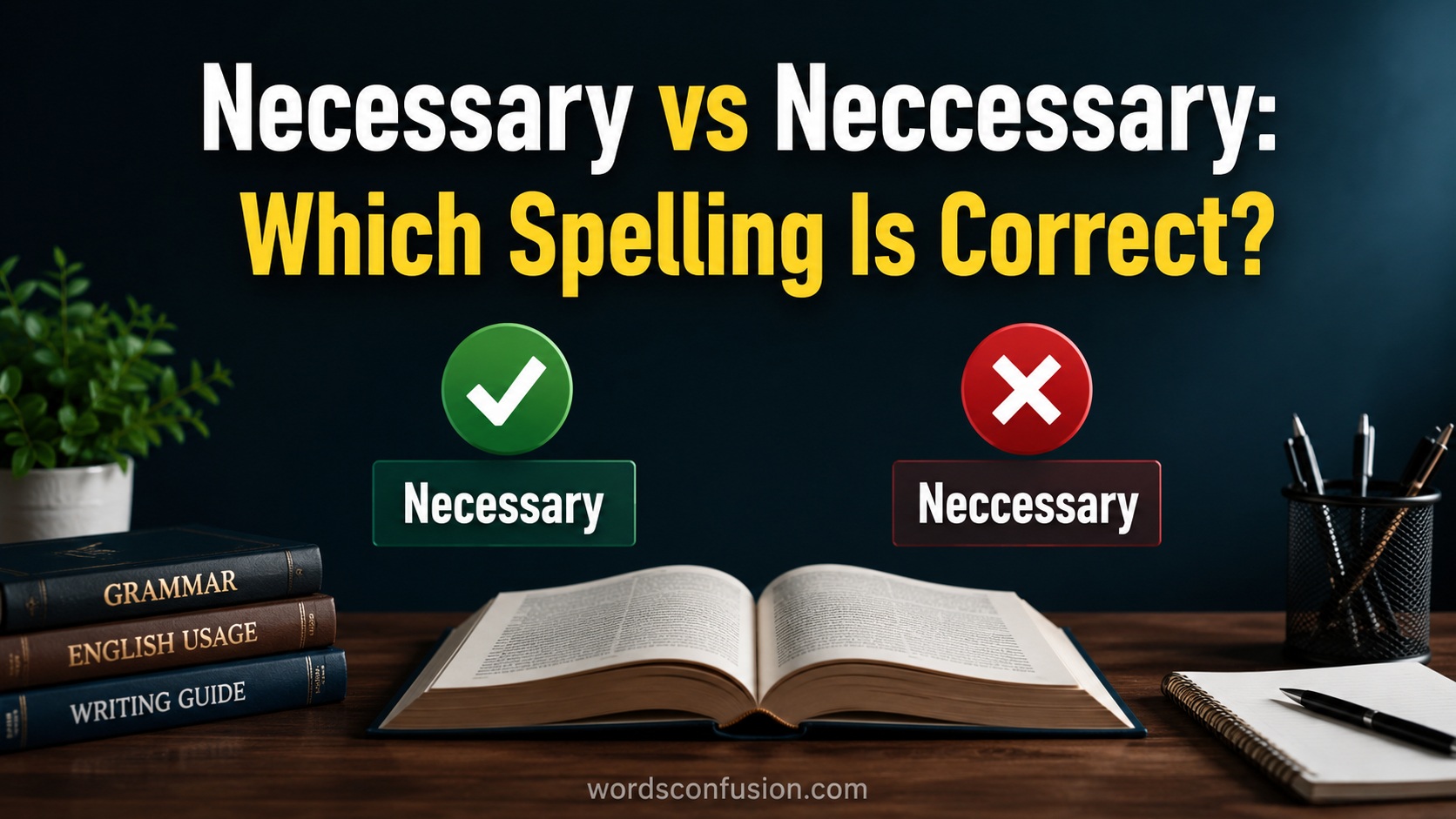
The correct spelling is necessary.
The spelling neccessary is incorrect and isn’t recognized in American English, British English, or any standard English dictionary.
| Word | Correct? | Meaning |
| Necessary | ✅ Yes | Required, essential, or needed |
| Neccessary | ❌ No | Incorrect spelling of necessary |
Simple rule to remember:
- Necessary has one “c” and two “s”.
- Think: One Collar, Two Sleeves.
- One C
- Two S’s
If you remember this simple phrase, you’ll rarely misspell the word again.
Necessary vs Neccessary at a Glance
Understanding the difference is straightforward once you know the correct spelling.
| Feature | Necessary | Neccessary |
| Correct spelling | ✅ Yes | ❌ No |
| Dictionary word | Yes | No |
| Used in academic writing | Yes | No |
| Accepted in business writing | Yes | No |
| Accepted in exams | Yes | No |
| Standard English | Yes | No |
The answer is simple: always use “necessary.”
Why “Neccessary” Is Incorrect
Many spelling mistakes happen because English doesn’t always spell words the way they sound. Necessary is a perfect example.
People often pronounce the middle of the word quickly. That makes it easy to think there should be two c’s instead of one.
Here’s the correct letter sequence:
N-E-C-E-S-S-A-R-Y
Notice that there is:
- One C
- One E
- Two S’s
Many writers accidentally type:
N-E-C-C-E-S-S-A-R-Y
That extra C creates the incorrect spelling neccessary.
Why People Add an Extra “C”
Several reasons explain why this mistake is so common.
Similar Words Create Confusion
Many English words contain double c letters.
Examples include:
- Occasion
- Occupy
- Success
- Account
Because of these familiar patterns, people naturally assume necessary follows the same rule.
It doesn’t.
Fast Typing
Typing quickly often causes people to insert an extra letter without noticing.
For example:
- neccessary
- neccessarily
- unneccessary
Spell check usually catches these mistakes, though it isn’t wise to rely on software alone.
Pronunciation Doesn’t Reveal the Spelling
Unlike words such as basket or garden, the pronunciation of necessary doesn’t clearly show how many letters belong in the middle.
That’s why memorizing the spelling works better than guessing.
What Does “Necessary” Mean?
The adjective necessary describes something that is needed, required, or essential.
If something is necessary, it must happen or exist to achieve a particular goal.
Simple Definition
Necessary means:
- Required
- Essential
- Needed
- Important for a specific purpose
Everyday Meaning
Imagine you’re baking a cake.
Flour is necessary.
Sugar is necessary.
An oven is necessary.
Without these, the cake cannot be made properly.
That’s exactly what the word means.
Dictionary-Style Meaning
Necessary (adjective):
“Needed in order to achieve a particular result or complete a task.”
When Do We Use “Necessary”?
The word appears in almost every type of writing.
Everyday Conversation
People often say:
- Is this really necessary?
- Water is necessary for life.
- That’s a necessary expense.
School Writing
Teachers frequently use sentences like:
- Include all necessary information.
- Bring the necessary materials tomorrow.
Workplace Communication
Businesses commonly write:
- Submit the necessary documents.
- Complete the necessary training.
- Make the necessary revisions.
Legal and Government Documents
Official documents often include phrases such as:
- Necessary permits
- Necessary approvals
- Necessary evidence
- Necessary precautions
The word is one of the most frequently used adjectives in professional English.
Pronunciation Guide
Correct pronunciation helps reinforce the correct spelling.
Necessary is pronounced:
NES-uh-ser-ee
Phonetic spelling:
/ˈnes.ə.ser.i/
Break it into parts:
- NES
- uh
- ser
- ee
Notice something important.
The pronunciation doesn’t sound like there should be two c’s.
Instead, it naturally flows with one c and two s’s.
Reading the word aloud several times helps build spelling memory.
How to Spell “Necessary” Correctly
Many people memorize words by breaking them into smaller pieces.
Here’s an easy breakdown.
| Letter Position | Letter |
| 1 | N |
| 2 | E |
| 3 | C |
| 4 | E |
| 5 | S |
| 6 | S |
| 7 | A |
| 8 | R |
| 9 | Y |
Notice again:
- One C
- Two S’s
That pattern never changes.
Letter-by-Letter Formula
Think of it this way:
N + E + C + E + SS + ARY
This formula becomes much easier to remember than trying to picture the entire word.
The Famous Memory Trick
Perhaps the best-known spelling mnemonic is:
Necessary has one Collar and two Sleeves.
Imagine a shirt.
Every shirt has:
- One collar
- Two sleeves
That matches the spelling perfectly.
- One C
- Two S’s
This trick has helped students remember the spelling for decades.
Another Helpful Trick
Split the word into smaller chunks:
Nec + ess + ary
Instead of memorizing nine letters together, you only remember three smaller parts.
This makes recall much easier during exams or while writing.
Memory Tricks to Remember “Necessary”
Memory techniques work because they connect spelling with something familiar.
Here are several that actually help.
One Collar, Two Sleeves
This remains the most effective mnemonic.
Visualize a shirt every time you write the word.
One collar.
Two sleeves.
One C.
Two S’s.
Write the Word Repeatedly
Writing a difficult word several times strengthens muscle memory.
Try writing:
Necessary
Necessary
Necessary
Necessary
After repeating it a few times, the spelling begins to feel natural.
Use It in Sentences
Creating original sentences also improves recall.
Examples:
- Good communication is necessary for teamwork.
- A passport is necessary for international travel.
- Regular exercise is necessary for good health.
- Careful planning is necessary before launching a business.
The more often you use the word correctly, the less likely you are to misspell it.
Group Similar Words
Practice these together:
- Necessary
- Necessity
- Necessities
- Necessarily
Seeing related words helps reinforce the shared spelling pattern.
Examples of “Necessary” in Sentences
Real examples make the difference easier to understand.
Everyday Examples
- Drinking enough water is necessary for good health.
- It isn’t necessary to arrive two hours early.
- We bought only the necessary groceries.
- Safety equipment is necessary before starting work.
- Patience is necessary when learning a new skill.
Academic Examples
- Students should bring all necessary materials to class.
- Additional research was necessary before reaching a conclusion.
- The experiment required the necessary laboratory equipment.
- Reading the instructions carefully is necessary for success.
Business Examples
- Please submit the necessary paperwork by Friday.
- The company made the necessary changes after customer feedback.
- Managers approved the necessary budget adjustments.
- Employees completed the necessary compliance training.
Professional Email Examples
Instead of writing:
Please send the neccessary documents.
Write:
Please send the necessary documents.
Instead of:
Make all neccessary corrections.
Write:
Make all necessary corrections.
Correct spelling creates a stronger first impression and helps your writing appear polished and professional.
Common Mistakes to Avoid
Even experienced writers occasionally misspell necessary. Most errors happen because the word contains two double-consonant sounds that are easy to confuse.
Learning the most common mistakes can help you spot them before you hit Send or Publish.
Mistake 1: Writing “Neccessary”
This is by far the most common error.
❌ Neccessary
✅ Necessary
Remember:
- One C
- Two S’s
Mistake 2: Adding Too Many Double Letters
People often assume both letters should be doubled.
For example:
- ❌ Necceessary
- ❌ Neccesary
- ❌ Neccessary
Only one spelling is correct:
- ✅ Necessary
Mistake 3: Relying Only on Spell Check
Spell-check tools are useful, though they aren’t perfect.
For example, if you accidentally type another correctly spelled word instead of the one you intended, spell check may not catch the mistake.
Always proofread important documents before sending them.
Mistake 4: Misspelling Related Words
If you don’t know how to spell necessary, you’ll probably struggle with its related forms.
| Correct | Incorrect |
| Necessary | Neccessary |
| Necessity | Neccessity |
| Necessities | Neccessities |
| Necessarily | Neccessarily |
Learning the base word makes every related word easier to spell.
Read More: Maintenance vs Maintainance: Which Spelling Is Correct?
Similar Commonly Misspelled Words
Necessary isn’t the only English word that causes confusion. Many everyday words follow unusual spelling patterns.
| Correct Spelling | Common Misspelling |
| Necessary | Neccessary |
| Accommodation | Accomodation |
| Embarrass | Embarass |
| Separate | Seperate |
| Government | Goverment |
| Occurred | Occured |
| Receive | Recieve |
| Discipline | Disipline |
| Independent | Independant |
| Judgment | Judgement (US English preference) |
If you’ve struggled with one of these words, you’re not alone. Even skilled writers sometimes pause before typing them.
Necessary as Different Parts of Speech
The word necessary is mainly an adjective, though it belongs to a family of related words that serve different grammatical roles.
Understanding those forms helps you use each one correctly.
Necessary as an Adjective
An adjective describes a noun.
Examples:
- A necessary tool
- A necessary change
- The necessary documents
- A necessary decision
In every example, necessary describes something that is required or essential.
Necessity as a Noun
The noun form is necessity.
Examples:
- Water is a necessity.
- Food is a basic necessity.
- Education has become a necessity in today’s economy.
Notice that necessity names a thing instead of describing one.
Necessarily as an Adverb
The adverb form is necessarily.
Examples:
- Bigger doesn’t necessarily mean better.
- Success isn’t necessarily measured by money.
- Expensive products aren’t necessarily higher quality.
Here, the word modifies the verb or the entire statement.
Common Phrases Using “Necessary”
Native English speakers use necessary in many fixed expressions.
Learning these collocations makes your writing sound more natural.
If Necessary
Examples:
- Call me if necessary.
- We’ll stay another day if necessary.
- Additional testing will be performed if necessary.
As Necessary
Examples:
- Update the records as necessary.
- Revise the proposal as necessary.
- Adjust the schedule as necessary.
Necessary Steps
Examples:
- We took the necessary steps to improve security.
- The doctor explained the necessary steps before surgery.
- Follow the necessary steps carefully.
Necessary Precautions
Examples:
- Workers wore helmets as a necessary precaution.
- Travelers should take the necessary precautions.
- Always follow the necessary safety procedures.
Necessary Documents
Examples:
- Bring all necessary documents to the interview.
- The embassy requested additional necessary paperwork.
- Upload the necessary files before submitting the application.
FAQs:
Is necessary or neccessary the correct spelling?
Necessary is the correct spelling. Neccessary is a misspelling and isn’t accepted in American English, British English, or any standard English dictionary. Remember that necessary has one “c” and two “s’s.”
Why do people misspell necessary as neccessary?
The mistake usually happens because the word contains two double-consonant sounds. Many writers mistakenly think it should have two c’s instead of one. Pronunciation doesn’t clearly reveal the correct spelling, which makes the error common.
How can I remember how to spell necessary?
The easiest memory trick is:
One Collar, Two Sleeves
Think of a shirt with one collar and two sleeves.
- One C
- Two S’s
This simple mnemonic has helped students and writers remember the correct spelling for years.
Is neccessary accepted in British English?
No. Both American English and British English use the spelling necessary. The spelling neccessary is incorrect in every major English dictionary and style guide.
What is the difference between necessary and necessity?
Necessary is an adjective that describes something required or essential.
Examples:
- A passport is necessary for international travel.
- Careful planning is necessary before starting a business.
Necessity is a noun that refers to something essential.
Examples:
- Clean water is a basic necessity.
- Education is no longer a luxury but a necessity.
Conclusion:
The debate between Necessary vs Neccessary has a simple answer: necessary is the only correct spelling. The spelling neccessary is a common mistake that should never appear in academic papers, professional emails, business documents, or everyday writing.
The easiest way to remember the correct spelling is the classic “One Collar, Two Sleeves” mnemonic. It reminds you that necessary contains one “c” and two “s’s.” With regular practice and careful proofreading, the correct spelling will soon become second nature.

Andrew Wilson is an experienced language researcher and content writer specializing in WordsConfusion topics. He helps readers understand commonly confused English words, spelling differences, grammar rules, word meanings, and proper usage through clear explanations, practical examples, and easy-to-follow language guides. His goal is to make English learning simple, accurate, and accessible for students, writers, professionals, and everyday learners.