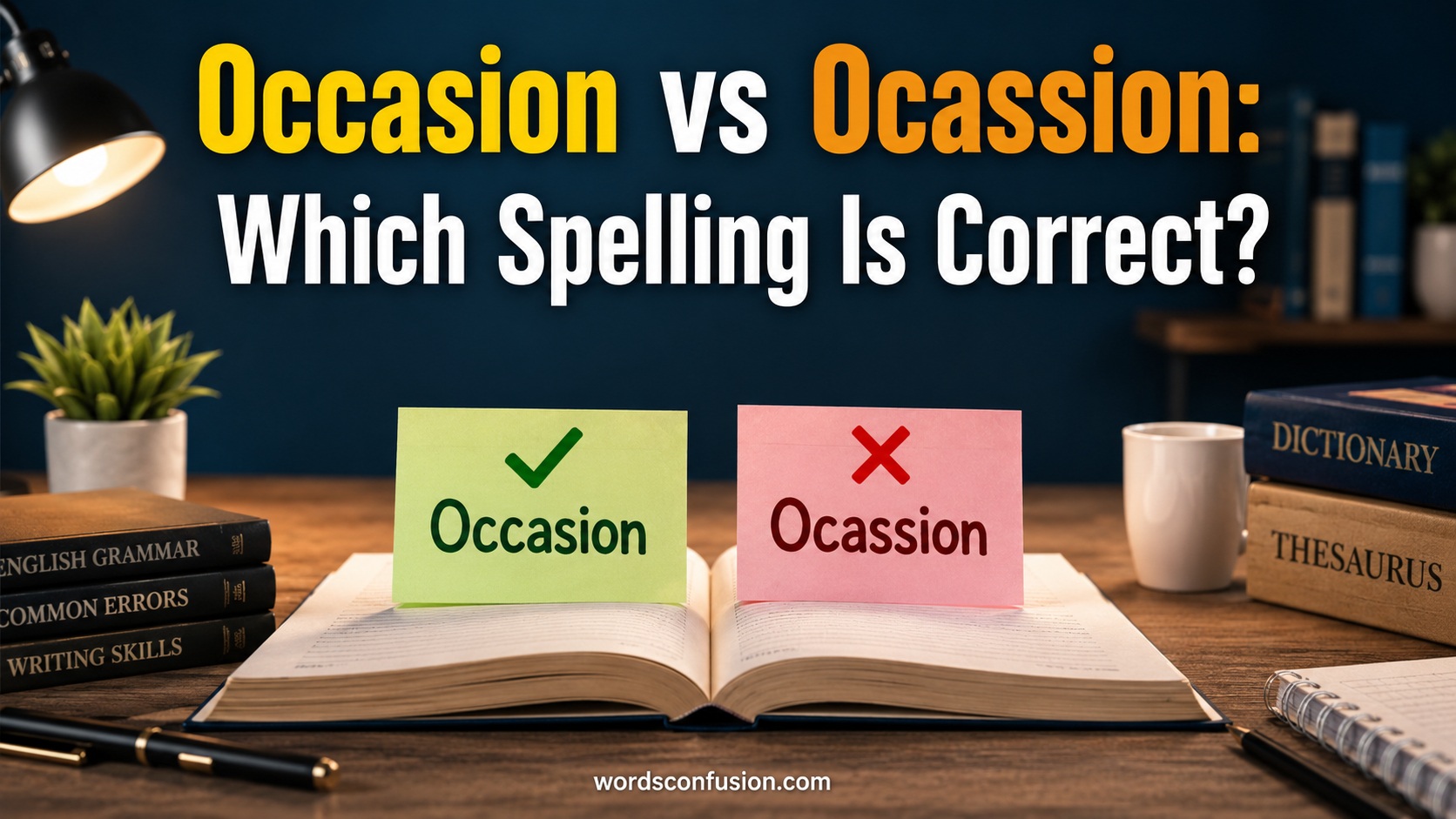
Have you ever stopped while typing occasion and wondered whether it should be spelled occasion or ocassion? You’re not alone. Thousands of people search for this exact question every month because the word contains double letters that can easily confuse even experienced writers.
The good news is that the answer is straightforward. Only one spelling is accepted in English dictionaries, academic writing, business communication, and professional publications.
In this guide, you’ll learn the correct spelling, why the mistake happens, how to remember the right version forever, and how to use occasion correctly in different situations. You’ll also see real-world examples, comparison tables, grammar tips, and common phrases that make this word easier to understand.
Quick Answer
| Word | Correct? | Meaning |
| Occasion | ✅ Correct | A particular event, celebration, time, opportunity, or reason |
| Ocassion | ❌ Incorrect | A misspelling of occasion |
The correct spelling is occasion.
The spelling ocassion is always incorrect in both American English and British English. Whether you’re writing an email, an essay, a report, or a social media post, you should always use occasion.
Occasion vs Ocassion at a Glance
| Feature | Occasion | Ocassion |
| Correct spelling | Yes | No |
| Dictionary word | Yes | No |
| Used in schools | Yes | No |
| Accepted in formal writing | Yes | No |
| Accepted in business writing | Yes | No |
| Used in exams | Yes | No |
| Found in English dictionaries | Yes | No |
The difference is only one letter, yet that single mistake changes the word from a correct English spelling into an error.
What Does “Occasion” Mean?
The word occasion refers to a specific event, time, opportunity, or reason for something to happen. Depending on the sentence, its meaning changes slightly, but the core idea remains the same.
Definition
As a noun, occasion means:
- A special event or celebration
- A particular time
- A reason or cause
- An opportunity for something
For example:
- We celebrated the occasion with our family.
- Her birthday was a special occasion.
- There was no occasion to worry.
- This meeting provides an occasion to discuss new ideas.
Although these examples use the same word, each sentence expresses a different meaning.
Pronunciation
Occasion is pronounced as:
/ə-KAY-zhən/
Breaking it into syllables makes it easier:
oc-ca-sion
Notice that pronunciation doesn’t clearly reveal the double c, which is one reason many people spell it incorrectly.
Word Origin (Etymology)
The word occasion comes from the Latin word occasio, meaning a favorable opportunity or a happening. It entered English through Old French and has been part of the language for centuries.
Its historical roots explain why the spelling may seem unusual today. English has preserved much of the original structure even though pronunciation has evolved.
Parts of Speech
The word occasion can function as more than one part of speech.
| Part of Speech | Meaning | Example |
| Noun | Event, reason, opportunity | The wedding was a joyful occasion. |
| Verb | To cause something | The mistake occasioned confusion. |
The noun form is far more common than the verb form.
Why Do People Misspell “Occasion” as “Ocassion”?
Misspellings don’t happen randomly. They usually follow patterns. Understanding those patterns helps you avoid making the same mistake again.
Confusion About Double Letters
Many English words contain double letters.
Examples include:
- Success
- Necessary
- Committee
- Accommodation
- Occasion
The challenge is remembering which letter is doubled.
Many people mistakenly think the word has only one c, producing ocassion instead of occasion.
The correct pattern is:
O + CC + ASION
There are two c’s followed by one s.
Pronunciation Doesn’t Reveal the Correct Spelling
English pronunciation often hides spelling details.
When you say occasion, you don’t naturally hear two separate c sounds. As a result, many writers rely on how the word sounds instead of how it’s spelled.
This is why phonetic spelling often leads to mistakes.
Common Typing Errors
Typing quickly increases the chance of making spelling errors.
Common reasons include:
- Fast keyboard typing
- Mobile phone autocorrect failures
- Muscle memory
- Lack of proofreading
Even professional writers occasionally mistype words. That’s why proofreading remains important.
How to Remember the Correct Spelling
Simple memory tricks work better than memorizing random letters.
Easy Memory Trick
Remember this sentence:
Every special occasion deserves two celebrations.
Think of the two celebrations as the two c’s in occasion.
Whenever you write the word, picture those two c’s before the s.
Visual Spelling Pattern
Occasion
O
CC
A
S
ION
Focus on the CC.
Most spelling mistakes happen because one c disappears.
Mnemonic You Can Use Every Time
Try this mnemonic:
“Two C’s Come before one S.”
Repeat it a few times, and the spelling becomes much easier to remember.
How to Use “Occasion” Correctly
The word appears in everyday conversation, academic writing, journalism, business communication, and literature.
Understanding the different uses helps you write naturally.
Referring to an Event
This is the most common meaning.
Examples:
- Graduation was a memorable occasion.
- The award ceremony was an important occasion.
- Their anniversary is always a happy occasion.
Here, occasion means a specific event.
Referring to a Special Celebration
Many celebrations are described as occasions.
Examples include:
- Weddings
- Birthdays
- Festivals
- Family reunions
- Retirement parties
- Holiday gatherings
Example sentence:
The family decorated the entire house for the special occasion.
Referring to a Reason or Cause
Sometimes the word doesn’t describe an event at all.
Instead, it refers to a reason.
Examples:
- There is no occasion for panic.
- We had every occasion to celebrate.
- The results gave us occasion for optimism.
In these sentences, occasion means reason rather than celebration.
Examples of “Occasion” in Sentences
Reading examples helps reinforce correct spelling and proper usage.
Everyday Examples
- Every birthday is a special occasion.
- We dressed nicely for the occasion.
- The weather made the picnic even more enjoyable.
- The family gathered for the happy occasion.
- She bought a beautiful dress for the occasion.
Academic Examples
- The graduation ceremony marked an important occasion in every student’s life.
- The university organized the event to celebrate the historic occasion.
- Researchers used the conference as an occasion to present new findings.
- The professor spoke about the significance of the occasion during the opening ceremony.
Business Examples
- The company hosted a dinner to mark the occasion of its tenth anniversary.
- Employees received awards on the special occasion.
- The addressed the audience on the occasion of the new office opening.
- The product launch became an important occasion for the brand.
Formal Writing Examples
Formal writing often uses occasion to express dignity or importance.
Examples:
- The president addressed the nation on the occasion of Independence Day.
- The ambassador delivered remarks on the occasion of the diplomatic agreement.
- The charity organized a fundraising gala for the occasion of its silver jubilee.
- The museum opened a new exhibition to mark the historic occasion.
Writing Tip: If you’re ever unsure, remember this simple rule: “Occasion” is always correct. “Ocassion” is always a spelling mistake.
Common Phrases and Expressions with “Occasion”
The word occasion appears in many everyday expressions. Learning these phrases helps you sound more natural and confident in both speaking and writing.
On Occasion
This phrase means sometimes or from time to time.
Examples:
- We eat at that restaurant on occasion.
- She visits her hometown on occasion.
- He drinks coffee on occasion, although he usually prefers tea.
Read More: Necessary vs Neccessary: Which Spelling Is Correct?
On This Occasion
This phrase refers to a specific event or moment.
Examples:
- On this occasion, the school invited former students to speak.
- The mayor delivered a special speech on this occasion.
- On this occasion, everyone wore traditional clothing.
Special Occasion
A special occasion is an important event worth celebrating.
Examples include:
- Weddings
- Graduations
- Birthdays
- Anniversaries
- Holiday celebrations
Example sentences:
- She bought a new suit for the special occasion.
- The restaurant offers a special menu for every special occasion.
Rise to the Occasion
This idiom means to perform well when facing a challenge or important moment.
Examples:
- Despite the pressure, the team rose to the occasion.
- She rose to the occasion and delivered an outstanding presentation.
Mark the Occasion
This phrase means to celebrate or recognize an important event.
Examples:
- The city held a parade to mark the occasion.
- Friends gathered to mark the occasion with dinner.
On the Occasion of
This expression commonly appears in formal writing.
Examples:
- He received an award on the occasion of his retirement.
- The organization issued a statement on the occasion of its anniversary.
Occasion as a Noun Explained
The noun occasion has several closely related meanings. The intended meaning depends on the context.
Occasion as an Event
This is the most common meaning.
Examples:
- Christmas is a joyful occasion.
- Their wedding was a beautiful occasion.
- Graduation is an unforgettable occasion.
In each example, occasion refers to an event.
Occasion as an Opportunity
Sometimes the word refers to a chance to do something.
Examples:
- The meeting gave everyone an occasion to ask questions.
- The conference created an occasion for networking.
- The ceremony provided an occasion to honor volunteers.
Occasion as a Reason
The word can also mean cause or reason.
Examples:
- There was no occasion for concern.
- The results gave us every occasion to celebrate.
- His actions gave the manager occasion to investigate.
Quick Summary
| Meaning | Example |
| Event | The wedding was a wonderful occasion. |
| Opportunity | The seminar provided an occasion to learn. |
| Reason | There is no occasion for alarm. |
Occasion as a Verb Explained
Although less common, occasion can also be used as a verb.
As a verb, occasion means to cause, to bring about, or to produce something.
Meaning
Examples:
- The accident occasioned delays across the city.
- His remarks occasioned laughter.
- The storm occasioned widespread flooding.
This usage is mostly found in:
- Academic writing
- Legal documents
- Historical writing
- News reports
- Formal literature
Everyday Alternative
In everyday conversation, people usually replace **occasion
FAQs:
Is ocassion ever the correct spelling?
No. Ocassion is never correct. The only accepted spelling in both American English and British English is occasion. Dictionaries, style guides, and spell-check tools all recognize occasion as the standard spelling.
Why do people misspell occasion as ocassion?
Most people make this mistake because the pronunciation doesn’t clearly indicate that the word contains two c’s followed by one s. Fast typing, relying on sound instead of spelling, and confusion with other double-letter words also contribute to the error.
What does occasion mean?
Occasion can refer to:
- A special event or celebration
- A particular time
- A reason or cause
- An opportunity to do something
For example:
- Her graduation was a memorable occasion.
- There was no occasion for concern.
Is occasion a noun or a verb?
Occasion is most commonly used as a noun. However, it can also be used as a verb in formal writing, where it means to cause or to bring about.
Examples:
- Noun: The wedding was a joyful occasion.
- Verb: The announcement occasioned widespread discussion.
How can I remember the correct spelling of occasion?
A simple memory trick is:
“Two C’s Come before one S.”
Think of the word like this:
O + CC + A + SION
Remembering this pattern makes it much easier to avoid writing ocassion by mistake.
Conclusion:
Understanding the difference between occasion and ocassion is easier than it seems. The correct spelling is always occasion, regardless of whether you’re writing an email, school assignment, business report, or social media post. The spelling ocassion is simply a common typo and isn’t accepted in any standard English dictionary.
Beyond spelling, it’s equally important to know how to use occasion correctly. It can describe a special event, a meaningful moment, a reason for something, or even an opportunity. You’ll also encounter it in familiar expressions such as special occasion, on occasion, rise to the occasion, and on the occasion of, all of which add variety and precision to your writing.

Andrew Wilson is an experienced language researcher and content writer specializing in WordsConfusion topics. He helps readers understand commonly confused English words, spelling differences, grammar rules, word meanings, and proper usage through clear explanations, practical examples, and easy-to-follow language guides. His goal is to make English learning simple, accurate, and accessible for students, writers, professionals, and everyday learners.