Have you ever typed “occured” and wondered why your spell checker immediately marked it as incorrect? You’re not alone. This is one of the most common spelling mistakes in English because the correct form contains a double r, which many writers accidentally forget.
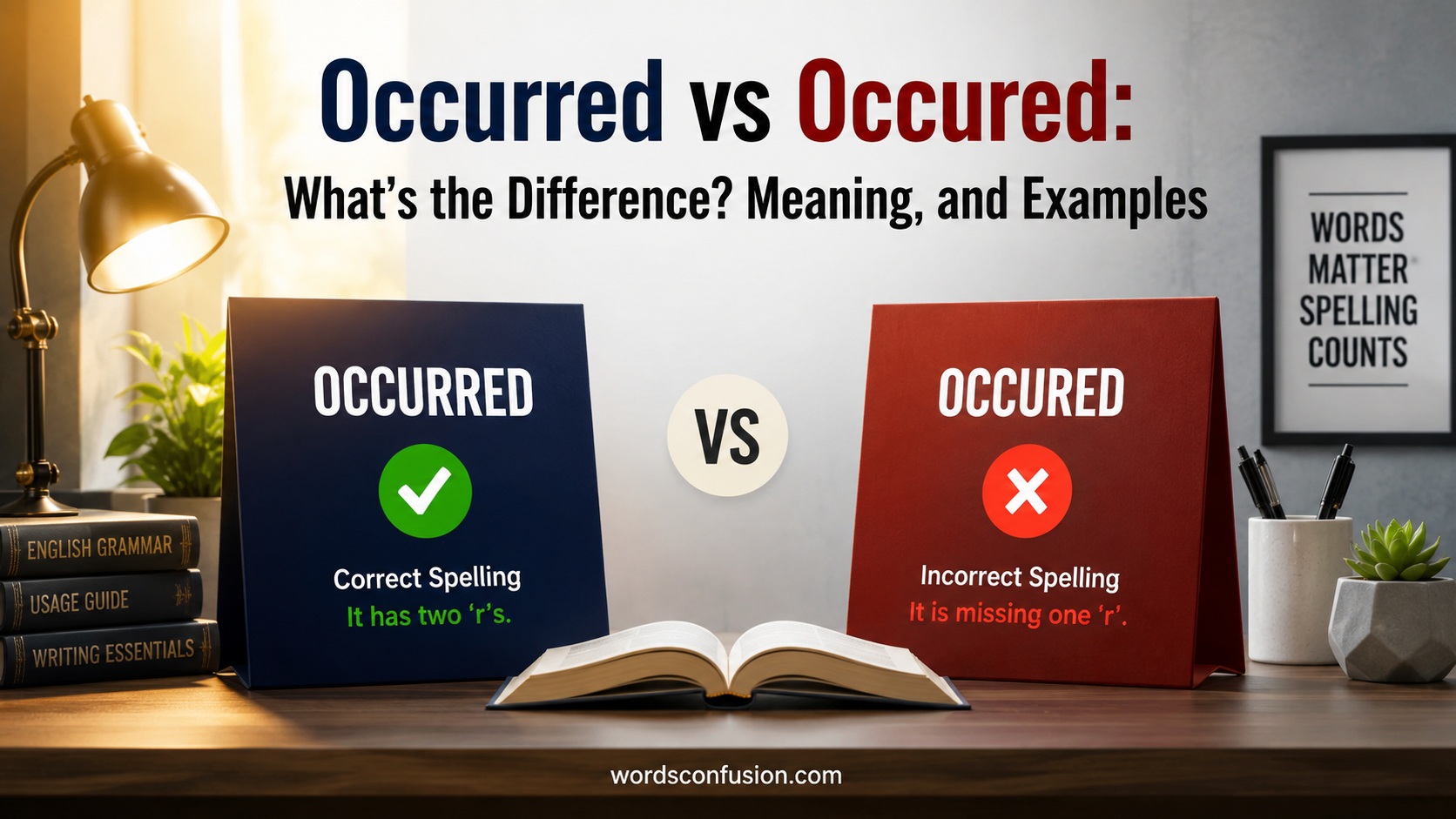
The confusion usually starts with the base verb occur. Since it ends with a single r, many people assume the past tense should simply add -ed to become occured. However, English spelling rules work differently. The correct past tense and past participle is occurred, not occured.
Whether you’re writing an email, an academic paper, a business report, or a social media post, using the correct spelling improves your credibility. A small spelling mistake can distract readers and make otherwise polished writing look careless.
In this guide, you’ll learn the difference between occurred vs occured, why only one spelling is correct, how the doubling rule works, common mistakes to avoid, memory tricks, and plenty of real-life examples that make the rule easy to remember.
Quick Answer
The answer is simple.
| Word | Correct? | Meaning |
| Occurred | Yes | The correct past tense and past participle of occur. |
| Occured | No | An incorrect spelling caused by forgetting to double the final r. |
Correct examples:
- The accident occurred late at night.
- An unexpected error occurred during the update.
- It never occurred to me that we were early.
Incorrect examples:
- The accident occured yesterday.
- An error occured during installation.
- It occured to me later.
Quick tip: If the verb is occur, the past tense always doubles the r before adding -ed.
Remember: If it happened, it occurred. It never occured.
What Does “Occurred” Mean?
The word occurred is the past tense and past participle of the verb occur. It means to happen, to take place, or to come into someone’s mind.
Although occurred often sounds more formal than happened, both words describe events. The difference lies mainly in tone and context.
Common Definitions of “Occurred”
Occurred can mean:
- Something happened.
- An event took place.
- A situation existed at a certain time.
- A thought suddenly came into someone’s mind.
Examples in Everyday English
- The meeting occurred earlier than expected.
- The power outage occurred after midnight.
- It suddenly occurred to me that I had forgotten my keys.
- Several mistakes occurred during the experiment.
Notice how naturally the word fits into both formal and informal writing.
Synonyms of “Occurred”
Depending on the sentence, occurred can often be replaced with:
| Synonym | Best Used For |
| Happened | Everyday conversation |
| Took place | Planned events |
| Came about | Informal writing |
| Transpired | Formal writing |
| Arose | Situations or problems |
| Emerged | Gradual developments |
Each synonym carries a slightly different tone, so choosing the right one depends on your audience.
Is “Occured” Ever Correct?
The short answer is no.
The spelling occured is always considered incorrect in standard American English and British English.
You may occasionally see it on blogs, discussion forums, social media posts, or even in professional documents. That doesn’t make it correct. It simply reflects one of the most common spelling mistakes in English.
Modern spell checkers automatically flag occured because dictionaries do not recognize it as a valid word.
Why Do People Write “Occured”?
Several factors contribute to the mistake.
The Base Word Ends with One “R”
Since occur has only one r, many people naturally assume adding -ed creates occured.
English doesn’t always work that way.
Double Letters Are Easy to Forget
Words with doubled consonants frequently confuse writers.
For example:
| Correct | Incorrect |
| Occurred | Occured |
| Preferred | Prefered |
| Referred | Refered |
| Transferred | Transfered |
| Inferred | Infered |
The same spelling rule applies to all of these words.
Pronunciation Doesn’t Help
When people say occurred, they don’t strongly pronounce both r letters.
Because pronunciation hides the doubled consonant, writers often forget it while typing.
Why Is “Occurred” Spelled with Double R?
This is where English spelling follows a predictable rule.
The verb occur becomes occurred because it follows the consonant doubling rule.
Instead of simply adding -ed, English doubles the final consonant before adding the ending.
The Rule Explained
A final consonant usually doubles when all three conditions are true:
- The word has more than one syllable.
- The final syllable receives the primary stress.
- The word ends with a single vowel followed by a single consonant.
Let’s test occur.
| Rule | Does “occur” qualify? |
| More than one syllable | Yes |
| Stress on last syllable | Yes |
| Ends vowel + consonant | Yes |
Since all three conditions are met, the r doubles.
occur → occurred
This isn’t a special exception. It’s a standard English spelling pattern.
More Words That Follow the Same Rule
| Base Verb | Past Tense |
| Refer | Referred |
| Prefer | Preferred |
| Infer | Inferred |
| Transfer | Transferred |
| Confer | Conferred |
Notice the pattern.
Every one of these verbs ends with a stressed syllable followed by a single consonant. Each doubles the final consonant before adding -ed.
Words That Do Not Double
Not every English verb doubles its final consonant.
Consider these examples.
| Base Verb | Past Tense |
| Open | Opened |
| Visit | Visited |
| Offer | Offered |
| Enter | Entered |
Why not?
Because the stress falls on the first syllable rather than the last.
For example:
- OPEN → opened
- VISit → visited
- OFfer → offered
Since the final syllable isn’t stressed, English doesn’t double the last consonant.
A Simple Memory Trick
Think about these three words together:
- occur → occurred
- refer → referred
- prefer → preferred
If preferred has two r letters, then occurred should too.
This simple comparison helps many learners remember the correct spelling instantly.
Pronunciation Guide: How to Pronounce “Occurred”
Even though occurred has two r letters, you don’t pronounce each one separately. That is one reason many people mistakenly write occured.
Pronunciation
Occurred is pronounced:
UK & US IPA: /əˈkɝːd/ or /əˈkɜːrd/
You can break it into syllables like this:
oc-curred
The stress falls on the second syllable.
Examples:
- The meeting occurred yesterday.
- An unexpected delay occurred during shipping.
Because the extra r isn’t clearly heard, many writers leave it out when spelling the word. That is perfectly understandable, but the correct spelling always includes two r letters.
When to Use “Occurred”
You should use occurred whenever you’re talking about something that happened, took place, or came into someone’s mind.
Although it has the same basic meaning as happened, occurred often sounds more formal. You’ll frequently see it in academic writing, news reports, scientific papers, legal documents, and business communication.
Using “Occurred” for Events
One of the most common uses of occurred is to describe events.
Examples:
- The accident occurred on Friday evening.
- The ceremony occurred at the city hall.
- The earthquake occurred shortly after sunrise.
- The meeting occurred earlier than planned.
In each sentence, occurred simply means happened.
Using “Occurred” for Thoughts
The phrase “it occurred to me” is extremely common in English.
It means that an idea suddenly entered your mind.
Examples:
- It occurred to me that I had left my wallet at home.
- It never occurred to her that the answer was so simple.
- The solution occurred to him while he was driving.
This expression is natural, fluent, and widely used by native English speakers.
Using “Occurred” in Scientific Writing
Researchers often use occurred because it sounds precise and objective.
Examples:
- The reaction occurred within five seconds.
- Cell division occurred more rapidly under higher temperatures.
- The mutation occurred naturally over several generations.
- The chemical change occurred after the solution was heated.
Scientific papers rarely use happened because occurred provides a more formal tone.
Using “Occurred” in Historical Writing
History books frequently describe past events with occurred.
Examples:
- The battle occurred in the eighteenth century.
- Major political reforms occurred after the election.
- The discovery occurred by accident.
- Significant cultural changes occurred over several decades.
The word fits naturally when discussing historical facts and timelines.
Using “Occurred” in Business Communication
Professional documents often favor occurred because it sounds clear and objective.
Examples:
- An error occurred while processing your payment.
- The issue occurred after the latest software update.
- The outage occurred during scheduled maintenance.
- A billing mistake occurred last month.
Many customer service emails also use this wording because it communicates facts without sounding emotional.
Common Phrases Using “Occurred”
Certain expressions appear repeatedly in everyday English. Learning them helps you sound more natural when speaking and writing.
It Occurred to Me
Meaning: A thought suddenly came into your mind.
Examples:
- It occurred to me that we had forgotten the tickets.
- It suddenly occurred to her that today was a holiday.
An Error Occurred
Meaning: A problem happened.
Examples:
- An error occurred while uploading the file.
- A system error occurred during installation.
You have probably seen this message on websites or apps.
The Incident Occurred
Meaning: An event or accident happened.
Examples:
- The incident occurred outside the stadium.
- The accident occurred just after sunset.
The Problem Occurred
Meaning: An issue developed.
Examples:
- The problem occurred after the update.
- The fault occurred without warning.
The Event Occurred
Meaning: Something took place.
Examples:
- The event occurred every summer.
- The celebration occurred despite the rain.
The Change Occurred
Meaning: Something became different.
Examples:
- The change occurred gradually.
- Most improvements occurred over several years.
These phrases appear regularly in newspapers, books, business reports, and everyday conversations.
Read More: Receive vs Recieve: Which Spelling Is Correct? Meaning, and Examples
Occurred in Different Tenses
Understanding how occur changes across different tenses makes it much easier to use correctly.
| Tense | Example |
| Simple Present | The error occurs every week. |
| Present Continuous | The issue is occurring again. |
| Simple Past | The error occurred yesterday. |
| Past Continuous | The problem was occurring repeatedly. |
| Present Perfect | The issue has occurred before. |
| Past Perfect | The error had occurred earlier. |
| Future Simple | The event will occur tomorrow. |
| Future Perfect | The change will have occurred by then. |
Notice that only the past tense and past participle use occurred.
Occurred vs Similarly Misspelled Words
The confusion surrounding occurred is not unique. English contains several verbs that follow the same doubling rule.
| Correct Spelling | Incorrect Spelling |
| Occurred | Occured |
| Referred | Refered |
| Preferred | Prefered |
| Transferred | Transfered |
| Inferred | Infered |
| Conferred | Confered |
Each correct word doubles the final r before adding -ed.
Once you recognize the pattern, remembering occurred becomes much easier.
Common Grammar Mistakes with “Occurred”
Even experienced writers occasionally misuse occurred. Fortunately, these mistakes are easy to avoid once you know what to watch for.
Mistake 1: Writing “Occured”
This is by far the most common error.
Incorrect:
- The accident occured yesterday.
Correct:
- The accident occurred yesterday.
Always double the r.
Mistake 2: Using the Wrong Verb Tense
Sometimes writers mix present and past forms.
Incorrect:
- The meeting occur yesterday.
Correct:
- The meeting occurred yesterday.
Past events require the past tense.
Mistake 3: Using “Occurred” for Planned Events That Sound Better with “Took Place”
While occurred is correct, another expression may sound more natural.
Compare these examples:
- The wedding occurred last Saturday.
- The wedding took place last Saturday.
Both are grammatically correct. However, took place often sounds smoother when describing scheduled events.
Mistake 4: Confusing “Occurred” with “Happened”
These words are close in meaning, but they don’t always fit the same context.
Natural:
- An accident occurred.
- An accident happened.
Less natural:
- It happened to me that I forgot my keys.
Better:
- It occurred to me that I forgot my keys.
The phrase “it occurred to me” is fixed and cannot usually be replaced with happened.
FAQs:
Is occurred or occured the correct spelling?
Occurred is the correct spelling. Occured is a misspelling and is not recognized as a correct English word. Whenever you refer to something that happened or took place, use occurred.
Why does occurred have two “r” letters?
The verb occur follows the English consonant-doubling rule. Because it has two syllables, the stress falls on the last syllable, and it ends with a single vowel followed by a single consonant, the final r doubles before adding -ed. This is the same pattern used in referred, preferred, and transferred.
Can I use occured in informal writing?
No. Whether you’re writing an email, text message, blog post, academic paper, or business report, occured is always considered incorrect. The correct spelling is occurred in every context.
What’s the difference between occurred and happened?
Both words mean that something took place, but occurred usually sounds more formal. You’ll often see it in news articles, research papers, official reports, and professional writing. Happened is more common in everyday conversations and casual writing.
How can I remember the correct spelling of occurred?
A simple trick is to connect it with similar words that also double the final r, such as preferred, referred, and transferred. If those words have two r letters, occurred does too.
Conclusion:
The debate over occurred vs occured has a straightforward answer. Occurred is the only correct spelling, while occured is a common spelling mistake that should always be avoided.
Understanding why the extra r appears makes the rule much easier to remember. Since occur follows the English consonant-doubling rule, the final r doubles before adding -ed, giving you occurred. The same pattern appears in words like referred, preferred, and transferred.

Andrew Wilson is an experienced language researcher and content writer specializing in WordsConfusion topics. He helps readers understand commonly confused English words, spelling differences, grammar rules, word meanings, and proper usage through clear explanations, practical examples, and easy-to-follow language guides. His goal is to make English learning simple, accurate, and accessible for students, writers, professionals, and everyday learners.