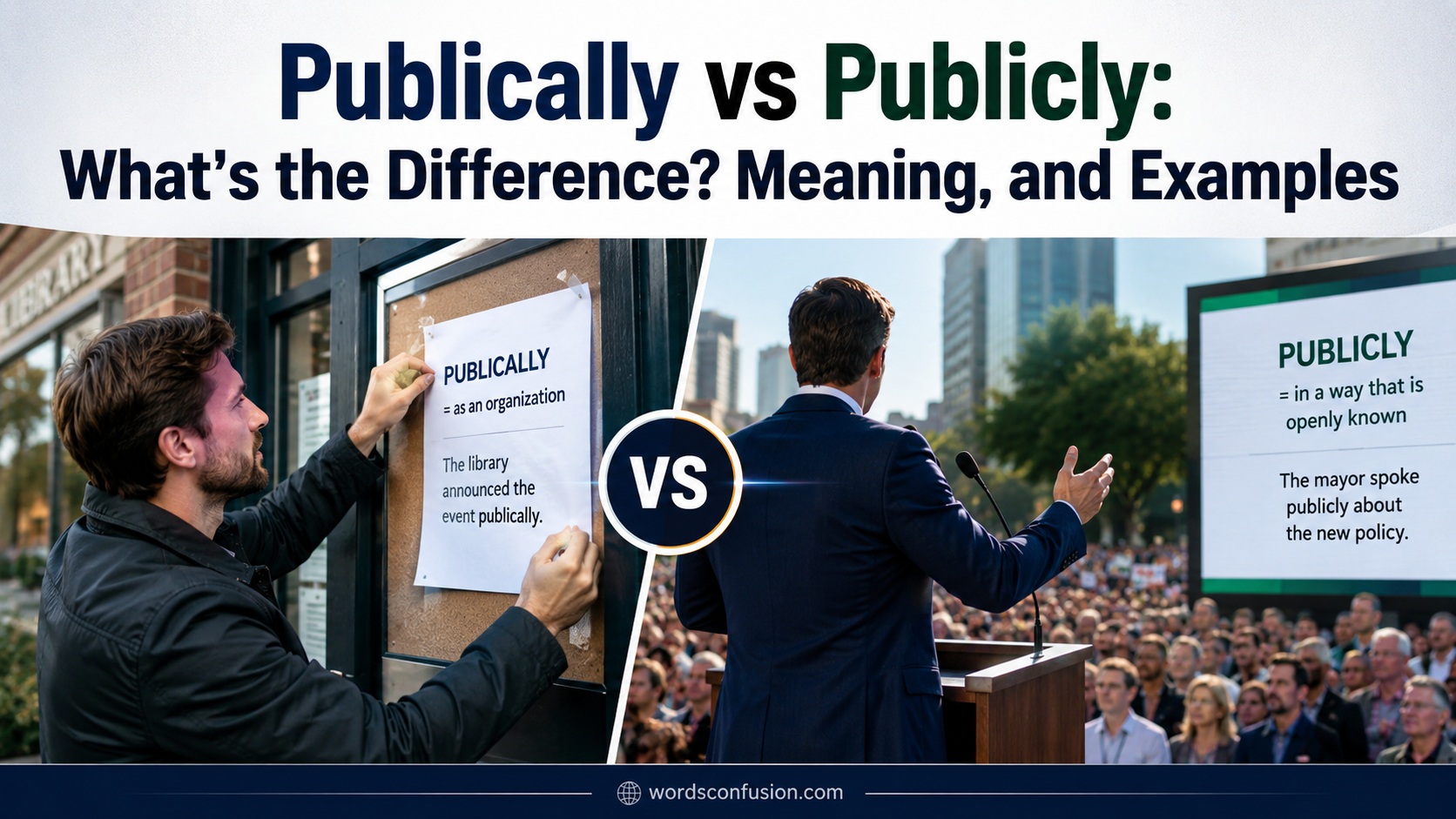
Have you ever paused while writing and wondered whether publically or publicly is the correct spelling? You’re not alone. This is one of the most common English spelling mistakes because both words look believable at first glance. However, only one is considered the standard spelling in modern English.
The confusion often happens because the adjective public ends with -ic, leading many people to assume the adverb should naturally become publically. English, however, doesn’t always follow predictable spelling patterns. In this case, the accepted adverb drops the extra -al, giving us publicly.
Whether you’re writing an email, preparing a business report, publishing a blog, or submitting an academic paper, using the correct spelling matters. A small spelling error can make otherwise polished writing appear less professional.
In this guide, you’ll learn the difference between publically vs publicly, discover why one spelling is correct, explore grammar rules, review dozens of real-world examples, and pick up an easy memory trick so you’ll never confuse these words again.
Quick Answer
The correct spelling is publicly.
Publically is generally considered a misspelling in modern American English and is also discouraged in most British English writing. Professional dictionaries, grammar guides, and style manuals recommend using publicly in virtually every context.
Here’s a quick comparison.
| Word | Correct? | Meaning |
| Publicly | Yes | In an open manner; in public; openly |
| Publically | No | Generally treated as a misspelling of publicly |
In short:
- Always write publicly in formal and informal writing.
- Avoid publically unless you’re quoting an old document or reproducing someone else’s original text.
- Spell checkers and grammar tools typically flag publically as incorrect.
Publically vs Publicly: What’s the Difference?
At first glance, these words seem almost identical. The only visible difference is the extra “al” in publically. Yet that single addition changes everything because only one spelling follows modern English standards.
Publicly is the accepted adverb of the adjective public. It describes something done openly or in front of other people.
For example:
- The company publicly apologized for the mistake.
- She publicly supported the new policy.
- The results were publicly announced during the conference.
By contrast, publically isn’t recognized as the standard spelling in reputable dictionaries. Although you may occasionally encounter it online or in older texts, most editors consider it an error.
The difference becomes even clearer in professional writing.
| Feature | Publicly | Publically |
| Standard English spelling | Yes | No |
| American English | Accepted | Incorrect |
| British English | Accepted | Rare and discouraged |
| Academic writing | Recommended | Avoid |
| Business writing | Recommended | Avoid |
| Journalism | Standard | Avoid |
Whenever you need an adverb meaning openly or in public, choose publicly.
What Does “Publicly” Mean?
The word publicly is an adverb. It describes an action performed openly, before other people, or in a way that anyone can observe.
Definition of Publicly
Publicly means:
- In public.
- Openly.
- In a manner visible to everyone.
- Before a general audience.
- Without secrecy.
Pronunciation
Publicly is pronounced:
/PUB-lik-lee/
Although the pronunciation sounds like public-lee, the spelling remains publicly without adding -al-.
Part of Speech
Publicly functions as an adverb because it modifies verbs, adjectives, or entire clauses.
Examples:
- He publicly admitted the mistake.
- The organization was publicly recognized.
- She publicly thanked every volunteer.
Common Synonyms
Depending on context, you can replace publicly with:
- Openly
- Transparently
- Before everyone
- In public
- Outwardly
- Officially
- Before an audience
- For everyone to see
Keep in mind that these words aren’t always interchangeable. For example, officially refers to authority or formal approval, while publicly focuses on visibility.
Example Sentences
Here are examples from different situations.
Everyday English
- They publicly celebrated their anniversary.
- She publicly thanked her parents during the ceremony.
- He publicly admitted he was wrong.
Business
- The CEO publicly announced the merger.
- Investors appreciated how the company publicly disclosed its financial results.
- The organization publicly released its sustainability report.
Education
- The university publicly recognized outstanding students.
- Scholarship winners were publicly announced.
- The principal publicly congratulated the debate team.
Government
- Officials publicly confirmed the new regulations.
- The mayor publicly addressed residents.
- Government data is publicly available online.
Media
- The actor publicly responded to the rumors.
- The athlete publicly apologized after the interview.
- The singer publicly thanked fans on social media.
Is “Publically” Ever Correct?
This question surprises many writers because publically appears in blog posts, comments, and even some published materials.
The reality is much simpler.
In modern English, publically is not the preferred spelling.
Major dictionaries recognize publicly as the correct form. Editors, teachers, publishers, and style guides consistently recommend using it.
So why does publically appear online?
Several reasons explain its existence.
People Assume the Spelling Is Logical
Many English words ending in -al become adverbs ending in -ally.
For example:
- Natural → Naturally
- Formal → Formally
- Legal → Legally
Because of this familiar pattern, writers often assume:
Public → Publical → Publically
The problem is that publical isn’t the adjective. The adjective is simply public, so English forms the adverb differently.
Older Publications Occasionally Used It
Some nineteenth-century books and newspapers contain publically. At the time, English spelling wasn’t as standardized as it is today.
Modern dictionaries, however, overwhelmingly favor publicly.
Typing Habits
Sometimes people instinctively add -ally because countless English adverbs follow that structure.
Examples include:
- Normally
- Globally
- Personally
- Politically
This habit makes publically look reasonable even though it isn’t standard English.
Professional Recommendation
If you’re writing:
- School assignments
- College essays
- Business emails
- Legal documents
- Website content
- Books
- Marketing materials
Always use publicly.
Doing so ensures your writing aligns with current grammar standards and professional expectations.
Why Is “Publicly” Spelled Without “Al”?
One reason people confuse publically vs publicly is that English spelling doesn’t always follow a single pattern. While many adverbs end in -ally, publicly is one of several exceptions.
The adjective public comes from the Latin word publicus. When English forms the adverb, it adds -ly directly instead of creating an intermediate word like publical.
That’s why the correct form is:
- Public → Publicly
- Public → Publically
Although publically may seem logical, modern English doesn’t recognize it as the standard spelling.
Why the Extra “Al” Feels Natural
Many common adjectives become adverbs by adding -ally.
For example:
| Adjective | Adverb |
| Basic | Basically |
| Dramatic | Dramatically |
| Automatic | Automatically |
| Historic | Historically |
| Scientific | Scientifically |
Because these words follow a familiar pattern, many writers assume public should become publically.
It doesn’t.
English contains several spelling exceptions, and publicly is one of them.
The Rule to Remember
Think of it this way:
If the adjective is “public,” simply add “-ly” to form the adverb: publicly.
Don’t invent the word publical, because it isn’t the adjective English uses today.
Publicly vs Publically: Side-by-Side Comparison
If you’re still unsure which spelling to choose, this table makes the difference easy to understand.
| Feature | Publicly | Publically |
| Standard spelling | Yes | No |
| Found in modern dictionaries | Yes | Rarely as a preferred form |
| Accepted in American English | Yes | No |
| Accepted in British English | Yes | Generally avoided |
| Appropriate for academic writing | Yes | No |
| Appropriate for business writing | Yes | No |
| Used by professional editors | Yes | No |
| Recommended for SEO content | Yes | No |
Whenever you have a choice, publicly is always the safer and more professional option.
When to Use “Publicly”
You should use publicly whenever something happens openly or can be seen, heard, or known by other people.
Let’s look at common situations where this word naturally fits.
Publicly in Academic Writing
Universities and researchers often use publicly when discussing information available to everyone.
Examples:
- The findings were publicly released after peer review.
- The database is publicly accessible.
- Researchers publicly shared their methodology.
Publicly in Business Communication
Businesses frequently communicate with customers, shareholders, and employees using this word.
Examples:
- The company publicly announced its quarterly earnings.
- Management publicly thanked employees for their hard work.
- The brand publicly responded to customer concerns.
Publicly in Emails
Professional emails sometimes require this adverb.
Examples:
- Please don’t publicly share confidential information.
- The announcement will be publicly available tomorrow.
- We haven’t publicly confirmed the schedule yet.
Publicly in News Articles
Journalists regularly use publicly because they report statements made before an audience.
Examples:
- The governor publicly addressed the controversy.
- Officials publicly denied the allegations.
- The report was publicly released on Monday.
Publicly on Social Media
Social media has made the word even more common.
Examples:
- She publicly thanked her followers.
- The athlete publicly apologized after the match.
- The creator publicly answered viewers’ questions.
Publicly in Legal and Government Documents
Government agencies often distinguish between private records and information available to everyone.
Examples:
- Court records are publicly available.
- The agency publicly disclosed the investigation’s findings.
- The document was publicly posted on the official website.
Examples of “Publicly” in Sentences
Seeing the word in context makes it much easier to remember.
Everyday Examples
- She publicly congratulated her brother after graduation.
- They publicly celebrated their championship victory.
- He never publicly complains about his coworkers.
- The family publicly thanked everyone for their support.
- We publicly announced our engagement yesterday.
- The restaurant publicly apologized for the delay.
- The coach publicly praised the entire team.
- She publicly defended her friend.
- The museum publicly displayed the historic painting.
- Our neighborhood publicly honored local veterans.
Professional Examples
- The company publicly released its annual report.
- Executives publicly discussed future expansion plans.
- Investors welcomed the firm’s publicly available financial statements.
- The publicly accepted responsibility for the mistake.
- Management publicly recognized outstanding employees.
- The organization publicly announced its charity partnership.
- Leaders publicly supported the new initiative.
- The board publicly approved the proposal.
- The corporation publicly disclosed environmental data.
- Employees were publicly thanked during the meeting.
Academic Examples
- Researchers publicly shared the study results.
- The university publicly honored top graduates.
- The lecture was publicly livestreamed.
- Students publicly presented their final projects.
- The findings became publicly available after publication.
- Professors publicly acknowledged their research assistants.
- The institution publicly funded the project.
- Scientists publicly explained their conclusions.
- The committee publicly released the evaluation report.
- Scholarship recipients were publicly recognized.
Read More: Until vs Untill: What’s the Difference? Meaning, and Examples
Common Mistakes People Make
The debate over publically vs publicly usually comes down to a few predictable errors.
Understanding them helps you avoid making the same mistake.
Adding an Unnecessary “Al”
This is by far the most common error.
Incorrect:
- The company publically apologized.
Correct:
- The company publicly apologized.
Assuming Pronunciation Determines Spelling
Many people spell words exactly as they hear them.
However, English pronunciation doesn’t always reveal the correct spelling.
For example:
- Business
- Wednesday
- Colonel
- Publicly
Each has spelling patterns that don’t perfectly match pronunciation.
Confusing Adjectives and Adverbs
Remember the difference.
| Word | Part of Speech | Example |
| Public | Adjective | Public opinion matters. |
| Publicly | Adverb | She publicly apologized. |
If the word describes how an action happens, you’ll usually need the adverb publicly.
Trusting Incorrect Online Sources
The internet contains millions of articles written without professional editing.
If enough websites repeat the misspelling publically, search engines may still display it.
That doesn’t make it correct.
When checking grammar, rely on trusted dictionaries and established style guides instead of random blogs or forum posts.
Why Do People Write “Publically”?
Misspellings rarely happen by accident alone. Usually, there’s a logical explanation behind them.
The Word Looks More Complete
Many people instinctively believe publically looks more balanced because it resembles words like:
- Practically
- Logically
- Academically
- Economically
Our brains naturally search for familiar spelling patterns.
School Grammar Rules Can Be Misleading
Students often learn that many adjectives form adverbs by adding -ly or -ally.
While that’s generally true, English also contains exceptions.
Publicly is one of those exceptions.
Autocorrect Doesn’t Always Save You
Although many writing tools flag publically, not every keyboard or text editor catches it immediately.
Older software may even ignore the mistake.
That’s another reason to proofread carefully.
Seeing Others Use It
Language spreads through imitation.
If you repeatedly see publically in blog posts, online comments, or social media captions, you may begin to assume it’s acceptable.
Professional editors, however, still recommend publicly in modern writing.
FAQs:
Is publically a real word?
Publically has appeared in some historical texts and older publications, but it is not the standard spelling in modern English. Today, dictionaries, grammar experts, and style guides recommend using publicly in nearly every situation.
Which spelling is correct: publically or publicly?
The correct spelling is publicly. Whether you’re writing an email, blog post, business report, academic paper, or social media update, publicly is the accepted and professional choice.
Why is it spelled publicly instead of publically?
Although many English adverbs end in -ally, publicly is an exception. The adverb is formed directly from the adjective public, so no extra “al” is added. This spelling has become the accepted standard in both American and British English.
Can I use publically in formal writing?
No. You should avoid publically in formal writing, including academic essays, business documents, legal papers, and professional publications. Using publicly ensures your writing follows modern English grammar and spelling conventions.
How can I remember the correct spelling?
A simple trick is to remember that public already ends with the complete adjective. Just add -ly:
- Public → Publicly
There’s no word publical, so there’s no reason to write publically.
Conclusion:
The debate over publically vs publicly is easier to settle than many people think. Publicly is the correct spelling recognized by modern dictionaries, grammar guides, and professional style manuals. While publically may occasionally appear in older texts or on unedited websites, it is generally treated as a misspelling and should be avoided in contemporary writing.
Whenever you want to describe an action performed openly, before others, or in a way that everyone can see or know, choose publicly. It’s the spelling you’ll find in newspapers, academic journals, government documents, business communications, and everyday English.

Andrew Wilson is an experienced language researcher and content writer specializing in WordsConfusion topics. He helps readers understand commonly confused English words, spelling differences, grammar rules, word meanings, and proper usage through clear explanations, practical examples, and easy-to-follow language guides. His goal is to make English learning simple, accurate, and accessible for students, writers, professionals, and everyday learners.