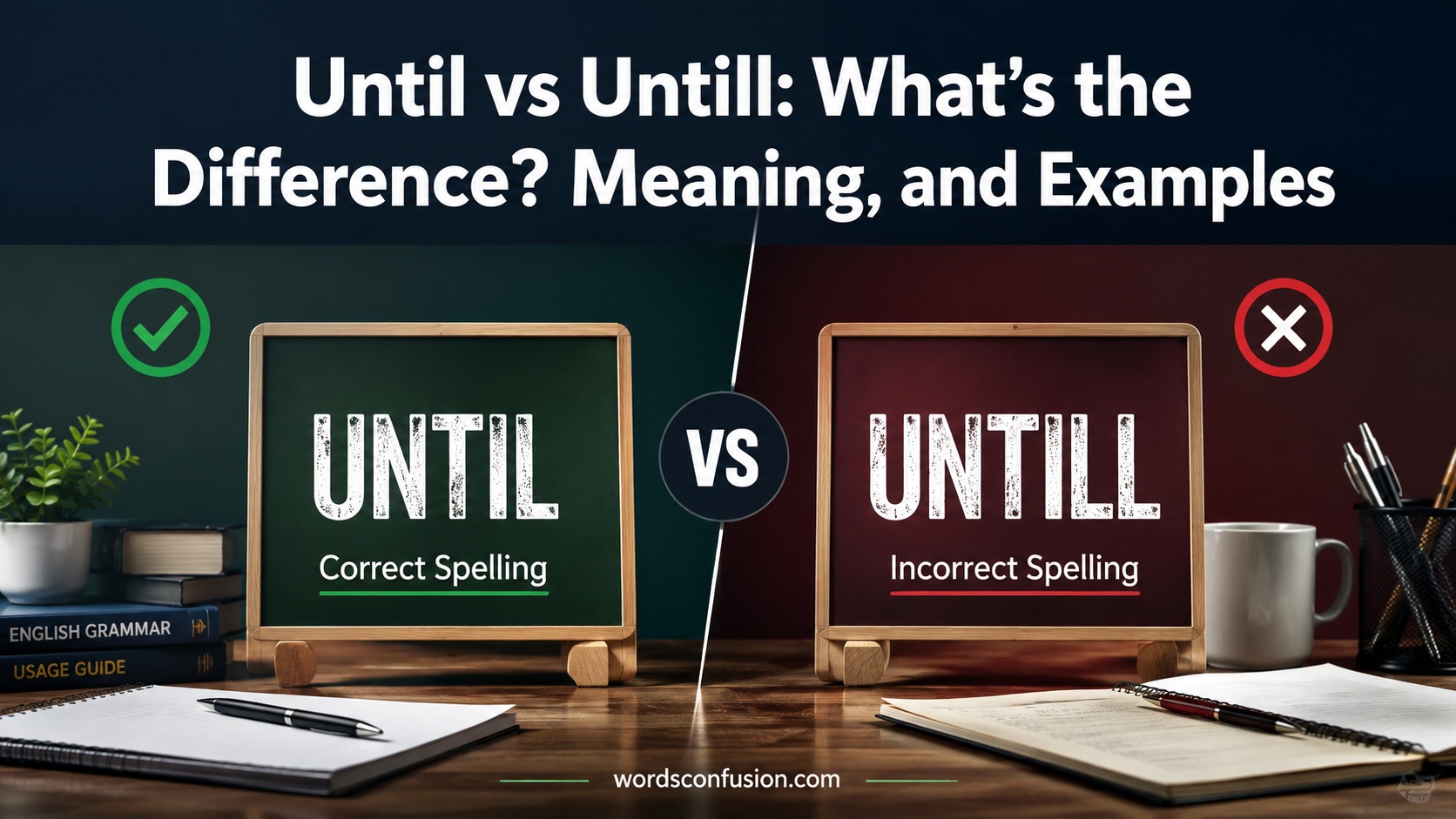
Have you ever paused while typing until and wondered whether it should have one L or two? You’re not alone. Thousands of people search for “until vs untill” every month because the extra L seems like it should belong there. After all, English includes words like still, will, and skill, so it’s easy to assume untill follows the same pattern.
However, English spelling doesn’t always follow what feels logical. In this case, only one spelling is accepted in standard English while the other is considered a spelling mistake.
Whether you’re writing an email, preparing an academic paper, publishing a blog, or simply improving your grammar, knowing the correct form helps you communicate with confidence. Even a small spelling mistake can affect the professionalism of your writing.
This guide explains everything you need to know about until vs untill. You’ll learn the correct spelling, understand why so many people make this mistake, discover simple grammar rules, compare similar words, and see dozens of real-life examples that make the concept easy to remember.
Quick Answer
If you’re looking for the short answer, here it is.
Until is the only correct spelling in American English and British English.
Untill is incorrect and does not appear as an accepted word in reputable English dictionaries.
| Word | Correct? | Meaning |
| Until | Yes | Up to a particular time, event, or condition |
| Untill | No | Incorrect spelling of until |
Quick Examples
Correct
- I’ll wait until you arrive.
- The library stays open until 9 p.m.
- Don’t leave until I call you.
Incorrect
- I’ll wait untill you arrive.
- The office is open untill Friday.
- Stay here untill dinner.
The rule is simple:
Always write “until.” Never write “untill.”
Until vs Untill: What Is the Difference?
The difference between until and untill is surprisingly simple.
One is a correctly spelled English word. The other is a common spelling error.
| Feature | Until | Untill |
| Correct English spelling | Yes | No |
| Found in dictionaries | Yes | No |
| Accepted in formal writing | Yes | No |
| Used in academic papers | Yes | No |
| Recommended by grammar checkers | Yes | No |
| Should you use it? | Always | Never |
Although the words look similar, only until belongs in professional writing, school assignments, books, websites, business emails, and everyday communication.
Many spell-check tools automatically underline untill because it isn’t recognized as a valid English word.
What Does “Until” Mean?
The word until refers to a point in time or an event that marks the end of something. It tells readers how long an action continues or when another action begins.
Depending on the sentence, until can function as either a preposition or a conjunction.
Here are a few definitions in simple language:
- Up to a specific time.
- Before a particular event happens.
- Continuing throughout a period.
Examples
- We waited until sunset.
- She studied until midnight.
- Stay here until I come back.
- The museum remains open until 6 p.m.
- They practiced every day until the tournament started.
In every example, until introduces the time when something changes.
Is “Untill” a Real Word?
No.
Untill is not a real English word.
You’ll rarely find it outside of spelling mistakes, informal online posts, or typing errors. Every major English dictionary recognizes until, not untill.
If you submit schoolwork, publish articles, or send professional emails with untill, grammar software will usually mark it as incorrect.
Here is a simple comparison.
| Question | Answer |
| Is untill in the dictionary? | No |
| Is untill accepted in formal English? | No |
| Should students use untill? | Never |
| Should businesses use untill? | Never |
| Is until always correct? | Yes |
Think of untill the same way you would think of misspellings like:
- recieve
- seperated
- goverment
- definately
They may appear online, but they are still incorrect.
Why Do People Misspell “Until” as “Untill”?
If untill is wrong, why do so many people write it?
The answer lies in the way our brains recognize spelling patterns.
English contains hundreds of words ending with double letters, so adding another L feels natural even though it isn’t correct.
Here are the most common reasons.
Double-L Pattern Confusion
Words such as these all end with LL.
- Still
- Will
- Skill
- Drill
- Fill
Because these words are common, many writers instinctively type untill instead of until.
Pronunciation Doesn’t Help
When spoken aloud, until doesn’t strongly emphasize the ending.
Whether someone writes until or untill, both usually sound the same.
As a result, pronunciation doesn’t reveal the correct spelling.
Fast Typing
Many spelling mistakes happen simply because people type quickly.
The second L often appears by accident, especially on keyboards where the same key is pressed twice.
Autocorrect Isn’t Perfect
Modern spell-checkers catch most errors, yet mistakes still slip through.
If someone disables spell-check or ignores correction suggestions, untill may remain in the final document.
Learning English as a Second Language
English learners often rely on pronunciation rather than memorized spelling.
Since many English words double their final consonants, writing untill seems reasonable at first.
Fortunately, this mistake is easy to fix once you know the correct spelling.
How to Use “Until” Correctly
Using until correctly is much easier than many people expect.
In most situations, it simply marks the point where something changes.
Ask yourself one question:
“Does this sentence describe time or the end of an action?”
If the answer is yes, until is probably the right choice.
Until as a Preposition
A preposition connects a noun or pronoun to another part of the sentence.
When until acts as a preposition, it comes before a noun or noun phrase.
Examples
- The store is open until Friday.
- We stayed there until morning.
- She worked until sunset.
- The tickets remain valid until December.
- I’ll be busy until next week.
Notice that every sentence names a specific point in time.
Until as a Conjunction
As a conjunction, until joins two clauses together.
One action continues, then another action happens.
Examples
- Wait until I finish.
- Don’t leave until your name is called.
- She practiced until she mastered the piano piece.
- We talked until everyone went home.
- Keep reading until you reach the final chapter.
This structure appears frequently in both spoken and written English.
Until in Negative Sentences
Negative sentences often include until because they describe something that does not happen before a certain time.
Examples
- I didn’t understand the lesson until today.
- He won’t sign the contract until his lawyer reviews it.
- They didn’t arrive until midnight.
- She couldn’t sleep until the rain stopped.
- The game won’t begin until everyone is ready.
These sentences emphasize the moment when something finally becomes true.
Common Sentence Patterns
Learning a few common patterns makes until much easier to remember.
| Pattern | Example |
| Verb + until + time | Wait until tomorrow. |
| Verb + until + event | Stay until dinner. |
| Negative verb + until | I didn’t know until yesterday. |
| Until + clause | Until you apologize, nothing will change. |
| Until + noun | Open until midnight. |
These structures appear every day in conversations, newspapers, novels, emails, and business writing.
Once you become familiar with them, choosing the correct spelling becomes almost automatic.
Until in American vs British English
One question appears frequently in grammar discussions:
Is “until” spelled differently in American and British English?
The answer is simple.
No. Both American English and British English use the exact same spelling: until.
Unlike words such as color/colour, center/centre, or traveled/travelled, there is no regional spelling variation for until.
| English Variety | Correct Spelling | Incorrect Spelling |
| American English | Until | Untill |
| British English | Until | Untill |
| Canadian English | Until | Untill |
| Australian English | Until | Untill |
This means you never need to change the spelling based on your audience. Whether you’re writing for readers in New York, London, Sydney, or Toronto, until is always the correct choice.
Does Pronunciation Change?
The pronunciation may vary slightly because of regional accents, yet the spelling never changes.
For example:
- American speakers may pronounce it with a flatter u sound.
- British speakers may pronounce the vowels slightly differently.
Despite these differences, everyone writes the word as until.
Common Grammar Rules for “Until”
Knowing the spelling is only part of the story. Understanding how until works in sentences will help you write more naturally.
Let’s look at the grammar rules that writers often confuse.
Until vs Till
Many people believe till is simply a shortened form of until.
Interestingly, that’s not true.
The word till actually existed in English before the word until.
Today, both words are correct. The main difference lies in style rather than grammar.
| Feature | Until | Till |
| Correct spelling | Yes | Yes |
| Formal writing | Preferred | Acceptable but less common |
| Academic writing | Recommended | Less common |
| Everyday conversation | Very common | Very common |
| Meaning | Same | Same |
Examples
Using Until
- Stay here until noon.
- I’ll work until Friday.
- Don’t leave until I return.
Using Till
- Stay here till noon.
- I’ll wait till tomorrow.
- We talked till midnight.
Although both words are correct, until generally sounds more formal and appears more often in business writing, essays, books, and professional communication.
Until vs By
This is one of the most common grammar mistakes.
Although both words refer to time, they do not mean the same thing.
By means before or no later than a specific time.
Until means continuing up to that specific time.
| Word | Meaning |
| By | Before a deadline |
| Until | Continuing up to a deadline |
Examples
By
- Please finish the report by Friday.
- Submit your application by noon.
- I’ll call you by 5 p.m.
These sentences focus on deadlines.
Until
- I’ll work until Friday.
- The office stays open until noon.
- She remained awake until sunrise.
These sentences focus on duration.
A simple way to remember the difference is this:
- By tells you when something must happen.
- Until tells you how long something continues.
Until vs Unless
Because both words begin with un-, learners often mix them up.
However, they have completely different meanings.
| Word | Meaning |
| Until | Refers to time |
| Unless | Refers to a condition |
Examples
Until
- Wait until I call.
- Keep studying until the exam begins.
Unless
- Don’t leave unless I call.
- You won’t pass unless you study.
Notice the difference.
Until answers “When?”
Unless answers “Under what condition?”
Understanding this distinction makes your writing much more accurate.
Until vs Untill: Side-by-Side Comparison
Sometimes, the easiest way to understand two similar words is through a direct comparison.
The table below summarizes everything you need to remember.
| Feature | Until | Untill |
| Correct English word | Yes | No |
| Recognized by dictionaries | Yes | No |
| Accepted in schools | Yes | No |
| Used in books | Yes | No |
| Professional writing | Yes | No |
| Business emails | Yes | No |
| Academic papers | Yes | No |
| Appears in grammar guides | Yes | Only as a spelling mistake |
| Recommended spelling | Always | Never |
The comparison makes one fact perfectly clear.
Until is the only spelling you should ever use.
Read More: Occurred vs Occured: What’s the Difference? Meaning, and Examples
Examples of “Until” in Everyday Sentences
Grammar rules become much easier to understand when you see them in real situations.
Below are practical examples from everyday life.
Workplace Examples
- I’ll stay at the office until the project is finished.
- The meeting continued until everyone agreed on the proposal.
- Please don’t submit the report until you’ve checked the numbers.
- The support team works until 8 p.m.
- We waited until the manager arrived.
School Examples
- Students studied until the final exam.
- The classroom remains open until 5 p.m.
- Don’t answer until you’ve read every question.
- She practiced math until she understood the lesson.
- The library stays open until midnight during finals.
Daily Conversation Examples
- Wait until I get home.
- We laughed until our stomachs hurt.
- Stay here until dinner is ready.
- I’ll keep trying until I succeed.
- They watched movies until midnight.
Travel Examples
- The train won’t leave until everyone boards.
- We’ll drive until we reach the hotel.
- Keep your passport safe until the trip ends.
- We explored the city until sunset.
- The museum stays open until 7 p.m.
Business Writing Examples
- The agreement remains valid until December 31.
- Payment must be received until the contract expires. (Better: before the contract expires, depending on context.)
- The promotion runs until the end of the month.
- Access continues until your subscription ends.
- Employees may update their information until Friday afternoon.
Academic Writing Examples
- Continue collecting data until the experiment concludes.
- Observe the reaction until the color changes.
- Record measurements until the timer reaches five minutes.
- Students should revise until they understand each concept.
- Keep reading until you finish the assigned chapter.
Common Mistakes to Avoid
Even experienced writers occasionally misuse until.
Here are the mistakes that appear most often.
Writing “Untill”
This is the most common mistake.
Incorrect
- I’ll wait untill tomorrow.
Correct
- I’ll wait until tomorrow.
Confusing “Until” with “By”
These words don’t mean the same thing.
Incorrect
- I’ll work by Friday.
Correct
- I’ll work until Friday.
If you’re talking about how long something continues, choose until.
Using “Till” in Formal Writing
Although till is correct, many editors prefer until in formal documents because it sounds slightly more polished.
Using the Wrong Verb Tense
When until introduces a future time clause, English normally uses the present simple, not will.
Incorrect
- Wait until she will arrive.
Correct
- Wait until she arrives.
Forgetting What “Until” Means
Remember that until always marks the point where something ends or changes.
If the sentence doesn’t involve time or duration, another word may fit better.
FAQs:
Is untill a real English word?
No. Untill is not a recognized English word. It is a common spelling mistake. The correct spelling is until, which appears in all major English dictionaries and is accepted in both American and British English.
Why do people spell until as untill?
Many people accidentally add an extra L because English contains many words ending in -ll, such as still, will, and fill. Fast typing, pronunciation, and unfamiliarity with the correct spelling also contribute to this common error.
Is till the same as until?
Yes. Till and until have the same meaning and are both grammatically correct. However, until is generally preferred in formal writing, academic papers, and professional communication, while till appears more often in casual conversation and informal writing.
What’s the difference between until and by?
Although both relate to time, they have different meanings. Until describes an action that continues up to a specific point, while by refers to a deadline before or no later than a particular time.
Example:
- I’ll work until 6 p.m. (The work continues up to 6 p.m.)
- Please submit the report by 6 p.m. (The report must be submitted before or at 6 p.m.)
Is until correct in both American and British English?
Yes. Until is the correct spelling in American English, British English, Canadian English, Australian English, and other major varieties of English. The spelling never changes based on the region.
Conclusion:
The debate over until vs untill has a straightforward answer. Until is the only correct spelling, while untill is simply a misspelling that should never appear in formal or informal writing.
Beyond spelling, understanding how until functions as both a preposition and a conjunction helps you write with greater clarity. It marks the point where an action ends or a new event begins, making it an essential word in everyday English.
Whenever you’re unsure, remember one simple rule: until has only one “L.” Whether you’re writing an email, an academic paper, a business report, or a social media post, using until correctly will make your writing more polished, professional, and grammatically accurate. With the grammar rules, examples, comparisons, and memory tricks covered in this guide, you’ll never have to second-guess until vs untill again.

Andrew Wilson is an experienced language researcher and content writer specializing in WordsConfusion topics. He helps readers understand commonly confused English words, spelling differences, grammar rules, word meanings, and proper usage through clear explanations, practical examples, and easy-to-follow language guides. His goal is to make English learning simple, accurate, and accessible for students, writers, professionals, and everyday learners.