
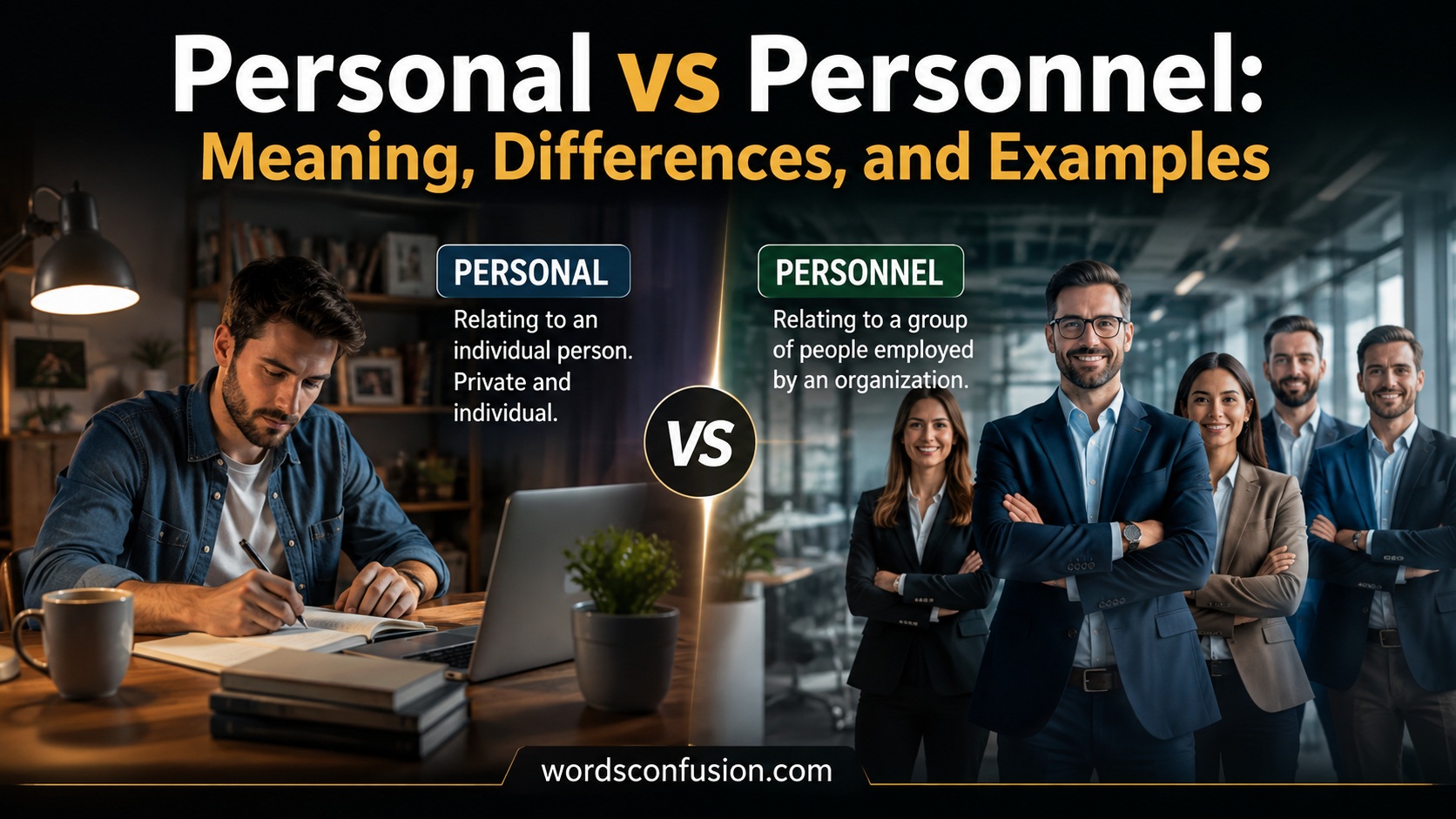
If you’ve ever paused over personal vs personnel, you’re not alone. These two words look almost identical, sound similar, and share the same root connected to the idea of people. Yet they play very different roles in English.
The difference becomes especially important in workplace writing. For example, personal information means private information about an individual, while personnel information usually relates to employees or staff. One small spelling difference can completely change the meaning of a sentence.
The easiest way to remember the distinction is simple: personal describes something connected to an individual, while personnel refers to the people who work for an organization.
Once you understand that basic split, the rest falls into place.
Quick Answer
Personal means relating to a particular person, their private life, their belongings, opinions, experiences, or individual choices. It usually works as an adjective.
Personnel means the people employed by or working for an organization, company, institution, or military unit. It functions mainly as a noun.
| Word | Meaning | Part of Speech | Example |
| Personal | Related to an individual or private life | Adjective | This is my personal opinion. |
| Personnel | Employees or staff of an organization | Noun | All personnel must attend the meeting. |
Quick memory trick:
Personal → person → one individual
Personnel → people working in an organization → staff
So, if you’re talking about someone’s private matters, choose personal. If you’re talking about employees or staff, choose personnel.
Comparison Overview
The clearest way to understand personal vs personnel is to compare their meanings, grammar, and typical contexts side by side.
| Feature | Personal | Personnel |
| Core meaning | Related to an individual | Employees or staff |
| Main grammatical role | Adjective | Noun |
| Usually refers to | One person or that person’s affairs | A group of workers |
| Common contexts | Private life, opinions, belongings, choices | Businesses, government, military, hospitals |
| Example | She shared her personal experience. | Hospital personnel treated the patient. |
| Common phrase | Personal information | Medical personnel |
| Related word | Person | People, employees, staff |
| Pronunciation | PUR-suh-nuhl | pur-suh-NEL |
The two words aren’t interchangeable. In fact, replacing one with the other can create a completely different meaning.
Consider these examples:
- Please protect your personal information.
- Please protect hospital personnel.
The first sentence discusses someone’s private data. The second discusses employees working at a hospital.
That tiny spelling difference carries a big semantic load.
Main Differences Between Personal vs Personnel
The central difference between personal vs personnel comes down to individual matters versus employees.
Personal describes something that belongs to, concerns, or comes from a particular person. Personnel identifies the people who work for an organization.
Think of it this way:
Personal describes the person. Personnel describes the people at work.
This distinction works in most everyday situations.
Personal Relates to an Individual
When something belongs to you or concerns your private life, personal is usually the right choice.
For example:
- personal opinion
- personal experience
- personal belongings
- personal information
- personal decision
- personal responsibility
- personal preference
- personal relationship
- personal space
- personal goals
In each phrase, personal connects an idea or object to an individual.
For example, when you say, “That’s my personal opinion,” you’re distinguishing your own view from an official position or someone else’s opinion.
Personnel Refers to Employees or Staff
Personnel refers to people who work for an organization or serve in a particular professional capacity.
For example:
- company personnel
- military personnel
- medical personnel
- security personnel
- administrative personnel
- emergency personnel
- support personnel
- government personnel
Here, personnel doesn’t describe a private quality. It identifies workers collectively.
If a hospital announces that its medical personnel responded to an emergency, the phrase refers to the doctors, nurses, technicians, or other healthcare workers involved.
Personal Is Usually an Adjective
The most common grammatical role of personal is adjective.
It modifies a noun:
- personal computer
- personal choice
- personal account
- personal problem
- personal belief
- personal achievement
For instance:
She made a personal decision about her career.
The word personal tells you what kind of decision it was.
Personnel Is a Noun
Personnel normally acts as a noun.
For example:
The company hired additional personnel.
Here, personnel is the group of employees being discussed.
You generally don’t say “a personnel” when referring to one worker. Instead, use an employee, a staff member, a worker, or a member of the personnel.
For example:
- Correct: The company hired three new personnel.
- Better in ordinary business English: The company hired three new employees.
- Incorrect: The company hired a personnel.
Because personnel is a collective or mass noun, it normally refers to workers as a group.
What Does Personal Mean?
Personal describes something connected with a particular person rather than with people generally or an organization as a whole.
The word has several closely related meanings. Understanding these meanings makes it much easier to use correctly.
Personal Means Belonging to a Person
If something belongs to you individually, it can be described as personal.
Examples include:
- personal belongings
- personal phone
- personal computer
- personal vehicle
- personal account
Consider this sentence:
Please remove your personal belongings from the office.
The belongings belong to individual people. That’s why personal fits naturally.
Personal Means Private
Personal can also describe matters that concern someone’s private life.
Examples include:
- personal information
- personal problems
- personal relationships
- personal finances
- personal matters
For example:
She doesn’t discuss her personal life at work.
The phrase refers to the private side of someone’s life rather than their professional activities.
Personal Means Individual or Subjective
The word can also describe an opinion, judgment, preference, or reaction that comes from an individual.
For example:
That’s my personal opinion.
This tells the reader that the opinion belongs to the speaker and doesn’t necessarily represent an organization, group, or official position.
Other examples include:
- personal preference
- personal belief
- personal judgment
- personal view
- personal choice
Personal Can Describe Something Experienced Directly
Another common use appears with experiences and stories.
For example:
He shared his personal experience with the audience.
Here, personal emphasizes that he experienced the event himself.
Compare that with:
The report contains historical information.
The first concerns an individual’s experience. The second presents information about history more broadly.
Common Uses of Personal
You’ll frequently see personal in these expressions:
| Phrase | Meaning |
| Personal information | Information about an individual |
| Personal opinion | An individual’s own view |
| Personal experience | Something someone experienced |
| Personal belongings | Things owned by an individual |
| Personal responsibility | Responsibility belonging to an individual |
| Personal preference | Something someone personally prefers |
| Personal space | Physical or emotional space someone wants to keep private |
| Personal life | The private side of someone’s life |
| Personal goals | Individual aims or ambitions |
| Personal choice | A decision made by an individual |
What Does Personnel Mean?
Personnel refers to the people who work for an organization, institution, company, government agency, or military unit.
It has a distinctly professional flavor.
For example:
All company personnel must complete the training.
The sentence doesn’t refer to someone’s private life. It refers to the employees of the company.
Personnel Means Employees or Staff
In many contexts, personnel can mean employees or staff members collectively.
For example:
The hospital needs more medical personnel.
This means the hospital needs more workers, such as qualified healthcare professionals or support staff.
Similarly:
Security personnel escorted the visitor outside.
The phrase refers to the people responsible for security.
Personnel in Business
Businesses often use personnel when discussing their workforce in formal language.
Examples include:
- personnel department
- personnel records
- personnel manager
- personnel policies
- company personnel
- personnel changes
The word was particularly common in traditional business and administrative language. Modern organizations often prefer terms such as employees, staff, human resources, or workforce depending on the context.
Still, personnel remains a standard and useful word.
Read More: Passed vs Past: Meaning, Examples, and Correct Usage
Personnel in the Military
The military uses personnel frequently.
For example:
Military personnel arrived at the training facility.
The phrase refers to members of the armed forces collectively.
Other examples include:
- military personnel
- naval personnel
- air force personnel
- army personnel
- civilian personnel
In these contexts, personnel has a clear institutional meaning.
Personnel in Healthcare
Healthcare also provides many natural examples.
You might encounter:
- medical personnel
- hospital personnel
- healthcare personnel
- emergency personnel
- clinical personnel
For example:
Emergency personnel arrived within minutes.
The word identifies the workers responding to the emergency.
Personal vs Personnel Examples
Seeing the words in real sentences makes the difference much easier to recognize.
Examples With Personal
- I don’t share my personal information online.
- She gave me her personal opinion.
- He kept his personal belongings in a locker.
- That was a personal decision.
- We discussed some personal matters.
- Her personal experience helped shape her career.
- Everyone has their own personal preferences.
- He used his personal phone during the trip.
- She takes personal responsibility for the mistake.
- Your personal goals may change over time.
Notice the pattern. In each sentence, personal connects something to an individual.
Examples With Personnel
- All personnel must wear identification badges.
- Medical personnel treated the injured passengers.
- Security personnel guarded the entrance.
- The company hired additional personnel.
- Military personnel participated in the exercise.
- Emergency personnel arrived at the scene.
- The manager addressed all personnel during the meeting.
- Airport personnel helped passengers find their gates.
- Only authorized personnel may enter this area.
- The organization needs more trained personnel.
In these examples, personnel refers to workers or staff.
Personal vs Personnel: Side-by-Side Examples
Sometimes the best way to spot the difference is to place the words next to each other.
| Personal | Personnel |
| Please protect your personal information. | Hospital personnel protected the patient. |
| She shared her personal experience. | Medical personnel treated the patient. |
| That’s my personal opinion. | Company personnel attended the meeting. |
| He packed his personal belongings. | Security personnel checked the bags. |
| This is a personal decision. | Authorized personnel can enter the room. |
| She has a personal account. | The company needs additional personnel. |
The contrast is straightforward: personal describes something connected to a person, while personnel names the workers themselves.
FAQs:
Is personal and personnel the same?
No. Personal relates to an individual or that person’s private matters. Personnel refers to employees, staff, or workers within an organization.
For example, personal information means information about an individual, while company personnel means the people who work for the company.
What is the difference between personal and personnel?
Personal is generally an adjective meaning related to an individual. Personnel is a noun meaning employees or staff.
Compare:
She shared her personal opinion.
The company’s personnel attended the meeting.
The first sentence describes an individual opinion. The second refers to workers.
Is personnel singular or plural?
Personnel is generally treated as a collective or mass noun when it refers to staff or employees.
For example:
The personnel are ready.
In American English, collective nouns can sometimes take singular verbs depending on whether the group is treated as a unit. However, because personnel directly refers to people collectively, plural agreement is common.
When you need to identify one worker, it’s clearer to say an employee, a staff member, or a member of the personnel.
Can personnel refer to one person?
Normally, personnel refers to employees or workers collectively rather than one individual.
Instead of saying:
He is a personnel.
Say:
He is an employee.
Or:
He is a member of the personnel.
The first option sounds much more natural in everyday English.
Conclusion:
The difference between personal vs personnel looks small on the page, but the meanings are worlds apart. Personal describes something connected to an individual. You use it for things such as personal information, personal opinions, personal belongings, personal choices, and personal experiences.
Personnel, on the other hand, refers to employees, staff, or workers, especially within an organization. You’ll often see it in phrases such as military personnel, medical personnel, security personnel, and company personnel.

Andrew Wilson is an experienced language researcher and content writer specializing in WordsConfusion topics. He helps readers understand commonly confused English words, spelling differences, grammar rules, word meanings, and proper usage through clear explanations, practical examples, and easy-to-follow language guides. His goal is to make English learning simple, accurate, and accessible for students, writers, professionals, and everyday learners.