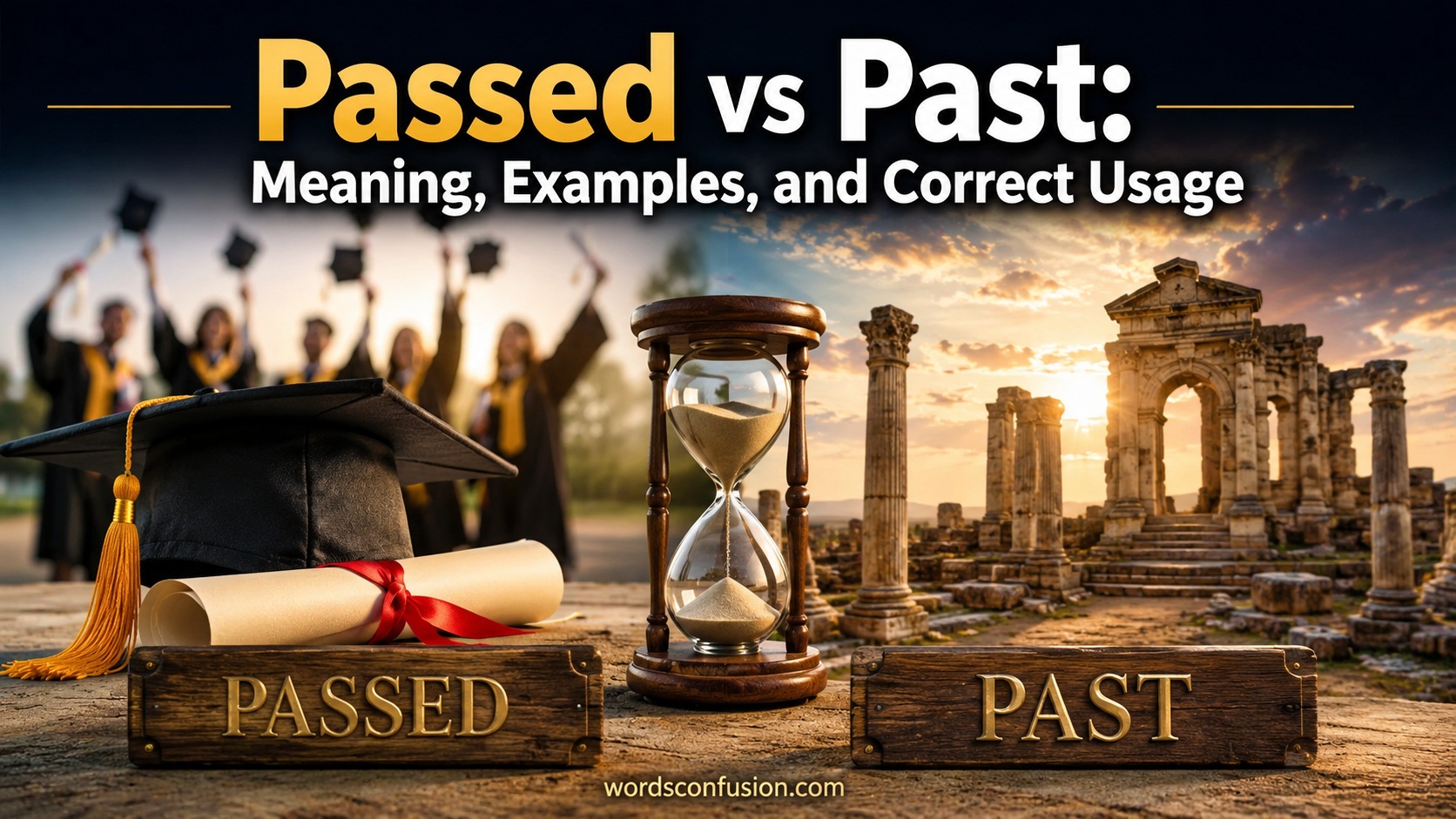
Passed vs Past is one of those English word pairs that can trip you up because both words sound almost exactly the same in American English. Yet they don’t mean the same thing and they don’t perform the same grammatical job.
For example, you can say, “She passed the exam,” but you can’t say, “She past the exam.” On the other hand, you can say, “She walked past the school,” but “She walked passed the school” is incorrect in standard English.
The confusion becomes even more interesting because both words can relate to movement and time. Passed describes an action, while past often describes a time, position, direction, or something that has already happened.
Once you understand their grammatical roles, the difference becomes much easier to remember. You won’t need to guess based on pronunciation. Instead, you can look at what the word is doing in the sentence.
Quick Answer
Passed is the past tense and past participle of the verb pass. It describes an action such as moving beyond something, succeeding in a test, handing something to someone, or allowing time to go by.
Past can function as a noun, adjective, adverb, or preposition. It commonly refers to an earlier time or something beyond a particular point or place.
| Word | Main Role | Basic Meaning | Example |
| Passed | Verb | Completed an action related to “pass” | She passed the exam. |
| Past | Noun | Earlier time | We can’t change the past. |
| Past | Adjective | Former or earlier | He learned from his past mistakes. |
| Past | Preposition | Beyond a point or place | We walked past the bank. |
| Past | Adverb | Beyond a particular point | The car drove past. |
The easiest rule to remember
Passed = an action.
Past = time, position, or beyond.
For example:
- I passed the bakery. → “Passed” describes what I did.
- I walked past the bakery. → “Past” describes the position or direction.
- The deadline passed. → “Passed” describes an action.
- The deadline is past. → “Past” describes a state or time.
Comparison Overview
The easiest way to understand passed vs past is to compare their grammatical functions rather than their pronunciation.
| Feature | Passed | Past |
| Part of speech | Verb | Noun, adjective, adverb, preposition |
| Related to “pass” | Yes | No |
| Can describe an action | Yes | Usually no |
| Can refer to earlier time | Yes, indirectly | Yes |
| Can indicate movement beyond something | Yes | Yes |
| Can describe something overdue | No | Yes |
| Correct phrase | Passed away | Past due |
| Example | He passed the test. | He walked past the test center. |
The biggest difference lies in grammar.
If the word represents something someone or something does, you may need passed. If the word describes when, where, or beyond what point something happens, past may be the right choice.
Consider these two sentences:
The car passed the house.
The car drove past the house.
Both sentences describe a car moving beyond a house. However, passed acts as the main verb in the first sentence. In the second sentence, drove is the verb while past works as a preposition.
That small grammatical difference explains why both words can appear in very similar situations.
What Does “Passed” Mean?
Passed is the simple past tense and past participle of pass. It has several meanings, but they all connect to the basic idea of moving, transferring, succeeding, or going beyond something.
Passed as the Past Tense of “Pass”
When passed describes something that happened in the past, it acts as a verb.
Examples:
- She passed her driving test.
- The bus passed our house.
- He passed the ball to his teammate.
- They passed through the security gate.
- Time passed quickly.
- The teacher passed the papers to the students.
Notice that each sentence contains an action.
You can usually test the word by changing the sentence to the present tense. If passed becomes pass or passes, you’re dealing with the verb pass.
Past: She passed the exam.
Present: She passes the exam.
Past: The car passed us.
Present: The car passes us.
This is one of the most reliable ways to recognize passed.
Passed as a Past Participle
Passed also works as a past participle. In this role, it often appears with helping verbs such as has, have, or had.
Examples include:
- She has passed the exam.
- The train has passed the station.
- They had passed the building before sunset.
- Several weeks have passed since the meeting.
- The deadline had passed before we submitted the form.
Here, passed still comes from the verb pass. The helping verb changes the grammatical structure but not the basic identity of the word.
Passed Can Mean “Succeeded”
One of the most common uses of passed involves exams, tests, courses, or assessments.
Examples:
- Maria passed her final exam.
- He passed the driving test on his second attempt.
- She finally passed the certification exam.
- Did you pass your math test?
In these sentences, passed means achieved the required standard or succeeded.
You should never use past in this meaning.
Correct: He passed the exam.
Incorrect: He past the exam.
Passed Can Mean “Moved Beyond”
Passed can also describe physical movement beyond someone or something.
Examples:
- The runner passed me near the finish line.
- We passed several restaurants on the way home.
- The train passed the station without stopping.
- A truck passed our car on the highway.
The word acts as the verb because it tells you what the subject did.
Passed Can Mean “Handed Over”
Another common meaning involves transferring something from one person to another.
Examples:
- She passed me the salt.
- He passed the note to his friend.
- The referee passed the ball to the player.
- Please pass the remote.
The past-tense form is passed.
Yesterday, she passed me the book.
Not “past me the book.”
Passed Can Describe Time
English often treats time as something that moves forward.
That’s why you can say:
- Three hours passed.
- The years passed quickly.
- Time passed without any major changes.
- Several months passed before they met again.
Here, passed remains a verb. It describes the progression of time.
What Does “Past” Mean?
Unlike passed, past doesn’t come from the verb pass. It has several grammatical roles and commonly connects to earlier time or a position beyond something.
Past as a Noun
As a noun, past refers to an earlier period of time or events that already happened.
Examples:
- We can’t change the past.
- She doesn’t like talking about her past.
- His past shaped his outlook.
- The past can teach us valuable lessons.
In these examples, past names a period or collection of previous events.
You can often put the before it:
the past
That structure is a strong clue that you’re dealing with the noun past.
Past as an Adjective
Past can also describe something connected with an earlier period.
Examples:
- He made several mistakes in the past year.
- She learned from her past experiences.
- The past president attended the ceremony.
- We discussed his past behavior.
Here, past modifies another noun.
The phrase past mistakes, for example, means mistakes that happened previously.
Past as a Preposition
This is where many passed vs past mistakes occur.
When past acts as a preposition, it can indicate movement beyond a particular person, place, object, or point.
Examples:
- We walked past the library.
- She drove past my house.
- The children ran past the gate.
- He walked past me without speaking.
- The train traveled past the station.
The important point is that another verb already performs the action.
In “She walked past the store,” the verb is walked. The word past tells you where she walked in relation to the store.
That’s why “walked passed” is incorrect.
Past as an Adverb
Past can also function as an adverb when it describes movement beyond a particular point.
Examples:
- The car sped past.
- She walked past without saying anything.
- The train rushed past.
- He glanced at me and moved past.
In these sentences, past doesn’t need to introduce a noun.
Main Differences Between Passed vs Past
The clearest distinction between passed vs past comes down to their grammatical function.
Passed Is a Verb
Passed tells you that an action occurred.
Examples:
- She passed the exam.
- The dog passed the gate.
- He passed the ball.
- Time passed quickly.
- They passed through the tunnel.
Ask yourself:
“What did someone or something do?”
If the answer is passed, you’re probably using the correct word.
Past Often Describes Time
When you mean an earlier period, use past.
Examples:
- Let’s leave the past behind.
- His past experiences shaped his career.
- We should learn from the past.
- The past decade brought major changes.
You aren’t describing an action performed by someone. You’re referring to an earlier period.
Past Can Mean “Beyond”
When you mean beyond a place or point, past is usually appropriate after another movement verb.
Examples:
- Walk past the pharmacy.
- Drive past the school.
- Run past the finish line.
- Look past the obvious answer.
This is one of the most useful distinctions in everyday English.
Passed vs Past: Common Sentence Comparisons
“I Passed the Store” vs “I Walked Past the Store”
These sentences look almost identical, but their structures differ.
I passed the store.
Here, passed is the main verb. It means that I moved beyond the store.
I walked past the store.
Here, walked is the main verb. Past tells us where I walked.
Both sentences are grammatically correct.
The mistake happens when writers combine the two structures:
Incorrect: I walked passed the store.
Correct: I walked past the store.
“She Passed the School” vs “She Went Past the School”
Again, both sentences can be correct.
- She passed the school.
- She went past the school.
In the first sentence, passed is the verb.
In the second sentence, went is the verb and past indicates direction or position.
“Time Passed” vs “The Past”
These expressions refer to related ideas but use different grammar.
Time passed quickly.
Here, passed is the verb describing time moving forward.
The past cannot be changed.
Here, past is a noun referring to events that already happened.
Think of it this way:
Passed = time moved.
Past = the time that has already gone.
Passed Away vs Past Away
This is one of the most common mistakes involving these words.
The correct expression is:
passed away
It is a polite expression meaning died.
Examples:
- Her grandfather passed away last year.
- His longtime friend passed away peacefully.
- The actor passed away at an advanced age.
“Past away” is incorrect.
The reason is straightforward. Passed is the verb in this expression. It comes from pass away, not from past.
Read More: Moral vs Morale: Meaning, Differences,and Examples
Past Due vs Passed Due
This pair creates another frequent mistake.
The standard expression is:
past due
It means something is late or has gone beyond its required deadline.
Examples:
- The payment is past due.
- Your library book is past due.
- The assignment is now past due.
- Several invoices remain past due.
Passed due isn’t the standard expression.
Compare:
Correct: The bill is past due.
Incorrect: The bill is passed due.
Here, past means that the required date has already gone by.
Passed vs Past in Everyday Situations
The distinction becomes much easier when you see these words in practical settings.
School and Exams
- She passed her English exam.
- He passed the entrance test.
- The teacher walked past the classroom.
- Students reflected on their past mistakes.
Driving and Directions
- We passed the gas station.
- Drive past the traffic light.
- The car passed us on the highway.
- Don’t look only at your past route when planning the next trip.
Work and Deadlines
- The manager passed the information to the team.
- The deadline passed yesterday.
- The invoice is past due.
- She learned from past projects.
Sports
- The midfielder passed the ball.
- The runner passed two competitors.
- The player moved past the defender.
- The coach reviewed the team’s past performances.
Common Mistakes With Passed and Past
Mistake: “She Past the Exam”
Incorrect: She past the exam.
Correct: She passed the exam.
Why? Because passed is the past-tense verb of pass.
Mistake: “He Walked Passed Me”
Incorrect: He walked passed me.
Correct: He walked past me.
Why? Walked already serves as the verb. Past indicates movement beyond the speaker.
Mistake: “Past Away”
Incorrect: Her uncle past away.
Correct: Her uncle passed away.
Why? Passed away is the established verb phrase.
Mistake: “Passed Due”
Incorrect: The payment is passed due.
Correct: The payment is past due.
Why? Past due means overdue.
Mistake: “I Past the Building”
Incorrect: I past the building yesterday.
Correct: I passed the building yesterday.
Why? The sentence needs a past-tense verb. Passed supplies that action.
FAQs:
Is “passed” the past tense of “pass”?
Yes. Passed is both the simple past tense and past participle of pass.
For example:
- Present: She passes the test.
- Past: She passed the test.
- Perfect: She has passed the test.
Is “past” a verb?
No. In standard modern English, past doesn’t function as the verb pass. It commonly works as a noun, adjective, adverb, or preposition.
For example, “The past is important” uses past as a noun.
Is it “walked past” or “walked passed”?
The correct phrase is walked past.
Example:
We walked past the restaurant.
The word walked is already the verb. Past shows that the movement went beyond the restaurant.
Is it “passed away” or “past away”?
The correct expression is passed away.
Example:
Her grandmother passed away last year.
“Past away” is incorrect.
Is it “past due” or “passed due”?
The standard expression is past due.
Example:
The payment is past due.
It means the payment has gone beyond its required date.
Do “passed” and “past” sound the same?
In standard American English, they are generally pronounced the same. Their meanings and grammatical functions are different even though their pronunciation is alike.
How can I remember the difference between passed and past?
Use this simple rule:
Passed = an action.
Past = time, position, or beyond.
If you can connect the word to the verb pass, passed is usually the correct choice.
Conclusion:
The difference between passed vs past becomes much clearer once you stop relying on pronunciation and start looking at grammar. Passed is a form of the verb pass. It describes actions such as succeeding in an exam, moving beyond something, transferring an object, or allowing time to go by. Past, meanwhile, can function as a noun, adjective, adverb, or preposition. It commonly refers to earlier time or indicates that something lies beyond a particular point.

Andrew Wilson is an experienced language researcher and content writer specializing in WordsConfusion topics. He helps readers understand commonly confused English words, spelling differences, grammar rules, word meanings, and proper usage through clear explanations, practical examples, and easy-to-follow language guides. His goal is to make English learning simple, accurate, and accessible for students, writers, professionals, and everyday learners.