Many people use poisonous and venomous as if they mean the same thing. They both describe dangerous animals, plants, or other living things, so the confusion is understandable. However, these words have very different meanings in science and everyday English.
People often search for “poisonous vs venomous” because they want to know which word is correct when talking about snakes, spiders, frogs, fish, plants, and other organisms. Using the wrong term can change the meaning of a sentence. For example, calling a venomous snake poisonous is technically incorrect, even though many people say it in casual conversation.
The good news is that the difference is simple once you understand how each one works. The key is knowing how the toxin gets into the body. One is harmful when you touch or eat it, while the other harms you by injecting toxins through a bite or sting.
This guide explains the difference in simple language. You’ll learn the meanings, origins, spelling, common mistakes, real-life examples, Google Trends insights, and practical tips so you can confidently choose the right word every time.
Poisonous vs Venomous – Quick Answer
The simplest way to remember the difference is this:
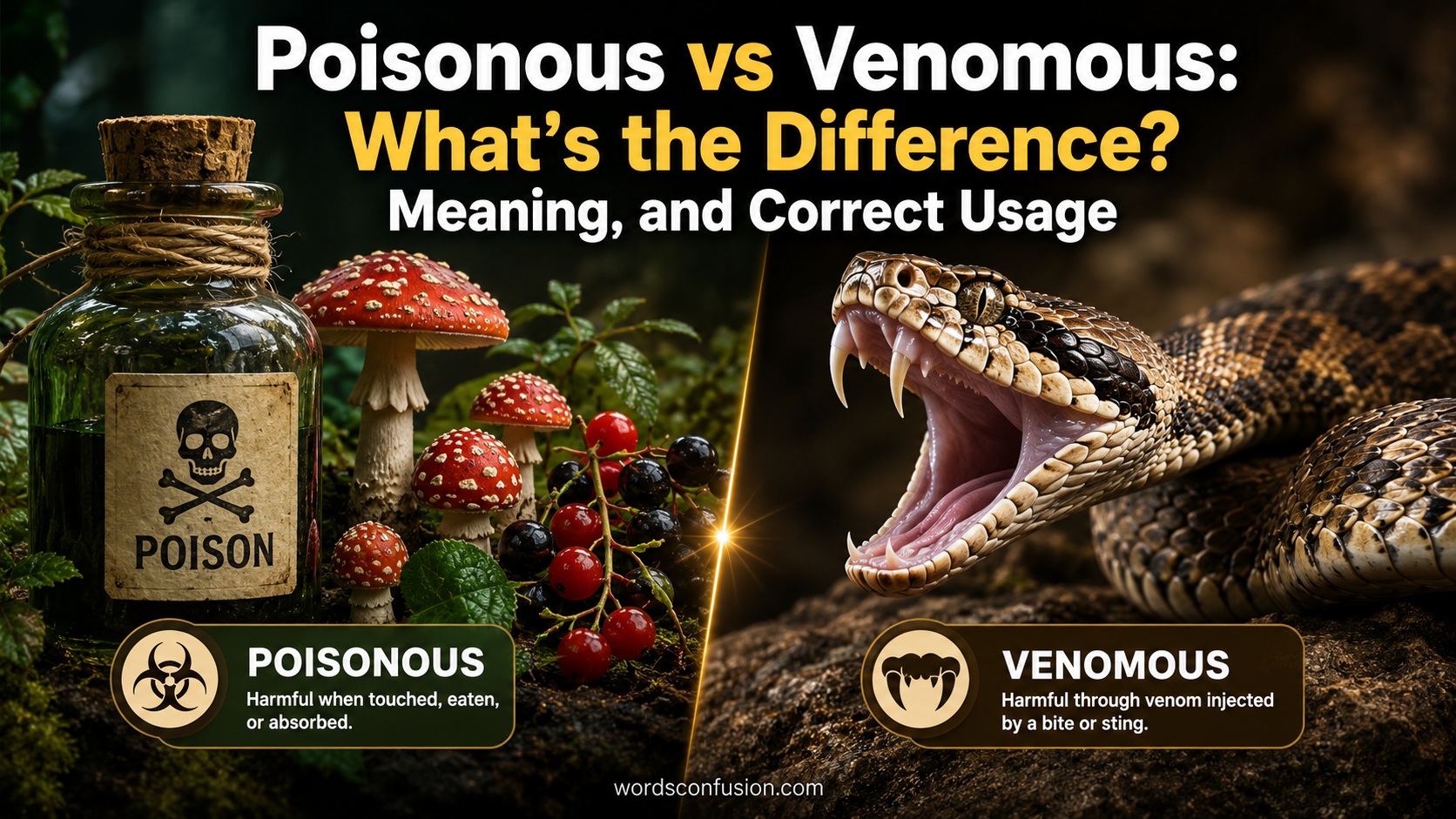
- Poisonous means an organism is harmful when you eat, touch, or inhale it.
- Venomous means an organism injects toxins through a bite, sting, spine, or fang.
Quick Examples
| Poisonous | Venomous |
| Poison dart frog | Cobra |
| Poison ivy | Scorpion |
| Deadly mushrooms | Black widow spider |
| Poison hemlock | Jellyfish |
| Some berries | Stingray |
Easy Memory Trick
If it bites you and you die, it’s venomous. If you bite it and you die, it’s poisonous.
While this saying is not perfect for every species, it helps most people remember the difference.
The Origin of Poisonous vs Venomous
Understanding where these words came from makes their meanings easier to remember.
Origin of “Poisonous”
The word poison comes from the Old French word poison, which originally meant a harmful drink or potion. It later entered Middle English and came to describe any harmful substance.
The adjective poisonous developed to describe something containing poison that can harm another living thing through contact, swallowing, or inhalation.
Example
- Poisonous mushrooms
- Poisonous berries
- Poisonous plants
Origin of “Venomous”
The word venom comes from the Latin word venenum, meaning poison or magical potion.
Over time, scientists used venom for toxins that animals actively inject into another organism using specialized body parts.
Example
- Venomous snakes
- Venomous spiders
- Venomous fish
Why the Meanings Changed
Originally, both words referred to harmful substances.
As biology developed, scientists needed clearer terms.
Today:
- Poison = passive delivery
- Venom = active injection
This distinction is now standard in science, medicine, and wildlife education.
British English vs American English Spelling
Unlike many English words, poisonous and venomous have exactly the same spelling in both British English and American English.
There are no spelling differences between the two varieties of English.
The only differences you might notice are writing style or vocabulary surrounding these words.
Comparison Table
| Feature | British English | American English |
| Poisonous | ✔ Poisonous | ✔ Poisonous |
| Venomous | ✔ Venomous | ✔ Venomous |
| Spelling difference | None | None |
| Meaning | Same | Same |
| Scientific use | Same | Same |
Examples
British English
- The adder is Britain’s only venomous snake.
- Some mushrooms are poisonous.
American English
- The rattlesnake is venomous.
- Poison ivy is poisonous.
The spellings never change.
Which Spelling Should You Use?
Since there is no spelling difference, the decision is easy.
If Your Audience Is in the United States
Use:
- poisonous
- venomous
These are the standard American spellings.
If Your Audience Is in the United Kingdom
Use:
- poisonous
- venomous
Again, these are the correct British spellings.
If Your Audience Is Global
Continue using:
- poisonous
- venomous
The important decision is choosing the correct word, not changing the spelling.
Best Practice
Ask yourself:
How does the toxin enter the victim?
If it is injected → Venomous
If it is eaten, touched, or absorbed → Poisonous
Common Mistakes with Poisonous vs Venomous
Many people confuse these words because both describe dangerous organisms.
Here are the most common mistakes.
| Incorrect | Correct |
| Cobras are poisonous. | Cobras are venomous. |
| Scorpions are poisonous. | Scorpions are venomous. |
| Poison ivy is venomous. | Poison ivy is poisonous. |
| Poison dart frogs are venomous. | Poison dart frogs are poisonous. |
| Jellyfish are poisonous. | Most jellyfish are venomous. |
Mistake 1: Calling Every Dangerous Animal Poisonous
Wrong:
That snake is poisonous.
Better:
That snake is venomous.
Mistake 2: Mixing Poison Ivy and Venom
Wrong:
Poison ivy is venomous.
Correct:
Poison ivy is poisonous because touching it causes a harmful reaction.
Mistake 3: Using Them as Synonyms
Although people often use them interchangeably, scientists treat them as different words.
Read More: Further vs Farther: What’s the Difference? Meaning, Examples, and When to Use Each
Poisonous vs Venomous in Everyday Examples
In Emails
Correct:
Please avoid touching poisonous plants during the field trip.
Correct:
The guide warned us about venomous snakes.
In News Reports
Rangers removed a venomous snake from the park.
Officials warned visitors about poisonous mushrooms growing after heavy rain.
On Social Media
I just learned that poison dart frogs are poisonous, not venomous!
Australia has many venomous animals.
In Formal Writing
Venomous animals inject toxins through specialized organs.
Poisonous organisms release toxins when touched, eaten, or absorbed.
In Everyday Conversation
Person A:
Is that snake poisonous?
Person B:
Actually, it’s venomous because it bites and injects venom.
Poisonous vs Venomous – Google Trends & Usage Data
Search interest for poisonous vs venomous stays steady throughout the year because people regularly encounter these words in:
- School assignments
- Wildlife documentaries
- Biology classes
- News stories
- Outdoor safety guides
Countries with High Interest
The keyword is commonly searched in:
- United States
- United Kingdom
- Canada
- Australia
- India
- New Zealand
People often search after seeing snakes, spiders, frogs, or poisonous plants in news reports or nature programs.
Related Search Queries
Users also search for:
| Main Keyword | Related Searches |
| Poisonous vs Venomous | poisonous snake vs venomous snake |
| Poisonous vs Venomous | poison vs venom |
| Poisonous vs Venomous | venomous meaning |
| Poisonous vs Venomous | poisonous meaning |
| Poisonous vs Venomous | poisonous animals |
| Poisonous vs Venomous | venomous animals |
| Poisonous vs Venomous | difference between poison and venom |
| Poisonous vs Venomous | is a snake poisonous or venomous |
Comparison Table: Poisonous vs Venomous
| Feature | Poisonous | Venomous |
| Toxin enters by | Eating, touching, inhaling | Bite, sting, fang, spine |
| Active or passive | Passive | Active |
| Uses injection? | No | Yes |
| Common examples | Poison ivy, poison dart frog | Cobra, scorpion, rattlesnake |
| Scientific meaning | Harmful by contact or ingestion | Harmful by injected venom |
| Everyday confusion | Very common | Often mistaken for poisonous |
FAQs:
1. What is the main difference between poisonous and venomous?
Poisonous organisms harm you when you eat, touch, or inhale them. Venomous organisms inject toxins through bites, stings, or fangs.
2. Are all snakes venomous?
No. Many snakes are harmless and produce no medically significant venom. Some snakes are venomous, while many others are not.
3. Is poison ivy venomous?
No. Poison ivy is poisonous because touching it can cause a skin reaction. It does not inject venom.
4. Are poison dart frogs venomous?
No. Poison dart frogs are poisonous because their skin contains toxins. They do not bite or inject poison.
5. Can an animal be both poisonous and venomous?
Yes. A few rare species possess both poisonous tissues and venom used for defense or hunting, though this is uncommon.
6. Why do people confuse poisonous and venomous?
Both words describe harmful organisms, and many people learn them informally rather than through biology. As a result, they are often used interchangeably in conversation.
7. Which word should I use in scientific writing?
Always choose the accurate scientific term:
- Poisonous for toxins absorbed through contact, inhalation, or ingestion.
- Venomous for toxins delivered by injection.
Conclusion:
Although poisonous and venomous are often confused, remembering the difference is easier than it first appears. The key is understanding how the toxin enters the body. A poisonous organism causes harm when its toxins are eaten, touched, or inhaled, while a venomous organism actively injects toxins through a bite, sting, fang, or spine. This simple distinction helps you use both words correctly in everyday conversations, school assignments, scientific discussions, and professional writing.
Another important point is that there is no spelling difference between British English and American English. Both varieties use poisonous and venomous with the same spelling and meaning. What matters most is selecting the correct term for the situation. When talking about snakes, spiders, and scorpions, “venomous” is usually the right choice. For toxic plants, mushrooms, and certain frogs, “poisonous” is the correct word. By keeping this rule in mind and practicing with real-world examples, you’ll avoid one of the most common vocabulary mistakes and communicate more clearly and accurately.

Andrew Wilson is an experienced language researcher and content writer specializing in WordsConfusion topics. He helps readers understand commonly confused English words, spelling differences, grammar rules, word meanings, and proper usage through clear explanations, practical examples, and easy-to-follow language guides. His goal is to make English learning simple, accurate, and accessible for students, writers, professionals, and everyday learners.