Many English learners and even native speakers get confused by further and farther. Both words look similar, sound almost the same, and can sometimes be used in the same sentence. Because of this, people often wonder which one is correct and when each word should be used.
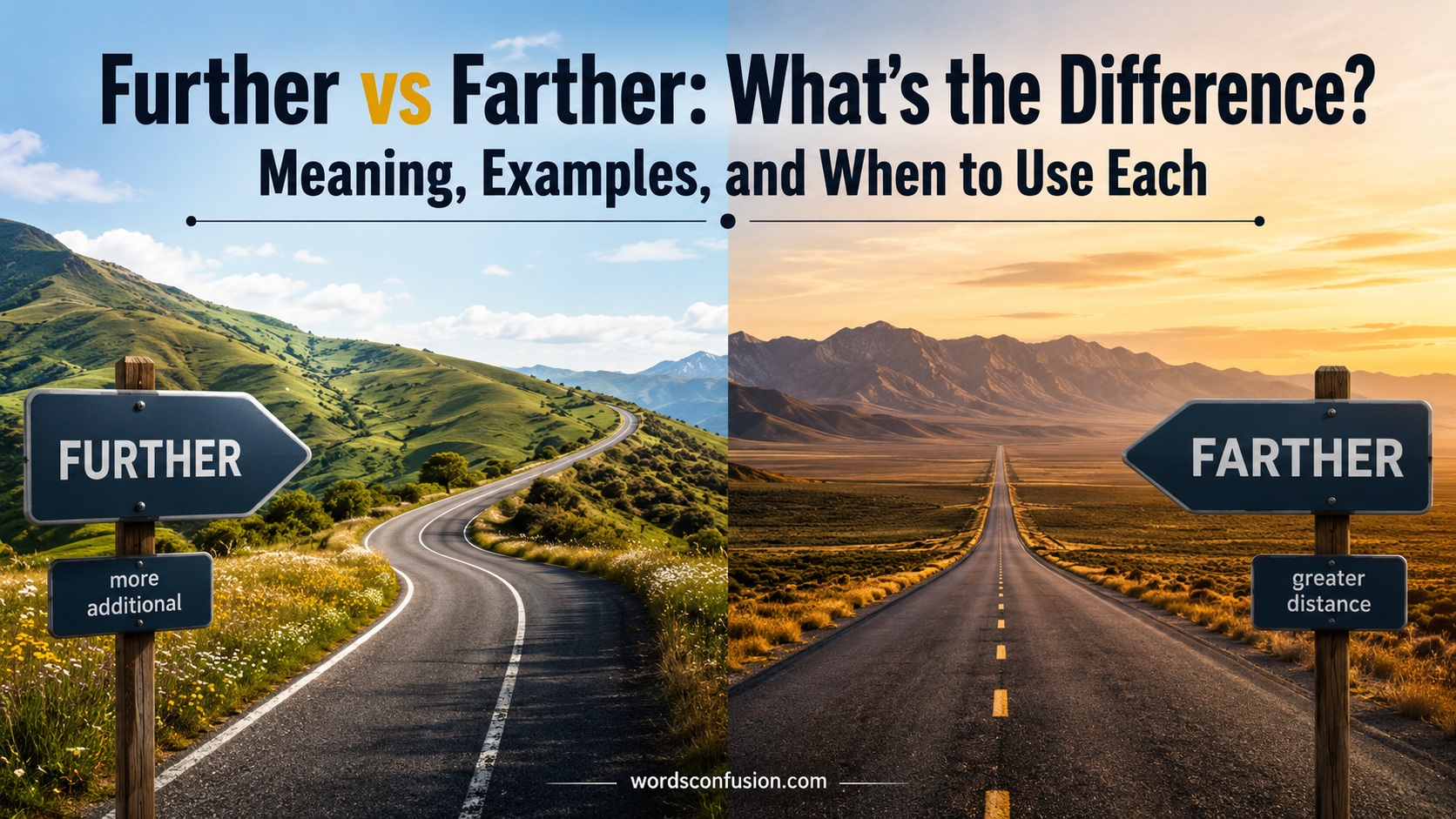
The main difference is simple. Farther usually refers to a physical distance, while further usually refers to a figurative distance, additional information, or a greater degree. However, modern English has made the rules more flexible, especially in everyday conversation. This flexibility creates confusion for students, writers, bloggers, and professionals.
If you have ever stopped while writing to ask yourself, Should I use further or farther? you are not alone. This guide answers that question in simple language. You will learn the meaning of each word, their origins, differences between British and American English, common mistakes, real-life examples, and practical tips to help you choose the correct word every time.
Further vs Farther – Quick Answer
Further and farther are both correct words, but they are used in different situations.
- Farther refers to a greater physical distance.
- Further refers to a greater figurative distance, additional information, time, progress, or degree.
In modern English, especially in American English, further is sometimes also used for physical distance. However, farther remains the clearer choice when talking about measurable distance.
Examples
| Further | Farther |
| Please contact us for further details. | The school is farther than the library. |
| We need further discussion before making a decision. | She threw the ball farther than anyone else. |
| His research went further than expected. | We walked farther along the beach. |
Simple rule to remember:
- Think far = farther = physical distance.
- Think further = more, extra, additional, beyond.
The Origin of Further vs Farther
Where Did “Further” Come From?
The word further comes from Old English. It developed from the word furthor, which meant more forward, beyond, or to a greater extent. Over time, English speakers began using further to describe not only distance but also ideas, progress, time, and additional information.
Today, further is commonly used in both spoken and written English. It appears in business writing, academic papers, news articles, and everyday conversations.
Examples:
- We need further research before making a decision.
- For further information, visit our website.
- The discussion continued further into the evening.
Where Did “Farther” Come From?
The word farther comes from the adjective far. It was created as the comparative form of far, just as taller comes from tall.
Because of its connection to far, farther naturally became the preferred word for describing physical distance.
Although farther has existed for centuries, it has always been closely linked to measurable distance.
Examples:
- The supermarket is farther than the bank.
- She ran farther than her teammates.
- We drove farther into the mountains.
Why Do Both Words Exist?
The history of English explains why both words are still used today.
Centuries ago, further and farther often meant the same thing. Writers used them almost interchangeably because there was no strict grammar rule.
As English became more standardized, style guides began recommending a simple distinction:
- Use farther for physical distance.
- Use further for figurative distance, additional information, time, progress, or degree.
Many modern dictionaries still accept further for physical distance, but most grammar experts recommend keeping this distinction because it makes writing clearer.
Timeline of Usage
| Time Period | Usage |
| Old English | Further meant beyond or more forward. |
| Middle English | Farther became a comparative form of far. |
| Early Modern English | Both words were often used interchangeably. |
| Modern English | Farther is mainly used for physical distance, while further is preferred for figurative meanings and additional information. |
Understanding their history makes it easier to remember their modern uses. While the words are closely related, their meanings have gradually become more specialized, helping writers communicate with greater precision.
British English vs American English Usage
British English
In British English, further is the more common word. It is often used for both physical distance and figurative meanings. Although farther is still correct, it appears less often in everyday writing and speech.
Examples:
- We walked further along the river.
- For further details, please contact the office.
- The project cannot continue without further approval.
Many British newspapers, books, and websites naturally prefer further, even when discussing distance.
American English
American English makes a clearer distinction between the two words.
Most American style guides recommend:
- Use farther for physical distance.
- Use further for additional information, progress, time, or figurative distance.
This distinction improves clarity and is widely followed in schools, journalism, and professional writing.
Examples:
- The next gas station is farther down the highway.
- We need further investigation.
- The company refused to comment further.
British English vs American English Comparison
| Feature | British English | American English |
| Physical distance | Usually further, sometimes farther | Usually farther |
| Additional information | Further | Further |
| Figurative meaning | Further | Further |
| Business writing | Further | Further |
| Everyday speech | Mostly further | Both words are common |
Which Version Is More Correct?
Neither version is more correct. The right choice depends on your audience and the style guide you follow.
- If you are writing for readers in the United Kingdom, using further in most situations will sound natural.
- If your audience is mainly in the United States, using farther for measurable distance and further for everything else is the preferred style.
- If your audience is international, either style is acceptable as long as you stay consistent throughout your writing.
Many modern dictionaries accept further for physical distance, but using farther for measurable distance makes your meaning clearer, especially for American readers.
Which Word Should You Use?
If You Write for an American Audience
If your readers are in the United States, follow the traditional grammar rule.
- Use farther for physical distance.
- Use further for additional information, progress, time, or figurative meaning.
This is the style recommended by many American editors and grammar guides.
Examples:
- The airport is farther from downtown than I expected.
- We need further testing before releasing the product.
- No further action is required.
If You Write for a British Audience
British English is more flexible.
Many British writers use further for both physical and figurative distance. While farther is still correct, it is less common in everyday writing.
Examples:
- We walked further into the forest.
- Please send further details.
- The meeting was postponed until further notice.
If you follow British spelling and grammar, choosing further in most situations will sound natural.
If You Write for an International Audience
For websites, blogs, educational content, and global businesses, clarity is the most important goal.
A good approach is to use:
- Farther when talking about measurable physical distance.
- Further for every other meaning.
This makes your writing easy to understand for readers around the world.
Quick Decision Guide
| Situation | Best Word |
| Walking, driving, or flying a greater distance | Farther |
| Additional information | Further |
| More discussion | Further |
| More research | Further |
| Greater progress | Further |
| Physical location on a map | Farther |
| Formal business writing | Further |
| Academic writing | Further |
Easy Memory Trick
A simple way to remember the difference is to focus on the word far.
- Far is inside farther, so use farther for physical distance.
- Further means more, extra, or additional.
Think of it like this:
- Farther = Far away
- Further = More or Beyond
This trick works in most writing situations and helps you choose the correct word without memorizing complicated grammar rules.
Common Mistakes with Further vs Farther
Many people use further and farther as if they mean exactly the same thing. While this is common in everyday speech, it can make your writing less clear. Learning these common mistakes will help you use each word correctly.
Mistake 1: Using “Further” for Clear Physical Distance
When talking about measurable distance, farther is usually the better choice, especially in American English.
Incorrect:
- The park is further than the school.
Correct:
- The park is farther than the school.
Mistake 2: Using “Farther” for Additional Information
Farther should not be used when you mean more, extra, or additional.
Incorrect:
- Please contact us for farther information.
Correct:
- Please contact us for further information.
Mistake 3: Mixing Both Words in the Same Context
Choose the word that matches the meaning of the sentence.
Incorrect:
- We need farther discussion before making a decision.
Correct:
- We need further discussion before making a decision.
Mistake 4: Assuming They Are Always Interchangeable
Some dictionaries allow further to describe physical distance, but that does not mean both words always sound equally natural.
Less Clear:
- We walked further down the trail.
Clearer (especially in American English):
- We walked farther down the trail.
Mistake 5: Forgetting the Audience
The best choice often depends on who will read your writing.
- American readers usually expect farther for physical distance.
- British readers commonly accept further in both physical and figurative contexts.
- International readers understand both, but consistency is important.
Common Mistakes and Corrections
| Incorrect | Correct | Reason |
| Farther information | Further information | Means additional information |
| Farther research | Further research | Means more research |
| Further down the highway (US style) | Farther down the highway | Refers to physical distance |
| Farther discussion | Further discussion | Discussion is not physical distance |
| Farther progress | Further progress | Progress is figurative |
| Further than the next town (US style) | Farther than the next town | Talking about measurable distance |
Quick Checklist
Before choosing a word, ask yourself these questions:
- Am I talking about a real, measurable distance?
- Use farther.
- Am I talking about more information, progress, time, discussion, or degree?
- Use further.
- Am I writing for an American audience?
- Follow the traditional distinction for the clearest writing.
- Am I writing for a British audience?
- Further is acceptable in most situations.
Using these simple checks will help you avoid the most common mistakes and make your writing more accurate and professional.
Read More: Especially vs Specially: What’s the Difference? Meaning, Examples, and Grammar Guide
Further vs Farther in Everyday Examples
Understanding grammar rules is helpful, but seeing real-life examples makes the difference much easier to remember. Here is how further and farther are commonly used in different situations.
In Emails
Professional emails often use further because they usually refer to additional information or the next step.
Examples:
- Please let me know if you need further assistance.
- We will provide further updates next week.
- Contact our support team for further information.
- No further action is required at this time.
In News Articles
News reports use both words depending on the meaning.
Examples:
- Police are conducting further investigations.
- The government announced further changes to the policy.
- The wildfire spread farther than expected.
- Rescue teams searched farther into the mountains.
On Social Media
People usually choose the simpler word that matches the situation.
Examples:
- I can’t walk any farther today.
- Stay tuned for further updates.
- We drove farther than we planned.
- More details will follow after further review.
In Academic Writing
Schools, colleges, and research papers almost always use further because they discuss ideas, studies, and progress rather than physical distance.
Examples:
- Further research is needed.
- The study requires further analysis.
- Scientists recommended further testing.
- Further evidence supports the theory.
In Business Writing
Business communication also prefers further because it often refers to additional work or information.
Examples:
- We need further approval before moving forward.
- The proposal requires further discussion.
- Please review the attached document for further details.
- No further expenses are expected.
In Everyday Conversation
Both words appear in daily speech.
Examples:
Farther
- Can you throw the ball farther?
- The restaurant is farther than I thought.
- We walked farther than yesterday.
Further
- Do you have any further questions?
- Let’s discuss this further tomorrow.
- I have nothing further to add.
Everyday Usage Comparison
| Situation | Correct Word | Example |
| Walking another mile | Farther | We walked farther than yesterday. |
| Driving to another city | Farther | The hotel is farther from the airport. |
| More information | Further | Please read for further details. |
| More discussion | Further | We need further discussion. |
| More research | Further | The scientist requested further testing. |
| Additional help | Further | Contact us for further assistance. |
| Throwing a ball | Farther | She threw the ball farther than her brother. |
These everyday examples show a simple pattern. Whenever you are talking about actual physical distance, farther is usually the best choice. Whenever you mean more, extra, additional, or beyond, further is the correct word.
FAQs:
Is farther always used for physical distance?
In most cases, yes. Farther is the preferred word when talking about measurable physical distance.
Example:
- The museum is farther from the station than the hotel.
Can further refer to physical distance?
Yes. Many dictionaries accept further for physical distance, especially in British English. However, farther is usually the clearer choice in American English.
What is the difference between further and farther?
The main difference is their meaning.
- Farther refers to physical distance.
- Further refers to additional information, progress, time, or figurative distance.
Which word is more common in British English?
British English often uses further for both physical and figurative meanings. Although farther is correct, it is less common.
Is “further information” correct?
Yes. Further information is the correct and widely accepted phrase.
Example:
- Please contact us for further information.
Is “farther information” correct?
No. Farther information is incorrect because information is not a physical distance.
The correct phrase is:
- Further information
How can I easily remember the difference?
Use this simple memory trick:
- Farther = Far = Physical distance
- Further = More, extra, additional, beyond
If you are talking about miles, roads, or locations, choose farther. If you mean more information or progress, choose further.
Conclusion:
The difference between further and farther is easier than it first appears. Both words are correct, but they are used in different situations. Farther is mainly used for physical distance, while further refers to additional information, progress, time, or figurative ideas.
Although British English often uses further for both meanings, American English usually keeps a clear distinction by reserving farther for measurable distance. Following this rule makes your writing more precise and easier to understand.
Whenever you are unsure, ask yourself one simple question: Am I talking about actual distance or about something more abstract? If it is a real distance, use farther. If it means more, extra, or beyond, use further.

Andrew Wilson is an experienced language researcher and content writer specializing in WordsConfusion topics. He helps readers understand commonly confused English words, spelling differences, grammar rules, word meanings, and proper usage through clear explanations, practical examples, and easy-to-follow language guides. His goal is to make English learning simple, accurate, and accessible for students, writers, professionals, and everyday learners.