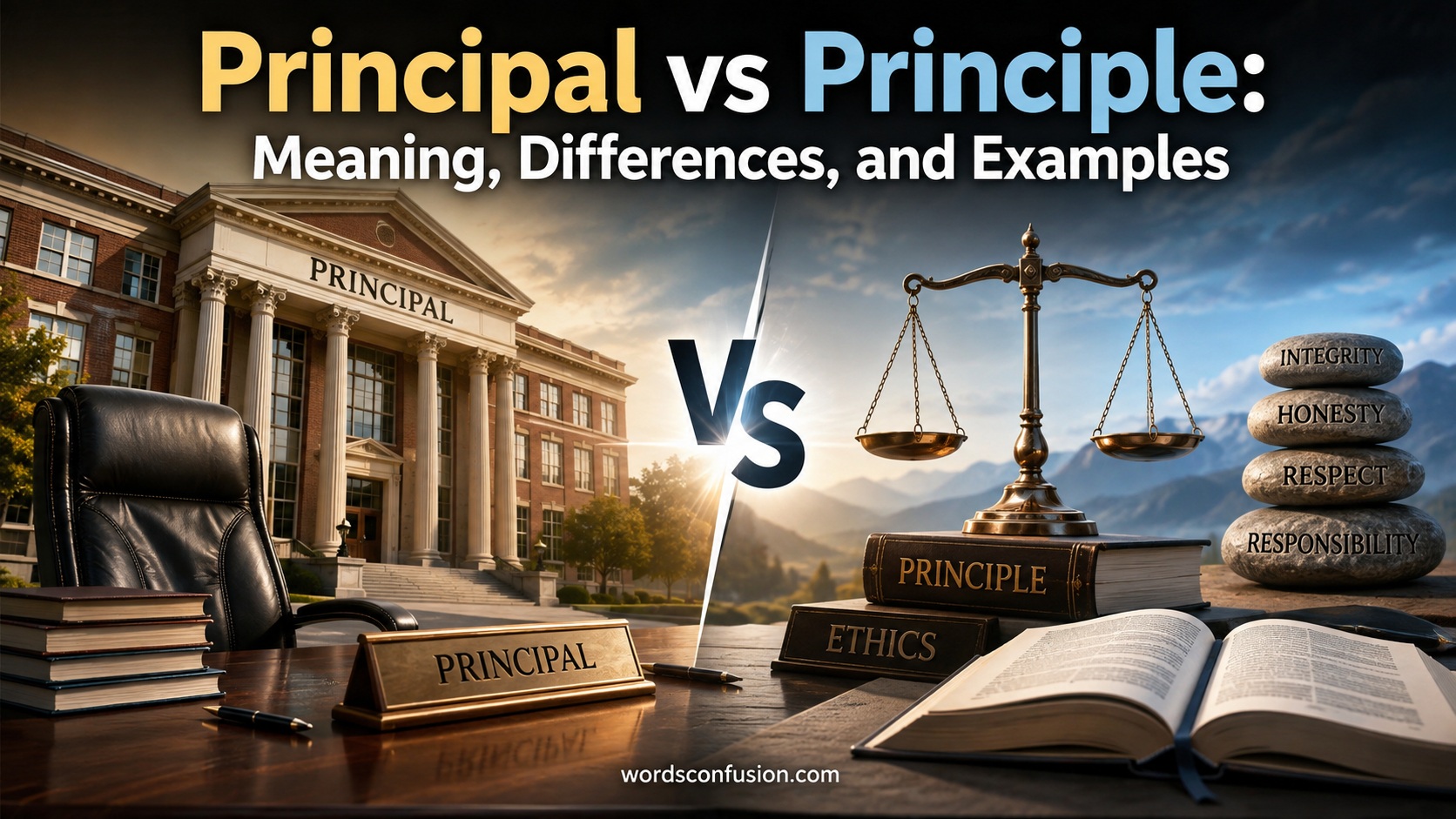
Have you ever typed “school principle” when you meant “school principal”? You’re not alone. Principal vs principle is one of those English word pairs that can trip up even strong writers because both words sound exactly alike.
The problem gets trickier because principal has several meanings. It can describe a school leader, something that matters most, or the original amount of money in a loan or investment. Principle, on the other hand, refers to a rule, belief, moral standard, or fundamental idea.
Although the pronunciation is identical, the spelling and meaning are completely different. Knowing the distinction can help you avoid embarrassing spelling mistakes in emails, school assignments, business writing, financial documents, and everyday conversations.
For example, compare these sentences:
- The principal spoke to the students after the meeting.
- Honesty is an important principle in our organization.
- The principal reason for the change was cost.
- She made an extra payment toward the loan principal.
The key is simple: principal often connects with a person, something primary, or money. Principle connects with a rule, belief, or fundamental idea.
Quick Answer
Principal and principle are homophones. They sound the same but have different meanings and spellings.
- Principal can be a noun or adjective.
- Principle is primarily a noun.
- Principal can mean the head of a school.
- Principal can mean the main or most important thing.
- Principal can mean the original amount of money borrowed or invested.
- Principle means a fundamental rule, belief, moral standard, or guiding idea.
A useful memory trick is “The principal is your pal.” If you’re talking about the person who runs a school, remember principal.
When you’re talking about a rule, value, or belief, use principle.
Principal = person, primary, or money.
Principle = rule, belief, or fundamental idea.
Comparison Overview
| Feature | Principal | Principle |
| Word type | Noun and adjective | Noun |
| Pronunciation | Same as principle | Same as principal |
| School meaning | Head of a school | Not used for the school leader |
| Main meaning | Main, primary, or most important | Fundamental rule, belief, or idea |
| Financial meaning | Original amount borrowed or invested | Not normally used in this sense |
| Moral meaning | Usually not used for moral rules | Rule, value, or belief |
| Example | The principal called a meeting. | Honesty is a core principle. |
| Memory clue | Principal = primary/person | Principle = rule/belief |
Main Differences Between Principal vs Principle
The biggest difference between principal vs principle comes down to meaning. While they sound identical, they perform different jobs in a sentence and refer to different concepts.
Principal Means a School Leader
The most familiar noun use of principal refers to the person who leads a school.
A principal typically oversees school operations, works with teachers and staff, communicates with parents, handles administrative matters, and helps maintain academic and behavioral standards.
For example:
- The principal announced the new school policy.
- The principal met with the student’s parents.
- Our principal welcomed the new teachers.
Using principle in these sentences would be incorrect.
Incorrect: The school principle addressed the students.
Correct: The school principal addressed the students.
This is one of the most common spelling mistakes involving the two words.
Principal Means Main or Most Important
Principal also works as an adjective meaning main, primary, or most important.
This meaning appears frequently in formal writing, business communication, academic discussions, and news reports.
Consider these examples:
- The principal reason for the delay was bad weather.
- Safety remains the principal concern.
- Her principal objective is to improve customer service.
- The principal cause of the problem was poor planning.
Here, principal doesn’t refer to a school administrator. It describes something that has greater importance than other things.
A useful substitution test can help. If you can replace principal with main or primary, you’re probably using the correct word.
The principal reason = The main reason
The principal objective = The primary objective
Principal Means the Original Amount of Money
In finance, principal has another important meaning.
The principal is the original amount of money borrowed, lent, or invested. Interest or returns may be calculated based on that amount.
Suppose you borrow $10,000. The $10,000 is the principal. If the lender charges interest, that interest is separate from the principal.
For example:
A borrower takes a $10,000 loan and gradually pays it back with interest.
The $10,000 represents the principal at the beginning of the loan. As the borrower makes payments, the outstanding principal can decrease.
This distinction matters because a loan payment can include both:
- Principal: The amount that reduces what you owe.
- Interest: The cost of borrowing the money.
So you might say:
She made an extra payment toward the loan principal.
You wouldn’t use principle here.
Principle Means a Fundamental Rule
Principle refers to a basic rule, idea, or standard that guides behavior, decisions, systems, or reasoning.
For example:
- Fairness is an important principle of the organization.
- The system operates according to a basic principle.
- The agreement is based on several important principles.
A principle doesn’t have to be a written law. It can be an accepted idea or standard that helps determine how something should work.
Think of a principle as a guiding framework. It gives you a basis for making decisions or understanding a process.
Principle Means a Moral Belief
People also use principle when talking about personal ethics and values.
For example:
- She refuses to lie because of her principles.
- He wouldn’t accept the money on principle.
- Honesty is one of his strongest principles.
- They made the decision based on ethical principles.
Here, principle describes an internal standard that influences someone’s behavior.
If someone says, “I won’t do it on principle,” they mean the action conflicts with a belief or moral standard they consider important.
What Does Principal Mean?
Principal has several distinct meanings, which explains why this word can be more confusing than it initially appears.
Principal as a Noun
As a noun, principal can refer to:
- A school leader
- A person in a leading position
- An original financial amount
- A main participant or party in certain formal contexts
The school meaning is especially common in American English.
Example:
The principal met with the teachers before the semester began.
In formal business or legal contexts, principal can also refer to a person or entity represented by another person, such as an agent.
However, the school and financial meanings are the ones most readers encounter in everyday writing.
Principal as an Adjective
As an adjective, principal means main, primary, or most important.
For example:
- The principal issue is the lack of funding.
- The principal goal is to reduce costs.
- The principal factor was customer demand.
- The principal challenge involves transportation.
A quick test works well here:
If main, primary, or most important fits the sentence, principal is likely correct.
For example:
The principal problem is poor communication.
You could rewrite it as:
The main problem is poor communication.
The meaning remains essentially the same.
Principal in Finance
Financial writing uses principal in a precise way.
If you invest money, the principal is the amount originally invested. If you borrow money, the principal is the amount originally borrowed.
For instance, imagine you borrow $20,000. If the loan later accumulates interest, the interest doesn’t become the original principal.
This distinction becomes especially important when discussing:
- Mortgages
- Personal loans
- Student loans
- Bonds
- Investments
- Interest calculations
- Debt repayment
When you pay down principal, you reduce the amount on which future interest may be calculated, depending on the terms of the financial product.
What Does Principle Mean?
Unlike principal, principle doesn’t refer to a school administrator or a loan amount.
It describes an underlying rule, standard, belief, or fundamental idea.
Principle as a Rule or Standard
A principle can guide how a person, company, institution, or system operates.
For example:
Transparency is a basic principle of responsible management.
This means transparency serves as an important standard that guides management decisions.
Other examples include:
- The company operates according to strict ethical principles.
- Equality is a central principle of the policy.
- The design follows several basic engineering principles.
Principle as a Personal Belief
A principle can also represent something you strongly believe is right or wrong.
For example:
She refused to participate because it went against her principles.
Her principles represent the values that guide her behavior.
This use often appears when people discuss:
- Honesty
- Fairness
- Integrity
- Justice
- Responsibility
- Respect
- Equality
Principle in Science and Other Fields
Principle isn’t limited to morality.
Scientists, engineers, economists, mathematicians, and other professionals use the word to describe fundamental ideas that explain how something works.
For example:
The machine operates according to the principle of leverage.
Here, principle doesn’t mean a personal moral belief. It means a fundamental concept or rule underlying a process.
This broader meaning makes principle useful across many fields.
Principal vs Principle in Different Contexts
The correct word often becomes obvious once you identify the context.
Principal vs Principle in Schools
School contexts usually make the distinction easy.
Principal refers to the school leader.
Principle refers to a rule, value, or guiding belief.
Compare:
- The principal called an assembly.
- Respect is an important principle at the school.
The first sentence identifies a person. The second identifies a value.
Principal vs Principle in Business
Business writing uses both words frequently.
Principal can describe the primary or most important factor:
Customer satisfaction is the principal goal.
Principle can describe an ethical or operational standard:
The company follows the principle of transparency.
The distinction becomes clearer when you ask whether you’re describing what is most important or what rule guides behavior.
Principal vs Principle in Finance
Finance almost always uses principal when referring to the original amount borrowed or invested.
For example:
The borrower paid $500 toward the principal.
Here, principal has a specific financial meaning.
Principal vs Principle in Everyday Life
Everyday conversations often use principle when people discuss values.
For example:
He wouldn’t accept the offer on principle.
Meanwhile, principal appears when someone discusses importance:
The principal reason for leaving was the long commute.
Read More: Personal vs Personnel: Meaning, Differences, and Examples
Principal vs Principle Examples
Seeing the words in realistic sentences makes the distinction easier to remember.
Examples With Principal
- The principal welcomed the new students.
- The school principal spoke during the ceremony.
- Safety is the principal concern.
- Cost was the principal reason for the change.
- The company’s principal objective is customer satisfaction.
- She made an additional payment toward the loan principal.
- The investment generated returns on its original principal.
Examples With Principle
- Honesty is an important principle.
- The organization operates according to ethical principles.
- He refused the offer on principle.
- The decision violated a basic principle of fairness.
- The machine works according to a scientific principle.
- She wouldn’t compromise her principles.
- The policy is based on the principle of equal treatment.
Common Expressions With Principal
Certain phrases make the word principal easier to recognize.
School Principal
This is the standard term for the head of a school.
Example:
The school principal addressed the parents.
Principal Amount
This phrase commonly appears in financial contexts.
Example:
The borrower made a payment toward the principal amount.
Principal Reason
This means the main reason.
Example:
The principal reason for the delay was a technical problem.
Principal Objective
This means the main or primary objective.
Example:
The principal objective of the project is to improve efficiency.
Common Expressions With Principle
Principle also appears in several familiar expressions.
On Principle
The phrase on principle means according to a belief or moral standard.
Example:
She refused to accept the unfair offer on principle.
It means her decision came from a strongly held belief rather than simple convenience.
Basic Principle
A basic principle is a fundamental idea or rule.
Example:
Respect is a basic principle of effective teamwork.
Moral Principle
A moral principle concerns beliefs about right and wrong.
Example:
He wouldn’t break that moral principle even under pressure.
Guiding Principle
A guiding principle influences decisions or behavior.
Example:
Customer safety remains the company’s guiding principle.
Principal vs Principle: Common Mistakes
These words create several predictable errors.
Mistake 1: Writing “School Principle”
This is probably the most common mistake.
Incorrect:
The school principle spoke to the students.
Correct:
The school principal spoke to the students.
Remember: The principal is your pal.
Mistake 2: Writing “Moral Principal”
When you mean a belief or ethical rule, use principle.
Incorrect:
Honesty is an important principal.
Correct:
Honesty is an important principle.
Mistake 3: Using Principle for Loan Money
Financial contexts require principal.
Incorrect:
She paid $1,000 toward the loan principle.
Correct:
She paid $1,000 toward the loan principal.
Mistake 4: Using Principle When You Mean “Main”
When main, primary, or most important fits the sentence, use principal.
Incorrect:
The principle cause was poor planning.
Correct:
The principal cause was poor planning.
FAQs:
Is a school principal called a principal or principle?
A school leader is called a principal. Principle means a rule, belief, value, or fundamental idea.
What is the easiest way to remember principal vs principle?
Use two shortcuts: principal = person or primary and principle = rule or belief. For schools, remember “The principal is your pal.”
What is the difference between principal and principle in finance?
Principal is the original amount borrowed or invested. Principle doesn’t normally refer to money in this financial sense.
Can principal be an adjective?
Yes. Principal can mean main, primary, or most important when used as an adjective.
For example:
Safety is the principal concern.
Can principle be an adjective?
In standard modern English, principle is primarily used as a noun. It refers to a rule, belief, standard, or fundamental idea.
Are principal and principle pronounced the same?
Yes. They are homophones, which means they have the same pronunciation but different meanings and spellings.
Is it “on principle” or “on principal”?
The correct phrase is “on principle.”
For example:
She refused the deal on principle.
It means she refused because the deal conflicted with her beliefs or moral standards.
Is “principal reason” correct?
Yes. Principal reason means the main or primary reason.
For example:
The principal reason for the delay was heavy traffic.
Is “loan principal” correct?
Yes. Loan principal refers to the amount originally borrowed or the remaining amount of that borrowed money that still needs to be repaid.
Conclusion:
The difference between principal vs principle becomes much easier once you connect each spelling with its core meaning.Principal has three especially useful meanings: a school leader, something main or primary, and the original amount of money borrowed or invested.Principle refers to a rule, belief, moral standard, or fundamental idea.

Andrew Wilson is an experienced language researcher and content writer specializing in WordsConfusion topics. He helps readers understand commonly confused English words, spelling differences, grammar rules, word meanings, and proper usage through clear explanations, practical examples, and easy-to-follow language guides. His goal is to make English learning simple, accurate, and accessible for students, writers, professionals, and everyday learners.