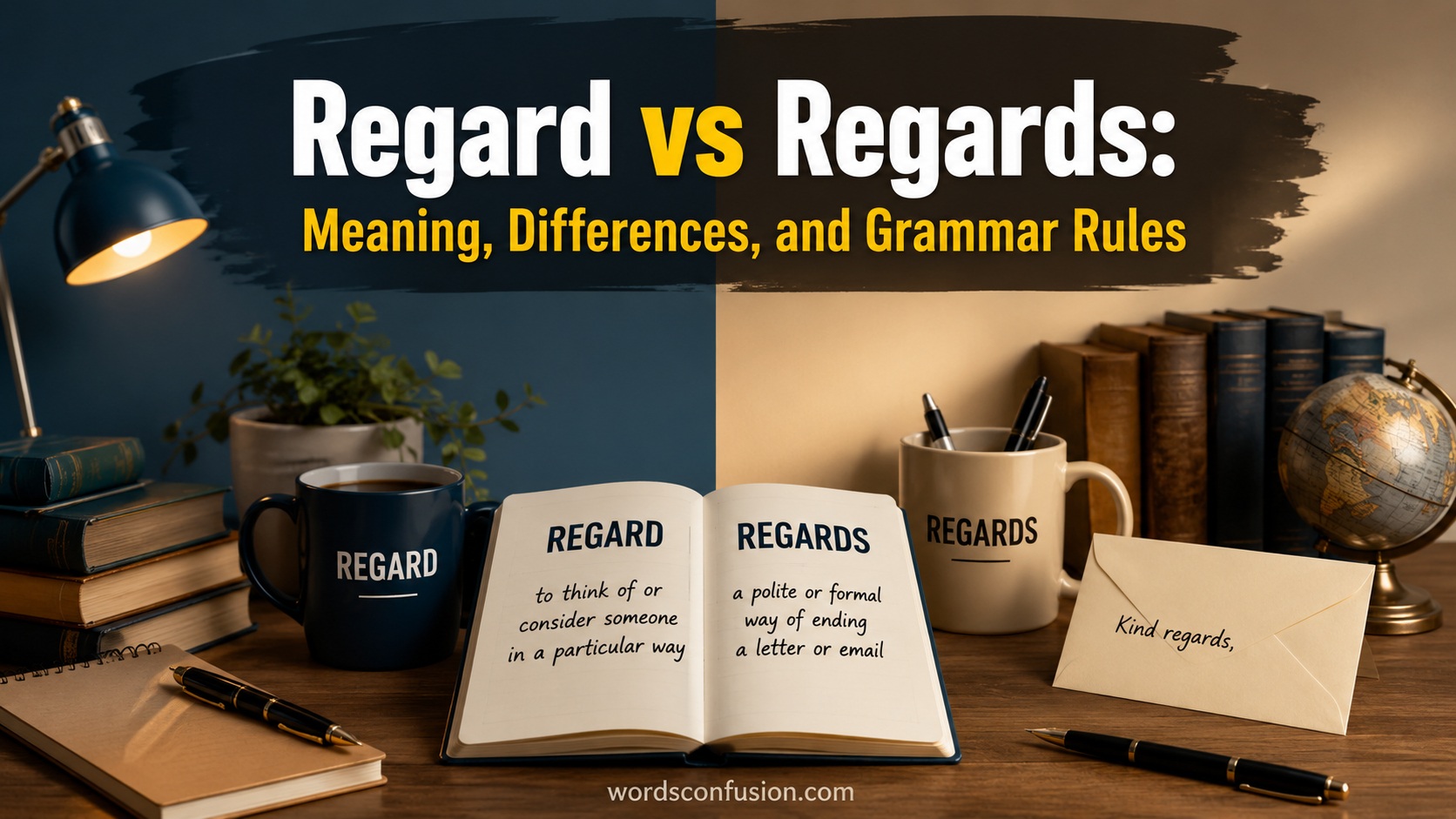
“Regard” and “regards” look almost identical, yet they serve different purposes in English. One is commonly used as a noun and verb while the other usually appears in email sign-offs or expressions of greetings. Because of their similar spelling, many English learners and even native speakers use them incorrectly.
If you’ve ever wondered whether to write “with regard to” or “with regards to,” or whether you should end an email with “Regards” or “Best Regards,” this guide explains everything in simple language.
By the end of this article, you’ll know exactly when to use regard and regards, understand the grammar behind each word, and avoid the mistakes that appear in everyday writing.
Quick Answer
Regard is a singular noun or a verb that refers to attention, respect, consideration, or the act of viewing someone or something in a particular way.
Regards is the plural form of regard, but it is most commonly used in email and letter closings such as Best Regards, Kind Regards, or Warm Regards. It is also used when sending greetings, such as “Give my regards to your family.”
When referring to a topic, “with regard to” and “in regard to” are the preferred forms in standard English. Although “with regards to” appears in informal writing, most grammar authorities recommend “with regard to.”
Regard vs Regards at a Glance
| Feature | Regard | Regards |
| Meaning | Attention, respect, consideration, or view | Greetings, good wishes, or polite closing |
| Part of Speech | Noun or verb | Plural noun |
| Common Use | Formal writing, discussions, grammar | Emails, letters, greetings |
| Formality | Formal and neutral | Professional and polite |
| Common Expressions | With regard to, regard as, high regard | Best regards, Kind regards, Warm regards |
| Example | I regard her as an expert. | Best regards, Sarah. |
What Does “Regard” Mean?
The word regard has several meanings depending on how it appears in a sentence. It can function as either a noun or a verb.
As a noun, it often means attention, consideration, respect, or concern.
As a verb, it means to think about, to consider, or to view someone or something in a particular way.
Definition
Here are the most common meanings of regard:
- Respect or admiration
- Care or concern
- Careful attention
- To think of someone or something in a certain way
Common Uses of Regard
You will often see regard used in formal writing, academic papers, business communication, and everyday English.
Examples include:
- I regard honesty as the most important quality.
- She has great regard for her teachers.
- The company acted without regard for customer safety.
- The committee will review the proposal with regard to cost.
Example Sentences
- Most employees regard teamwork as essential.
- The judge showed little regard for weak evidence.
- Parents should always show regard for their children’s opinions.
- Scientists regard climate data as an important source of evidence.
Common Collocations
Some expressions containing regard appear frequently in English.
| Expression | Meaning |
| With regard to | About or concerning |
| In regard to | Concerning |
| Regard as | Consider someone or something as |
| Hold in high regard | Respect greatly |
| Without regard for | Without considering |
What Does “Regards” Mean?
Unlike regard, the word regards rarely refers to attention or respect in everyday writing.
Instead, it usually represents greetings, good wishes, or a polite closing in letters and emails.
Definition
Regards means:
- Best wishes
- Greetings
- Respectful closing remarks
Why “Regards” Is Usually Plural
English speakers traditionally use the plural form when expressing greetings or good wishes.
That is why phrases like these sound natural:
- Best Regards
- Kind Regards
- Warm Regards
Using “Regard” alone as an email closing would sound incorrect.
Example Sentences
- Best Regards,
- Kind Regards,
- Please give my regards to your parents.
- Send my regards to your colleagues.
Common Collocations
| Expression | Usage |
| Best Regards | Professional email closing |
| Kind Regards | Polite business communication |
| Warm Regards | Friendly but respectful |
| Give my regards | Send greetings through another person |
| Send my regards | Express good wishes |
Regard vs Regards: What’s the Difference?
Although only one letter separates these words, their meanings differ significantly.
| Regard | Regards |
| Means attention, respect, consideration, or opinion | Means greetings or polite wishes |
| Can be a noun or verb | Usually a plural noun |
| Used in grammar expressions | Used in email closings |
| Appears in formal documents | Appears in correspondence |
Think of it this way:
- Regard relates to respect or consideration.
- Regards relates to greetings.
Comparison Table: Regard vs Regards
| Feature | Regard | Regards |
| Meaning | Respect, attention, opinion | Greetings or best wishes |
| Grammar | Noun and verb | Plural noun |
| Used in emails | Rarely | Frequently |
| Used in formal documents | Yes | Usually only as a closing |
| Example | We regard safety as essential. | Kind Regards, James |
When to Use “Regard”
Knowing when to choose regard becomes much easier once you recognize its role in a sentence.
In Formal Writing
Legal documents, reports, research papers, and official correspondence often use phrases like:
- With regard to your application
- In regard to company policy
These expressions introduce the topic under discussion.
In Business Communication
Managers and professionals often write:
- We regard customer satisfaction as our highest priority.
- The report was updated with regard to recent changes.
In Everyday English
The word also appears naturally in conversation.
Examples:
- I regard him as a close friend.
- She holds education in high regard.
- They showed little regard for the rules.
When to Use “Regards”
The word regards belongs mostly in greetings and email sign-offs.
Email Closings
Professional emails often end with:
- Best Regards
- Kind Regards
- Warm Regards
- Regards
Each version has a slightly different tone.
| Closing | Tone |
| Regards | Neutral |
| Best Regards | Professional |
| Kind Regards | Polite |
| Warm Regards | Friendly |
Letters
Formal letters frequently include:
Best Regards,
followed by the sender’s name.
Sending Greetings Through Someone
You can also say:
- Give my regards to your family.
- Please send my regards to everyone at work.
“With Regard To” vs “With Regards To”
This is one of the most searched grammar questions online.
Which One Is Grammatically Correct?
Most style guides recommend:
With regard to
This version has been accepted in formal English for many years.
Why “With Regard To” Is Preferred
The expression treats regard as an abstract noun meaning reference or consideration.
Examples:
- With regard to your request, we have approved it.
- With regard to safety procedures, nothing has changed.
Is “With Regards To” Ever Acceptable?
You may occasionally see with regards to in informal writing or speech.
However, professional editors usually replace it with:
- with regard to
- regarding
- concerning
- about
If you’re writing for work, school, or publication, with regard to is the better choice.
“In Regard To” vs “In Regards To”
The same rule applies here.
Correct Form
Use:
In regard to
Example:
- In regard to your invoice, payment has already been processed.
Common Mistake Explained
Many people mistakenly add the s because expressions like Best Regards are so common.
However, these are different grammatical constructions.
Better Alternatives
Instead of repeating in regard to, you can write:
- Regarding
- Concerning
- About
- Related to
These alternatives often make sentences shorter and easier to read.
Best Email Closings Using “Regards”
Choosing the right closing creates the right impression.
| Closing | Best Used For |
| Regards | General professional emails |
| Best Regards | Clients, coworkers, managers |
| Kind Regards | Formal but warm communication |
| Warm Regards | Friendly professional relationships |
Best Regards
A safe choice for almost every business email.
Kind Regards
Slightly warmer while remaining professional.
Warm Regards
Suitable when you know the recipient well.
Regards
Simple, neutral, and widely accepted.
Read More: Perquisite vs. Prerequisite: Meaning, Differences, and Examples
Common Mistakes People Make
Many learners confuse these expressions because they appear similar.
Here are the mistakes to avoid.
Using “Regards” Instead of “Regard”
Incorrect:
- With regards to your application…
Preferred:
- With regard to your application…
Writing “With Regards To” in Formal Documents
Although common online, many editors change it to with regard to.
Confusing Email Sign-Offs with Prepositions
Remember:
- Best Regards ends an email.
- With regard to introduces a topic.
Overusing Formal Expressions
Sometimes a simpler word works better.
Instead of:
- With regard to your question…
You can simply write:
- About your question…
The sentence becomes shorter without losing meaning.
Real-Life Examples
Seeing the words in context makes them much easier to remember.
Workplace Email
Subject: Meeting Schedule
Hello Michael,
With regard to tomorrow’s meeting, the start time has changed to 10:00 AM.
Best Regards,
Emma
Academic Writing
Researchers generally regard peer review as an essential part of scientific publishing.
Customer Service
With regard to your refund request, the payment has already been issued.
Everyday Conversation
- I regard her as my mentor.
- Please give my regards to your grandparents.
Memory Trick to Remember the Difference
Here’s an easy way to remember.
Regard = Respect or Consideration
Think of regard whenever someone is showing respect or discussing a topic.
Regards = Greetings
Think of the final S as standing for Sending wishes.
This simple trick helps many English learners avoid confusion.
Similar Word Pairs You May Confuse
English contains many similar-looking expressions.
Here are a few related ones worth learning.
| Word Pair | Main Difference |
| Regard vs Respect | Regard can mean consideration or opinion. Respect focuses on admiration. |
| Sincerely vs Regards | Both close letters, but Sincerely is generally more formal. |
| Affect vs Effect | One is usually a verb while the other is usually a noun. |
| Advice vs Advise | Advice is a noun. Advise is a verb. |
Learning these pairs together improves both grammar and vocabulary.
FAQs:
Is it “with regard to” or “with regards to”?
With regard to is the preferred form in formal English. Although with regards to appears in informal writing, most editors recommend using the singular version.
Can I end an email with just “Regards”?
Yes. Regards is a perfectly acceptable professional email closing. However, Best Regards and Kind Regards often sound slightly warmer.
Is “Best Regards” more formal than “Kind Regards”?
Both are professional. Best Regards is slightly more neutral while Kind Regards adds a touch of friendliness.
Is “Regards” singular or plural?
Regards is the plural form of regard, but in email closings it functions as a fixed expression meaning best wishes.
What does “hold someone in high regard” mean?
It means you respect or admire someone greatly.
Is “in regards to” grammatically incorrect?
Many grammar experts consider in regard to the preferred form in formal writing. In regards to appears in informal English but is generally avoided in professional documents.
Can “regard” be used as both a verb and a noun?
Yes. It works as both.
Examples:
- I regard him as an expert. (verb)
- She has great regard for honesty. (noun)
Conclusion:
Understanding the difference between regard vs regards is easier than it first appears. Regard focuses on respect, consideration, or the way you think about someone or something. Regards, on the other hand, expresses good wishes and polite greetings, especially in emails and letters.
The most important grammar rule is also the simplest to remember. When introducing a topic, write with regard to or in regard to. When ending an email or sending greetings through another person, use regards.
Once you recognize these patterns, you’ll write with greater confidence and avoid one of the most common mistakes in English grammar.

Andrew Wilson is an experienced language researcher and content writer specializing in WordsConfusion topics. He helps readers understand commonly confused English words, spelling differences, grammar rules, word meanings, and proper usage through clear explanations, practical examples, and easy-to-follow language guides. His goal is to make English learning simple, accurate, and accessible for students, writers, professionals, and everyday learners.