
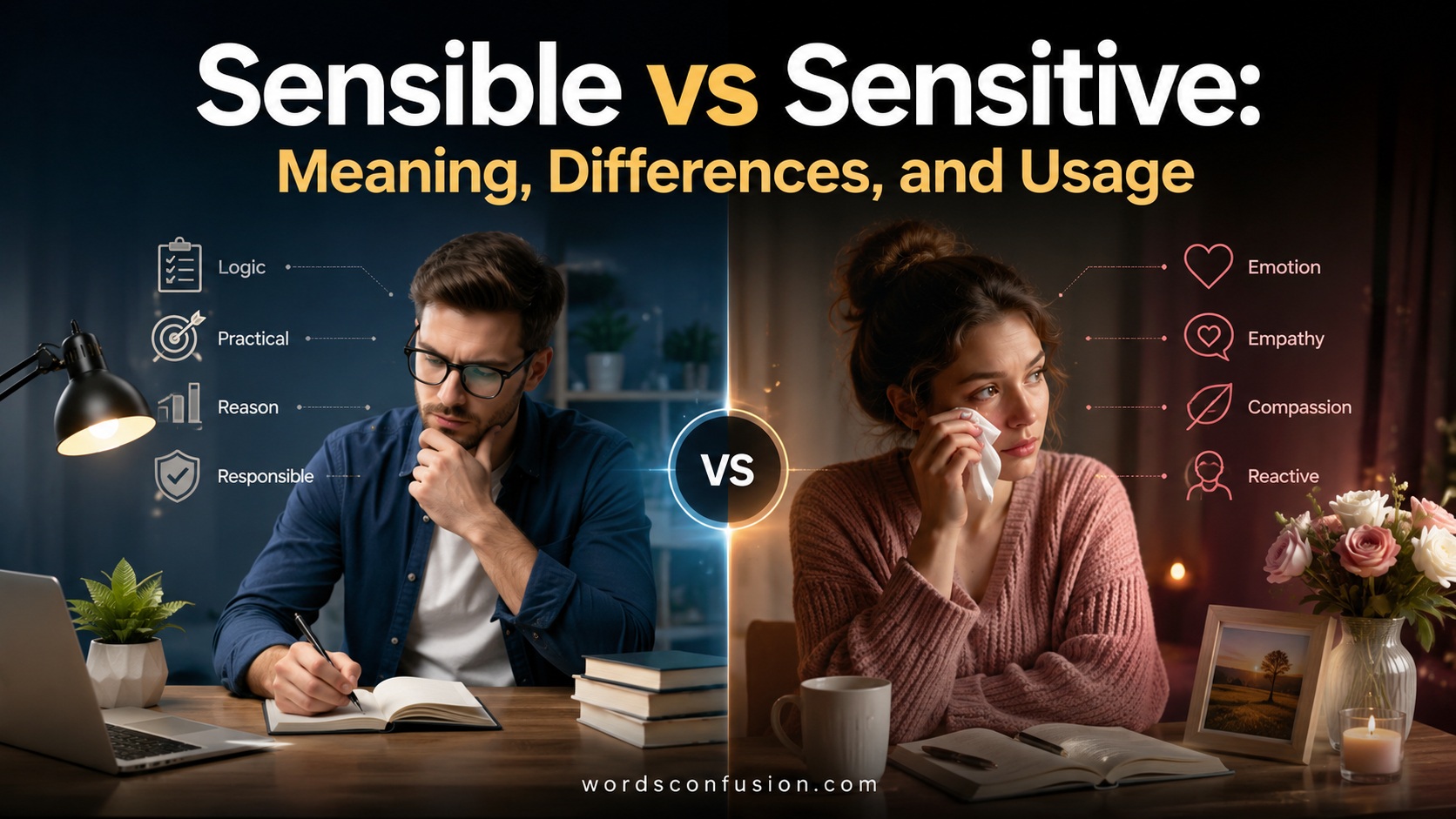
Choosing between sensible and sensitive can be surprisingly difficult. At first glance, the words look alike. They even share the same Latin roots. However, their meanings are completely different. Mixing them up can make your writing confusing or even change the meaning of a sentence.
For example, imagine someone says, “She’s a sensible child.” That means she makes wise decisions and behaves responsibly. Now compare it with “She’s a sensitive child.” This describes someone who feels emotions deeply or reacts strongly to criticism, noise, or other experiences. One word focuses on good judgment while the other focuses on feelings and reactions.
If you’re learning English, preparing for an exam, improving your grammar, or simply trying to write more clearly, understanding the difference between sensible vs sensitive will help you communicate with confidence.
Quick Answer
The difference between sensible and sensitive is simple:
| Word | Meaning | Example |
| Sensible | Practical, reasonable, and showing good judgment | Buying travel insurance was a sensible decision. |
| Sensitive | Easily affected by emotions, criticism, or physical conditions | He’s sensitive about comments regarding his appearance. |
Quick tip: If you’re talking about wisdom or practical thinking, use sensible. If you’re talking about feelings, emotions, or strong reactions, use sensitive.
Sensible vs Sensitive at a Glance
| Feature | Sensible | Sensitive |
| Meaning | Practical and reasonable | Easily affected emotionally or physically |
| Part of Speech | Adjective | Adjective |
| Focus | Good judgment | Emotions and reactions |
| Common Use | Decisions, plans, advice | People, skin, information, emotions |
| Positive Meaning | Usually yes | Usually neutral or positive |
| Example | A sensible investment | Sensitive skin |
What Does “Sensible” Mean?
Sensible describes someone or something that shows good judgment, practicality, and common sense.
A sensible person thinks before acting. They consider the facts instead of making emotional decisions. Their choices are usually realistic and responsible.
When to Use “Sensible”
Use sensible when talking about:
- Practical decisions
- Wise advice
- Responsible behavior
- Logical thinking
- Good financial choices
- Safe actions
Common Contexts
People often use sensible in conversations about everyday life.
Examples include:
- A sensible budget
- Sensible shoes
- A sensible solution
- A sensible investment
- Sensible parenting
- A sensible approach
Example Sentences
- Wearing a helmet while cycling is a sensible habit.
- It would be sensible to save money before buying a house.
- She offered a sensible solution that everyone accepted.
- Choosing quality over quantity is often the sensible option.
- His sensible advice helped the team avoid costly mistakes.
What Does “Sensitive” Mean?
Sensitive describes someone or something that reacts easily to emotions, physical conditions, or changes in the environment.
A sensitive person may notice small emotional changes, feel hurt by criticism, or show great empathy toward others.
However, sensitive is not limited to people. It also describes objects, technology, information, and even skin.
When to Use “Sensitive”
Use sensitive when referring to:
- Emotions
- Feelings
- Personal issues
- Confidential information
- Delicate situations
- Physical reactions
Common Contexts
You’ll frequently hear expressions such as:
- Sensitive skin
- Sensitive topic
- Sensitive information
- Sensitive equipment
- Sensitive child
- Emotionally sensitive person
Example Sentences
- She has sensitive skin that reacts to certain soaps.
- This is a sensitive subject for many families.
- The microphone is extremely sensitive to background noise.
- He’s very sensitive to criticism.
- The report contains sensitive company data.
Sensible vs Sensitive: Key Differences
Although these words look similar, they describe completely different qualities.
| Feature | Sensible | Sensitive |
| Main Meaning | Practical and reasonable | Easily affected or responsive |
| Focus | Logic | Feelings or reactions |
| Describes | Decisions and behavior | People, emotions, skin, information |
| Related Idea | Common sense | Awareness and responsiveness |
| Opposite | Foolish | Insensitive |
| Typical Tone | Practical | Emotional or delicate |
The easiest way to remember the difference is this:
- Sensible = Smart choices
- Sensitive = Strong feelings or reactions
Sensible vs Sensitive in Everyday English
Understanding how native speakers use these words makes choosing the right one much easier.
At Work
A manager may make a sensible decision by reducing unnecessary spending.
An employee may handle sensitive customer information that must remain confidential.
In Relationships
A sensible partner communicates calmly during disagreements.
A sensitive partner notices when someone feels upset without being told.
In School
A student who studies consistently makes a sensible choice.
A student who feels deeply hurt after criticism may be sensitive.
In Business and Professional Communication
Companies encourage employees to make sensible financial decisions.
They also protect sensitive customer data through strong security measures.
Common Collocations
Learning common word combinations helps your English sound more natural.
Common Phrases with “Sensible”
- Sensible advice
- Sensible decision
- Sensible choice
- Sensible solution
- Sensible investment
- Sensible budget
- Sensible clothing
- Sensible precautions
Common Phrases with “Sensitive”
- Sensitive information
- Sensitive data
- Sensitive skin
- Sensitive issue
- Sensitive equipment
- Sensitive topic
- Sensitive child
- Sensitive response
Grammar Rules
Both sensible and sensitive are adjectives, but they describe different qualities.
Is “Sensible” an Adjective?
Yes.
It describes nouns by showing they are practical or reasonable.
Examples:
- A sensible plan
- A sensible teacher
- A sensible decision
Is “Sensitive” an Adjective?
Yes.
It describes nouns that react easily or require careful handling.
Examples:
- Sensitive material
- Sensitive eyes
- Sensitive negotiations
Related Word Forms
| Word | Part of Speech | Meaning |
| Sensibly | Adverb | In a practical or reasonable way |
| Sensibleness | Noun | Quality of being practical |
| Sensitivity | Noun | Ability to react or respond |
| Sensitively | Adverb | In a caring or delicate way |
Real-Life Examples
Seeing these words in realistic situations makes the distinction much clearer.
Examples Using “Sensible”
- Buying emergency supplies before storm season is a sensible idea.
- She made the sensible decision to finish university before starting a business.
- Driving slowly in heavy rain is always sensible.
- Investing for retirement at a young age is financially sensible.
- The doctor recommended a sensible diet instead of a crash diet.
Examples Using “Sensitive”
- Many smartphones have highly sensitive touchscreens.
- Young children are often sensitive to loud noises.
- Climate change remains a politically sensitive issue.
- The laboratory uses sensitive instruments for precise measurements.
- His dog is sensitive to certain foods.
Common Mistakes and How to Avoid Them
Many English learners confuse these words because they look similar. Fortunately, the mistakes are easy to avoid once you know what each word means.
Mistake One
Incorrect: She is very sensible to criticism.
Correct: She is very sensitive to criticism.
Criticism affects emotions, not judgment.
Mistake Two
Incorrect: It was a sensitive financial decision.
Correct: It was a sensible financial decision.
Financial decisions require logic and practicality.
Mistake Three
Incorrect: My laptop is sensible to heat.
Correct: My laptop is sensitive to heat.
Machines can react to environmental conditions.
Read More: Regard vs Regards: Meaning, Differences, and Grammar Rules
Memory Trick to Remember the Difference
Here’s an easy trick:
- Sensible = Sense = Common sense
- Sensitive = Sensitivity = Feelings and reactions
If the sentence involves logic, choose sensible.
If it involves emotion, physical reaction, or careful handling, choose sensitive.
Can a Person Be Both Sensible and Sensitive?
Absolutely.
These qualities often complement each other.
Someone can make practical decisions while still caring deeply about other people’s feelings.
For example, imagine a school principal handling a bullying complaint. A sensible principal gathers facts before making a decision. A sensitive principal also listens carefully to every student involved and understands the emotional impact of the situation.
The best leaders often combine both qualities.
Practical Example
Sarah manages a healthcare team.
She creates realistic work schedules because she’s sensible.
She also notices when staff members feel overwhelmed and offers support because she’s sensitive.
Her success comes from balancing logic with empathy.
Synonyms and Antonyms
Sensible
Synonyms
- Practical
- Wise
- Rational
- Logical
- Reasonable
- Level-headed
- Sound
- Judicious
Antonyms
- Foolish
- Reckless
- Irrational
- Careless
- Impractical
Sensitive
Synonyms
- Emotional
- Responsive
- Delicate
- Perceptive
- Compassionate
- Empathetic
- Reactive
- Aware
Antonyms
- Insensitive
- Unemotional
- Unresponsive
- Unfeeling
- Cold
- Indifferent
Similar Word Pairs You Might Confuse
Many English words look alike but carry different meanings.
| Word Pair | Main Difference |
| Practical vs Practicable | Useful vs capable of being done |
| Rational vs Emotional | Logic vs feelings |
| Empathetic vs Sympathetic | Understanding feelings vs expressing concern |
| Logical vs Emotional | Reasoning vs emotional response |
Learning these pairs together strengthens your vocabulary and reduces common grammar mistakes.
FAQs:
Is sensible a compliment?
Yes. Calling someone sensible usually means they make thoughtful, practical, and responsible decisions. It is considered a positive compliment.
Can someone be both sensible and sensitive?
Yes. A person can think logically while also understanding emotions. In fact, many successful leaders, teachers, and healthcare professionals display both qualities.
Does sensitive always mean emotional?
No. It can also describe physical reactions, technology, medical conditions, scientific instruments, confidential information, or delicate situations.
What is the difference between sensible and practical?
Sensible focuses on wise judgment and common sense. Practical focuses on usefulness and effectiveness. Many decisions can be both sensible and practical.
Which word should I use in formal writing?
Use whichever matches your intended meaning. Sensible is appropriate when discussing logic or judgment. Sensitive is correct when discussing emotions, confidential matters, or physical responsiveness.
Why do English learners confuse sensible and sensitive?
The words have similar spelling and pronunciation. However, their meanings are completely different. Learning them through examples and common phrases makes them much easier to remember.
Conclusion:
Understanding the difference between sensible vs sensitive improves both your spoken and written English. Although the words look similar, they describe very different ideas.
Choose sensible when you’re talking about good judgment, practical thinking, and wise decisions.
Choose sensitive when you’re referring to emotions, physical reactions, delicate subjects, or things that respond easily to change.
A simple way to remember the difference is this:
- Sensible people use common sense.
- Sensitive people or things react easily.
Once you connect each word with its core meaning, you’ll use them naturally and avoid one of the most common vocabulary mistakes in English.

Andrew Wilson is an experienced language researcher and content writer specializing in WordsConfusion topics. He helps readers understand commonly confused English words, spelling differences, grammar rules, word meanings, and proper usage through clear explanations, practical examples, and easy-to-follow language guides. His goal is to make English learning simple, accurate, and accessible for students, writers, professionals, and everyday learners.