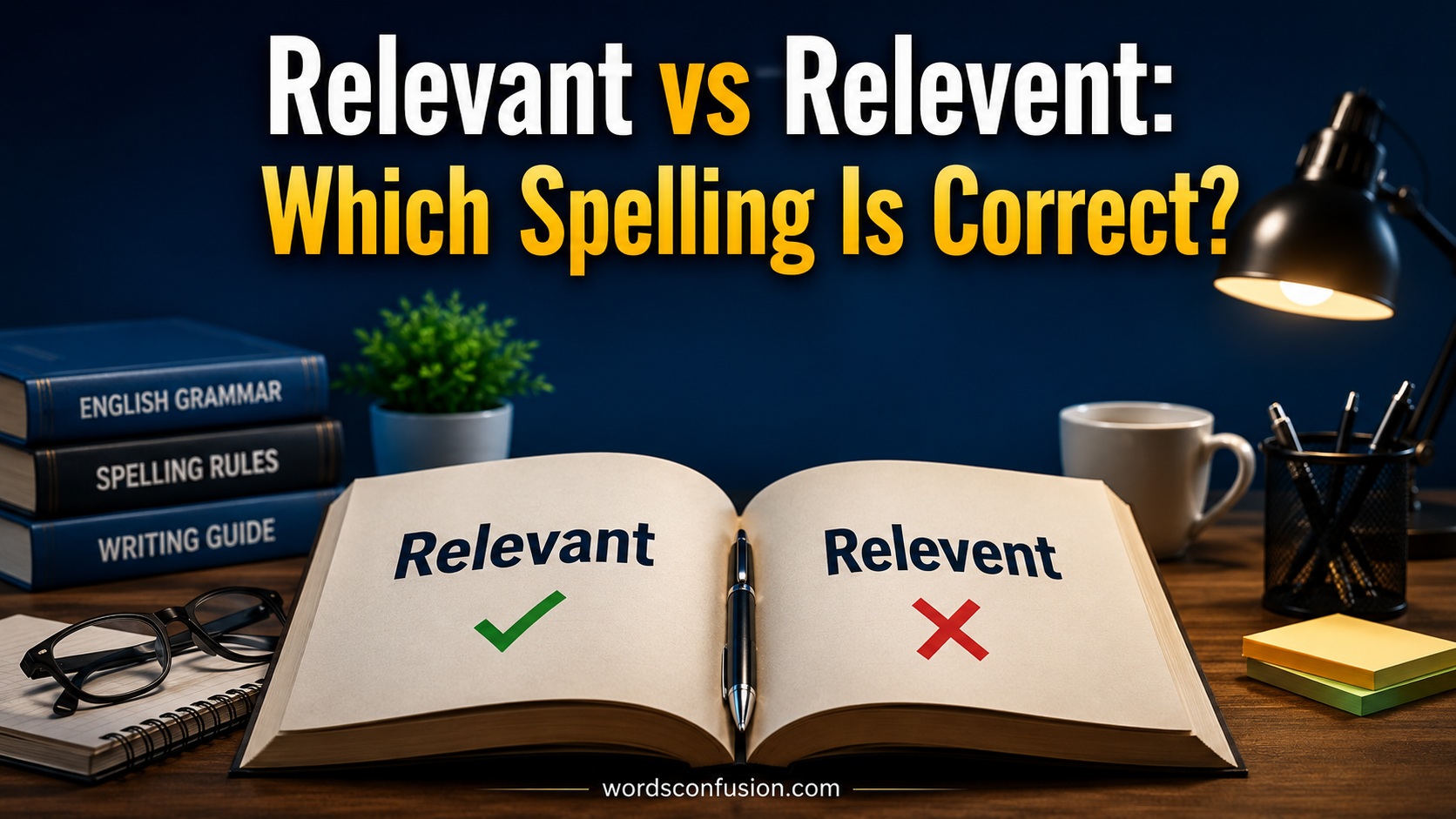
If you’ve ever paused while writing the word relevant, you’re not alone. Many English learners and native speakers occasionally write relevent instead. The two spellings look almost identical, and their pronunciation doesn’t always make the difference obvious. However, only one spelling is correct in standard English.
The correct spelling is relevant.
Relevent is a common spelling mistake, not an alternative form of the word. The correct word means closely connected with a particular subject, situation, question, or issue. You might talk about relevant information, relevant experience, relevant evidence, or relevant details.
The main spelling challenge appears near the end of the word. Many people write relevent because they replace the a in relevant with an e. That small change creates an incorrect spelling.
Quick Answer: Relevant vs Relevent
Relevant is the correct spelling.
Relevent is incorrect and should not be used in standard English.
| Spelling | Correct? | Meaning |
| Relevant | Yes | Connected with or important to a particular subject |
| Relevent | No | A common misspelling of relevant |
Example: Please provide only relevant information for the application.
A simple way to remember the spelling is:
ReleVAnt = Relevant
The letter A comes after V:
R-E-L-E-V-A-N-T
Not:
R-E-L-E-V-E-N-T
Relevant vs Relevent: Which Spelling Is Correct?
The correct spelling is relevant.
The word contains the letter sequence -vant near the end:
relevant
The incorrect version, relevent, changes this sequence to -vent. Although that mistake may seem minor, it creates a spelling error.
Correct spelling
Relevant
Incorrect spelling
Relevent
The difference comes down to one letter:
| Correct Word | Incorrect Word |
| R-E-L-E-V-A-N-T | R-E-L-E-V-E-N-T |
That single vowel changes the spelling from a standard English word into a misspelling.
For example:
- Correct: This information is relevant to the discussion.
- Incorrect: This information is relevent to the discussion.
The second sentence contains a spelling error. The word should always be written as relevant.
What Does Relevant Mean?
Relevant is an adjective that describes something connected to a particular subject, situation, question, or problem.
When something is relevant, it has a meaningful connection to what you’re discussing. It isn’t merely connected in some distant way. In many situations, it directly helps explain, answer, support, or clarify the matter at hand.
For example:
The witness provided relevant evidence during the trial.
The evidence matters because it connects to the case. A random fact about the witness’s favorite food probably wouldn’t be relevant to the legal issue.
Here are more examples:
- Please include relevant information in your report.
- Her previous experience is relevant to the job.
- That question isn’t relevant to the current discussion.
- The researcher collected relevant data for the study.
- The teacher asked students to focus on relevant details.
The word relevant often answers an important question:
“Does this connect directly to what we’re talking about?”
If the answer is yes, the information may be relevant.
Relevant Definition Explained Clearly
The main definition of relevant is:
Closely connected with or important to the subject or matter being discussed.
The word can describe information, facts, evidence, experience, skills, questions, examples, documents, and many other things.
Relevant Information
Relevant information directly relates to a topic or decision.
For example, if you’re applying for a software engineering job, your programming experience is relevant information. Your favorite movie may be interesting, but it usually isn’t relevant to the position.
Relevant Evidence
Relevant evidence has a meaningful connection to a question or case.
For example:
The lawyer presented relevant evidence to support the argument.
The evidence matters because it helps address the issue under consideration.
Relevant Experience
Relevant experience refers to past work, training, or knowledge that connects to a current role or situation.
For example:
The applicant has five years of relevant experience in digital marketing.
The experience is relevant because it relates directly to the position.
Relevant Details
Relevant details are the pieces of information that help explain or understand the main subject.
If you’re describing a car accident, the weather, road conditions, and traffic signals may be relevant details. The color of your shirt may not be.
Relevant Pronunciation and Spelling
The word relevant is commonly pronounced:
REL-uh-vuhnt
Its pronunciation is commonly represented as:
/ˈrɛl.ə.vənt/
The exact sound can vary slightly depending on a speaker’s accent. However, the spelling remains the same:
R-E-L-E-V-A-N-T
This creates one reason people sometimes write relevent. The unstressed vowel sounds in English can be difficult to identify. When people hear a word rather than see it written, they may guess the spelling incorrectly.
English contains many words whose pronunciation doesn’t perfectly reveal their spelling. Relevant is one of them.
That’s why pronunciation alone isn’t a reliable way to remember this word. The spelling needs to be learned separately.
Why Do People Spell Relevant as Relevent?
The mistake relevent happens for several practical reasons.
The Vowel Sound Is Easy to Mishear
The vowel after v doesn’t always sound strongly pronounced in everyday speech. As a result, writers may remember the word as relevent.
English Spelling Doesn’t Always Match Pronunciation
English spelling often contains letters that don’t sound exactly as expected. This makes spelling mistakes common even among fluent speakers.
For example, a writer may hear:
rel-uh-vuhnt
Then, while writing the word, they may instinctively choose e instead of a.
The Word Looks Similar to Other Words
The ending -vent appears in words such as:
- event
- prevent
- invent
- adventure-related words containing similar sound patterns
That familiarity can influence spelling. However, relevant has a different spelling pattern.
The Word Is Often Used Quickly
People commonly use relevant in emails, essays, reports, applications, and conversations. When writing quickly, a writer may type relevent without noticing the error.
The solution is simple: remember the correct sequence.
releVAnt
The A comes after V.
Relevant vs Relevent Spelling Breakdown
A letter-by-letter comparison makes the difference easy to see.
Correct: Relevant
R – E – L – E – V – A – N – T
Incorrect: Relevent
R – E – L – E – V – E – N – T
Only one letter changes. Yet that one letter determines whether the spelling is correct.
| Position | Correct: Relevant | Incorrect: Relevent |
| 1 | R | R |
| 2 | E | E |
| 3 | L | L |
| 4 | E | E |
| 5 | V | V |
| 6 | A | E |
| 7 | N | N |
| 8 | T | T |
The easiest memory point is the sixth letter:
Relevant has A after V.
Relevant in a Sentence
The word relevant usually appears before a noun or after a linking verb.
Before a Noun
- relevant information
- relevant evidence
- relevant experience
- relevant facts
- relevant details
- relevant research
Examples:
The manager reviewed the applicant’s relevant experience.
The report contains several relevant facts.
After a Linking Verb
The word can also appear after verbs such as is, are, was, and remain.
Examples:
- This information is relevant.
- Those facts are relevant to the case.
- The issue remains relevant today.
- Her experience was relevant to the position.
The word often appears with the preposition to.
The Common Pattern: Relevant To
The standard expression is:
relevant to something
Examples:
- This evidence is relevant to the case.
- Her skills are relevant to the position.
- The topic is relevant to modern education.
- These statistics are relevant to the research.
- That question isn’t relevant to our discussion.
A common mistake involves using an incorrect preposition. In most standard contexts, relevant to is the natural structure.
Relevant vs Relevent Examples in Sentences
The following examples show how to use the correct spelling naturally.
Correct Examples
- Please provide relevant information about your previous experience.
- The professor asked students to find relevant sources for their essays.
- Her communication skills are highly relevant to the position.
- The lawyer presented relevant evidence during the hearing.
- Only relevant documents should be attached to the application.
- The discussion moved away from the relevant issue.
- This research provides relevant data for future studies.
- The manager asked the team to focus on relevant facts.
- His previous experience is directly relevant to the new role.
- The question is relevant to the main topic.
Incorrect Examples
The following sentences contain the misspelling relevent:
- Please provide relevent information.
- Her experience is relevent to the job.
- The evidence is not relevent to the case.
Corrected Versions
- Please provide relevant information.
- Her experience is relevant to the job.
- The evidence is not relevant to the case.
The meaning doesn’t change. The spelling does.
Relevant vs Relevent in Common Phrases
Certain phrases appear frequently in professional, academic, and everyday English.
| Correct Phrase | Example |
| Relevant information | The report contains relevant information. |
| Relevant experience | She has relevant experience in sales. |
| Relevant details | Please include all relevant details. |
| Relevant evidence | The court considered the relevant evidence. |
| Relevant skills | The applicant has relevant technical skills. |
| Relevant facts | The report explains the relevant facts. |
| Relevant research | The paper reviews relevant research. |
| Relevant question | That is a relevant question. |
| Relevant data | The analyst examined relevant data. |
| Relevant documents | Submit all relevant documents. |
Notice how naturally relevant fits into formal writing. It’s especially common in education, business, law, research, technology, and professional communication.
Read More: Questionnaire vs Questionaire: Which Spelling Is Correct?
Relevant vs Related: What’s the Difference?
Relevant and related share a similar meaning. However, they aren’t always interchangeable.
Related means connected in some way.
Relevant means connected in a way that matters to the current subject or situation.
Consider this example:
The two topics are related.
This sentence says the topics have some connection.
Now compare:
The information is relevant to the investigation.
This sentence makes a stronger point. The information doesn’t merely connect to the investigation. It has a meaningful connection that matters to the investigation.
Comparison Table
| Word | Meaning | Example |
| Relevant | Directly connected and useful to the current matter | This evidence is relevant to the case. |
| Related | Connected in some way | The two subjects are related. |
Simple Example
Imagine you’re discussing a job application.
- The applicant’s previous experience is relevant.
- The applicant’s interest in business podcasts may be related to the field.
- The applicant’s favorite football team is probably unrelated to the hiring decision.
The distinction depends on context.
Something can be related without being relevant.
Relevant vs Important: Are They the Same?
Not always.
Important describes something that has great value, significance, or influence.
Relevant describes something that connects to the current subject or situation.
A piece of information can be important but irrelevant to a specific discussion.
For example, a company’s annual revenue may be extremely important to investors. However, if a meeting focuses only on employee training, the company’s revenue figures may not be relevant to that particular conversation.
The reverse can also happen. A small detail may be relevant even if it isn’t especially important overall.
Example
Suppose a doctor asks about your recent symptoms. The exact time a symptom began may be relevant to the diagnosis. However, it may not be the most important fact about your overall health.
The words overlap in some contexts. They don’t have identical meanings.
Relevant vs Appropriate: What’s the Difference?
Relevant focuses on connection.
Appropriate focuses on suitability.
For example:
The question is relevant but inappropriate.
This could mean the question directly relates to the topic. However, asking it in that particular situation may not be suitable.
Another example:
The example is appropriate but not relevant.
The example might be polite and suitable for the audience. Yet it may not connect directly to the topic.
| Word | Main Focus |
| Relevant | Connection to the subject |
| Appropriate | Suitability for the situation |
This distinction matters in professional and academic writing.
Common Mistakes with Relevant
Mistake 1: Writing Relevent Instead of Relevant
This is the most common spelling mistake.
Incorrect: The information is relevent.
Correct: The information is relevant.
Remember:
releVAnt
Mistake 2: Confusing Relevant With Relevance
These words come from the same word family. However, they serve different grammatical roles.
Relevant is an adjective.
The information is relevant.
Relevance is a noun.
The information has relevance to the case.
Compare the two:
| Word | Part of Speech | Example |
| Relevant | Adjective | This is relevant information. |
| Relevance | Noun | The relevance of the evidence is clear. |
Mistake 3: Confusing Relevant With Relevantly
Relevantly is the adverb form. It’s much less common in everyday writing.
For most sentences, relevant or relevance will be the better choice.
Mistake 4: Using Relevant When You Mean Irrelevant
The prefix ir- changes the meaning.
- Relevant = connected to the matter.
- Irrelevant = not connected to the matter.
Examples:
The witness provided relevant evidence.
The witness’s favorite color was irrelevant to the case.
The opposite of relevant is irrelevant.
FAQs:
Is Relevant or Relevent Correct?
Relevant is the correct spelling. Relevent is a common spelling mistake and isn’t accepted as the standard spelling of the word.
For example:
Correct: The information is relevant to the discussion.
Incorrect: The information is relevent to the discussion.
How Do You Spell Relevant Correctly?
The correct spelling is:
R-E-L-E-V-A-N-T
A useful memory trick is releVAnt. Remember that the letter A comes after V.
What Does Relevant Mean?
Relevant means closely connected to a particular subject, question, situation, or issue.
For example:
Her previous work experience is relevant to the position.
This means her experience directly relates to the job.
Why Is Relevent Incorrect?
Relevent is incorrect because it changes the a in relevant to an e. Although the two spellings look and sound similar, only relevant is the standard English spelling.
What Is the Difference Between Relevant and Related?
Relevant means directly connected to the subject and useful in the current context. Related means connected in some way but not necessarily important to the immediate discussion.
For example, two subjects can be related without one being directly relevant to the other.
Conclusion:
When choosing between Relevant vs Relevent, the answer is simple: relevant is correct and relevent is a misspelling.
The correct spelling is R-E-L-E-V-A-N-T. The word means closely connected to a particular subject, situation, question, or issue. You can use it in phrases such as relevant information, relevant experience, relevant evidence, and relevant details.
The easiest way to remember the spelling is releVAnt. Keep the A after V and you’ll avoid the common mistake. So, whether you’re writing an essay, resume, email, report, or professional document, always choose relevant. The spelling may differ by only one letter, but that small letter makes all the difference.

Andrew Wilson is an experienced language researcher and content writer specializing in WordsConfusion topics. He helps readers understand commonly confused English words, spelling differences, grammar rules, word meanings, and proper usage through clear explanations, practical examples, and easy-to-follow language guides. His goal is to make English learning simple, accurate, and accessible for students, writers, professionals, and everyday learners.