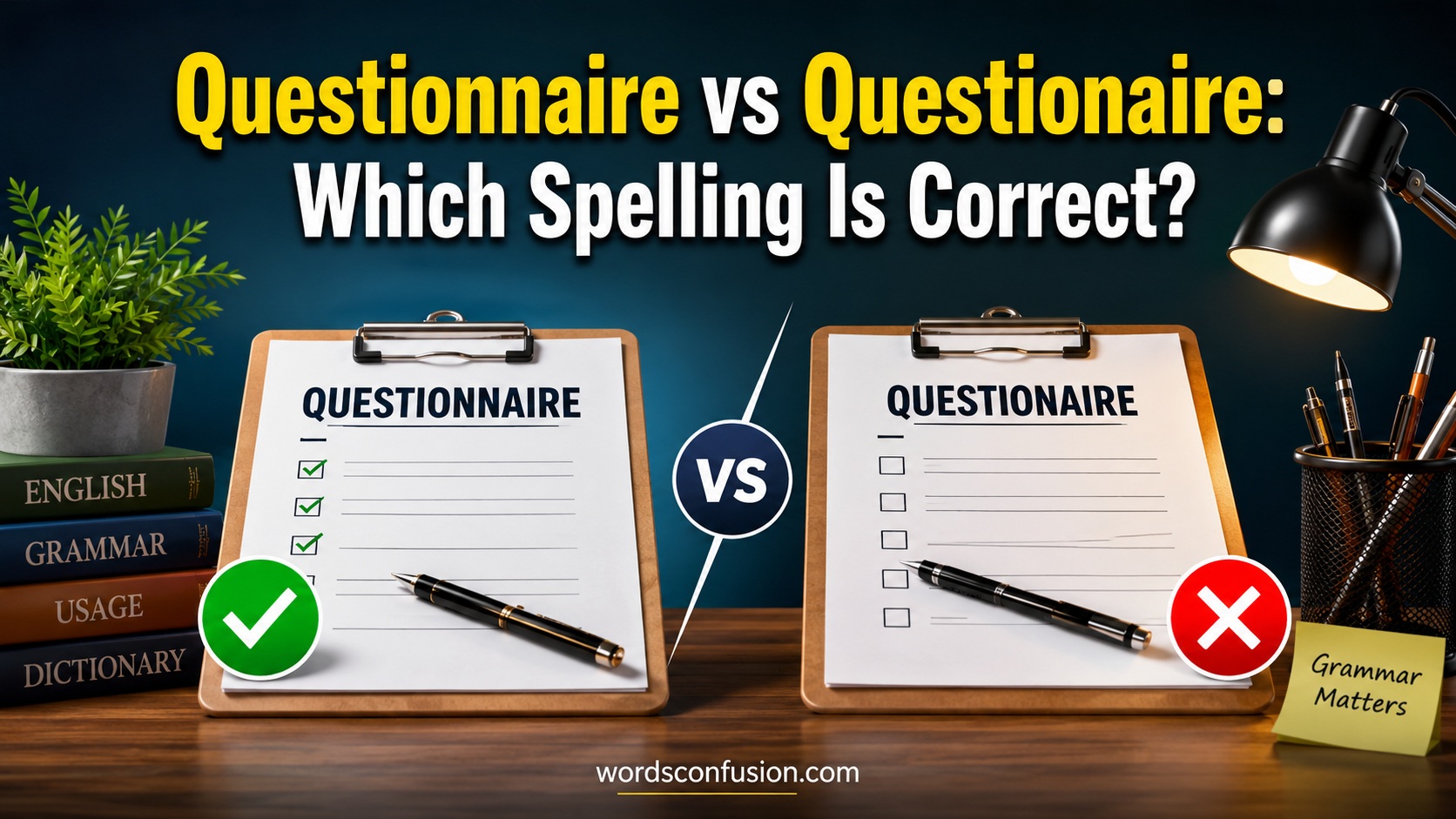
When you’re writing about surveys, research, customer feedback, or data collection, one spelling mistake can quietly slip into an otherwise polished document. Questionnaire vs Questionaire is a perfect example. The two forms look almost identical, and the difference is only one letter. Still, that single n determines whether the spelling is correct.
The correct spelling is questionnaire.
Questionaire is a common misspelling. It isn’t a separate standard English word with a different meaning. If you’re referring to a written or digital set of questions used to collect information, opinions, or facts, you should write questionnaire.
The spelling can feel tricky because the word contains an unusual sequence of letters. Many people remember the beginning, question, but lose one of the two consecutive n’s near the end. Once you know where that extra n belongs, the spelling becomes much easier to remember.
Quick Answer: Questionnaire or Questionaire?
Questionnaire is the correct spelling.
Questionaire is incorrect.
| Spelling | Correct? | Meaning |
| Questionnaire | Yes | A written or digital set of questions used to collect information |
| Questionaire | No | A common misspelling of questionnaire |
Correct Example
The researchers distributed a questionnaire to 500 participants.
Incorrect Example
The researchers distributed a questionaire to 500 participants.
A simple way to remember the correct form is this:
question + naire = questionnaire
The word contains two consecutive n’s:
questionnaire
Not:
questionaire
According to the Cambridge Dictionary, a questionnaire is a list or set of questions used to collect information from people. It can appear in research, business, education, healthcare, government, and everyday situations. (Cambridge Dictionary)
What Is the Correct Spelling: Questionnaire or Questionaire?
The correct spelling is questionnaire.
The incorrect spelling is questionaire.
The difference may look small, but the correct spelling follows this pattern:
Q-U-E-S-T-I-O-N-N-A-I-R-E
The most important detail is the double n in the middle:
questionnaire
Many writers accidentally remove one of those letters and produce:
questionaire
That error usually happens because the word’s pronunciation doesn’t make every letter obvious. When you say questionnaire, the word sounds roughly like kwes-chuh-NAIR in American English. The two written n’s aren’t pronounced as clearly as they appear on the page.
This creates a familiar spelling trap. You hear the word, remember the sound, and write what seems logical. Unfortunately, English spelling doesn’t always work that way.
Why Is “Questionnaire” Easy to Misspell?
Several factors make questionnaire surprisingly difficult to spell.
First, the word combines the familiar word question with the less familiar ending -naire. The ending may look similar to words ending in -aire, which can encourage writers to drop the extra n.
Second, pronunciation doesn’t provide a perfect spelling guide. You can hear the word correctly and still write it incorrectly.
Third, the word is long enough to create typing mistakes. When people write quickly, they often focus on the beginning and ending while skipping a letter in the middle.
For example:
- questionnaire — correct
- questionaire — incorrect
- questionnare — incorrect
- questionair — incorrect
The most common mistake remains questionaire because writers often treat the ending as -aire instead of -naire.
Questionnaire Definition and Meaning
A questionnaire is a structured set of questions designed to gather information from one person or many people.
The questions may ask about:
- Opinions
- Experiences
- Preferences
- Behaviors
- Personal information
- Customer satisfaction
- Health or lifestyle factors
- Academic subjects
- Workplace experiences
- Market preferences
The format can vary. A questionnaire might consist of a printed sheet, an online form, a mobile survey, or a series of questions inside a research study.
The Cambridge Dictionary describes a questionnaire as a set or list of questions used to collect information from people. (Cambridge Dictionary)
What Does Questionnaire Mean?
In simple terms, a questionnaire is a collection of questions that people answer to provide information.
Imagine a university wants to learn how students use artificial intelligence for studying. Instead of interviewing every student individually, researchers might create a questionnaire containing questions such as:
- How often do you use AI tools for studying?
- Which subjects do you use them for?
- How helpful do you find them?
- What concerns do you have about using them?
Students can answer the same questions. Researchers can then compare the responses.
That is the basic idea behind a questionnaire: standardized questions help collect comparable information.
Questionnaire as a Noun
Questionnaire is primarily a noun.
It names the document, form, or collection of questions itself.
Examples:
- Please complete the questionnaire before your appointment.
- The research team created a questionnaire for university students.
- The company sent a customer satisfaction questionnaire.
- Each participant received the same questionnaire.
The plural form is questionnaires.
The researchers analyzed 2,000 completed questionnaires.
Questionnaire in Simple Terms
A questionnaire is similar to a written interview.
In an interview, one person asks questions directly. In a questionnaire, the questions appear in a fixed format that people answer independently.
This distinction makes questionnaires especially useful when researchers need information from many people.
For example, interviewing 1,000 customers individually would take a tremendous amount of time. Sending those customers the same online questionnaire can make the process faster and easier to organize.
That doesn’t mean questionnaires always produce better information. The quality depends heavily on the questions. A confusing questionnaire can generate confusing answers.
Questionaire: Why Is It Incorrect?
Questionaire is a misspelling of questionnaire.
It doesn’t represent a separate standard English word with its own accepted definition. If you write questionaire in an essay, report, email, or article, readers will generally understand what you mean. However, the spelling remains incorrect.
The missing letter is the second n.
Correct:
questionnaire
Incorrect:
questionaire
Think of the word as:
question + naire
The final part begins with n, so the word keeps the n from question and adds another one:
question + naire = questionnaire
Common Reasons People Write “Questionaire”
The mistake usually comes from one of five habits.
1. Spelling by Sound
The pronunciation doesn’t clearly reveal the double n. As a result, people may write the word based on how it sounds.
English contains many words that don’t follow a perfect sound-to-letter pattern. Questionnaire is one of them.
2. Forgetting the Double N
The word begins with question, which contains one n. The suffix-like ending adds another.
That creates:
question + naire
The result is:
questionnaire
When people type quickly, they may accidentally remove one of those letters.
3. Confusing the Ending
Some writers remember an ending that sounds like -naire but spell it as -aire.
That produces:
question + aire = questionaire
Unfortunately, this spelling isn’t correct.
4. Typing Too Quickly
A long word can lose a letter during fast typing. The missing n is easy to overlook because the rest of the word still looks familiar.
5. Relying Only on Spellcheck
Spellcheck can catch many mistakes. However, it shouldn’t replace proofreading.
A word may appear correct in a sentence while still being misspelled. In addition, some software may not immediately flag every spelling variation.
Questionnaire vs Questionaire: Key Differences
The main difference is simple: questionnaire is correct while questionaire is not.
| Feature | Questionnaire | Questionaire |
| Spelling | Correct | Incorrect |
| Standard English word | Yes | No |
| Meaning | A set of questions used to gather information | No standard meaning |
| Formal writing | Appropriate | Avoid |
| Academic writing | Appropriate | Incorrect |
| Business writing | Appropriate | Incorrect |
There is no meaningful difference in definition because questionaire isn’t a standard alternative spelling.
If you’re writing about a form that asks people questions, use questionnaire every time.
How to Spell Questionnaire Correctly
The full spelling is:
Q-U-E-S-T-I-O-N-N-A-I-R-E
A useful breakdown is:
question + naire
The key part is:
NN
Let’s look at the word in sections:
QUESTIO + NN + AIRE
Or use this:
QUESTION + NAIRE
Both parts help you remember the spelling.
The Double-N Rule
The most important spelling rule is simple:
Don’t forget the second n in questionnaire.
The correct word contains:
questionnaire
The incorrect version removes one:
questionaire
That extra n may look insignificant. It isn’t. Spelling accuracy depends on it.
A Simple Spelling Memory Trick
Try this memory formula:
Question + N + aire = questionnaire
You can also remember:
A questionnaire has an extra “n” because it asks more than one question.
That isn’t a formal linguistic rule. It’s simply a useful memory device.
Another helpful method involves visual repetition:
questionnaire = question + naire
Once you see question followed by naire, the spelling becomes easier to reconstruct.
Questionnaire Pronunciation
In American English, questionnaire is commonly pronounced approximately:
kwes-chuh-NAIR
The Cambridge Dictionary gives the American pronunciation as /ˌkwes.tʃəˈner/. (Cambridge Dictionary)
The pronunciation can be divided into three parts:
ques — like the beginning of question
tion — a soft “shun” sound
naire — sounds like nair
Together:
kwes-chuh-NAIR
The pronunciation explains part of the spelling problem. You don’t clearly hear two separate n sounds in the middle of the word. Therefore, writers may naturally leave one out.
However, pronunciation and spelling don’t always match perfectly in English. That’s why visual memory helps here.
Examples of Questionnaire in a Sentence
Seeing the correct word in context makes the difference easier to remember.
Everyday Examples
- Please complete the questionnaire before your appointment.
- The hotel gave guests a questionnaire about their stay.
- I answered a short questionnaire about my shopping habits.
- The school sent a questionnaire to parents.
Academic and Research Examples
- The researchers used a questionnaire to collect data from university students.
- Each participant completed the same questionnaire.
- The questionnaire included questions about study habits and academic performance.
- Researchers analyzed the questionnaire responses after the study ended.
A research questionnaire can contain different types of questions, including multiple-choice questions, rating scales, yes-or-no questions, and open-ended questions.
For example:
| Question Type | Example |
| Multiple choice | Which device do you use most often? |
| Rating scale | How satisfied are you from 1 to 5? |
| Yes or no | Have you used this service before? |
| Open-ended | What improvements would you suggest? |
The structure depends on the information the researcher needs.
Business Examples
- The company sent customers a questionnaire after the purchase.
- The employee questionnaire revealed concerns about workplace communication.
- Our marketing team designed a questionnaire to understand customer preferences.
- The manager reviewed the completed questionnaires before planning the next meeting.
Businesses often use questionnaires to collect feedback at scale. A single well-designed form can reveal patterns that individual conversations might miss.
Marketing Examples
- The marketing team created a questionnaire to identify the company’s target audience.
- Customers completed a questionnaire about their preferred product features.
- The brand used an online questionnaire to measure customer satisfaction.
A questionnaire can help a business answer practical questions:
- What do customers like?
- What frustrates them?
- Which features matter most?
- How much are they willing to pay?
- Why do they choose one product over another?
The answers don’t automatically provide perfect market intelligence. Poor questions can produce misleading results. Still, a carefully designed questionnaire can offer valuable insight.
Read More: Permanent vs Permenant: Which Spelling Is Correct?
Incorrect Examples Using Questionaire
The following examples contain the misspelling:
- Please complete the questionaire.
- The researchers analyzed the questionaire responses.
- We sent a customer questionaire by email.
The corrected versions are:
- Please complete the questionnaire.
- The researchers analyzed the questionnaire responses.
- We sent a customer questionnaire by email.
Questionnaire: Plural and Related Word Forms
The plural of questionnaire is questionnaires.
Singular
The participant completed one questionnaire.
Plural
The researchers distributed several questionnaires.
The plural simply adds -s:
questionnaire → questionnaires
Examples:
- The company collected 3,000 questionnaires.
- The questionnaires contained similar questions.
- Researchers compared the questionnaires from different groups.
Common Related Terms
| Term | Meaning |
| Questionnaire | A structured set of questions |
| Survey | A broader process of collecting and analyzing information |
| Interview | A direct question-and-answer conversation |
| Form | A document used to collect information |
| Poll | A method of measuring opinions or preferences |
| Quiz | A short test of knowledge or understanding |
These words can overlap. However, they aren’t always interchangeable.
A questionnaire focuses on the questions people answer. A survey can describe the entire process, including the questionnaire, participants, data collection, and analysis.
Questionnaire vs Survey: Are They the Same?
The words questionnaire and survey are closely related. Yet they don’t always mean exactly the same thing.
A questionnaire is generally the actual list or set of questions.
A survey may refer to the broader research activity.
For example:
A company conducts a customer survey by sending customers a questionnaire.
In this sentence:
- The survey is the overall information-gathering project.
- The questionnaire is the tool containing the questions.
Here’s another example.
Imagine a university wants to understand student satisfaction.
The university might:
- Design a questionnaire.
- Send it to students.
- Collect responses.
- Analyze the data.
- Publish a survey report.
The questionnaire is one component of the larger survey process.
That distinction matters in academic and professional writing because precise word choice helps readers understand exactly what happened.
Questionnaire vs Form: What’s the Difference?
A form usually collects specific information needed for a particular purpose.
For example:
- A job application form
- A registration form
- A tax form
- A medical intake form
A questionnaire usually focuses more heavily on asking questions to collect information, opinions, or responses.
Still, the categories can overlap. An online customer feedback form may effectively function as a questionnaire if it contains a structured series of questions.
The difference often depends on purpose.
Form: “Please enter your name and address.”
Questionnaire: “How satisfied were you with your experience?”
The first collects required information. The second seeks responses that can be analyzed.
Questionnaire vs Interview: What’s the Difference?
An interview usually involves direct interaction between an interviewer and a participant.
A questionnaire allows people to answer questions independently.
| Feature | Questionnaire | Interview |
| Interaction | Often limited | Direct interaction |
| Number of participants | Can reach many people | Usually fewer at one time |
| Format | Written or digital | Spoken or sometimes written |
| Follow-up questions | Often limited | Usually possible |
| Speed | Often faster for large groups | Usually slower |
| Depth | Depends on question design | Can provide detailed answers |
Neither method is automatically better. The right choice depends on the research goal.
If a researcher needs responses from thousands of people, a questionnaire may be practical. If the researcher wants detailed personal experiences, interviews may provide richer information.
FAQs:
Is questionnaire or questionaire correct?
Questionnaire is correct. Questionaire is a misspelling.
Why do people spell questionnaire as questionaire?
People often omit the second n because the word’s pronunciation doesn’t clearly reveal the spelling. The ending -naire can also be confused with -aire.
How do you spell questionnaire?
The correct spelling is:
Q-U-E-S-T-I-O-N-N-A-I-R-E
A useful breakdown is:
question + naire = questionnaire
What is the plural of questionnaire?
The plural is questionnaires.
Example:
The researchers distributed several questionnaires.
Is questionnaire the same as survey?
Not exactly. A questionnaire is usually the set of questions used to collect information. A survey can refer to the broader process of collecting and analyzing that information.
Is questionnaire spelled differently in American and British English?
No. Questionnaire is the standard spelling in both American and British English.
What does questionnaire mean?
A questionnaire is a written or digital set of questions used to collect information, opinions, facts, or responses from people.
What is the easiest way to remember questionnaire?
Remember:
question + naire = questionnaire
The word contains two consecutive n’s in the middle.
Conclusion:
When choosing between Questionnaire vs Questionaire, the answer is straightforward: questionnaire is the correct spelling.
Questionaire is a common misspelling caused mainly by the missing second n. The correct word refers to a set of questions used to collect information from people. You may find questionnaires in academic research, customer feedback, healthcare, education, business, marketing, and many other settings.

Andrew Wilson is an experienced language researcher and content writer specializing in WordsConfusion topics. He helps readers understand commonly confused English words, spelling differences, grammar rules, word meanings, and proper usage through clear explanations, practical examples, and easy-to-follow language guides. His goal is to make English learning simple, accurate, and accessible for students, writers, professionals, and everyday learners.