Have you ever paused before saying “I remembered him about the meeting” or “Please remember me tomorrow” because something didn’t sound right? You’re not alone. Many English learners confuse remember and remind because both words deal with memory. However, they play very different roles in a sentence.
The easiest way to understand the difference is this:
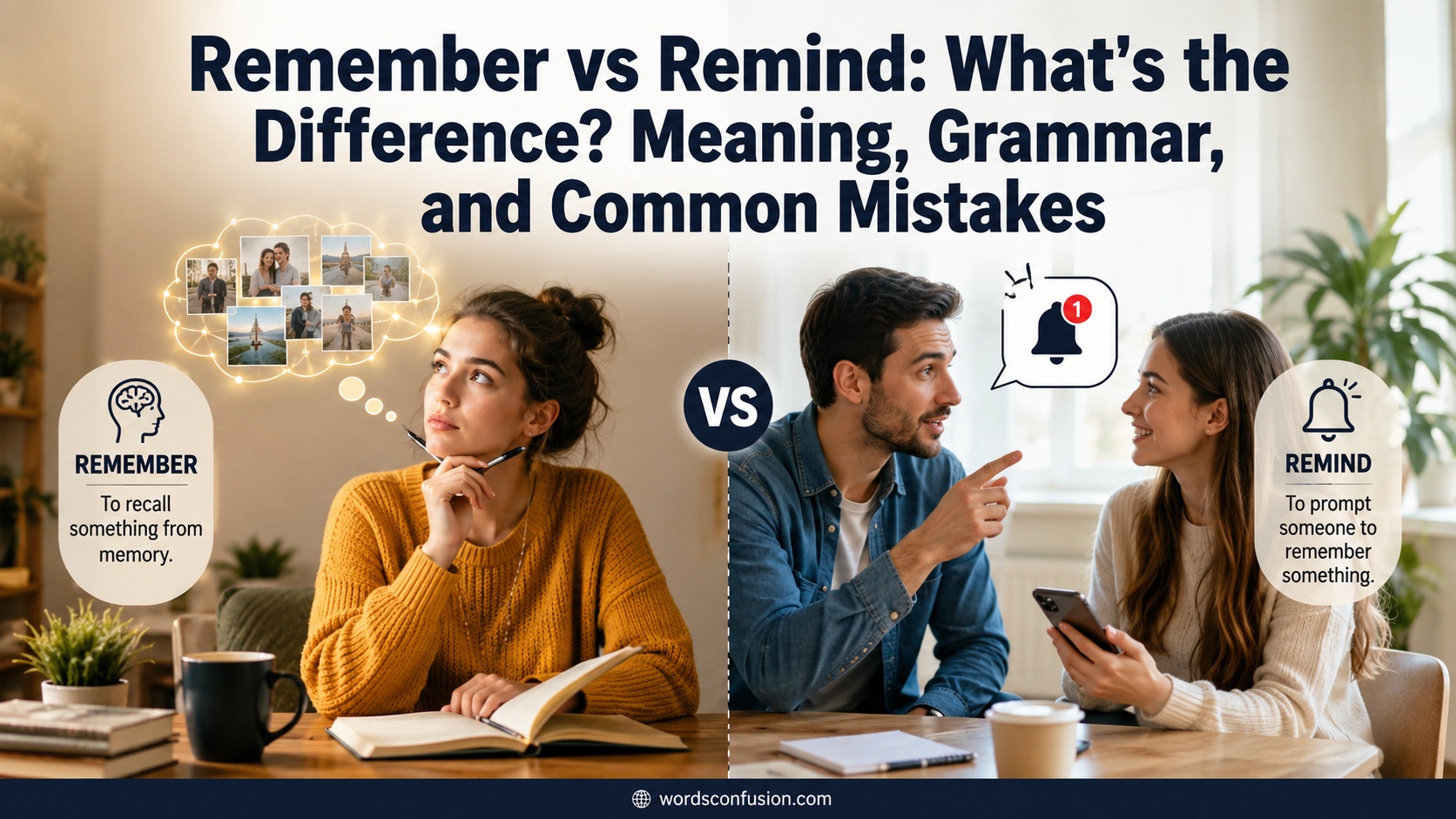
- Remember means to keep or bring something into your own memory.
- Remind means to help someone else remember something.
That small difference changes the grammar, sentence structure, and meaning entirely.
In this guide, you’ll learn the exact difference between remember vs remind, their meanings, grammar rules, sentence patterns, common mistakes, real-life examples, collocations, synonyms, and practical memory tricks. By the end, you’ll know exactly when to use each word with confidence.
Remember vs Remind at a Glance
Before diving into the details, here’s a quick comparison.
| Feature | Remember | Remind |
| Meaning | Keep or recall something in your own memory | Help someone else remember something |
| Action | Internal | External |
| Subject | The person who remembers | The person or thing giving the reminder |
| Object | A memory, fact, event, or task | A person followed by information |
| Common Pattern | Remember + noun / to + verb / -ing | Remind + someone + to / of / about / that |
| Example | I remembered your birthday. | She reminded me about your birthday. |
Quick Rule
- If the memory comes from your own mind, use remember.
- If someone or something triggers that memory, use remind.
What Does “Remember” Mean?
Definition of Remember
Remember means to keep information in your memory or bring something back into your mind.
It refers to your own ability to recall people, places, experiences, facts, or future tasks.
Think of remember as opening a file that’s already stored in your brain.
How Remember Works
Unlike remind, remember doesn’t require another person to trigger the memory.
For example:
- I remember my first day at college.
- Do you remember his name?
- She remembered to lock the door.
- We remembered buying this house years ago.
In each example, the person retrieves the information independently.
Common Sentence Patterns with Remember
English uses several patterns with remember, and each serves a different purpose.
| Pattern | Example |
| Remember + noun | I remember your address. |
| Remember + pronoun | She remembers him well. |
| Remember + to + verb | Remember to call your mother. |
| Remember + verb-ing | I remember meeting you before. |
| Remember + that clause | I remember that we spoke yesterday. |
Learning these patterns helps you avoid many common grammar mistakes.
Everyday Examples of Remember
Here are examples from daily life.
At home
- I remembered to turn off the lights.
- We remembered where we left the keys.
At school
- She remembers every science formula.
- I don’t remember the answer.
At work
- Remember to send the report before noon.
- He remembered everyone’s name during the meeting.
While traveling
- I’ll always remember my trip to Japan.
- Do you remember the hotel?
These examples show that remember can refer to both past memories and future responsibilities.
Common Expressions with Remember
English speakers often use remember in fixed expressions.
Some popular examples include:
- Remember me?
- Remember this.
- Remember that.
- As far as I remember.
- If I remember correctly.
- Always remember.
- I’ll never forget, but I’ll always remember.
These phrases appear frequently in conversations, presentations, and writing.
What Does “Remind” Mean?
Definition of Remind
Remind means to cause someone to remember something.
In other words, another person, object, event, or situation acts as the trigger.
Imagine a phone notification. It doesn’t remember your appointment. Instead, it reminds you about it.
How Remind Works
Unlike remember, remind almost always involves another person.
Examples:
- Please remind me tomorrow.
- She reminded him to pay the bill.
- The old photograph reminds me of my grandfather.
- His voice reminds me of my teacher.
Notice that something always causes the memory.
Common Sentence Patterns with Remind
The grammar of remind follows predictable patterns.
| Pattern | Example |
| Remind + someone + to + verb | Remind me to buy milk. |
| Remind + someone + about + noun | Please remind him about the meeting. |
| Remind + someone + of + noun | You remind me of my brother. |
| Remind + someone + that + clause | Remind me that the office closes early. |
Once you learn these patterns, using remind becomes much easier.
Everyday Examples of Remind
At home
- Please remind me to water the plants.
- My calendar reminds me about birthdays.
At school
- The teacher reminded students to submit homework.
- Can you remind me about tomorrow’s test?
At work
- My manager reminded everyone about the deadline.
- The software reminds users to update passwords.
Travel
- This beach reminds me of Hawaii.
- The smell of coffee reminds him of Italy.
Common Expressions with Remind
You’ll hear these expressions frequently.
- Friendly reminder
- Just a reminder
- Gentle reminder
- Constant reminder
- Reminder email
- Remind me later
- Remind someone again
Businesses, schools, and workplaces use these phrases every day.
The Key Difference Between Remember and Remind
Although both words relate to memory, they describe opposite actions.
| Remember | Remind |
| You recall something yourself. | Someone helps you recall something. |
| Internal memory | External trigger |
| Focuses on the person remembering | Focuses on the person giving the reminder |
Compare these examples.
Remember
I remembered her birthday.
The memory came from me.
Remind
My calendar reminded me about her birthday.
The calendar triggered my memory.
Here’s another example.
Imagine you have an important interview tomorrow.
If you naturally think about it before bed, you remember it.
If your phone sends a notification, it reminds you.
That’s the difference.
Remember vs Remind Comparison Table
| Aspect | Remember | Remind |
| Main idea | Recall information | Trigger someone’s memory |
| Requires another person | No | Usually yes |
| Used for future tasks | Yes | Yes |
| Used for past memories | Yes | Yes |
| Common object | Memory, event, person | Person |
| Typical verbs | remember doing, remember to do | remind someone to do |
| Focus | Memory retrieval | Memory trigger |
Grammar Rules You Should Know
Remember + To + Verb
This structure refers to something you must not forget to do in the future.
Structure:
Remember + to + base verb
Examples:
- Remember to lock the door.
- Remember to charge your phone.
- Remember to bring your passport.
These actions happen after remembering.
Remember + Verb-ing
This pattern refers to a memory of something that already happened.
Examples:
- I remember meeting him.
- She remembers visiting Paris.
- We remember watching that movie together.
The action happened first. The memory comes later.
Remember To Do vs Remember Doing
Many learners mix these patterns because both use remember.
The meanings are completely different.
| Pattern | Meaning |
| Remember to do | Don’t forget a future action. |
| Remember doing | Recall a past experience. |
Compare:
- Remember to send the email.
- I remember sending the email.
The first sentence talks about a future responsibility.
The second talks about a completed action.
This distinction is essential in everyday English.
Remind + Someone + To + Verb
This structure tells someone not to forget a future action.
Structure
Remind + object + to + base verb
Examples:
- Please remind me to call the doctor.
- She reminded her son to finish his homework.
- Our manager reminded everyone to join the meeting on time.
- Can you remind Dad to pick up the groceries?
- The teacher reminded the class to bring their textbooks.
Notice that someone always appears between remind and to + verb. Without an object, the sentence is incomplete.
Correct
- Please remind me to lock the door.
- She reminded him to study.
Incorrect
- Please remind to lock the door.
- She reminded to study.
Remind + Someone + Of + Something
Use this pattern when one person, place, smell, sound, or object causes another person to think of something else.
Structure
Remind + object + of + noun/pronoun
Examples:
- This song reminds me of high school.
- Your smile reminds me of your mother.
- That restaurant reminds us of our vacation in Italy.
- The fresh smell of rain reminds him of childhood.
- The painting reminds visitors of life in the countryside.
This pattern is especially common when talking about memories, emotions, and comparisons.
What Can Remind You of Something?
Almost anything can trigger a memory, including:
- A photograph
- A familiar voice
- A song
- A smell
- A location
- A season
- A favorite meal
- A movie
For example:
The smell of fresh bread reminds me of my grandmother’s kitchen.
A single scent can unlock memories from decades ago. That’s why this structure appears so often in everyday conversation.
Remind + Someone + About + Something
Use about when reminding someone of an upcoming event, task, appointment, or responsibility.
Structure
Remind + object + about + noun
Examples:
- Please remind me about tomorrow’s meeting.
- She reminded him about the deadline.
- Don’t forget to remind us about the party.
- The assistant reminded the team about the presentation.
- My phone reminded me about my dentist appointment.
This structure focuses on information someone shouldn’t forget.
“Of” vs “About”
Many learners struggle with these prepositions.
Here’s an easy way to remember them.
| Pattern | Use | Example |
| Remind someone of | Creates a memory or association | That perfume reminds me of Paris. |
| Remind someone about | Brings attention to an event or task | Please remind me about the meeting. |
Think of it this way:
- Of = Memory
- About = Information or responsibility
Remind + Someone + That Clause
Sometimes you need to remind someone of an entire fact instead of a single word or phrase.
Structure
Remind + object + that + clause
Examples:
- Remind me that the store closes at 8 p.m.
- She reminded him that today was his interview.
- The email reminded employees that the office would be closed on Friday.
- My wife reminded me that we promised to visit our neighbors.
This pattern is common in both spoken and written English.
Remember vs Remind in Real-Life Situations
Understanding grammar is important. Seeing these words in context makes the difference much easier to remember.
At Home
Imagine you’re leaving for work.
You suddenly think about your lunch.
I remembered my lunch.
Your spouse says:
Let me remind you to take your lunch.
One sentence describes your own memory. The other describes someone helping you remember.
At School
A student studies all night before an exam.
I remembered every formula.
The teacher says:
I’ll remind everyone about tomorrow’s exam schedule.
Again, remember happens inside the student’s mind. Remind comes from another person.
At Work
A project deadline is approaching.
You say:
I remembered to submit the report.
Your manager says:
I reminded the entire team about the deadline yesterday.
Both sentences involve the same event. The perspective changes.
While Traveling
You’re walking through a historic city.
I remembered visiting this street years ago.
Your friend points to a café.
That café reminds me of our trip to Spain.
One sentence recalls an experience. The other creates a new association.
In Everyday Conversations
Here are common exchanges you’ll hear.
Conversation One
A: Did you remember the tickets?
B: Yes, I packed them this morning.
Conversation Two
A: Can you remind me to send that email?
B: Of course.
Conversation Three
A: This photo reminds me of college.
B: I remember that day perfectly.
These examples show how naturally both verbs appear together.
Read More: Historic vs Historical: What’s the Difference? Meaning, Examples, and When to Use Each
Common Mistakes and How to Fix Them
Many English learners repeat the same mistakes because they translate directly from their first language.
Let’s fix the most common ones.
| Incorrect | Correct | Why |
| Remember me tomorrow. | Remind me tomorrow. | You want someone to help you remember. |
| I reminded my keys. | I remembered my keys. | Keys cannot receive reminders. |
| Please remember me to call. | Please remind me to call. | Someone must give the reminder. |
| I remembered him about the meeting. | I reminded him about the meeting. | You informed another person. |
| She reminded to lock the door. | She reminded me to lock the door. | “Remind” needs an object. |
| This cake remembers me of home. | This cake reminds me of home. | Objects remind people. |
| I remind your birthday. | I remember your birthday. | You recall it yourself. |
| Please remember him the meeting. | Please remind him about the meeting. | Wrong verb and missing preposition. |
Why These Mistakes Happen
Most learners focus on the meaning instead of the sentence structure.
Here’s the easiest rule.
Ask yourself one question.
Who is remembering?
- You → Use remember.
- Someone else helps you → Use remind.
That single question solves most grammar problems.
Remember vs Remind in American and British English
The good news is that both American English and British English use remember and remind almost identically.
The meanings don’t change.
The grammar doesn’t change.
The sentence patterns stay the same.
However, there are small differences in style.
| American English | British English |
| Reminder email | Reminder email |
| Please remind me. | Please remind me. |
| Remember to call. | Remember to call. |
| Remind me about tomorrow. | Remind me about tomorrow. |
The only differences you may notice involve vocabulary surrounding the sentence rather than the verbs themselves.
For example:
- Americans often say cell phone.
- Britons usually say mobile phone.
Yet both would naturally say:
My phone reminded me about the meeting.
Frequently Used Collocations with Remember
Native speakers rarely use words alone. They combine them into natural word partnerships called collocations.
Learning these combinations helps your English sound fluent.
| Collocation | Example |
| Remember clearly | I remember clearly what happened. |
| Remember well | She remembers him well. |
| Remember vividly | He vividly remembers the accident. |
| Remember correctly | If I remember correctly, the meeting starts at noon. |
| Always remember | Always remember to be kind. |
| Barely remember | I barely remember his name. |
| Remember forever | We’ll remember this day forever. |
| Remember someone’s name | I’m terrible at remembering names. |
Common Expressions
- Remember this.
- Remember that.
- Remember when…
- I’ll always remember.
- Do you remember?
- As far as I remember.
- If I remember correctly.
Using these naturally makes your speech sound more authentic rather than translated.
FAQs:
What is the main difference between remember and remind?
The main difference is who performs the action. Remember means you recall something from your own memory, while remind means someone or something helps another person remember it.
Example
- I remembered her birthday.
- My calendar reminded me about her birthday.
Is “Remind me to” grammatically correct?
Yes. “Remind me to” is one of the most common and grammatically correct sentence patterns in English.
Examples:
- Remind me to call the bank.
- Please remind me to send the email.
- Can you remind me to lock the door?
The structure is:
Remind + object + to + base verb
What is the difference between “remember to do” and “remember doing”?
These two structures have different meanings.
- Remember to do refers to a future action you shouldn’t forget.
- Remember to turn off the lights.
- Remember doing refers to a past action you can recall.
- I remember turning off the lights.
This distinction is one of the most important grammar rules involving remember.
Can remember and remind be used interchangeably?
No. Although both relate to memory, they serve different purposes and follow different grammar patterns.
Compare these sentences:
- I remembered the appointment.
- My assistant reminded me about the appointment.
Switching the verbs changes the meaning and often makes the sentence incorrect.
How can I easily remember the difference between remember and remind?
Use this simple rule:
You remember something. Someone reminds you of something.
Whenever you’re unsure, ask yourself one question:
Who is doing the remembering?
If it’s you, use remember.
If another person, object, or event causes the memory, use remind.
Conclusion:
Understanding the difference between remember vs remind becomes much easier once you focus on the direction of the memory.
Use remember when you recall information, experiences, or future tasks on your own. Use remind when another person, object, event, or notification helps trigger that memory. While the two verbs share a connection to memory, they are not interchangeable because they perform different grammatical functions.

Andrew Wilson is an experienced language researcher and content writer specializing in WordsConfusion topics. He helps readers understand commonly confused English words, spelling differences, grammar rules, word meanings, and proper usage through clear explanations, practical examples, and easy-to-follow language guides. His goal is to make English learning simple, accurate, and accessible for students, writers, professionals, and everyday learners.