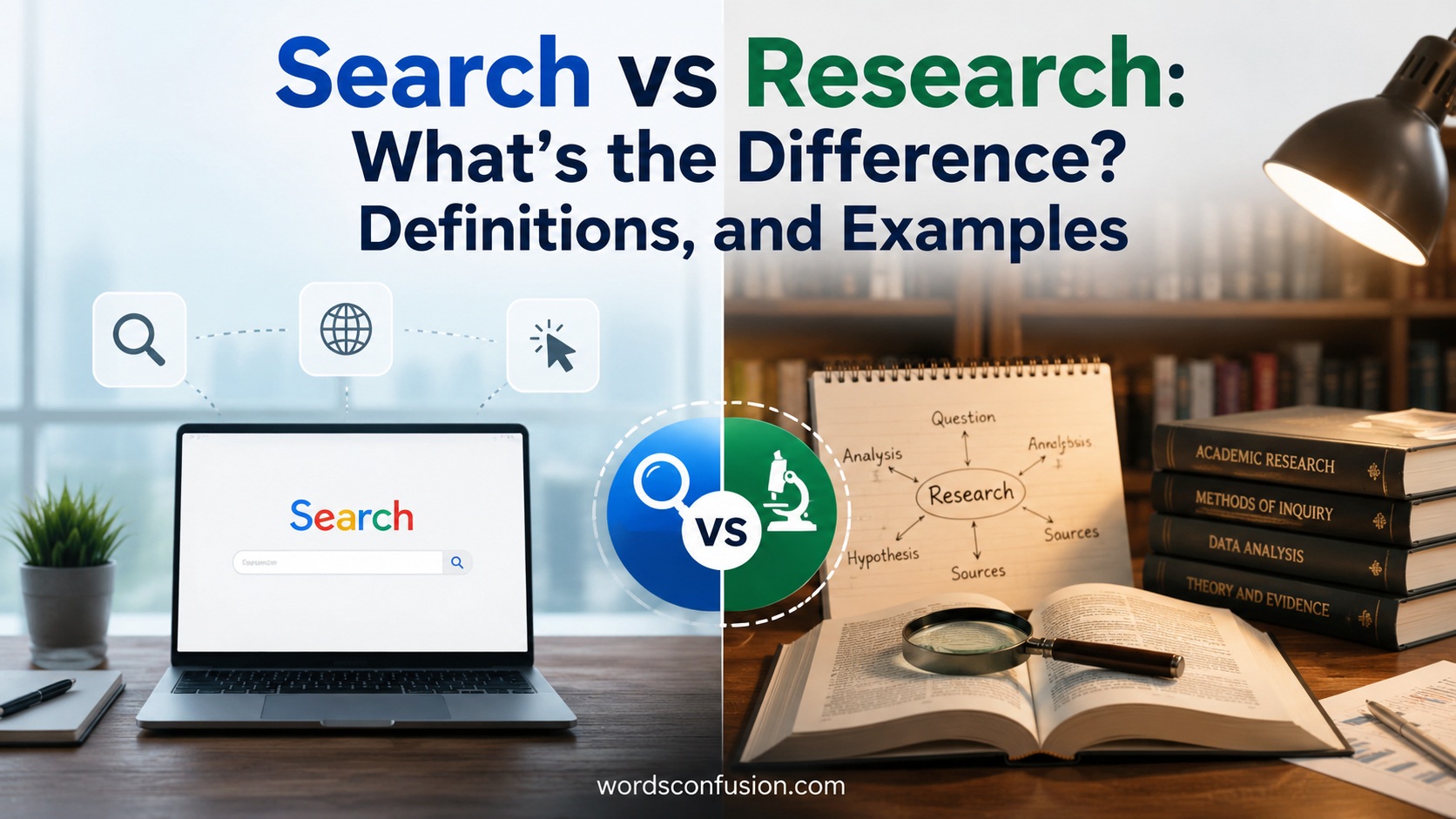
Have you ever heard someone say, “I researched it on Google,” when all they did was type a few words into a search engine? It happens all the time. Although search and research sound similar, they don’t mean the same thing. Confusing the two can lead to weak decisions, unreliable conclusions, and missed opportunities to learn something meaningful.
A search helps you find information quickly. Research goes much further. It involves collecting information, evaluating sources, analyzing evidence, comparing viewpoints, and drawing informed conclusions. In simple terms, searching is about finding information, while researching is about understanding information.
Knowing the difference matters whether you’re writing a school paper, making a business decision, buying an expensive product, or solving a complex problem. The right approach saves time and helps you make smarter choices.
In this guide, you’ll learn what search and research really mean, how they differ, when to use each one, and why successful professionals rely on both instead of treating them as interchangeable.
What Does Search Mean?
A search is the process of looking for specific information. The goal is usually simple: find an answer, a document, a website, or a piece of data as quickly as possible.
Today, most searches happen online through search engines like Google or Bing. However, searching isn’t limited to the internet. Looking for a book in a library catalog, locating a file on your computer, or checking a product in an online store are all examples of searching.
A search focuses on retrieving existing information, not creating new knowledge.
Characteristics of a Search
A typical search has several defining features:
- It is quick and goal-oriented.
- It answers a specific question.
- It relies on existing information.
- It usually requires little analysis.
- It often ends once the needed information is found.
For example, if you search “What is the capital of Canada?”, you’ll quickly find the answer: Ottawa. There’s no need to compare multiple studies or evaluate competing arguments because the information is widely established.
Common Ways People Search
People perform searches every day without thinking much about the process.
Examples include:
- Finding a restaurant nearby
- Looking up today’s weather
- Searching for flight prices
- Checking product specifications
- Finding definitions of unfamiliar words
- Looking for troubleshooting guides
- Locating government forms
- Searching for movie showtimes
Each of these tasks requires finding information rather than deeply investigating a subject.
When Is a Search Enough?
Searching works well when:
- You need a quick fact.
- The answer is straightforward.
- The information already exists.
- You don’t need extensive evidence.
- Time is limited.
For everyday questions, searching is often the fastest and most efficient solution.
What Does Research Mean?
Research is a structured process of gathering, evaluating, interpreting, and synthesizing information to answer a question or solve a problem.
Unlike a search, research doesn’t stop after finding information. It asks important follow-up questions.
- Is the source reliable?
- Does the evidence support the claim?
- Are there conflicting viewpoints?
- What conclusions can reasonably be drawn?
Research transforms information into knowledge through careful analysis.
Characteristics of Research
Research typically involves:
- Defining a clear objective
- Reviewing existing knowledge
- Collecting evidence
- Evaluating source credibility
- Comparing multiple perspectives
- Identifying patterns
- Drawing logical conclusions
- Documenting findings
Rather than accepting the first answer, researchers continue investigating until they develop a complete understanding.
Common Types of Research
Research appears in almost every profession.
Some common forms include:
- Academic research
- Scientific research
- Medical research
- Market research
- Legal research
- Historical research
- Financial research
- User experience research
Although the methods differ, each type follows a systematic process designed to produce reliable conclusions.
Example of Research
Imagine a company wants to launch a new fitness smartwatch.
A simple search might reveal existing smartwatch brands.
Research would go much further by examining:
- Customer preferences
- Pricing trends
- Competitor strengths
- Manufacturing costs
- Market demand
- Consumer reviews
- Industry forecasts
- Sales data
Only after analyzing all this information would the company decide whether launching the product makes sense.
That’s the difference between searching and researching.
Search vs Research: Quick Comparison Table
| Feature | Search | Research |
| Definition | Finding existing information quickly | Systematically investigating a topic to develop reliable conclusions |
| Primary Goal | Locate information | Understand, analyze, and solve a problem |
| Depth | Surface-level | In-depth and comprehensive |
| Time Required | Seconds to minutes | Hours, days, weeks, or even years |
| Information Sources | Search engines, websites, directories | Books, journals, databases, interviews, surveys, reports, and primary sources |
| Critical Thinking | Minimal | Extensive |
| Data Collection | Usually none | Often involves collecting original or secondary data |
| Analysis | Limited | Thorough evaluation and interpretation |
| Outcome | A quick answer | Evidence-based conclusions or recommendations |
| Best For | Everyday questions and quick facts | Academic work, business decisions, scientific studies, and complex problems |
At first glance, search and research may appear similar because both involve finding information. However, their purpose and process are fundamentally different. A search is only one step within the broader research process.
Read More: Remember vs Remind: What’s the Difference? Meaning, Grammar, and Common Mistakes
The Key Differences Between Search and Research
Understanding the distinction between search and research helps you choose the right approach for every situation. Let’s explore the major differences in detail.
Purpose
The biggest difference lies in why you’re gathering information.
A search aims to locate information that already exists. You’re trying to answer a straightforward question or find something specific.
Research, on the other hand, seeks to answer questions that require investigation, evidence, and thoughtful analysis. Rather than accepting information at face value, research asks whether that information is accurate, complete, and supported by credible evidence.
For example:
Search
“What’s the population of Japan?”
Research
“How has Japan’s aging population affected its economy over the last two decades?”
The second question requires much more than locating a number.
Depth of Information
Searches usually provide surface-level information.
Research explores the topic from multiple angles. It identifies patterns, compares evidence, evaluates competing viewpoints, and explains why something happens.
Think of it this way:
- Searching helps you find pieces of a puzzle.
- Research helps you assemble the entire puzzle.
That’s why research often produces insights that aren’t obvious from a simple search.
Time and Effort
Searching is designed to save time.
You type keywords into a search engine, scan the results, and choose the most relevant answer.
Research demands patience.
Researchers may spend days reviewing books, reading journal articles, conducting interviews, analyzing statistics, or performing experiments before reaching a conclusion.
Here’s a simple comparison:
| Activity | Typical Time |
| Searching today’s weather | Less than 30 seconds |
| Searching a product manual | 2–5 minutes |
| Writing a university research paper | Several weeks |
| Conducting scientific research | Months or years |
Information Sources
Searches often rely on whatever information appears first.
Research carefully selects sources based on quality, authority, and relevance.
Common research sources include:
- Peer-reviewed journals
- Academic books
- Government publications
- Industry reports
- Statistical databases
- Professional organizations
- Interviews with experts
- Surveys
- Historical records
Researchers don’t assume every source is equally trustworthy. They verify facts before accepting them.
Critical Thinking
Critical thinking separates research from ordinary searching.
During a search, you might simply read the answer and move on.
Research requires asking questions such as:
- Who published this information?
- Is there evidence supporting the claim?
- Is the source biased?
- Are there conflicting findings?
- Is the information current?
- What limitations exist?
These questions improve the reliability of the final conclusion.
Data Collection
Searching usually retrieves existing information.
Research may involve collecting entirely new data.
Researchers often gather information through:
- Surveys
- Interviews
- Questionnaires
- Laboratory experiments
- Field observations
- Customer feedback
- Focus groups
- Case studies
Original data helps answer questions that existing information cannot fully explain.
Analysis
Analysis is where research truly begins.
Finding information is only the starting point.
Researchers compare findings, identify relationships, evaluate evidence, recognize inconsistencies, and determine which conclusions are best supported.
Suppose three studies report different results.
A researcher doesn’t simply pick one.
Instead, they ask:
- Why are the findings different?
- Which study has the strongest methodology?
- Were the sample sizes similar?
- Were there outside factors affecting the results?
That level of analysis transforms information into meaningful knowledge.
Final Outcome
The outcome of a search is usually straightforward.
You find:
- A website
- A phone number
- A definition
- A statistic
- A location
- A document
The outcome of research is much broader.
It may produce:
- A scientific paper
- A business strategy
- A thesis
- A medical recommendation
- A policy proposal
- A market analysis
- A technical report
Research creates understanding rather than simply locating facts.
Search vs Research Process
Although searching and researching sometimes overlap, their workflows look very different.
The Search Process
Most searches follow a simple sequence.
- Identify your question.
- Choose the right search tool.
- Enter relevant keywords.
- Review the search results.
- Select the most useful information.
- Use the answer.
For example, imagine you need the release date of a software update.
You open a search engine, type the product name and version number, visit the official website, and find the date within minutes.
The process ends there because you’ve answered your question.
The Research Process
Research involves many additional steps.
- Define the problem or objective.
- Develop research questions.
- Review existing literature.
- Identify credible sources.
- Collect relevant information.
- Gather original data if necessary.
- Analyze and compare findings.
- Evaluate conflicting evidence.
- Draw conclusions.
- Present recommendations supported by evidence.
Notice that searching is only one part of research. Before analyzing information, you first need to locate it. After finding it, the real work begins.
FAQs:
Is searching the internet the same as research?
No. Searching is the act of finding information, while research involves evaluating, analyzing, and synthesizing information from multiple credible sources to answer a question or solve a problem. A Google search can be the first step in research, but it doesn’t become research unless you critically examine the information you find.
What is the simplest difference between search and research?
The simplest way to remember the difference is this:
- Search finds information.
- Research explains information.
A search gives you quick answers. Research helps you understand why those answers matter and whether they’re reliable.
Can research be done without searching?
In most cases, no. Nearly every research project begins with some form of search to locate books, journal articles, reports, statistics, or other relevant resources. However, research goes much further by collecting evidence, evaluating source quality, comparing viewpoints, and drawing evidence-based conclusions.
When should I search instead of research?
A search is the better choice when you need a fast, factual answer.
For example, use a search when you want to:
- Check today’s weather
- Find a business address
- Look up a definition
- Verify a date or statistic
- Locate a website
- Compare basic product specifications
These tasks don’t require extensive analysis because the information is already well established.
Why is research considered more reliable than a simple search?
Research relies on a systematic process rather than the first answer you find. Researchers consult multiple trustworthy sources, verify facts, analyze evidence, identify potential bias, and compare different perspectives before reaching a conclusion.
Because of this careful approach, research produces findings that are generally more accurate, balanced, and dependable than information gathered from a single search result.
Conclusion:
Although search and research are closely related, they serve different purposes. A search helps you locate existing information quickly, making it ideal for answering simple questions and finding immediate facts. Research takes the process much further by gathering evidence, evaluating source credibility, analyzing information, and developing well-supported conclusions.
The distinction becomes especially important when your decision carries real consequences. Choosing a university, launching a business, investing money, writing an academic paper, or making healthcare decisions requires more than a quick search. These situations demand careful research built on reliable evidence and critical thinking.

Andrew Wilson is an experienced language researcher and content writer specializing in WordsConfusion topics. He helps readers understand commonly confused English words, spelling differences, grammar rules, word meanings, and proper usage through clear explanations, practical examples, and easy-to-follow language guides. His goal is to make English learning simple, accurate, and accessible for students, writers, professionals, and everyday learners.