Many people search for “Salary vs Wage” because they want to understand the difference between these two common employment terms. While both refer to money earned from work, they are not exactly the same. Understanding the distinction can help job seekers, employees, students, business owners, and human resource professionals communicate more clearly.
The confusion often arises because salary and wage are both forms of compensation. However, the way they are calculated, paid, and discussed in employment contracts can differ significantly. Some jobs offer a fixed annual salary, while others pay workers based on the number of hours worked.
Whether you are applying for a new job, negotiating pay, reading an employment contract, or simply improving your English vocabulary, knowing the difference between salary and wage is important. This guide explains the meaning, origin, usage, examples, and common mistakes related to Salary vs Wage in simple and easy-to-understand language.
Salary vs Wage – Quick Answer
The quick answer is simple:
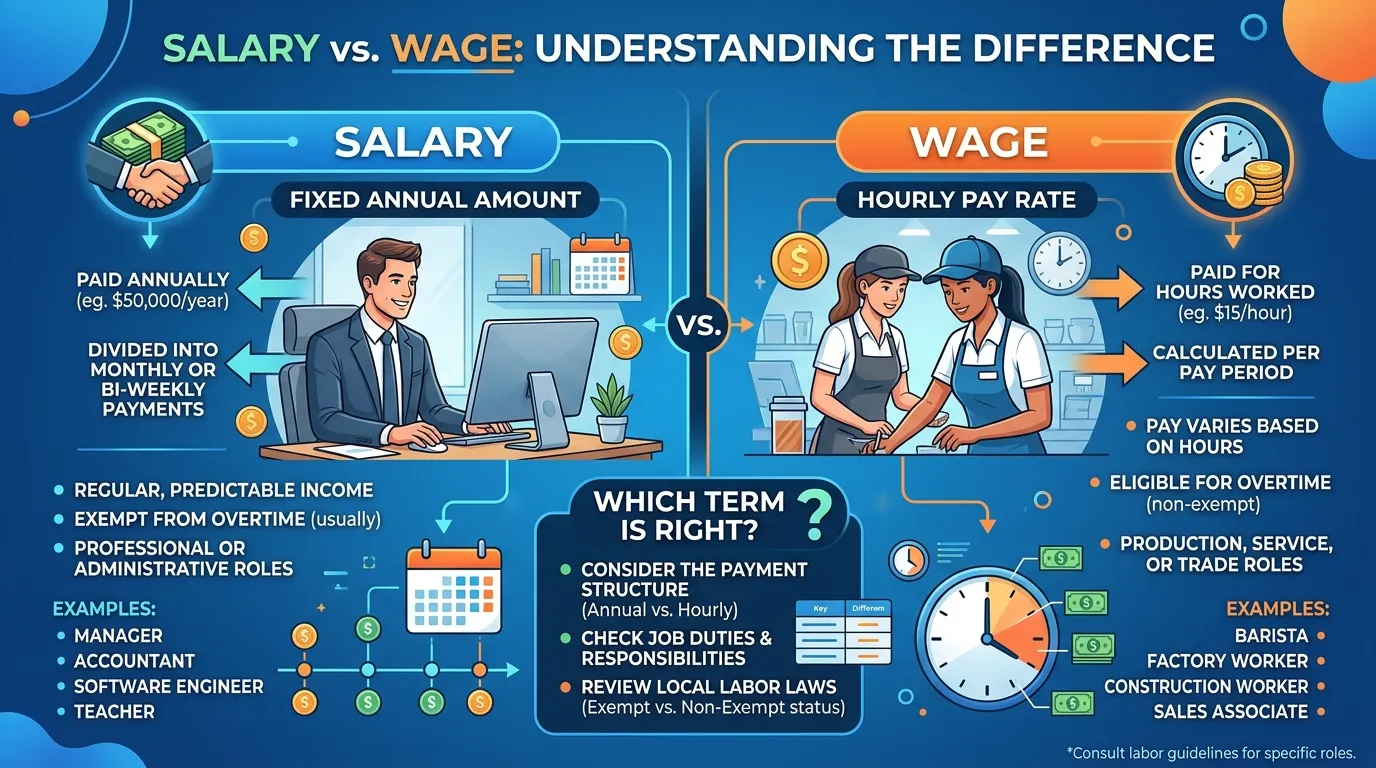
- Salary is a fixed amount of money paid regularly, usually monthly or annually.
- Wage is payment based on hours worked, days worked, or units produced.
Examples
- A manager earning $60,000 per year receives a salary.
- A cashier earning $18 per hour receives a wage.
Quick Comparison
| Feature | Salary | Wage |
|---|---|---|
| Payment Method | Fixed amount | Hourly or daily |
| Working Hours | Often fixed role | Based on hours worked |
| Overtime Pay | Usually not included | Often included |
| Common Jobs | Managers, professionals | Retail workers, laborers |
The Origin of Salary vs Wage
Origin of Salary
The word salary comes from the Latin word salarium. Historically, Roman soldiers received payments related to purchasing salt, which was a valuable commodity at the time.
Over time, the word evolved to mean a regular payment for employment.
Origin of Wage
The word wage comes from the Old Northern French word wage and Germanic roots meaning a pledge or compensation.
It eventually became associated with payment given for labor or services.
Why the Terms Differ
Salary and wage developed from different historical concepts. Today, they describe two distinct methods of employee compensation.
British English vs American English Spelling
Unlike words such as “labor” and “labour,” there is no spelling difference between salary and wage in British and American English.
Comparison Table
| Word | British English | American English |
|---|---|---|
| Salary | Salary | Salary |
| Wage | Wage | Wage |
Examples
British English:
- She earns a salary from her office job.
- Factory workers receive hourly wages.
American English:
- He negotiated a higher salary.
- Employees are paid wages every week.
The spelling remains identical in both versions of English.
Which Spelling Should You Use?
There is no spelling variation to choose from.
Instead, choose the correct word based on the payment structure.
Use Salary When
- Referring to annual compensation.
- Discussing professional positions.
- Talking about fixed income jobs.
Use Wage When
- Referring to hourly pay.
- Discussing hourly workers.
- Talking about labor-based compensation.
For Global Audiences
Use the term that accurately describes the payment arrangement rather than focusing on location.
Common Mistakes with Salary vs Wage
Many people use these terms interchangeably, which can create confusion.
Frequent Errors and Corrections
| Mistake | Correction |
|---|---|
| Calling hourly pay a salary | Hourly pay is usually a wage |
| Calling annual pay a wage | Annual fixed pay is usually a salary |
| Assuming salaried workers earn overtime | Many salaried positions do not include overtime |
| Assuming wages are always lower | Some wage earners make more than salaried employees |
| Using both words as synonyms | They have different meanings |
Salary vs Wage in Everyday Examples
In Emails
“The position offers a competitive salary and health benefits.”
“The company pays an hourly wage of $22.”
In News Articles
“Average salaries increased across the technology sector.”
“Minimum wage laws were updated this year.”
On Social Media
“Just got a salary increase at work!”
“Hourly wage workers are asking for better benefits.”
In Formal Writing
“The employee receives an annual salary based on contractual terms.”
“The organization pays wages according to hours worked.”
Salary vs Wage – Google Trends & Usage Data
Search interest in Salary vs Wage remains strong because people frequently compare employment options and compensation packages.
Salary Searches
Salary-related searches are common among:
- Professionals
- Office workers
- Corporate employees
- Job seekers
Common searches include:
- Average salary
- Salary calculator
- Salary negotiation
Wage Searches
Wage-related searches are common among:
- Hourly employees
- Retail workers
- Construction workers
- Labor market researchers
Common searches include:
- Minimum wage
- Hourly wage
- Living wage
Popular Countries
| Country | Common Search Focus |
|---|---|
| United States | Salary and minimum wage |
| United Kingdom | Salary and living wage |
| Canada | Salary comparisons |
| Australia | Wage growth |
| India | Salary packages |
Salary vs Wage Comparison Table
| Feature | Salary | Wage |
|---|---|---|
| Definition | Fixed regular pay | Pay based on hours worked |
| Payment Frequency | Monthly or annual | Hourly, daily, weekly |
| Overtime | Often excluded | Often included |
| Predictability | Highly predictable | Depends on hours worked |
| Common Occupations | Managers, engineers, accountants | Retail staff, laborers, drivers |
| Income Stability | Generally stable | May vary |
Frequently Asked Questions (FAQs)
1. What is the main difference between salary and wage?
A salary is a fixed amount paid regularly, while a wage is usually based on hours worked.
2. Is salary better than wage?
Not necessarily. The best option depends on job type, benefits, overtime opportunities, and personal preferences.
3. Can wage workers earn more than salaried workers?
Yes. Workers earning overtime or working many hours may earn more than some salaried employees.
4. Do salaried employees get overtime?
Some do, but many salaried positions are exempt from overtime pay rules.
5. Is minimum wage the same as salary?
No. Minimum wage refers to the lowest legal hourly pay rate, not a fixed annual salary.
6. Which jobs usually pay a salary?
Professional and management positions often provide salaries.
7. Which jobs usually pay wages?
Retail, hospitality, manufacturing, and labor jobs commonly use hourly wages.
Conclusion
Understanding Salary vs Wage helps employees, employers, students, and job seekers make informed decisions. Although both terms describe compensation for work, they represent different payment systems. A salary is generally a fixed amount paid regularly regardless of hours worked, while a wage is typically calculated based on actual hours worked.
There are no British or American spelling differences between these words. The key is selecting the correct term according to the employment arrangement. Salary is most often associated with professional, managerial, and office-based positions, while wages are common in hourly and labor-focused jobs.
Knowing the distinction can help when reviewing job offers, negotiating compensation, understanding employment contracts, and discussing workplace earnings. By using the correct term in the right context, you can communicate more accurately and avoid common misunderstandings.
Whether you earn a salary or a wage, understanding how compensation works is an important part of financial planning, career growth, and workplace success.

Andrew Wilson is an experienced language researcher and content writer specializing in WordsConfusion topics. He helps readers understand commonly confused English words, spelling differences, grammar rules, word meanings, and proper usage through clear explanations, practical examples, and easy-to-follow language guides. His goal is to make English learning simple, accurate, and accessible for students, writers, professionals, and everyday learners.