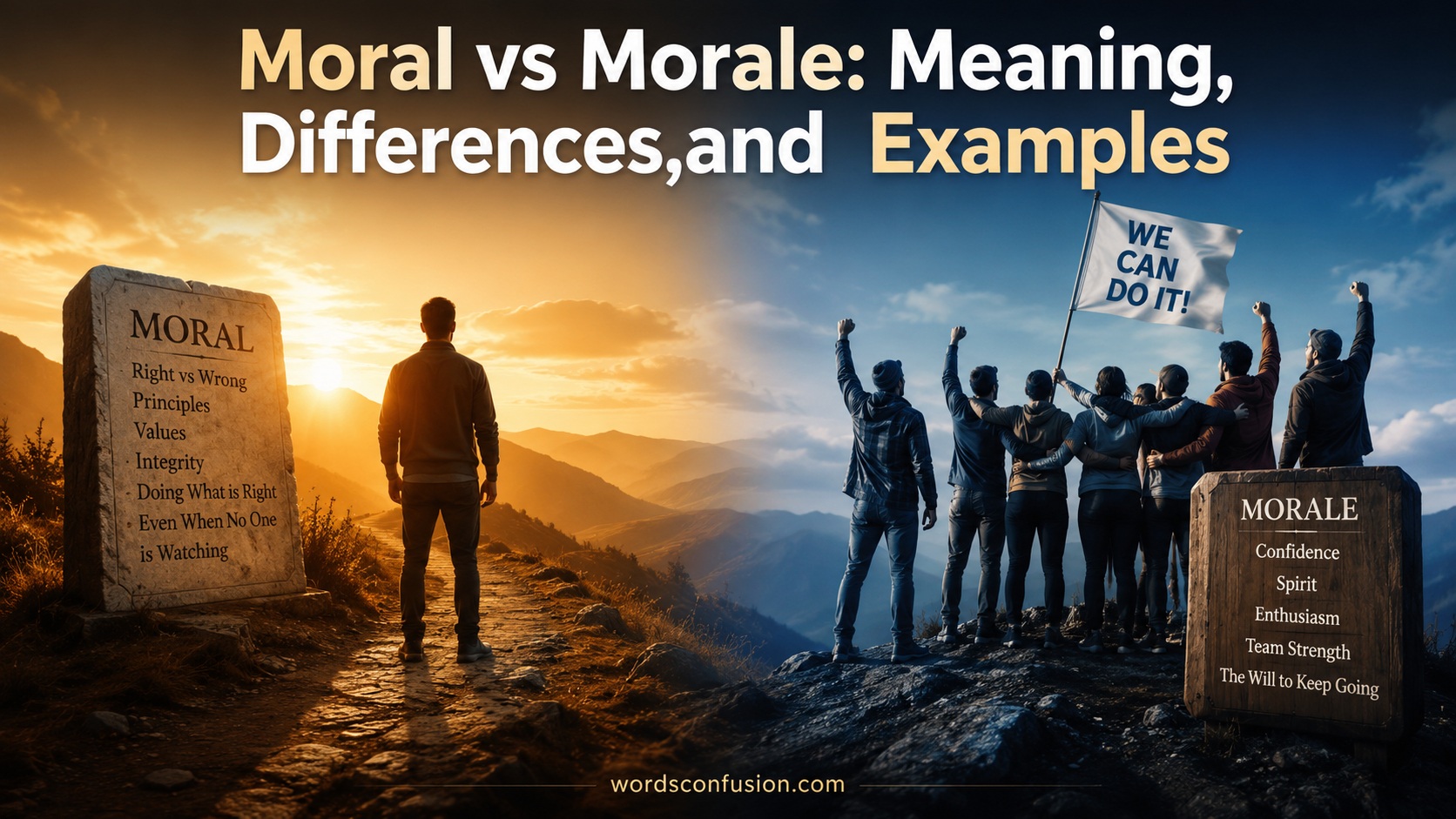
Have you ever written “moral” when you actually meant “morale”? These two words look almost identical, but they point to completely different ideas. One deals with right and wrong, while the other describes confidence, enthusiasm, and group spirit.
The confusion usually appears in sentences such as “The team’s moral was high” or “The story’s morale was honesty.” In both cases, the intended meaning may be clear, but the word choice is incorrect.
Understanding moral vs morale becomes much easier when you connect each word with its core idea. Moral relates to ethics, principles, behavior, or a lesson. Morale refers to the mental and emotional spirit of an individual or group, especially their confidence and willingness to keep going.
For example, a company might face a moral dilemma when deciding whether to hide an important mistake from customers. The same company might experience low morale when employees feel exhausted, ignored, or discouraged.
These words may differ by only one letter, yet they belong to different semantic lanes. Let’s break down exactly how they work.
Quick Answer
Moral refers to principles of right and wrong, ethical behavior, or the lesson of a story. It can work as an adjective or noun.
Morale refers to the confidence, enthusiasm, motivation, or emotional spirit of a person or group. It functions primarily as a noun.
| Word | Meaning | Part of Speech | Example |
| Moral | Related to right and wrong | Adjective | “She faced a moral dilemma.” |
| Moral | A lesson about right and wrong | Noun | “The moral of the story is to be honest.” |
| Morale | Confidence, enthusiasm, or group spirit | Noun | “The victory boosted team morale.” |
A simple rule can help:
Moral = ethics and lessons.
Morale = confidence and spirit.
If you’re talking about what is right or wrong, choose moral. If you’re talking about how motivated or confident people feel, choose morale.
Comparison Overview
Moral vs morale becomes much clearer when you compare their meanings, grammatical roles, and typical contexts side by side.
| Comparison | Moral | Morale |
| Core meaning | Relating to right and wrong | Confidence, enthusiasm, or emotional spirit |
| Common use | Ethics, values, behavior, stories | Teams, employees, soldiers, organizations |
| Part of speech | Adjective and noun | Noun |
| Refers to | Principles, conduct, or lessons | Mental and emotional condition |
| Common phrase | Moral values | High morale |
| Another common phrase | Moral dilemma | Low morale |
| Example | “He made a moral choice.” | “The team has strong morale.” |
| Main question | “Is this right or wrong?” | “How confident or motivated are they?” |
The easiest distinction is conceptual rather than grammatical. Moral concerns principles, whereas morale concerns spirit.
Imagine a football team preparing for a championship. The coach might face a moral decision about whether to allow an injured player to compete. Meanwhile, the team’s morale might rise after several successful practices.
The two concepts can appear in the same situation, but they don’t mean the same thing.
Main Differences Between Moral vs Morale
The biggest difference between moral vs morale lies in what each word describes. Moral focuses on ethics and principles. Morale focuses on confidence, enthusiasm, and emotional readiness.
Moral Relates to Right and Wrong
When moral works as an adjective, it describes something connected with accepted ideas of right and wrong.
For example:
- “She made a moral decision.”
- “The issue created a moral dilemma.”
- “Parents often teach moral values.”
- “The company has a moral responsibility to protect customers.”
In each sentence, the word relates to principles or ethical behavior.
A moral choice isn’t simply a difficult choice. It involves a question of what a person ought to do based on ethical principles.
Morale Relates to Confidence and Spirit
Morale describes the emotional condition of a person or group. It often reflects how confident, motivated, enthusiastic, or hopeful people feel.
For example:
- “The team’s morale improved after the victory.”
- “Low employee morale affected productivity.”
- “The manager organized a meeting to boost morale.”
- “The soldiers maintained high morale during the difficult campaign.”
Here, nobody is discussing right and wrong. The focus is on attitude, confidence, and motivation.
Moral Can Be a Noun
Many learners know moral only as an adjective. However, it can also function as a noun.
As a noun, moral usually means a lesson about right and wrong, especially one drawn from a story or experience.
For example:
“The moral of the story is to tell the truth.”
Here, moral means the lesson or principle that the story teaches.
Another example is:
“The moral is simple: greed can create problems.”
This use is common in fables, children’s stories, and discussions about life lessons.
Morale Is a Noun
Morale generally functions as a noun.
You can talk about:
- high morale
- low morale
- employee morale
- team morale
- workplace morale
- military morale
- boosting morale
- improving morale
You wouldn’t normally use morale as an adjective.
For example:
Correct: “The employees have high morale.”
Incorrect: “The employees are morale.”
The grammatical difference matters because it can immediately reveal which word belongs in a sentence.
What Does “Moral” Mean?
Moral has two closely connected uses. It can describe something related to ethics, or it can identify the lesson learned from a story or situation.
Moral as an Adjective
As an adjective, moral describes beliefs, actions, decisions, duties, or standards involving right and wrong.
Consider this sentence:
“The lawyer faced a moral dilemma.”
The dilemma isn’t merely inconvenient. It involves competing ethical choices.
You might also hear:
- moral principles
- moral standards
- moral responsibility
- moral behavior
- moral judgment
- moral values
- moral obligation
- moral courage
These expressions all involve ethical questions.
Moral as a Noun
As a noun, moral usually refers to a lesson.
The classic expression is:
“The moral of the story is…”
For example:
“The fox wanted everything for himself. The moral of the story is that greed often leads to loss.”
The moral isn’t the plot itself. It’s the principle or lesson you take from the plot.
Moral vs Morality vs Morals
These related words can create another layer of confusion.
Moral can describe a particular ethical principle or something related to right and wrong.
Morals usually refers to a person’s or group’s principles about right and wrong.
Morality refers to the broader system or concept of distinguishing right from wrong.
Compare these examples:
- “Honesty is a moral value.”
- “Her morals prevent her from cheating.”
- “The novel explores the morality of war.”
The words share the same root idea, but they don’t work interchangeably.
What Does “Morale” Mean?
Morale describes the emotional and psychological spirit of an individual or group. It often appears when people face pressure, challenges, competition, or demanding work.
Morale in the Workplace
Workplace morale describes how employees generally feel about their work, environment, leadership, and organization.
High morale can appear when employees feel:
- respected
- supported
- valued
- motivated
- connected to their team
- confident about their work
Low morale can emerge when employees experience:
- constant criticism
- poor communication
- excessive workload
- lack of recognition
- uncertainty
- weak leadership
For example:
“The company introduced flexible schedules to improve employee morale.”
The sentence doesn’t discuss ethics. It describes an attempt to improve employees’ attitude and motivation.
Morale in Sports
Sports provide an easy way to understand morale.
Imagine a basketball team that loses five games in a row. Players may start doubting themselves. Their energy during practice may fall. They might stop believing they can win.
The team’s morale has declined.
Then they defeat a strong rival. Confidence returns. Players communicate better and practice with more energy.
Their morale rises.
That’s why coaches often talk about boosting team morale.
Morale in the Military
The word morale also has a long-standing association with military organizations.
Military morale refers broadly to the confidence, discipline, motivation, and emotional resilience of personnel.
A unit with high morale may remain committed during difficult circumstances. Poor morale can make demanding conditions even harder to handle.
For example:
“The commander arranged regular communication with the troops to maintain morale.”
Again, the issue isn’t ethics. It’s the group’s psychological and emotional state.
Moral vs Morale Examples
Examples make this distinction much easier because they show how each word behaves in natural sentences.
Examples With Moral
- “Stealing from someone is generally considered moral wrongdoing.”
- “She faced a difficult moral dilemma.”
- “The teacher discussed moral responsibility with the class.”
- “The story has a powerful moral lesson.”
- “He refused to compromise his moral principles.”
- “The decision raised several moral questions.”
- “The fable’s moral teaches children about honesty.”
Examples With Morale
- “The team’s victory boosted morale.”
- “Low employee morale can hurt workplace performance.”
- “The manager introduced rewards to improve staff morale.”
- “The coach gave an inspiring speech to raise team morale.”
- “The long project affected the workers’ morale.”
- “The company held a celebration to boost employee morale.”
- “The soldiers maintained high morale despite difficult conditions.”
Notice the pattern. Moral connects with principles or lessons. Morale connects with confidence or spirit.
Moral vs Morale in Real-Life Situations
The distinction becomes even clearer when both words appear in practical situations.
Workplace Example
Suppose a manager discovers that a product has a serious defect.
The manager now faces a moral question:
Should the company tell customers about the problem even if doing so costs money?
After the company announces the issue, employees might worry about layoffs or criticism. Their confidence could decline.
That’s a morale issue.
So the same event can involve both concepts:
Moral: What is the right thing to do?
Morale: How do employees feel about the situation?
School Example
A student sees a classmate cheating during an exam.
The decision about whether to report the cheating involves a moral question.
Later, if the school introduces a stressful new testing system, students might become discouraged. Their morale could fall.
The words describe two entirely different dimensions of the situation.
Sports Example
A player intentionally injures an opponent. The question of whether that behavior violates ethical standards involves moral judgment.
After losing several games, however, the team’s confidence may decline. That’s a problem with morale.
Story and Literature Example
A fable about a dishonest merchant might end with a lesson about honesty.
That lesson is the story’s moral.
You wouldn’t normally call it the story’s morale because morale isn’t a lesson about right and wrong.
Common Mistakes With Moral and Morale
These words often get mixed up because they sound similar. The following mistakes are especially common.
Mistake: “The Team Has High Moral”
This is incorrect when you mean confidence or team spirit.
Correct:
“The team has high morale.”
The word high morale describes strong enthusiasm, confidence, and group spirit.
Mistake: “The Moral of the Team Is Low”
This sentence probably intends to describe the team’s emotional condition.
Correct:
“The team’s morale is low.”
The word moral would suggest ethics or a lesson instead.
Mistake: “The Morale of the Story”
When you’re discussing the lesson of a story, use moral.
Correct:
“The moral of the story is to value honesty.”
Incorrect:
“The morale of the story is to value honesty.”
The latter confuses a story’s lesson with a group’s emotional state.
Moral, Morals, Morality, and Morale Compared
These four words look related because they are related. However, each has a distinct job in English.
| Word | Meaning | Example |
| Moral | Related to right and wrong | “It was a moral issue.” |
| Moral | A lesson from a story | “The moral is to be honest.” |
| Morals | Personal or social principles | “His morals guide his choices.” |
| Morality | The broader system of ethical principles | “The book explores morality.” |
| Morale | Confidence, enthusiasm, or group spirit | “The victory improved morale.” |
A useful way to visualize them is:
Moral → right and wrong
Morals → personal principles
Morality → broader ethical system
Morale → confidence and spirit
That mental map can prevent most mistakes.
Read More: Loose vs Lose: Meaning, Differences, and Correct Usage
How to Remember Moral vs Morale
A good memory trick doesn’t need to be complicated.
Think of moral as the word connected with meaning and principles.
When you ask:
“Is this right or wrong?”
You’re entering moral territory.
When you ask:
“How confident or motivated do these people feel?”
You’re dealing with morale.
Another useful trick is to remember the E in morale.
Think:
Morale → Emotion and Energy
It’s not a formal linguistic rule. It’s simply a memory aid.
For example:
- Moral decision = an ethical decision.
- Morale problem = a confidence or motivation problem.
Common Expressions With Moral and Morale
Certain word combinations can make the correct choice almost automatic.
Common Expressions With Moral
- moral values
- moral principles
- moral responsibility
- moral dilemma
- moral obligation
- moral judgment
- moral lesson
- moral courage
- moral standards
Example:
“The case raised serious moral questions about responsibility.”
Common Expressions With Morale
- high morale
- low morale
- boost morale
- raise morale
- improve morale
- employee morale
- team morale
- workplace morale
- military morale
- morale booster
Example:
“The unexpected bonus was a major morale booster.”
These collocations are useful because native English speakers commonly pair these words with particular nouns and verbs.
FAQs:
Is it “moral support” or “morale support”?
The standard phrase is moral support. It means emotional encouragement or support given to someone who is facing a difficult situation.
For example:
“Her friends offered moral support during the difficult period.”
This phrase can seem confusing because it involves emotions. However, moral support doesn’t mean team morale.
Is it “high moral” or “high morale”?
Use high morale when you’re talking about confidence, enthusiasm, or team spirit.
For example:
“The employees have high morale.”
High moral would not normally express this meaning.
What is the difference between moral and morale?
Moral relates to right and wrong, ethical principles, or the lesson of a story.
Morale refers to confidence, enthusiasm, motivation, or emotional spirit.
A simple comparison is:
Moral = ethics.
Morale = spirit.
Can moral be a noun?
Yes. Moral can function as a noun when it means a lesson or principle, especially one drawn from a story.
For example:
“The moral of the story is to tell the truth.”
It can also appear in discussions about ethical principles.
Is morale related to morality?
The words have related historical roots, but their modern meanings differ significantly.
Morality concerns principles of right and wrong. Morale refers to confidence, enthusiasm, and emotional spirit.
Their similar spelling shouldn’t lead you to treat them as synonyms.
How can I remember moral vs morale?
Use this simple distinction:
Moral = right and wrong.
Morale = confidence and spirit.
If you’re discussing ethics, choose moral. If you’re discussing motivation or group confidence, choose morale.
Conclusion:
The difference between moral vs morale becomes simple once you focus on the idea behind each word. Moral belongs to the world of ethics. It can describe principles, decisions, behavior, obligations, or the lesson of a story. For example, a moral dilemma involves a question of right and wrong.
Morale, on the other hand, describes confidence, enthusiasm, motivation, or group spirit. A team with high morale feels energized and confident, while a group with low morale may feel discouraged or unmotivated.

Andrew Wilson is an experienced language researcher and content writer specializing in WordsConfusion topics. He helps readers understand commonly confused English words, spelling differences, grammar rules, word meanings, and proper usage through clear explanations, practical examples, and easy-to-follow language guides. His goal is to make English learning simple, accurate, and accessible for students, writers, professionals, and everyday learners.