Accuracy vs Precision is a common topic in science, math, engineering, and data analysis. Many people search for this keyword because the two terms look similar but mean very different things. This confusion often leads to mistakes in exams, lab reports, and real-world measurements. For example, a student may think that repeated results mean they are correct, but that is not always true.
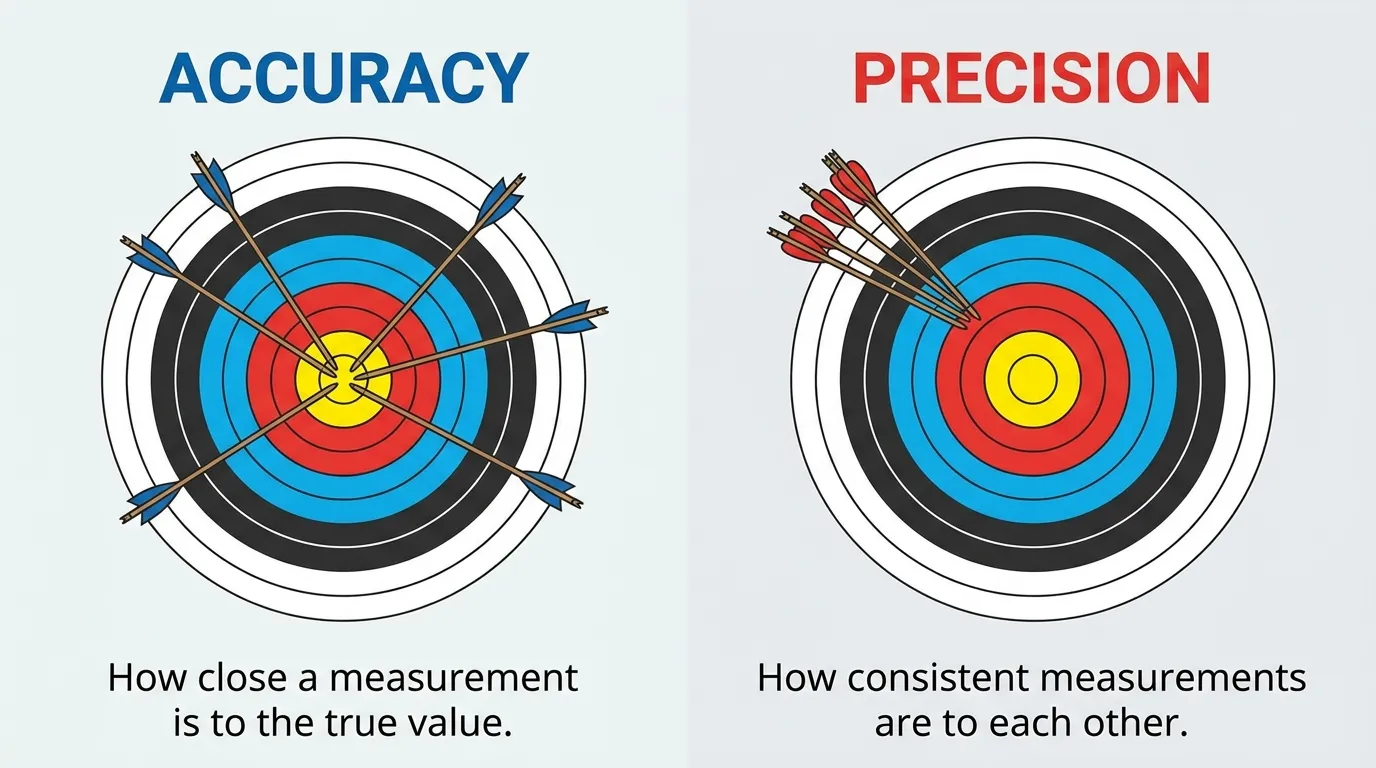
Accuracy tells us how close a measurement is to the true or correct value. Precision tells us how consistent repeated measurements are, even if they are not correct. You can be precise without being accurate, and accurate without being precise.
Understanding Accuracy vs Precision helps in experiments, quality control, statistics, and even daily life decisions. It clears confusion and improves how we interpret data. This concept is especially important in science labs, engineering tests, medical results, and digital measurements where small errors can change outcomes.
Accuracy vs Precision – Quick Answer
Accuracy vs Precision means the difference between being correct and being consistent.
- Accuracy = How close a value is to the true value
- Precision = How close repeated values are to each other
Example:
- If you hit near the bullseye → accurate
- If you hit the same spot again and again → precise
You can be:
- Accurate and precise (best case)
- Accurate but not precise
- Precise but not accurate
- Neither accurate nor precise
The Origin of Accuracy vs Precision
The word accuracy comes from the Latin word accuratus, meaning “done with care.” It entered English in the 17th century.
The word precision comes from the Latin praecisionem, meaning “cutting off” or “exact limit.” It also became common in scientific language during the same period.
These words became important in science and measurement when instruments started being used to record exact data.
British English vs American English Spelling
There is no major spelling difference between British and American English for “accuracy” and “precision.” However, usage style and context can differ slightly.
| Term | British English | American English | Example Usage |
|---|---|---|---|
| Accuracy | Accuracy | Accuracy | High accuracy test results |
| Precision | Precision | Precision | Machine precision is high |
Both regions use the same spelling, but scientific writing in the US often emphasizes “precision and accuracy” in technical order.
Which Spelling Should You Use?
- US Audience: Use standard scientific format “accuracy and precision”
- UK/Commonwealth: Same usage, no spelling change
- Global Writing: Use both terms together for clarity
Best practice: Always use “accuracy vs precision” in educational or SEO content.
Common Mistakes with Accuracy vs Precision
- Thinking precision means correct
- Assuming accuracy and precision are the same
- Using only one term in scientific reports
- Mixing definitions in exams
Corrections:
- Precision = consistency
- Accuracy = correctness
- They are related but not identical
Accuracy vs Precision in Everyday Examples
In Science Labs
Repeated measurements may be precise but not accurate if the instrument is wrong.
In Sports
A player hitting the same spot is precise, but not accurate if the target is elsewhere.
In Weather Reports
Forecasts may be accurate overall but not precise daily.
In Social Media Data
Engagement numbers may be precise but not accurate due to bots or errors.
In Emails or Reports
Professionals use both terms to describe data quality clearly.
Accuracy vs Precision – Google Trends & Usage Data
Search data shows that “accuracy vs precision” is most popular in:
- United States → High academic search volume
- India → Student-related searches
- UK → Educational and exam preparation use
- Canada & Australia → Science and engineering contexts
The keyword is most common in:
- Science exams
- Engineering courses
- Data science learning
- Research reports
It peaks during exam seasons and academic months.
Comparison Table: Accuracy vs Precision
| Feature | Accuracy | Precision |
|---|---|---|
| Meaning | Closeness to true value | Closeness of repeated values |
| Focus | Correctness | Consistency |
| Depends on | True reference value | Measurement repeatability |
| Example | Hitting bullseye | Hitting same spot repeatedly |
| Best case | Accurate and precise | Accurate and precise |
FAQs – Accuracy vs Precision
1. What is the main difference between accuracy and precision?
Accuracy is closeness to the true value, while precision is consistency in repeated results.
2. Can something be precise but not accurate?
Yes. A measurement can be consistent but still wrong.
3. Can something be accurate but not precise?
Yes. Results can be correct on average but not consistent.
4. Why are accuracy and precision important?
They help ensure reliable results in science, engineering, and data analysis.
5. What is a real-life example of precision?
A clock that always gains exactly 5 minutes daily is precise but not accurate.
6. What is a real-life example of accuracy?
A clock that shows correct time occasionally is accurate.
7. Which is more important, accuracy or precision?
Both are important depending on the situation.
Conclusion
Accuracy vs Precision is a simple but powerful concept used in science, math, engineering, and everyday life. Accuracy tells us how close we are to the correct value, while precision tells us how consistent our results are. Many people confuse the two, but understanding the difference helps improve measurement quality and decision-making.
In real-world situations, both accuracy and precision matter. For example, in medical tests, high accuracy ensures correct diagnosis, while high precision ensures consistent results. In engineering, both are needed to build safe and reliable systems. In education, mastering this concept helps students perform better in exams and experiments.
By clearly understanding Accuracy vs Precision, you can interpret data more correctly and avoid common mistakes in analysis, reporting, and problem-solving. It is a fundamental concept that builds a strong foundation for scientific thinking.

Andrew Wilson is an experienced language researcher and content writer specializing in WordsConfusion topics. He helps readers understand commonly confused English words, spelling differences, grammar rules, word meanings, and proper usage through clear explanations, practical examples, and easy-to-follow language guides. His goal is to make English learning simple, accurate, and accessible for students, writers, professionals, and everyday learners.