
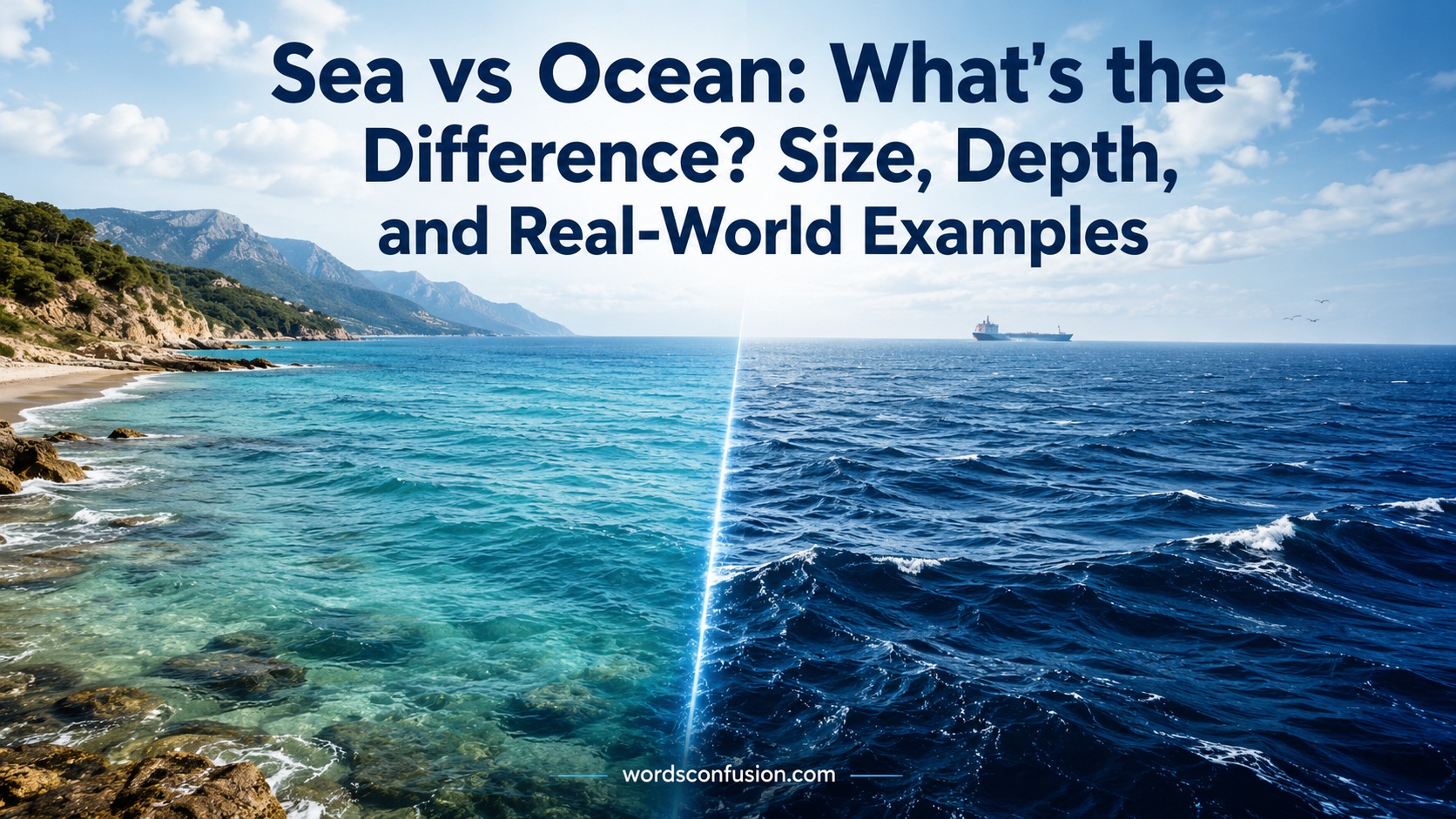
If you’ve ever looked at a map and wondered why one body of water is called a sea while another is called an ocean, you’re not alone. Many people use these terms interchangeably because both refer to vast bodies of saltwater. However, they don’t mean the same thing. Geography, oceanography, and Earth science all distinguish between seas and oceans based on their size, location, depth, and relationship with surrounding land.
Understanding the sea vs ocean difference isn’t just useful for passing a geography quiz. It also helps you better understand how Earth’s water system works. Oceans regulate the planet’s climate, transport heat around the globe, and support millions of marine species. Seas, while generally smaller, often contain some of the world’s richest ecosystems and busiest shipping routes. From the crystal-clear waters of the Mediterranean Sea to the immense Pacific Ocean, each body of water plays a unique role in the natural world.
This guide explains everything you need to know in plain English. You’ll learn what defines a sea and an ocean, how they compare in size and depth, why some inland bodies of water are still called seas, and how these water bodies influence weather, wildlife, trade, and daily life. Along the way, you’ll find practical examples, comparison tables, and fascinating facts that make the topic easy to understand.
Sea vs Ocean: Quick Answer
A sea is a large body of saltwater that is usually partially enclosed by land and connected to an ocean. Seas are generally smaller and shallower than oceans, although there are exceptions.
An ocean is a massive, continuous body of saltwater that covers vast areas of Earth’s surface. Oceans separate continents, contain the deepest parts of the planet, and drive global climate and weather patterns.
For example, the Mediterranean Sea connects to the Atlantic Ocean through the Strait of Gibraltar, while the Pacific Ocean stretches from Asia and Australia to the Americas, making it the largest and deepest ocean on Earth.
In simple terms:
- Oceans are the planet’s largest bodies of saltwater.
- Seas are usually smaller sections of oceans that lie closer to land.
Although the distinction sounds straightforward, geography includes a few interesting exceptions that make the topic even more fascinating.
Sea vs Ocean Comparison Table
| Feature | Sea | Ocean |
| Definition | A body of saltwater usually connected to an ocean and partly enclosed by land | A vast continuous body of saltwater covering major portions of Earth |
| Average Size | Smaller | Much larger |
| Average Depth | Usually shallower | Much deeper |
| Surrounding Land | Often bordered by land | Generally open and not enclosed |
| Number on Earth | More than 50 named seas | Five recognized oceans |
| Water Movement | Influenced by nearby land and local currents | Dominated by large global current systems |
| Marine Life | Rich coastal biodiversity | Includes shallow coastal waters and deep-sea ecosystems |
| Climate Role | Primarily regional | Global climate regulation |
| Examples | Mediterranean Sea, Caribbean Sea, Arabian Sea | Pacific Ocean, Atlantic Ocean, Indian Ocean |
What Is a Sea?
A sea is a significant body of saltwater that usually forms part of an ocean. Most seas lie along the edges of continents and remain at least partially surrounded by land. This position creates unique environmental conditions that often differ from those found in the open ocean.
Because many seas receive freshwater from rivers while remaining connected to saltwater oceans, their salinity, temperature, and biodiversity can vary considerably. These changing conditions make seas some of the most productive marine habitats on Earth.
Many of the world’s oldest civilizations developed along seas rather than oceans. Their calmer waters supported fishing, transportation, agriculture, and trade long before modern shipping existed.
Key Characteristics of a Sea
Several features distinguish a sea from an ocean.
- Usually connected to an ocean
- Often partially enclosed by land
- Generally smaller in surface area
- Typically shallower than oceans
- Strong influence from nearby rivers and coastlines
- Rich coastal ecosystems
- Important centers for trade and fishing
The presence of surrounding land also affects water circulation. Unlike oceans, where currents can travel across thousands of miles, seas often have localized current systems shaped by coastlines and underwater geography.
Examples of Famous Seas
Many seas play major roles in history, commerce, tourism, and marine science.
| Sea | Connected Ocean | Notable Feature |
| Mediterranean Sea | Atlantic Ocean | Linked three continents through trade |
| Caribbean Sea | Atlantic Ocean | Home to extensive coral reef systems |
| Arabian Sea | Indian Ocean | Major international shipping route |
| Red Sea | Indian Ocean | One of the warmest and saltiest seas |
| Baltic Sea | Atlantic Ocean | Low salinity due to river inflow |
| Black Sea | Mediterranean Sea through connecting straits | Deep water with limited oxygen below the surface |
| South China Sea | Pacific Ocean | One of the busiest maritime regions in the world |
Each of these seas has distinct physical characteristics, ecosystems, and economic importance.
What Is an Ocean?
An ocean is one of Earth’s largest interconnected bodies of saltwater. Together, the oceans cover about 71% of Earth’s surface and contain roughly 97% of all the water on the planet. They form a continuous global system even though scientists divide them into five named oceans for geographic convenience.
Oceans influence nearly every aspect of life on Earth. They absorb solar heat, regulate global temperatures, produce much of the planet’s oxygen through microscopic marine plants, and support an extraordinary diversity of life ranging from tiny plankton to enormous blue whales.
Unlike seas, oceans stretch across enormous distances with relatively few interruptions from land. Their immense size allows them to generate powerful current systems that transport heat around the globe and influence weather patterns thousands of miles away.
Key Characteristics of an Ocean
Oceans share several defining features.
- Extremely large surface area
- Great average depth
- Continuous global circulation
- Home to deep ocean trenches
- Major influence on Earth’s climate
- Support countless marine species
- Connect every continent except Antarctica through surrounding waters
The open nature of oceans allows winds and currents to move freely across vast distances. These processes help distribute heat and nutrients, making oceans essential to Earth’s climate system.
The Five Oceans
Although all oceans are physically connected, geographers recognize five distinct oceans.
| Ocean | Approximate Area | Deepest Point |
| Pacific Ocean | 165.25 million km² | Challenger Deep, Mariana Trench (about 10,935 meters) |
| Atlantic Ocean | 106.46 million km² | Milwaukee Deep, Puerto Rico Trench (about 8,380 meters) |
| Indian Ocean | 70.56 million km² | Java Trench (about 7,258 meters) |
| Southern Ocean | 20.33 million km² | Factorian Deep (over 7,400 meters) |
| Arctic Ocean | 14.06 million km² | Molloy Deep (about 5,550 meters) |
The Pacific Ocean is larger than all Earth’s land area combined. Its enormous size and depth make it the dominant feature of our planet’s surface.
The Atlantic Ocean separates Europe and Africa from North and South America. It has played a central role in exploration, migration, and global trade for centuries.
The Indian Ocean borders Asia, Africa, and Australia. Warm waters and seasonal monsoon winds strongly influence weather across the surrounding regions.
The Southern Ocean circles Antarctica and contains the powerful Antarctic Circumpolar Current, which helps regulate global ocean circulation.
The Arctic Ocean is the smallest and shallowest ocean. Much of it remains covered by sea ice during winter, making it one of Earth’s most sensitive regions to climate change.
The Main Differences Between a Sea and an Ocean
At first glance, seas and oceans may appear almost identical. Both contain saltwater, support marine life, and connect through Earth’s global water system. Yet several important characteristics set them apart.
The table below highlights the most significant differences.
| Feature | Sea | Ocean |
| Size | Smaller | Much larger |
| Depth | Generally shallower | Much deeper |
| Location | Usually near continents | Between continents |
| Land Boundaries | Often partly enclosed | Mostly open water |
| Currents | Local circulation | Global circulation systems |
| Climate Impact | Mostly regional | Global |
| Marine Habitats | Coastal ecosystems | Coastal and deep-sea ecosystems |
Sea vs Ocean Size
Size is the easiest way to distinguish a sea from an ocean.
Oceans span millions of square miles and cover most of Earth’s surface. Seas occupy much smaller areas, even though some remain impressively large.
For example:
- The Pacific Ocean covers approximately 165 million square kilometers.
- The Mediterranean Sea covers about 2.5 million square kilometers.
- The Caribbean Sea spans roughly 2.75 million square kilometers.
Even the largest seas represent only a small fraction of the world’s largest oceans.
Think of it this way:
- An ocean is like an entire country.
- A sea is like one region within that country.
The comparison isn’t perfect, but it helps explain the dramatic difference in scale.
Sea vs Ocean Depth
Depth provides another clear distinction.
Oceans contain the deepest locations on Earth. Their floors include vast abyssal plains, underwater mountain ranges, and deep trenches that scientists continue to explore.
By contrast, most seas lie on continental shelves, making them significantly shallower.
| Body of Water | Average Depth |
| Pacific Ocean | About 4,280 meters |
| Atlantic Ocean | About 3,646 meters |
| Indian Ocean | About 3,741 meters |
| Mediterranean Sea | About 1,500 meters |
| North Sea | About 95 meters |
| Baltic Sea | About 55 meters |
The deepest point on Earth, Challenger Deep in the Mariana Trench, reaches nearly 11 kilometers below sea level. No sea comes close to matching that depth.
Greater depth also means oceans experience much higher pressure, lower temperatures, and complete darkness in their deepest zones.
Geographic Location
Location plays a major role in classification.
Most seas sit along the edges of continents and connect directly or indirectly to an ocean. Land often surrounds them on several sides, creating partially enclosed basins.
Oceans, on the other hand, separate continents and extend across enormous open areas without significant land barriers.
For example:
- The Arabian Sea lies between the Arabian Peninsula and India.
- The Red Sea sits between Africa and Asia.
- The Pacific Ocean stretches between Asia, Australia, and the Americas.
This geographic arrangement affects everything from wave patterns to marine ecosystems.
Water Movement
Water is never truly still.
Both seas and oceans experience tides, waves, and currents. However, the scale differs dramatically.
Oceans contain massive current systems that circulate around the globe. These include famous currents such as:
- Gulf Stream
- Kuroshio Current
- Antarctic Circumpolar Current
- California Current
These currents transport warm and cold water across thousands of miles, helping regulate Earth’s climate.
Seas usually have more localized circulation because nearby coastlines restrict water movement. Wind patterns, river inflow, and narrow straits often determine how water moves within a sea.
Biodiversity
Both seas and oceans support extraordinary marine life, but their ecosystems differ.
Seas often receive nutrients from rivers, making coastal waters highly productive. Sunlight easily reaches much of the seabed, allowing plants, coral reefs, and algae to thrive.
Common sea habitats include:
- Coral reefs
- Seagrass meadows
- Mangrove forests
- Coastal wetlands
- Estuaries
Oceans contain these habitats near shorelines but also feature environments that seas generally lack.
These include:
- Abyssal plains
- Hydrothermal vents
- Deep ocean trenches
- Open-ocean pelagic zones
Many species living thousands of meters below the surface have never been observed directly in their natural habitat.
Scientists estimate that a large portion of ocean biodiversity remains undiscovered.
Climate Influence
One of the greatest differences between seas and oceans lies in their influence on climate.
Because oceans store enormous amounts of heat, they act as Earth’s natural temperature regulator. They absorb solar energy during warmer months and gradually release it over time, reducing temperature extremes across the planet.
Ocean circulation also redistributes heat between the equator and the poles.
Without oceans:
- Global temperatures would fluctuate much more dramatically.
- Rainfall patterns would change significantly.
- Many regions would become far less suitable for life.
Seas affect climate too, but their influence is usually regional.
For example:
- The Mediterranean Sea helps moderate temperatures across Southern Europe.
- The North Sea influences weather in the United Kingdom and Scandinavia.
- The Arabian Sea plays a major role in the South Asian monsoon.
Can a Sea Exist Without an Ocean?
Most seas connect to an ocean through natural waterways, but not all do.
A few famous examples are completely landlocked. These bodies of water are traditionally called seas because of their size, salinity, or historical significance rather than their scientific classification.
Some notable examples include:
| Inland Sea | Connected to an Ocean? | Type |
| Caspian Sea | No | Largest enclosed inland water body |
| Dead Sea | No | Salt lake |
| Aral Sea | No | Inland lake that has dramatically shrunk |
The Caspian Sea is actually the world’s largest enclosed inland body of water. It contains saltwater but has no natural outlet to any ocean.
The Dead Sea is even more unusual. Despite its name, it is technically a hypersaline lake. Its salt concentration is nearly ten times higher than that of the average ocean, allowing people to float effortlessly on its surface.
The Aral Sea once ranked among the world’s largest inland lakes. Extensive river diversion projects during the twentieth century caused it to shrink dramatically, becoming one of history’s most significant environmental disasters.
These examples show that historical naming conventions don’t always match modern scientific definitions.
Why Are Some Large Bodies of Water Called Seas Instead of Oceans?
Names often reflect history as much as geography.
Ancient civilizations named nearby waters long before modern mapping and oceanography existed. Sailors, traders, and explorers typically identified regional bodies of water as seas because they represented familiar navigation routes.
Several factors influence whether a body of water is called a sea.
Historical Tradition
Many names have survived for thousands of years.
The Mediterranean Sea, for instance, was central to Egyptian, Greek, Roman, and Phoenician civilizations. Long before scientists classified Earth’s oceans, people already recognized this water body as a distinct sea.
Changing the name today would create confusion and erase centuries of historical continuity.
Geographic Features
Many seas occupy partially enclosed basins.
Because land surrounds much of their shoreline, they behave differently from open oceans. This geographic distinction supports their separate names.
Political and Cultural Identity
Some names carry strong cultural importance.
Countries bordering the Baltic Sea, Black Sea, or South China Sea have developed identities, economies, and histories closely tied to those waters.
In many cases, the traditional name remains more meaningful than a purely scientific classification.
Scientific Classification
Modern oceanographers generally define seas as subdivisions of oceans or as enclosed saline water bodies.
Even so, official names usually preserve historical usage rather than replacing familiar terms with technically precise ones.
This blend of science, history, and culture explains why Earth’s maps include dozens of seas but only five oceans.
Are All Seas Saltwater?
Most seas contain saltwater, but not every body of water with the word sea in its name fits the scientific definition of a sea. In fact, the name often reflects history, geography, or local tradition rather than strict classification.
The vast majority of seas connect to an ocean, which explains why they have similar salt concentrations. However, freshwater flowing in from rivers, evaporation, rainfall, and restricted water exchange can change a sea’s salinity.
Here’s how different types of seas compare.
| Type | Water | Example |
| Marginal sea | Saltwater | Arabian Sea |
| Mediterranean sea | Saltwater | Mediterranean Sea |
| Inland saline sea | Very salty | Caspian Sea |
| Hypersaline lake called a sea | Extremely salty | Dead Sea |
| Brackish sea | Mix of fresh and saltwater | Baltic Sea |
Why Are Most Seas Salty?
Rain slowly dissolves minerals from rocks on land. Rivers carry those dissolved minerals into seas and oceans. As water evaporates, the minerals remain behind. Over millions of years, this process has created the salty water we know today.
On average, seawater contains about 35 grams of dissolved salt per liter, although the exact amount varies by location.
The Baltic Sea Is Less Salty
The Baltic Sea is one of the least salty seas in the world.
Several large rivers flow into it, adding huge amounts of freshwater. Because only a limited amount of ocean water enters through narrow channels, the Baltic Sea remains brackish, meaning it is neither fully freshwater nor fully saltwater.
This unique environment supports species that have adapted to lower salinity levels.
The Dead Sea Is Exceptionally Salty
Despite its name, the Dead Sea is actually a landlocked lake.
Its salinity reaches around 340 grams per liter, making it almost ten times saltier than the average ocean.
Because almost nothing can survive in such salty conditions, the lake earned the name “Dead Sea.” Only certain microorganisms thrive there.
Its extreme density also allows people to float with very little effort, making it one of the world’s most famous natural attractions.
What Is an Inland Sea?
An inland sea is a large body of water that is mostly or completely surrounded by land. Some inland seas connect to an ocean through narrow waterways, while others remain entirely enclosed.
Although many inland seas resemble lakes from a scientific perspective, historical naming conventions have preserved the word sea.
Characteristics of an Inland Sea
Most inland seas share several features.
- Surrounded by land
- Limited or no connection to an ocean
- Water levels affected by evaporation and river inflow
- Distinct ecosystems
- Often higher salinity than nearby oceans
Some inland seas have existed for millions of years, while others continue to change due to climate and human activity.
Examples of Inland Seas
Caspian Sea
The Caspian Sea is the largest enclosed inland body of water on Earth.
- Surface area: About 371,000 square kilometers
- Maximum depth: More than 1,000 meters
- Borders five countries
- Contains both freshwater and marine species
Scientists debate whether it should be classified as a sea or a lake because it possesses characteristics of both.
Dead Sea
The Dead Sea sits between Jordan and Israel.
Its shoreline lies approximately 430 meters below sea level, making it Earth’s lowest exposed land elevation.
High evaporation and limited water inflow continue to increase its salinity, although the water level has declined significantly over recent decades.
Aral Sea
The Aral Sea once ranked as the world’s fourth-largest inland lake.
Beginning in the 1960s, rivers feeding the sea were diverted for irrigation projects. As a result, the Aral Sea lost most of its water.
The consequences included:
- Collapse of commercial fisheries
- Dust storms carrying salt and pesticides
- Local climate changes
- Economic decline in surrounding communities
Today, the Aral Sea stands as one of the clearest examples of how human activity can dramatically reshape the environment.
Read More: Forest vs Jungle: What’s the Real Difference? Definitions, and Real-World Examples
The Five Oceans Explained
Although all oceans connect to form one global ocean, geographers recognize five distinct oceans based on their location.
Each has its own geography, climate, wildlife, and role in Earth’s natural systems.
Pacific Ocean
The Pacific Ocean is the largest and deepest ocean on the planet.
Key facts
- Covers about 165.25 million square kilometers
- Contains the Mariana Trench
- Borders Asia, Australia, North America, and South America
- Holds more than half of Earth’s open ocean water
The Pacific also contains thousands of islands, active volcanoes, and powerful tectonic plate boundaries that create frequent earthquakes and tsunamis.
Atlantic Ocean
The Atlantic Ocean is the world’s second-largest ocean.
Key facts
- Covers about 106.46 million square kilometers
- Separates Europe and Africa from the Americas
- Home to the Gulf Stream
- Supports some of the world’s busiest shipping routes
Historically, the Atlantic Ocean connected continents through exploration, migration, and international trade.
Indian Ocean
The Indian Ocean ranks as the third-largest ocean.
Key facts
- Covers about 70.56 million square kilometers
- Bordered by Africa, Asia, and Australia
- Warmest of the world’s major oceans
- Strongly influenced by seasonal monsoon winds
The Indian Ocean remains one of the most important waterways for transporting oil and commercial goods.
Southern Ocean
The Southern Ocean surrounds Antarctica.
Unlike other oceans, it completely encircles a continent.
Key facts
- Covers about 20.33 million square kilometers
- Home to the Antarctic Circumpolar Current
- Supports penguins, seals, whales, and krill
- Plays a critical role in regulating global temperatures
The Southern Ocean helps move cold water around the globe, influencing climate far beyond Antarctica.
Arctic Ocean
The Arctic Ocean is the smallest and shallowest ocean.
Despite its size, it plays an outsized role in Earth’s climate.
Key facts
- Covers about 14.06 million square kilometers
- Surrounded by North America, Europe, and Asia
- Much of the surface freezes during winter
- Home to polar bears, walruses, narwhals, and Arctic cod
Scientists closely monitor the Arctic because rising global temperatures have reduced its sea ice over recent decades.
The World’s Most Famous Seas
Some seas are known for their history. Others stand out because of their biodiversity, trade routes, or unique natural features.
| Sea | Connected Ocean | Why It’s Famous |
| Mediterranean Sea | Atlantic Ocean | Ancient civilizations and tourism |
| Caribbean Sea | Atlantic Ocean | Coral reefs and tropical islands |
| Arabian Sea | Indian Ocean | Global shipping and monsoon influence |
| Red Sea | Indian Ocean | Warm waters and coral reefs |
| Baltic Sea | Atlantic Ocean | Brackish water ecosystem |
| Black Sea | Mediterranean Sea | Deep oxygen-poor waters |
| North Sea | Atlantic Ocean | Offshore wind farms and oil production |
| Coral Sea | Pacific Ocean | Great Barrier Reef |
| Bering Sea | Pacific Ocean | Rich fisheries |
| South China Sea | Pacific Ocean | International shipping and marine biodiversity |
Each of these seas contributes to regional economies, supports marine ecosystems, and shapes the cultures of nearby countries.
Some have served as trade routes for thousands of years, while others continue to provide food, energy, and transportation for millions of people around the world.
FAQs:
Is a sea part of an ocean?
Yes, most seas are part of an ocean. They are usually located along the edges of continents and connect to an ocean through straits or open waterways. For example, the Mediterranean Sea connects to the Atlantic Ocean through the Strait of Gibraltar. However, a few inland bodies of water, such as the Caspian Sea, are completely enclosed by land and do not connect to any ocean.
Which is bigger, a sea or an ocean?
An ocean is much larger than a sea. Oceans cover vast portions of Earth’s surface and separate continents, while seas are generally smaller bodies of saltwater located near land. For instance, the Pacific Ocean covers about 165 million square kilometers, whereas the Mediterranean Sea covers roughly 2.5 million square kilometers.
Is the Dead Sea actually a sea?
No. Despite its name, the Dead Sea is not a true sea. It is a hypersaline lake that lies between Jordan and Israel. Scientists classify it as a lake because it is completely landlocked and has no natural connection to an ocean. Its extremely high salt concentration allows people to float effortlessly.
Why is the Arabian Sea called a sea?
The Arabian Sea is called a sea because it is a large subdivision of the Indian Ocean located between the Arabian Peninsula and the Indian subcontinent. Although it is enormous, it remains smaller than an ocean and is bordered by surrounding land, which matches the geographic characteristics of a sea.
What is the largest sea in the world?
The Philippine Sea is the largest sea in the world, covering approximately 5.7 million square kilometers. Located in the western Pacific Ocean, it is surrounded by island chains rather than continental landmasses. Its immense size demonstrates that some seas can be enormous, even though they are still smaller than the world’s oceans.
Conclusion:
Understanding the sea vs ocean difference becomes much easier once you know what defines each one. Oceans are the planet’s largest interconnected bodies of saltwater. They cover about 71% of Earth’s surface, regulate the global climate, drive major ocean currents, and contain the deepest places on Earth. Seas, by comparison, are generally smaller bodies of saltwater that are often partially enclosed by land and connected to an ocean.
While size is the most obvious distinction, it’s not the only one. Location, depth, water circulation, biodiversity, and climate influence all help separate seas from oceans. Historical naming traditions also explain why some enclosed lakes, such as the Dead Sea and Caspian Sea, continue to carry the word sea even though they don’t meet the modern scientific definition.

Andrew Wilson is an experienced language researcher and content writer specializing in WordsConfusion topics. He helps readers understand commonly confused English words, spelling differences, grammar rules, word meanings, and proper usage through clear explanations, practical examples, and easy-to-follow language guides. His goal is to make English learning simple, accurate, and accessible for students, writers, professionals, and everyday learners.