
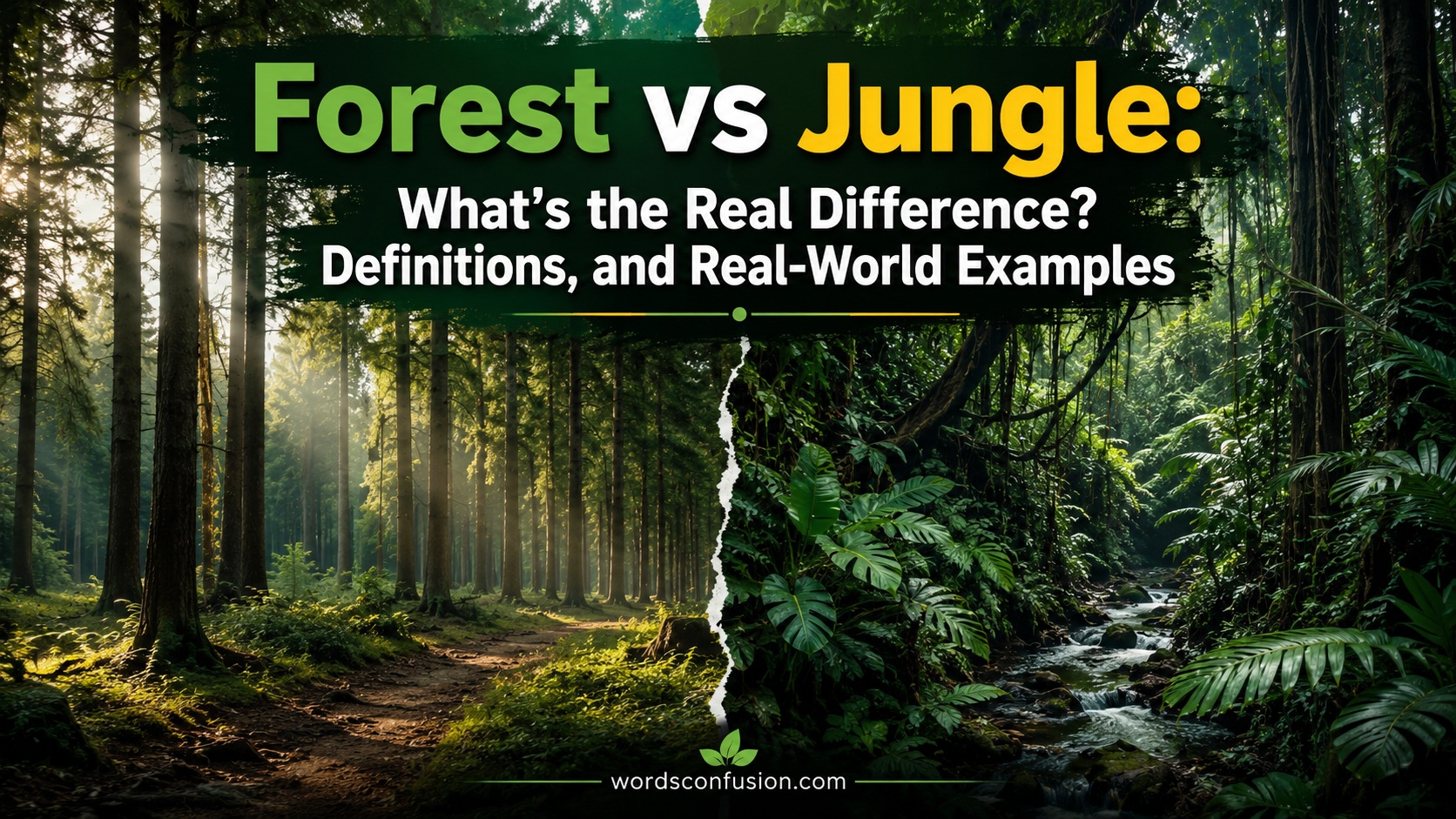
Have you ever looked at a dense green landscape and wondered whether it was a forest or a jungle? You’re not alone. Many people use the two terms interchangeably because both describe places filled with trees, wildlife, and vegetation. However, they don’t mean the same thing.
The difference between a forest and a jungle isn’t simply about how many trees grow in an area. Instead, it comes down to the structure of the vegetation, the amount of sunlight that reaches the ground, the climate, and how scientists classify ecosystems.
One of the biggest misconceptions is that a jungle is a completely different type of ecosystem. In reality, a jungle is usually a part of a tropical forest where dense vegetation grows beneath an open or broken canopy. That distinction changes everything.
In this guide, you’ll learn what makes forests and jungles different, where each one exists, why the terms are often confused, and how to identify them using real-world examples.
Forest vs Jungle – Quick Comparison
| Feature | Forest | Jungle |
| Definition | A large area dominated by trees and woody vegetation | A dense area of tangled vegetation growing beneath a tropical forest canopy |
| Tree Canopy | Usually continuous and dense | More open, allowing sunlight to reach the ground |
| Ground Vegetation | Sparse to moderate | Extremely dense and difficult to pass through |
| Sunlight | Limited at the forest floor in many forests | Plenty reaches the ground, encouraging thick plant growth |
| Climate | Tropical, temperate, boreal, Mediterranean, and more | Almost always tropical and humid |
| Rainfall | Varies widely by forest type | Very high throughout the year |
| Biodiversity | High to extremely high | Exceptionally high due to layered vegetation |
| Accessibility | Often easier to navigate | Usually difficult because of vines and thick undergrowth |
| Examples | Black Forest, Taiga, Amazon Rainforest | Dense undergrowth within the Amazon and Southeast Asian rainforests |
What Is a Forest?
A forest is a large ecosystem where trees dominate the landscape. Forests exist on every continent except Antarctica and cover about 31% of Earth’s land surface, according to the Food and Agriculture Organization (FAO).
Unlike popular belief, forests aren’t limited to tropical regions. They thrive in cold northern climates, dry Mediterranean regions, mountainous landscapes, and humid tropical zones. Each type supports different plants and animals while playing a vital role in Earth’s climate.
Definition of a Forest
Scientists generally define a forest as land where trees cover a significant portion of the area and form a recognizable ecosystem. Different countries use slightly different thresholds for tree cover, but most definitions include:
- A minimum area of about 0.5 hectares (1.24 acres)
- Trees capable of reaching at least 5 meters (16 feet) in height
- A canopy covering at least 10% of the land
These criteria help distinguish forests from grasslands, shrublands, and agricultural land.
Key Characteristics of Forests
Every forest has unique features, yet most share several important characteristics.
Tree-dominated ecosystems
Trees are the defining feature. They create multiple layers that support countless organisms.
Distinct canopy layers
Many forests have several vertical layers:
- Emergent layer
- Canopy
- Understory
- Shrub layer
- Forest floor
Each layer provides a different habitat for wildlife.
Wide climate range
Forests can survive in temperatures below freezing or in tropical heat exceeding 90°F (32°C).
Rich biodiversity
Even temperate forests contain thousands of species of plants, insects, birds, fungi, and mammals.
Natural nutrient cycling
Leaves fall, decompose, and return nutrients to the soil. This process supports healthy plant growth year after year.
Types of Forests
Not every forest looks like the Amazon. Scientists classify forests based on climate, latitude, and vegetation.
Tropical Forests
Tropical forests grow near the equator where temperatures stay warm throughout the year.
Characteristics include:
- Heavy rainfall
- Evergreen trees
- Exceptional biodiversity
- High humidity
Examples include parts of the Amazon Basin, Central Africa, and Southeast Asia.
Temperate Forests
Temperate forests experience four distinct seasons.
Common features include:
- Deciduous trees such as oak and maple
- Moderate rainfall
- Fertile soil
- Colorful autumn foliage
These forests dominate much of eastern North America, Europe, China, Korea, and Japan.
Boreal Forests (Taiga)
The boreal forest forms the world’s largest terrestrial biome.
Characteristics include:
- Long, cold winters
- Short growing seasons
- Coniferous trees such as spruce, fir, and pine
- Lower biodiversity than tropical forests
Large portions stretch across Canada, Alaska, Scandinavia, and Russia.
Mediterranean Forests
These forests grow in regions with hot, dry summers and mild, wet winters.
Vegetation has adapted to drought and frequent wildfires.
Mangrove Forests
Mangrove forests grow along tropical coastlines where saltwater meets land.
Their remarkable root systems:
- Prevent coastal erosion
- Provide fish nurseries
- Protect communities from storm surges
- Store large amounts of carbon
Famous Forests Around the World
Some forests have become globally recognized because of their size, biodiversity, or cultural importance.
| Forest | Location | Why It’s Famous |
| Amazon Rainforest | South America | Largest tropical rainforest on Earth |
| Black Forest | Germany | Dense woodland with rich folklore |
| Congo Rainforest | Central Africa | Second-largest tropical rainforest |
| Białowieża Forest | Poland and Belarus | One of Europe’s last primeval forests |
| Daintree Rainforest | Australia | Among the world’s oldest rainforests |
| Taiga | Canada, Russia, Scandinavia | Largest forest biome on Earth |
What Is a Jungle?
A jungle is not a separate ecological category. Instead, it refers to an area of extremely dense vegetation that develops on the forest floor of certain tropical forests.
The word “jungle” comes from the Hindi word jangal, which originally meant uncultivated or wild land. Over time, English speakers began using it to describe thick tropical vegetation.
Today, ecologists rarely classify ecosystems as jungles. Instead, they describe vegetation using terms such as tropical rainforest, secondary growth, or dense understory.
Why Jungles Have Dense Vegetation
The secret lies in sunlight.
In forests with a tightly closed canopy, very little sunlight reaches the ground. As a result, fewer shrubs and vines can grow.
However, when storms, falling trees, or natural gaps open the canopy, sunlight floods the forest floor. Plants respond quickly.
Within months, the area can become packed with:
- Shrubs
- Bamboo
- Young trees
- Ferns
- Vines
- Lianas
- Thorny plants
- Climbing palms
This tangled growth creates what people commonly call a jungle.
Key Characteristics of Jungles
Several features distinguish jungles from other forest environments.
Dense undergrowth
The vegetation is so thick that walking often requires cutting through vines and shrubs.
Warm temperatures
Jungles remain warm throughout the year.
High humidity
Humidity frequently exceeds 80%, creating ideal conditions for rapid plant growth.
Abundant rainfall
Most jungles receive over 80 inches (2,000 mm) of annual rainfall.
Rich biodiversity
The dense vegetation supports insects, reptiles, birds, amphibians, mammals, fungi, and countless microorganisms.
Rapid plant growth
Plants compete intensely for sunlight, causing vines and climbing plants to spread quickly.
Where Jungles Are Usually Found
Jungles occur mainly within tropical regions, including:
- The Amazon Basin
- The Congo Basin
- Southeast Asia
- Papua New Guinea
- Parts of Central America
- Northeastern Australia
They often develop along:
- Riverbanks
- Forest edges
- Areas recovering from disturbance
- Natural canopy openings
Famous Jungles Around the World
Although scientists usually describe these places as tropical rainforests, visitors often refer to their dense sections as jungles.
| Jungle Area | Country or Region | Known For |
| Amazon Jungle | South America | Extraordinary biodiversity |
| Congo Jungle | Central Africa | Gorillas, forest elephants, and dense vegetation |
| Borneo Jungle | Malaysia, Indonesia, Brunei | Orangutans and ancient rainforests |
| Sundarbans | India and Bangladesh | Mangroves and Bengal tigers |
| Darién Jungle | Panama and Colombia | Difficult terrain and exceptional wildlife |
Forest vs Jungle: The Major Differences Explained
Although forests and jungles share many similarities, several important differences set them apart.
Vegetation Density
The most noticeable difference is vegetation at ground level.
Many forests have relatively open floors because thick tree canopies block sunlight. Without enough light, shrubs and vines struggle to grow.
Jungles tell a different story.
Sunlight reaches the ground, allowing plants to grow rapidly in every available space. Thick vines wrap around trees, shrubs compete for room, and climbing plants create tangled walls of vegetation.
As a result, walking through a jungle often feels like moving through a living maze.
Tree Canopy
The canopy plays a central role in determining whether an area develops jungle-like conditions.
In many mature forests, tree crowns overlap to create a nearly continuous roof. This dense canopy shades the ground.
Jungles usually develop where the canopy becomes more open. Fallen trees, storms, landslides, or natural forest gaps allow sunlight to penetrate, encouraging explosive plant growth.
Amount of Sunlight
Sunlight shapes the entire ecosystem.
In a closed-canopy forest:
- Less sunlight reaches the soil.
- Ground vegetation remains limited.
- Mosses and shade-tolerant plants dominate.
In a jungle:
- More direct sunlight reaches the forest floor.
- Shrubs and vines grow rapidly.
- Plant competition becomes intense.
- Wildlife benefits from additional food sources.
Forest vs Jungle: The Major Differences Explained
Forest Floor
The forest floor often reveals whether you’re standing in a forest or a jungle.
In many mature forests, the ground is surprisingly open. You might see fallen leaves, decaying logs, mushrooms, moss, and scattered shrubs. Because little sunlight reaches the soil, only shade-loving plants thrive.
A jungle looks completely different.
The ground disappears beneath layers of vegetation. Young trees compete for sunlight, thorny bushes spread in every direction, and thick vines connect trunks like natural ropes. Ferns, palms, and climbing plants fill nearly every open space.
Here’s a simple way to remember it:
- Forest: Trees dominate the landscape.
- Jungle: Undergrowth dominates the landscape.
Climate
Forests grow across many climates, making them one of Earth’s most widespread ecosystems.
They can be found in:
- Tropical regions with year-round warmth
- Temperate areas with four seasons
- Cold northern regions where snow covers the ground for months
- Mediterranean climates with dry summers and wet winters
Jungles, however, almost always exist in tropical climates where temperatures stay consistently warm.
Typical jungle conditions include:
- Average temperatures between 70°F and 90°F (21°C–32°C)
- High humidity throughout the year
- Minimal seasonal temperature changes
These stable conditions allow plants to grow continuously instead of slowing during winter.
Rainfall
Rainfall is another major difference.
Some forests receive less than 20 inches (500 mm) of rain annually, while tropical rainforests may receive over 160 inches (4,000 mm).
Jungles generally form in areas with abundant rainfall.
Heavy rain supports:
- Continuous plant growth
- Thick vines
- Dense shrubs
- Large-leafed plants
- Fast-growing trees
Without frequent rainfall, jungle vegetation cannot maintain its remarkable density.
Biodiversity
Both forests and jungles support impressive biodiversity, but tropical jungles often contain the highest concentration of life on Earth.
For example, scientists estimate that the Amazon rainforest contains:
- More than 40,000 plant species
- Around 16,000 tree species
- Over 2.5 million insect species
- More than 1,300 bird species
- Hundreds of mammal and reptile species
The dense vegetation creates countless microhabitats where organisms can survive.
Temperate and boreal forests also support rich ecosystems, though they generally contain fewer species than tropical forests.
Ease of Movement
If you’ve ever watched explorers in documentaries hacking through thick vines with machetes, you’ve seen a jungle in action.
Dense undergrowth makes movement slow and exhausting.
Common obstacles include:
- Thorny shrubs
- Twisting vines
- Fallen branches
- Bamboo thickets
- Thick grasses
- Swampy ground
Many forests are much easier to navigate because the open forest floor provides natural walking paths.
Wildlife
Both ecosystems provide homes for incredible wildlife.
Forest animals often include:
- Deer
- Wolves
- Bears
- Foxes
- Owls
- Woodpeckers
- Moose
- Elk
Jungles support species adapted to warm, humid environments such as:
- Jaguars
- Tigers
- Orangutans
- Gorillas
- Sloths
- Tapirs
- Poison dart frogs
- Tree snakes
- Toucans
- Macaws
Dense vegetation offers excellent shelter, nesting sites, and hunting opportunities.
Human Settlement and Accessibility
People have lived in forests for thousands of years.
Many forests contain:
- Hiking trails
- Roads
- National parks
- Sustainable logging operations
- Small towns
Jungles present greater challenges.
Limited visibility, heavy rainfall, insects, dense vegetation, and difficult terrain often make transportation expensive and time-consuming.
Even modern technology struggles in some remote tropical jungles.
Geographic Distribution
Forests exist almost everywhere trees can grow.
You’ll find forests in:
- North America
- South America
- Europe
- Asia
- Africa
- Australia
Jungles have a much narrower distribution.
They occur mainly in tropical regions near the equator where warmth and rainfall remain consistently high.
Is Every Jungle a Forest?
Yes. Every jungle is considered part of a forest ecosystem.
This point surprises many people because movies often portray jungles as completely different environments.
The reality is much simpler.
A jungle develops within certain forests rather than replacing them.
Think of a forest as the entire ecosystem.
A jungle describes one particular section where dense vegetation grows beneath an open canopy.
Why Every Jungle Is Part of a Forest
A jungle still contains the defining features of a forest:
- Trees
- Forest soil
- Layered vegetation
- Wildlife communities
- Natural nutrient cycling
The main difference is the unusually thick undergrowth.
Ecologists often describe these areas as dense understory or secondary vegetation instead of using the word “jungle.”
Why Not Every Forest Is a Jungle
Many forests never develop jungle conditions.
Examples include:
- Boreal forests
- Temperate deciduous forests
- Pine forests
- Mountain forests
In these ecosystems, cooler temperatures, seasonal changes, or limited sunlight prevent dense undergrowth from forming.
As a result, you can walk through many forests without fighting through walls of vegetation.
Why the Terms “Forest” and “Jungle” Are Often Confused
The confusion comes from history, popular culture, and everyday language.
Most people learn these words through books, movies, or television rather than ecology.
Everyday Language
People often use “forest” and “jungle” to describe any place with lots of trees.
For example, someone might say:
“We hiked through the jungle.”
Even if the location was actually a temperate forest.
Over time, casual usage blurred the distinction.
Movies and Popular Culture
Adventure films have reinforced the image of jungles as mysterious, dangerous places.
Characters battle:
- Thick vines
- Poisonous snakes
- Hidden temples
- Exotic wildlife
- Dense vegetation
While these scenes capture certain tropical environments, they rarely explain that a jungle is usually just one part of a rainforest.
Historical Use of the Word “Jungle”
The English word comes from the Hindi word jangal, meaning uncultivated land or wilderness.
During the colonial period, explorers used “jungle” broadly for many tropical landscapes.
Eventually, the word became associated with dense tropical vegetation.
Scientific vs. Common Usage
Modern ecologists prefer more precise terms.
Instead of saying “jungle,” researchers often use:
- Tropical rainforest
- Secondary forest
- Dense understory
- Tropical woodland
- Regenerating forest
These terms describe ecosystems more accurately.
Forest vs Jungle in Ecology
Scientists classify ecosystems using measurable characteristics rather than popular names.
That approach helps researchers compare habitats across different continents.
How Ecologists Classify Forests
Forests are usually classified by:
- Climate
- Rainfall
- Latitude
- Dominant tree species
- Seasonal patterns
- Elevation
Examples include:
- Tropical rainforest
- Tropical dry forest
- Temperate deciduous forest
- Boreal forest
- Montane forest
- Cloud forest
Each category reflects unique environmental conditions.
Is “Jungle” an Official Scientific Classification?
Not usually.
Although scientists understand what people mean by “jungle,” the term has little value in formal ecological classification.
Instead, researchers describe:
- Vegetation density
- Canopy openness
- Successional stage
- Plant composition
Those details provide far more useful information than the word “jungle.”
The Role of Canopy Layers
Forest canopies influence everything below them.
A dense canopy:
- Blocks sunlight
- Keeps temperatures cooler
- Reduces evaporation
- Limits undergrowth
An open canopy:
- Increases sunlight
- Encourages new plant growth
- Creates dense vegetation
- Supports different animal communities
This relationship explains why two nearby areas within the same rainforest can look completely different.
Succession and Vegetation Growth
Jungles commonly develop during ecological succession.
Imagine a large tree falling after a storm.
Suddenly, sunlight reaches the forest floor.
Within months:
- Seeds germinate.
- Shrubs spread rapidly.
- Vines climb nearby trees.
- Young trees race toward the light.
This burst of growth transforms the area into dense jungle-like vegetation until the canopy gradually closes again.
Forest vs Jungle Around the World
Forests and jungles exist across multiple continents, but they don’t appear in the same places or under the same environmental conditions. Forests occur in nearly every region where trees can grow. Jungles, on the other hand, are limited to warm, humid tropical areas.
The table below highlights where you’re most likely to find each ecosystem.
| Region | Common Forest Types | Jungle Present? | Notable Examples |
| North America | Temperate deciduous, coniferous, boreal | Rare | Great Smoky Mountains, Tongass National Forest |
| South America | Tropical rainforest, cloud forest | Yes | Amazon Rainforest |
| Europe | Temperate deciduous, mixed forest | No | Black Forest, Białowieża Forest |
| Africa | Tropical rainforest, savanna woodland | Yes | Congo Rainforest |
| Asia | Tropical rainforest, temperate forest, bamboo forest | Yes | Borneo Rainforest, Western Ghats |
| Australia | Tropical rainforest, eucalyptus forest | Yes | Daintree Rainforest |
One interesting fact stands out.
The Amazon Rainforest contains both dense forests and jungle-like areas. You could walk through one section with little undergrowth and then enter another where vines and shrubs completely block your path.
That’s why calling the entire Amazon a jungle isn’t entirely accurate.
Animals Found in Forests vs Jungles
Wildlife depends on climate, food availability, and habitat structure. Since forests and jungles differ in vegetation and environmental conditions, they support different animal communities.
| Forest Animals | Jungle Animals |
| Black bear | Jaguar |
| Gray wolf | Bengal tiger |
| Moose | Orangutan |
| Red fox | Gorilla |
| White-tailed deer | Sloth |
| Snowshoe hare | Tapir |
| Great horned owl | Harpy eagle |
| Woodpecker | Toucan |
| Elk | Macaw |
| Lynx | Green anaconda |
Although some species overlap in tropical forests, many animals have evolved specifically for dense jungle habitats.
For example:
- Sloths spend most of their lives hanging from tree branches.
- Orangutans use long arms to move through rainforest canopies.
- Jaguars hunt both on land and in water, making them highly adaptable jungle predators.
- Poison dart frogs thrive in humid environments where moisture remains high year-round.
Meanwhile, animals living in temperate forests often develop seasonal adaptations.
Examples include:
- Bears hibernate during winter.
- Deer grow thicker coats.
- Many birds migrate south.
- Squirrels store food for colder months.
These seasonal behaviors rarely occur in tropical jungles because food remains available throughout most of the year.
Read More: Lake vs Pond: Key Differences, Characteristics, and Real-World Examples
Plant Life in Forests vs Jungles
Plants define both ecosystems, but they grow in very different ways.
Trees
Trees dominate forests regardless of climate.
Common forest trees include:
- Oak
- Maple
- Pine
- Spruce
- Fir
- Birch
- Cedar
Jungle trees tend to be tropical species such as:
- Mahogany
- Kapok
- Rubber tree
- Brazil nut tree
- Dipterocarps
Many tropical trees grow exceptionally tall as they compete for sunlight.
Shrubs
Shrubs play a supporting role in many forests.
In jungles, shrubs become a dominant feature.
Dense shrub growth creates natural barriers that make travel difficult and provide shelter for countless animal species.
Vines and Lianas
One of the defining characteristics of a jungle is the abundance of climbing plants.
These include:
- Lianas
- Woody vines
- Climbing palms
- Creepers
Instead of investing energy in growing thick trunks, many vines climb existing trees to reach sunlight more efficiently.
Some lianas can extend more than 300 feet (90 meters) through the canopy.
Mosses and Ferns
Forests support many mosses and ferns, particularly in damp environments.
You’ll often find:
- Moss-covered rocks
- Fern-lined streams
- Decaying logs covered with lichens
Jungles also contain ferns, but they usually grow alongside much larger tropical plants.
Epiphytes
Epiphytes are plants that grow on other plants without taking nutrients from them.
Common examples include:
- Orchids
- Bromeliads
- Air plants
They collect water from rainfall and humidity instead of relying on soil.
Tropical forests contain thousands of epiphyte species, adding another layer of biodiversity to the ecosystem.
Forest vs Jungle: Climate and Rainfall Comparison
Climate strongly influences the appearance of every forest and jungle.
The comparison below summarizes the major differences.
| Factor | Forest | Jungle |
| Average Temperature | Varies from below freezing to tropical warmth | Usually 70–90°F (21–32°C) |
| Humidity | Low to high depending on region | Very high year-round |
| Annual Rainfall | 20–160+ inches (500–4,000+ mm) | Usually over 80 inches (2,000 mm) |
| Seasons | May have four seasons or dry and wet seasons | Little temperature variation; often wet and dry seasons |
| Growing Conditions | Depend on climate and latitude | Favor continuous plant growth |
The combination of heat, moisture, and sunlight explains why jungles produce such dense vegetation.
Plants don’t need to wait for spring.
They grow almost continuously.
Examples That Make the Difference Easy to Understand
Looking at real-world examples makes the distinction much easier.
Example 1: A Temperate Forest
Imagine hiking through a forest in the Appalachian Mountains.
Tall oak and maple trees surround you.
Sunlight filters through the canopy, but the ground remains mostly clear except for fallen leaves, ferns, and occasional shrubs.
Walking is relatively easy.
This is a classic forest.
Example 2: A Tropical Rainforest with Jungle Undergrowth
Now picture part of the Amazon after a large tree has fallen.
Sunlight pours through the opening.
Within a short time:
- Vines climb neighboring trees.
- Shrubs spread rapidly.
- Young trees compete for space.
- Ferns cover the ground.
The once-open forest floor transforms into dense jungle vegetation.
Example 3: A Managed Forest
Many countries maintain forests for conservation, recreation, and sustainable timber production.
These forests often include:
- Hiking trails
- Fire management plans
- Wildlife monitoring
- Controlled harvesting
Because the undergrowth remains manageable, visitors can explore much of the area safely.
Example 4: Dense Secondary Growth Near Tropical Rivers
Riverbanks in tropical regions frequently develop jungle conditions.
Frequent flooding creates fertile soils.
Combined with abundant sunlight and moisture, plants grow rapidly, producing tangled vegetation that’s difficult to cross.
Common Myths About Forests and Jungles
Many misconceptions continue to circulate.
Let’s separate fact from fiction.
| Myth | Reality |
| A jungle has more trees than a forest. | Jungles have denser undergrowth, not necessarily more trees. |
| Every tropical rainforest is a jungle. | Only certain sections develop jungle-like vegetation. |
| Forests are always cold. | Tropical forests stay warm throughout the year. |
| Jungles exist only in the Amazon. | They also occur in Africa, Asia, Central America, and Australia. |
| Jungles are impossible for humans to enter. | Difficult, yes. Impossible, no. Indigenous communities and researchers navigate them regularly. |
| Forest and jungle mean exactly the same thing. | They describe different features of vegetation and ecosystem structure. |
Understanding these differences helps you identify landscapes more accurately.
It also improves your understanding of ecology and conservation.
Forest vs Jungle: Which Supports More Biodiversity?
When people think of biodiversity, tropical rainforests usually come to mind.
There’s a good reason for that.
The world’s richest ecosystems occur in tropical forests where warm temperatures and abundant rainfall support life throughout the year.
Dense jungle vegetation contributes even more habitat diversity.
For example, one small area of tropical rainforest may contain:
- Towering canopy trees
- Young saplings
- Thick shrubs
- Climbing vines
- Mosses
- Ferns
- Orchids
- Bromeliads
- Fungi
- Fallen logs
- Streams
- Temporary pools
Each microhabitat supports different species.
As a result, tropical forests with jungle-like undergrowth often contain far more species than temperate or boreal forests.
However, biodiversity isn’t only about numbers.
Every forest plays an important ecological role.
Boreal forests store enormous amounts of carbon.
Temperate forests protect watersheds and support migratory birds.
Mangrove forests defend coastlines against erosion and storms.
Each ecosystem contributes something unique to Earth’s environmental health.
FAQs:
What is the main difference between a forest and a jungle?
The main difference is the vegetation growing on the ground. A forest is an ecosystem dominated by trees, while a jungle is a part of a tropical forest with extremely dense undergrowth. Jungles develop where enough sunlight reaches the forest floor, allowing shrubs, vines, and young trees to grow thickly.
Is every jungle considered a forest?
Yes. Every jungle is part of a forest ecosystem, but not every forest is a jungle. The term “jungle” describes dense vegetation beneath the trees rather than a separate ecological category. Scientists usually classify these areas as tropical forests with dense understory instead of using the word jungle.
Is the Amazon a forest or a jungle?
The Amazon is primarily a tropical rainforest, which makes it a forest. However, some areas within the Amazon contain dense undergrowth that people commonly call a jungle. In other words, the Amazon includes both forested areas with little ground vegetation and jungle-like sections with thick, tangled plant growth.
Which has more biodiversity, a forest or a jungle?
Tropical forests with jungle-like vegetation generally support the highest biodiversity on Earth. The combination of warm temperatures, abundant rainfall, and multiple vegetation layers creates habitats for millions of species of plants, animals, fungi, and insects. That said, all forest types play an important role in maintaining global biodiversity.
Why do scientists rarely use the term “jungle”?
Scientists prefer more precise terms such as tropical rainforest, secondary forest, or dense understory because these descriptions better explain an ecosystem’s structure and characteristics. The word jungle is widely understood in everyday language, but it isn’t considered a formal ecological classification.
Conclusion:
The debate over forest vs jungle becomes much simpler once you understand the role of the forest canopy and ground vegetation.
A forest is any large ecosystem dominated by trees, regardless of whether it grows in tropical, temperate, or boreal climates. A jungle, on the other hand, refers to the dense, tangled vegetation that develops beneath certain tropical forests when enough sunlight reaches the forest floor.
The easiest way to remember the difference is this:
- Forest = Defined by trees.
- Jungle = Defined by dense undergrowth.
Although people often use the terms interchangeably, they describe different aspects of the same natural world. Every jungle exists within a forest, but only specific tropical forests develop the thick vegetation that earns the name jungle.

Andrew Wilson is an experienced language researcher and content writer specializing in WordsConfusion topics. He helps readers understand commonly confused English words, spelling differences, grammar rules, word meanings, and proper usage through clear explanations, practical examples, and easy-to-follow language guides. His goal is to make English learning simple, accurate, and accessible for students, writers, professionals, and everyday learners.