
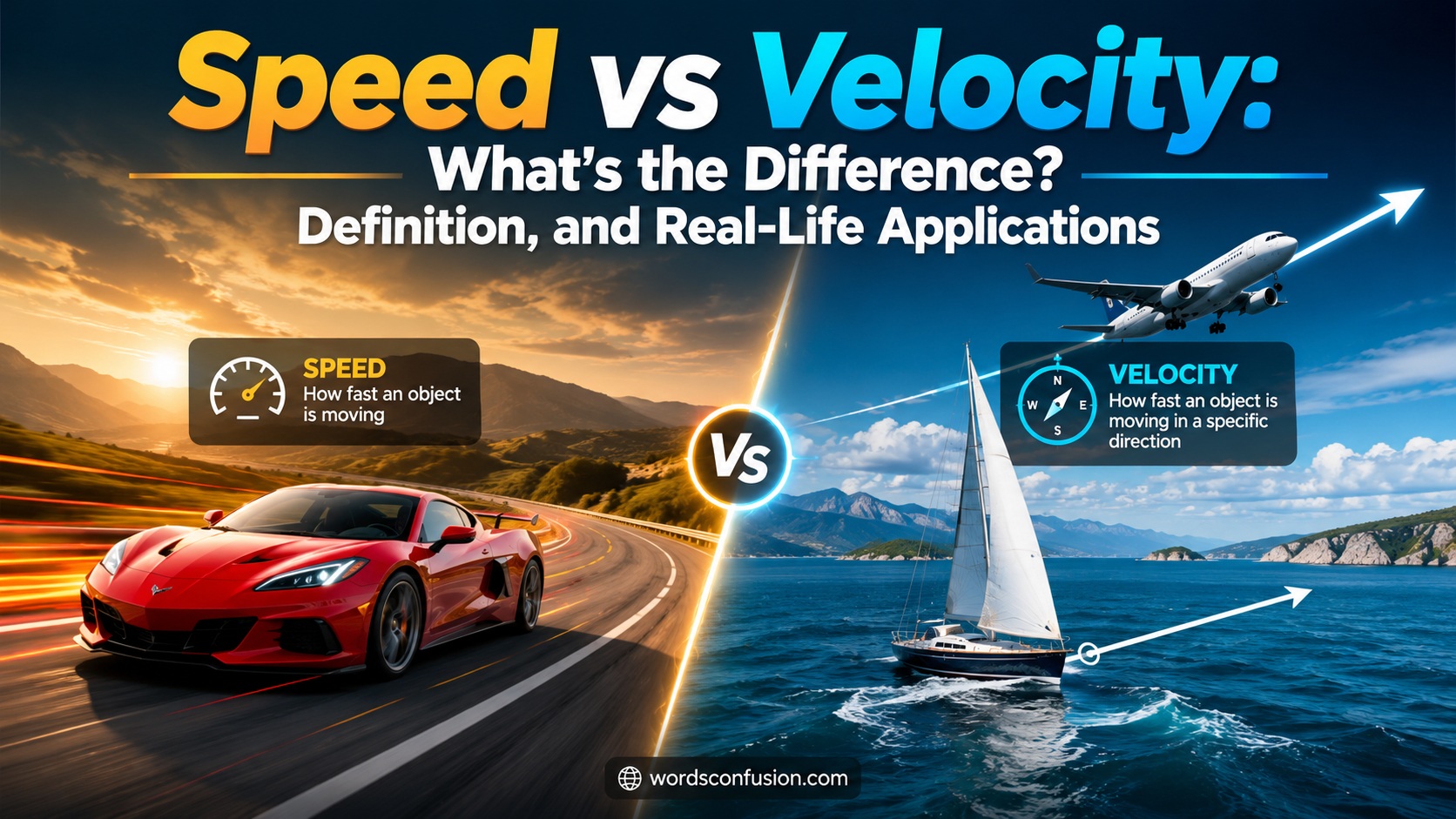
Have you ever heard someone say, “The car was traveling at a velocity of 80 mph,” when they really meant speed? It happens all the time. Although people often use speed and velocity as if they mean the same thing, physics treats them as two distinct concepts. Knowing the difference helps you solve science problems, understand motion more clearly, and avoid common mistakes in school and everyday conversations.
At first glance, both terms describe how fast something moves. However, one crucial detail changes everything: direction. Speed only tells you how fast an object is moving. Velocity tells you how fast and in which direction it is moving.
This distinction matters in many fields. Engineers calculate velocity to design safe roads and bridges. Pilots use velocity to navigate aircraft accurately. GPS systems rely on velocity calculations to estimate arrival times, while scientists studying planets, satellites, and rockets depend on velocity to predict motion with remarkable precision.
In this guide, you’ll learn exactly what separates speed from velocity. You’ll also discover the formulas, units, worked examples, practical applications, and common misconceptions that make these concepts easy to understand.
Speed vs Velocity: Quick Answer
The difference between speed and velocity is simple:
- Speed measures how fast an object travels, regardless of direction.
- Velocity measures how fast an object travels and the direction of its motion.
For example, imagine you drive 60 miles in one hour.
- Your speed is 60 mph.
- If you’re traveling 60 mph east, your velocity is 60 mph east.
Now imagine you drive 30 miles east and then return 30 miles west to your starting point.
- Your average speed is still 60 miles ÷ 1 hour = 60 mph if the trip took one hour.
- Your average velocity becomes 0 mph because your overall displacement is zero.
This single example shows why direction makes all the difference.
Speed vs Velocity at a Glance
| Feature | Speed | Velocity |
| Definition | Distance traveled per unit of time | Displacement per unit of time |
| Quantity Type | Scalar | Vector |
| Includes Direction | No | Yes |
| Based On | Distance | Displacement |
| Formula | Distance ÷ Time | Displacement ÷ Time |
| SI Unit | meters per second (m/s) | meters per second (m/s) |
| Can Be Negative? | No | Yes, depending on direction |
| Can Be Zero? | Yes | Yes |
| Example | 80 km/h | 80 km/h north |
What Is Speed?
Speed is the rate at which an object covers distance over time. It tells you only how fast something moves. It does not tell you where the object is heading.
Think about your car’s speedometer. It might display 70 mph, but it doesn’t indicate whether you’re driving north, south, east, or west. That’s because a speedometer measures speed, not velocity.
Key Characteristics of Speed
Speed has several important characteristics:
- It is a scalar quantity.
- It has only magnitude.
- Direction does not matter.
- It is always zero or positive.
- It depends on total distance traveled.
Speed Formula
The basic formula for speed is:
Speed = Distance ÷ Time
For example:
- Distance traveled = 150 km
- Time taken = 3 hours
Speed = 150 ÷ 3 = 50 km/h
This formula works whether you’re walking, cycling, driving, flying, or even observing the movement of planets.
Average Speed
Average speed measures the total distance traveled divided by the total time taken.
Average Speed = Total Distance ÷ Total Time
Suppose you drive:
- 120 km in 2 hours
- 60 km in 1 hour
Total distance = 180 km
Total time = 3 hours
Average speed = 60 km/h
Instantaneous Speed
Instantaneous speed is the speed of an object at a particular moment.
When your car’s speedometer reads 90 km/h, it shows your instantaneous speed at that exact second.
Common Units of Speed
| Unit | Common Use |
| meters per second (m/s) | Science and physics |
| kilometers per hour (km/h) | Road travel |
| miles per hour (mph) | United States and United Kingdom |
| feet per second (ft/s) | Engineering |
| knots | Aviation and maritime travel |
Everyday Examples of Speed
You encounter speed almost everywhere:
- A runner completes a race at 18 km/h.
- A train travels at 250 km/h.
- A commercial airplane cruises at around 900 km/h.
- A cyclist rides at 25 km/h.
In each example, only the rate of motion matters—not the direction.
What Is Velocity?
Velocity describes both how fast an object moves and the direction in which it moves.
Unlike speed, velocity cannot exist without direction. Simply saying a car moves at 70 km/h is incomplete when discussing velocity. You must specify a direction, such as 70 km/h north.
Key Characteristics of Velocity
Velocity differs from speed in several important ways:
- It is a vector quantity.
- It has both magnitude and direction.
- It depends on displacement rather than total distance.
- It can be positive, negative, or zero depending on the chosen reference direction.
- Changing direction changes velocity even if speed remains constant.
Velocity Formula
The formula for average velocity is:
Velocity = Displacement ÷ Time
Notice that displacement replaces distance.
Displacement measures the shortest straight-line distance between the starting and ending points while considering direction.
Average Velocity Example
A student walks:
- 100 meters east.
Time taken:
- 20 seconds.
Average velocity:
100 ÷ 20 = 5 m/s east
Because direction is included, the answer becomes a velocity instead of a speed.
Instantaneous Velocity
Instantaneous velocity measures an object’s velocity at a specific moment.
For example, a racing car may have an instantaneous velocity of 200 km/h east at one point on the track.
If the driver turns sharply, the velocity changes immediately because the direction changes—even if the speed stays at 200 km/h.
The Fundamental Difference Between Speed and Velocity
Many learners struggle with speed vs velocity because both use similar units and describe motion. The real difference lies in what each quantity measures.
- Speed tells you how fast something moves.
- Velocity tells you how fast and in which direction it moves.
That single addition—direction—changes how scientists analyze motion.
Imagine two cars traveling at 60 mph.
- Car A is traveling 60 mph east.
- Car B is traveling 60 mph west.
Both cars have the same speed, but they have different velocities because their directions are opposite.
Speed Depends on Distance
Distance is the total length of the path an object travels.
Suppose you walk around a circular park and return to where you started. You may have walked 1 kilometer, so your speed depends on that full distance.
The path matters.
Velocity Depends on Displacement
Displacement measures the straight-line change in position from the starting point to the ending point.
If you return to your starting position after walking around the park, your displacement becomes zero.
That means your average velocity is zero, even though you spent time walking.
This is one of the easiest ways to remember the difference.
Distance vs Displacement Explained
Understanding distance and displacement makes the difference between speed and velocity much easier to grasp.
What Is Distance?
Distance is the total path traveled by an object.
It never decreases as you move. Every step adds to the total distance.
Characteristics of Distance
- Scalar quantity
- Has magnitude only
- Always positive
- Depends on the actual path taken
- Measured in meters, kilometers, miles, or similar units
Example
A person walks:
- 300 meters east
- 200 meters west
Total distance:
300 + 200 = 500 meters
What Is Displacement?
Displacement is the shortest straight-line distance between the starting point and the ending point.
It always includes direction.
Characteristics of Displacement
- Vector quantity
- Includes magnitude and direction
- Can be zero
- Can be positive or negative depending on the reference direction
- Ignores the actual path traveled
Example
Using the previous example:
- Walk 300 meters east.
- Walk 200 meters west.
Final position:
100 meters east of the starting point.
Displacement:
100 meters east
Distance vs Displacement Comparison
| Feature | Distance | Displacement |
| Definition | Total path traveled | Straight-line change in position |
| Quantity Type | Scalar | Vector |
| Includes Direction | No | Yes |
| Depends on Path | Yes | No |
| Can Be Zero | No, unless no movement occurs | Yes |
| Can Be Negative | No | Yes |
Speed Formula Explained
The formula for speed is one of the first equations students learn in physics because it applies to almost every type of motion.
Speed = Distance ÷ Time
Although the formula is simple, using the correct values is important.
Average Speed Formula
Average speed considers the entire journey rather than one specific moment.
Average Speed = Total Distance ÷ Total Time
Worked Example
A cyclist completes a 90-kilometer ride in 3 hours.
Given:
- Distance = 90 km
- Time = 3 hours
Average speed:
90 ÷ 3 = 30 km/h
The cyclist’s average speed is 30 km/h.
Instantaneous Speed
Instantaneous speed refers to the speed at a single moment.
For example, while driving on a highway, your speedometer might change like this:
- 55 mph
- 60 mph
- 68 mph
- 62 mph
Each reading represents your instantaneous speed at that exact moment.
Uniform Speed
Uniform speed means an object covers equal distances in equal intervals of time.
Examples include:
- A conveyor belt moving steadily.
- A train traveling at a constant speed on a straight track.
- A moving walkway at an airport.
Variable Speed
Variable speed means the object’s speed changes during its journey.
Most vehicles travel at variable speed because they accelerate, slow down, or stop.
Examples include:
- Driving through city traffic.
- A roller coaster.
- A runner sprinting toward the finish line.
Read More: Climate vs Weather: What’s the Difference? Complete Guide with Examples, and Real-World Impact
Velocity Formula Explained
Velocity uses displacement instead of distance.
Average Velocity = Displacement ÷ Time
This small difference produces very different answers in many situations.
Worked Example
A student walks 80 meters north in 20 seconds.
Average velocity:
80 ÷ 20 = 4 m/s north
Notice that the direction is part of the final answer.
Instantaneous Velocity
Instantaneous velocity describes an object’s velocity at one specific instant.
If a drone is flying at 15 m/s east, that value represents its instantaneous velocity.
If the drone suddenly turns north while maintaining the same speed, its velocity changes immediately because the direction changes.
Constant Velocity
An object has constant velocity only when both speed and direction remain unchanged.
For constant velocity:
- Speed stays the same.
- Direction stays the same.
- Acceleration equals zero.
A car traveling at 70 km/h east on a perfectly straight road is an example of constant velocity.
Changing Velocity
Velocity changes whenever:
- Speed changes.
- Direction changes.
- Both speed and direction change.
This explains why a car moving around a curved road experiences changing velocity even if the speedometer stays fixed at 60 km/h.
FAQs:
Is speed always greater than velocity?
Not always. Speed is always equal to or greater than the magnitude of velocity. When an object moves in a straight line without changing direction, its speed and the magnitude of its velocity are equal. However, if the object changes direction during its journey, the average speed becomes greater than the magnitude of the average velocity because speed depends on total distance while velocity depends on displacement.
Can an object have speed but zero velocity?
Yes. This is one of the most common examples used in physics.
Imagine a runner completes one full lap around a 400-meter track and finishes at the starting line.
- Distance traveled: 400 meters
- Displacement: 0 meters
The runner had a positive average speed because they covered 400 meters. However, their average velocity is 0 m/s because the starting and ending positions are the same.
Why is velocity considered a vector quantity?
Velocity is a vector quantity because it has both magnitude and direction. Saying a car travels at 70 km/h only describes its speed. To describe its velocity, you must include a direction, such as 70 km/h north. Without direction, velocity is incomplete.
Can velocity change while speed stays the same?
Absolutely. Whenever an object changes direction, its velocity changes even if its speed remains constant.
For example:
- A satellite orbiting Earth moves at nearly constant speed.
- A car turns around a bend without slowing down.
- A runner moves around a circular track at a steady pace.
In each case, the direction changes continuously, so the velocity changes even though the speed stays the same.
Why does a car’s speedometer show speed instead of velocity?
A standard speedometer measures how fast the vehicle is moving, regardless of direction. Determining velocity would require combining speed with directional information from another system, such as GPS or a navigation device. Since drivers primarily need to know whether they are within the legal speed limit, displaying speed alone is practical and sufficient.
Conclusion:
Understanding the difference between speed and velocity is essential because these two terms describe motion in different ways. While they may appear similar at first, they are based on different measurements and serve different purposes.
Speed measures how fast an object travels over a given distance. It is a scalar quantity, meaning it has magnitude only and never includes direction. Velocity, on the other hand, measures the rate of change of displacement and always includes both magnitude and direction, making it a vector quantity.
The distinction becomes clear whenever an object changes direction. A runner completing a full lap around a track, a car navigating a curved road, or a satellite orbiting Earth can all maintain a steady speed while their velocity changes continuously. Likewise, an object can have a positive speed yet an average velocity of zero if it returns to its starting point.

Andrew Wilson is an experienced language researcher and content writer specializing in WordsConfusion topics. He helps readers understand commonly confused English words, spelling differences, grammar rules, word meanings, and proper usage through clear explanations, practical examples, and easy-to-follow language guides. His goal is to make English learning simple, accurate, and accessible for students, writers, professionals, and everyday learners.