
Have you ever stepped on a bathroom scale and wondered whether it measures your mass or your weight? Most people use these words interchangeably. You’ll hear someone say, “I weigh 70 kilograms,” or “The package has a weight of 10 kilograms.” In everyday conversation, that sounds perfectly normal. In science, however, those statements aren’t technically correct.
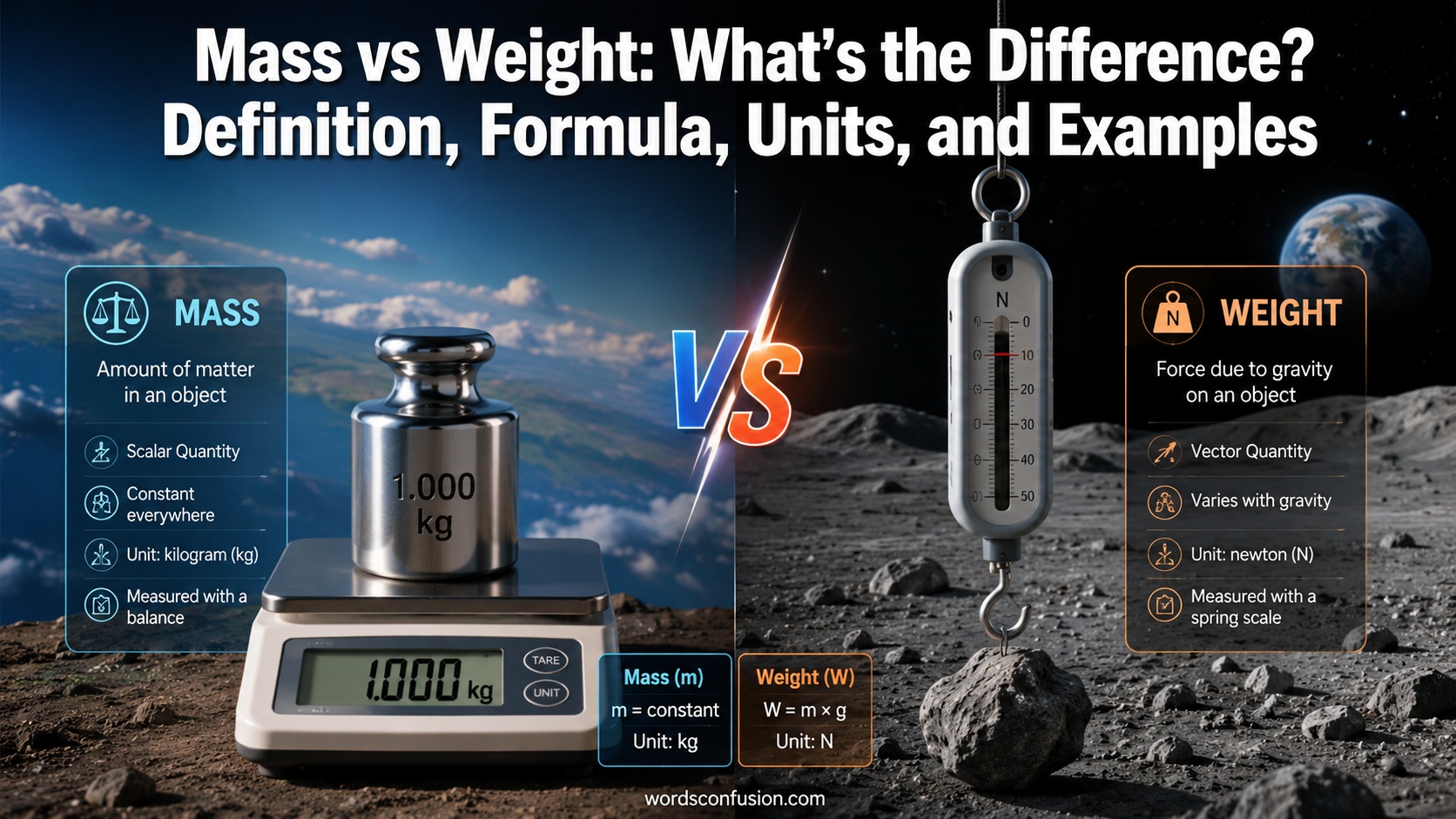
The difference between mass vs weight is one of the first concepts students learn in physics because it explains how objects behave under gravity. Although the two terms are closely related, they describe completely different physical properties. Mass tells you how much matter an object contains, while weight tells you how strongly gravity pulls on that object.
Understanding this distinction isn’t just important for passing a physics exam. Engineers rely on it when designing bridges and aircraft. Astronauts experience it every day in orbit. Doctors, fitness professionals, and shipping companies also use these concepts in practical ways.
By the end of this guide, you’ll understand:
- The exact difference between mass and weight
- Why mass stays the same while weight changes
- The formulas used in physics
- SI units and measuring instruments
- Real-world examples from Earth, the Moon, and space
- Common misconceptions people still believe
- Practical applications in everyday life
Whether you’re a student, teacher, or simply curious about science, this guide will give you a clear understanding of mass vs weight without confusing technical jargon.
Mass vs Weight: Quick Answer
The easiest way to remember the difference is this:
- Mass is the amount of matter in an object.
- Weight is the force of gravity acting on that mass.
In other words, your mass remains constant wherever you go, but your weight changes whenever gravity changes.
For example, imagine you have a suitcase with a mass of 20 kilograms.
- On Earth, it weighs about 196 Newtons.
- On the Moon, it weighs only about 32 Newtons.
- On Mars, it weighs around 74 Newtons.
The suitcase didn’t lose any matter. Its mass stayed exactly 20 kilograms. Only its weight changed because each celestial body has a different gravitational pull.
This simple example explains the core difference better than any definition.
Mass vs Weight at a Glance
| Feature | Mass | Weight |
| Definition | Amount of matter in an object | Gravitational force acting on an object |
| Depends on Gravity | No | Yes |
| SI Unit | Kilogram (kg) | Newton (N) |
| Symbol | m | W |
| Formula | Remains constant | W = m × g |
| Quantity Type | Scalar | Vector |
| Can Change? | Rarely | Yes |
| Measuring Instrument | Balance | Spring scale |
| Direction | No direction | Always points toward the center of gravity |
| Example | 5 kg laptop | About 49 N on Earth |
What Is Mass?
Definition of Mass
Mass is the physical quantity that measures how much matter an object contains. Every object, from a grain of sand to an entire planet, has mass because it consists of matter.
Unlike weight, mass does not depend on gravity. It remains the same whether you’re standing on Earth, walking on the Moon, or floating inside a spacecraft.
Scientists use mass as one of the fundamental properties of matter because it helps explain how objects respond to forces.
What Mass Actually Measures
Many people think mass simply means “how heavy something is.” That’s only partly true.
Mass actually measures:
- The amount of matter inside an object
- The object’s resistance to acceleration (called inertia)
- How difficult it is to change the object’s motion
Imagine pushing two shopping carts.
- One cart is empty.
- The other is filled with bricks.
The full cart has more mass, so it takes much more effort to push or stop. That resistance isn’t caused by gravity. It’s caused by mass.
Key Characteristics of Mass
Mass has several important properties:
- It remains constant regardless of location.
- It is a scalar quantity, meaning it has magnitude but no direction.
- It cannot become negative.
- It is measured using balances rather than force-measuring devices.
- It determines an object’s inertia.
Because mass never changes with location, scientists often use it when comparing objects under different gravitational conditions.
SI Units of Mass
The International System of Units (SI) measures mass in kilograms (kg).
Other common units include:
| Unit | Symbol | Equivalent |
| Kilogram | kg | 1 kg |
| Gram | g | 1/1000 kg |
| Milligram | mg | 1/1,000,000 kg |
| Metric Ton | t | 1,000 kg |
Some countries also use customary units such as:
- Pound (lb)
- Ounce (oz)
- Slug (used mainly in engineering)
Although pounds are commonly used in everyday life, the kilogram remains the international scientific standard.
What Is Weight?
Definition of Weight
Weight is the gravitational force exerted on an object due to its mass.
Unlike mass, weight depends entirely on gravity. If gravity changes, weight changes immediately.
This makes weight a force, not a property of matter itself.
What Weight Really Means
Whenever an object is near a planet, moon, or star, gravity pulls it toward that body.
That pulling force is called weight.
The stronger the gravitational field, the greater the weight.
For example:
- Earth has stronger gravity than the Moon.
- Jupiter has much stronger gravity than Earth.
- Deep space has very little gravitational influence, so weight becomes extremely small.
Key Characteristics of Weight
Weight has several defining features:
- It depends on gravitational acceleration.
- It changes from one location to another.
- It is a vector quantity because it has both magnitude and direction.
- It always points toward the center of the attracting body.
- It is measured in Newtons.
SI Units of Weight
Because weight is a force, its SI unit is the Newton (N).
One Newton equals the force required to accelerate a one-kilogram mass by one meter per second squared.
Larger forces may be expressed in:
- Kilonewtons (kN)
- Meganewtons (MN)
Although everyday conversations often mention kilograms as “weight,” physicists reserve kilograms for mass and Newtons for weight.
The Science Behind the Difference Between Mass and Weight
The distinction between mass vs weight becomes much easier to understand once you know how gravity works.
Mass is an intrinsic property of matter. In simple terms, it’s built into every object and doesn’t depend on where that object is located.
Weight, however, exists only because gravity pulls on mass.
Think of gravity as an invisible rope connecting every object to a planet or moon. The stronger that pull, the greater the object’s weight. Remove or weaken the pull, and the weight changes instantly. The mass doesn’t.
For example, imagine holding a 5-kilogram bowling ball.
- On Earth, it feels heavy because Earth’s gravity pulls strongly on it.
- On the Moon, the same bowling ball feels much lighter because the Moon’s gravity is weaker.
- Far away from any large object in deep space, the ball would appear almost weightless.
Even though the ball feels different in each location, it still contains the same amount of matter. Its mass remains 5 kilograms.
This is why scientists always separate the concepts of mass and weight instead of treating them as synonyms.
Why Gravity Changes Weight but Not Mass
Gravity affects force, not matter.
An object’s atoms don’t disappear when you travel to another planet. The number of atoms remains exactly the same, which means the mass stays constant.
Only the gravitational attraction changes.
Here’s a simple comparison:
| Location | Mass | Gravity (m/s²) | Weight |
| Earth | 10 kg | 9.81 | 98.1 N |
| Moon | 10 kg | 1.62 | 16.2 N |
| Mars | 10 kg | 3.71 | 37.1 N |
| Jupiter | 10 kg | 24.79 | 247.9 N |
Notice that the mass stays at 10 kilograms everywhere. Only the weight changes because each celestial body has a different gravitational acceleration.
Earth’s Gravity
Earth’s average gravitational acceleration is:
9.81 meters per second squared (9.81 m/s²)
This means every kilogram of mass experiences approximately 9.81 Newtons of force.
For example:
- 1 kg weighs about 9.81 N
- 5 kg weighs about 49.05 N
- 20 kg weighs about 196.2 N
This value is often rounded to 9.8 m/s² or 10 m/s² in classroom calculations.
Moon’s Gravity
The Moon’s gravity is only about one-sixth of Earth’s.
Its gravitational acceleration is approximately:
1.62 m/s²
That’s why astronauts can jump much higher and carry heavier equipment with less effort.
Suppose an astronaut has:
- Mass = 80 kg
On Earth:
Weight = 80 × 9.81 = 784.8 N
On the Moon:
Weight = 80 × 1.62 = 129.6 N
The astronaut’s mass is still 80 kilograms, but the weight has dropped dramatically.
Mars’ Gravity
Mars has stronger gravity than the Moon but weaker gravity than Earth.
Average gravitational acceleration:
3.71 m/s²
Using the same astronaut:
Weight = 80 × 3.71 = 296.8 N
This explains why future Mars explorers will find it easier to move heavy equipment than they do on Earth.
What Happens in Space?
People often say astronauts have “no weight.”
That’s not completely true.
Astronauts aboard the International Space Station (ISS) are still under the influence of Earth’s gravity. In fact, gravity at the ISS is about 90% as strong as it is on Earth’s surface.
They appear weightless because both the spacecraft and the astronauts are continuously falling around Earth at the same rate. This condition is called free fall or microgravity.
As a result:
- Their mass stays the same.
- Their apparent weight becomes nearly zero.
This creates the floating effect seen in space videos.
Mass vs Weight Formula
Physics uses simple equations to calculate both mass and weight.
Learning these formulas makes it easy to solve most basic physics problems.
Formula for Weight
The standard formula is:
Weight = Mass × Gravity
Mathematically:
W = m × g
Where:
- W = Weight (Newtons)
- m = Mass (kilograms)
- g = Gravitational acceleration (m/s²)
Example 1
A suitcase has a mass of 15 kg.
Earth’s gravity = 9.81 m/s²
Calculation:
W = 15 × 9.81
W = 147.15 N
So the suitcase weighs 147.15 Newtons on Earth.
Example 2
The same suitcase is taken to the Moon.
Moon’s gravity = 1.62 m/s²
Calculation:
W = 15 × 1.62
W = 24.3 N
Nothing about the suitcase changed except the gravitational pull acting on it.
Finding Mass from Weight
Sometimes you’re given the weight and asked to calculate mass.
Rearrange the formula:
Mass = Weight ÷ Gravity
or
m = W ÷ g
Example:
A box weighs 98.1 N on Earth.
Mass = 98.1 ÷ 9.81
Mass = 10 kg
Read More: Speed vs Velocity: What’s the Difference? Definition, and Real-Life Applications
Understanding Gravity’s Role
Gravity is one of the four fundamental forces of nature.
Without gravity:
- Planets wouldn’t orbit stars.
- The Moon wouldn’t orbit Earth.
- Oceans wouldn’t stay on Earth’s surface.
- Humans couldn’t walk.
Gravity gives objects weight, yet it never changes their mass.
Standard Gravity on Earth
Scientists use a standard value of:
9.80665 m/s²
This internationally accepted constant simplifies engineering and scientific calculations.
Most school problems round it to:
9.8 m/s²
Why Gravity Isn’t Exactly the Same Everywhere
Although Earth has an average gravitational acceleration of 9.81 m/s², gravity isn’t identical across the planet.
Several factors influence it.
Latitude
Earth isn’t a perfect sphere.
It’s slightly wider around the equator.
As a result:
- Gravity is slightly weaker near the equator.
- Gravity is slightly stronger near the poles.
Altitude
The farther you move from Earth’s center, the weaker gravity becomes.
Someone standing on top of Mount Everest experiences slightly less gravity than someone at sea level.
The difference is tiny, but scientists can measure it with precision instruments.
Local Geological Conditions
Large underground rock formations and differences in Earth’s density also create small variations in gravity.
These variations help geologists study Earth’s interior.
For everyday activities like shopping or cooking, these differences are far too small to notice. However, they become important in surveying, satellite navigation, and scientific research.
SI Units Explained
Understanding units is essential because many people confuse kilograms and Newtons.
Why Mass Uses Kilograms
The kilogram measures the amount of matter in an object.
It doesn’t depend on gravity.
Whether you’re on Earth, Mars, or the Moon, a 2-kilogram object always has a mass of 2 kilograms.
Scientists around the world use kilograms because they provide a universal standard for measuring matter.
Why Weight Uses Newtons
Weight is a force.
In the SI system, all forces are measured in Newtons (N).
One Newton is defined as the force needed to accelerate a one-kilogram object by one meter per second squared.
That’s why weight should always be expressed in Newtons in scientific work.
Why Bathroom Scales Display Kilograms Instead of Newtons
This question confuses many people.
A bathroom scale actually measures the force your body exerts on it.
Inside the scale, sensors detect that force.
The scale then assumes you’re standing on Earth, divides the measured force by Earth’s standard gravity, and displays your mass in kilograms.
This makes the reading easier for everyday use.
If you took the same bathroom scale to the Moon without recalibrating it, it would display an incorrect value because it assumes Earth’s gravity.
FAQs:
Is mass ever equal to weight?
No. Mass and weight are different physical quantities, so they are never technically equal because they use different units.
- Mass is measured in kilograms (kg).
- Weight is measured in Newtons (N).
For example, if your mass is 70 kg, your weight on Earth is approximately:
70 × 9.81 = 686.7 N
Although people often say they “weigh 70 kilograms,” that’s everyday language rather than scientific terminology. In physics, your mass is 70 kg, while your weight is about 687 N.
Why is weight measured in Newtons instead of kilograms?
Weight is a force, and the SI unit for force is the Newton (N).
According to Newton’s Second Law:
Force = Mass × Acceleration
Since gravity is an acceleration, the force produced by gravity—your weight—is measured in Newtons.
Kilograms measure the amount of matter in an object, not the force acting on it.
Why do bathroom scales show kilograms instead of Newtons?
Bathroom scales actually detect the force your body applies to the scale.
The scale’s electronics assume you’re standing on Earth, where gravity is approximately 9.81 m/s². It then converts that force into an equivalent mass in kilograms because kilograms are easier for most people to understand.
This is why your bathroom scale displays 70 kg instead of 686.7 N.
Can mass change?
Yes, but only when the amount of matter in an object changes.
For example:
- Burning wood reduces its mass because gases and ash leave the original material.
- A rocket loses mass as it burns fuel during launch.
- Drinking water or eating food increases your body’s mass.
- A car becomes lighter after using a full tank of fuel.
Simply moving from Earth to the Moon does not change your mass because the amount of matter remains the same.
Why do astronauts float if gravity still exists?
Astronauts float because they are in a state of continuous free fall, not because gravity disappears.
The International Space Station (ISS) orbits Earth at tremendous speed while constantly falling toward the planet. Since the astronauts and the spacecraft fall together, they experience microgravity, which creates the sensation of weightlessness.
Gravity at the ISS is still about 90% as strong as it is on Earth’s surface. Their mass remains unchanged, but their apparent weight becomes extremely small, allowing them to float.
Conclusion:
Understanding mass vs weight is much easier once you recognize that the two terms describe different physical concepts.
Mass measures the amount of matter in an object. It is a scalar quantity, remains constant wherever you go, and is measured in kilograms (kg).
Weight, on the other hand, is the gravitational force acting on that mass. It is a vector quantity, changes whenever gravity changes, and is measured in Newtons (N).
This distinction explains many everyday observations. A suitcase doesn’t lose mass when it’s taken to the Moon, but it becomes much easier to lift because the Moon’s weaker gravity reduces its weight. Astronauts don’t lose their mass in orbit either. They simply experience microgravity, making them appear weightless.

Andrew Wilson is an experienced language researcher and content writer specializing in WordsConfusion topics. He helps readers understand commonly confused English words, spelling differences, grammar rules, word meanings, and proper usage through clear explanations, practical examples, and easy-to-follow language guides. His goal is to make English learning simple, accurate, and accessible for students, writers, professionals, and everyday learners.