
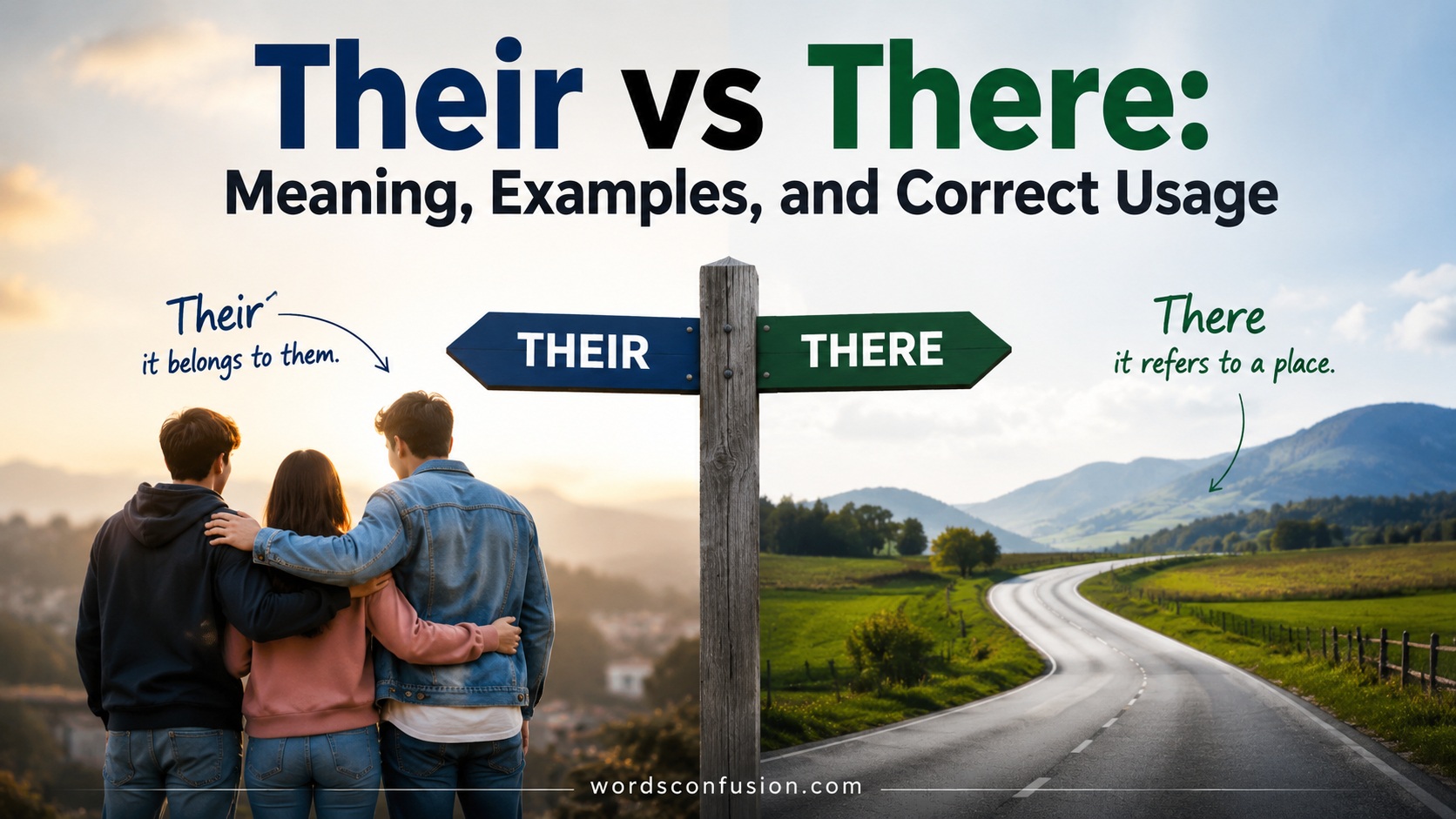
If you’ve ever paused while writing “their” or “there,” you’re not alone. These two words sound almost identical in everyday English, yet they perform completely different jobs in a sentence. One shows possession or association, while the other usually points to a place or introduces something that exists.
That small spelling difference can change the entire meaning of a sentence. For example, “Their house is beautiful” talks about a house belonging to them. “The house is there” tells you where the house is. The words sound similar, but their grammatical roles are worlds apart.
The confusion becomes even trickier when “they’re” enters the picture. They’re means they are, which creates a three-way spelling trap for students, writers, and even fast typists.
This guide explains their vs there in plain English. You’ll learn what each word means, where to use it, how to recognize common mistakes, and several quick tricks that make the correct choice almost automatic.
Quick Answer
Their shows possession, ownership, or association with people or things referred to by they. There commonly refers to a place or introduces the existence of something. They’re is a contraction of they are.
| Word | Meaning | Main Use | Example |
| Their | Belonging to or associated with them | Possession | Their car is new. |
| There | In or at a particular place; existence | Location or existence | The car is over there. |
| They’re | They are | Contraction | They’re ready to leave. |
A simple way to remember them is:
- Their = belonging to them
- There = a place or existence
- They’re = they are
So, compare these three sentences:
- Their dog is sleeping.
- The dog is over there.
- They’re sleeping.
Each sentence uses a different word because each word performs a different grammatical job.
Comparison Overview
The easiest way to understand their vs there is to compare their meanings and functions side by side.
| Feature | Their | There | They’re |
| Meaning | Belonging to them | A place or existence | They are |
| Function | Possessive determiner | Adverb or existential word | Contraction |
| Shows possession? | Yes | No | No |
| Refers to location? | No | Yes | No |
| Can replace with “they are”? | No | No | Yes |
| Example | Their books are here. | The books are there. | They’re reading. |
The distinction becomes much easier when you stop focusing on pronunciation. Instead, look at what the word is doing in the sentence.
Consider:
Their friends are waiting over there because they’re late.
All three words appear in one sentence. Their identifies whose friends they are. There identifies a location. They’re means they are.
That’s the basic pattern you can use again and again.
Main Differences Between Their vs There
The biggest difference between their vs there lies in grammatical function. Their expresses possession or association. There usually identifies a location or introduces something that exists.
Their Shows Possession or Association
Their is a possessive determiner. It connects a person, group, or sometimes a singular individual with a noun.
For example:
- Their house is large.
- The students finished their homework.
- The players changed their uniforms.
- The company announced their decision.
- The children picked up their toys.
In each example, their answers a question such as “Whose?”
Whose house is large? Their house.
Whose homework did the students finish? Their homework.
Whose toys did the children pick up? Their toys.
That “whose” test is one of the quickest ways to identify their.
There Refers to a Place
There often points to a location. The location can be specific or general.
For example:
- Put the bag there.
- She lives there.
- We went there yesterday.
- Your shoes are over there.
- The restaurant is just there.
In these sentences, there answers a question such as “Where?”
Where should you put the bag? There.
Where does she live? There.
Where are the shoes? Over there.
This gives you a useful shortcut:
Their = Whose?
There = Where?
There Can Also Introduce Existence
There has another important use that doesn’t involve a physical location.
English commonly uses there in constructions such as:
- There is a problem.
- There are several options.
- There was an accident.
- There were many people outside.
- There seems to be a mistake.
Here, there introduces the existence or presence of something.
For example:
There is a book on the table.
The sentence isn’t really telling you that the word there represents a particular location. Instead, there introduces the fact that a book exists in that situation.
This use is sometimes called existential there.
They’re Means “They Are”
Although the main focus is their vs there, you can’t fully understand the confusion without they’re.
They’re is simply a contraction of they are.
Examples:
- They’re happy. → They are happy.
- They’re coming soon. → They are coming soon.
- They’re working today. → They are working today.
- They’re already inside. → They are already inside.
The easiest test is remarkably simple:
Replace “they’re” with “they are.”
If the sentence still makes sense, they’re is probably correct.
What Does “Their” Mean?
Their means belonging to, associated with, or connected to someone or something referred to by they.
It normally appears before a noun or noun phrase.
For example:
- their car
- their house
- their parents
- their business
- their opinion
- their responsibility
- their decision
Notice the pattern. Their normally helps identify a noun.
Their as a Possessive Determiner
Consider this sentence:
The employees finished their work.
The word their tells you who the work belongs to or is associated with. It doesn’t necessarily mean physical ownership. The employees don’t have to own the work itself.
That’s an important distinction.
Possession in grammar can mean more than legal ownership. It can describe relationships, responsibilities, characteristics, or associations.
For example:
- She called their manager.
- They shared their ideas.
- The students completed their project.
- The company changed their policy.
In each case, their establishes a relationship between the people and the following noun.
Their Can Refer to One Person
Modern English also uses their with singular they when the person’s gender is unknown, irrelevant, or intentionally unspecified.
For example:
Someone left their phone on the table.
Here, their refers to one person, not necessarily several people.
Another example:
Every student should bring their own notebook.
This construction is now common in everyday English and formal writing.
The important point is that their can function with both plural they and singular they.
How to Recognize Their
Ask yourself:
Does this word show possession or association?
If the answer is yes, their is usually the correct choice.
Try these:
Their house is across the street.
Whose house? Their house.
The team celebrated their victory.
Whose victory? Their victory.
Everyone should bring their identification.
Whose identification? Their identification.
The test works because their answers the idea of “whose?”
What Does “There” Mean?
There has several grammatical uses, but two are especially important: location and existence.
There as a Location Word
The most familiar use of there refers to a place.
Examples include:
- Come over there.
- I left my keys there.
- They waited there.
- Look over there.
- We stayed there for two nights.
The location doesn’t have to be far away. There simply identifies a place that isn’t being treated as the speaker’s immediate location.
Compare:
- Come here.
- Go there.
Here generally points toward the speaker’s location. There points toward another location.
There in “There Is” and “There Are”
Another major use appears in sentences describing existence.
Use there is with a singular noun:
There is a problem.
Use there are with a plural noun:
There are three problems.
More examples:
- There is a new restaurant nearby.
- There are two books on the desk.
- There was a strange noise.
- There were several people outside.
The word there helps introduce the subject or situation being discussed.
There in Everyday Expressions
You may also encounter there in expressions where it doesn’t simply mean a physical location.
Examples include:
- There you go.
- There we are.
- There seems to be a problem.
- There is no reason to worry.
- There must be another explanation.
The meaning depends on the construction and context.
Their vs There Examples
Seeing the words in pairs makes the difference much clearer.
Examples With Their
- Their house has a red door.
- The students opened their books.
- The children lost their toys.
- The company updated their website.
- Everyone should check their email.
- The players celebrated their victory.
- They invited their friends to dinner.
In every example, their connects someone with a noun.
Examples With There
- Your jacket is over there.
- We stayed there last summer.
- She went there after work.
- Look over there.
- There is a problem with the computer.
- There are five people in the room.
- There seems to be an error.
Here, there either identifies a place or helps introduce existence.
Read More: Than vs Then: Meaning, Examples, and Correct Usage
Examples Using Their and There Together
Sometimes both words belong in the same sentence.
Their house is over there.
Their tells you whose house it is. There tells you where it is.
Another example:
Their children are waiting there.
Again, their expresses association while there identifies a location.
Try this one:
They left their bags there.
This sentence contains two different meanings:
- their bags = bags belonging to them
- there = a particular place
That’s why swapping the words doesn’t work.
Their vs There vs They’re
The three words are often confused because they have similar pronunciations in standard English.
Their meanings, however, are completely different.
| Word | Simple Meaning | Example |
| Their | Belonging to them | Their dog is friendly. |
| There | A place / existence | The dog is there. |
| They’re | They are | They’re outside. |
A useful sentence can help you remember all three:
They’re taking their dog over there.
Break it apart:
- They’re = they are
- their = belonging to them
- there = a place
Once you see the three functions separately, the spelling becomes much less confusing.
How to Remember Their vs There
Memory tricks work best when they connect spelling with meaning.
Remember Their With “Theirs”
Think about the word theirs.
If you’re talking about something belonging to someone, their is probably what you need.
That is their car.
You can also say:
That car is theirs.
Both words express possession.
Remember There With “Here”
A popular memory trick is:
There contains “here.”
Think:
- Here = this place
- There = that place
For example:
Put the box here.
or:
Put the box there.
This trick isn’t a complete grammar rule because there has other uses. Still, it’s an excellent reminder for location-related sentences.
Remember They’re With “They Are”
This is the easiest of the three.
Whenever you see they’re, expand it:
They’re ready.
becomes:
They are ready.
If they are works, they’re works.
If it doesn’t, choose their or there instead.
Common Mistakes With Their and There
The most common errors usually happen because writers rely on sound rather than meaning.
Mistake: “There House Is Beautiful”
Incorrect:
There house is beautiful.
Correct:
Their house is beautiful.
Why? The sentence describes whose house is beautiful. It needs a possessive word.
Mistake: “The Books Are Over Their”
Incorrect:
The books are over their.
Correct:
The books are over there.
Why? The sentence describes the location of the books.
Mistake: “Their Going to School”
Incorrect:
Their going to school.
Correct:
They’re going to school.
Why? The intended meaning is they are going to school.
Mistake: “They’re House Is New”
Incorrect:
They’re house is new.
Correct:
Their house is new.
Why? You need a possessive determiner before house.
Mistake: “Put It Their”
Incorrect:
Put it their.
Correct:
Put it there.
Why? The word refers to a location.
FAQs:
Is “their” used for possession?
Yes. Their is used to show possession, association, or a relationship with someone or something referred to by they.
For example:
Their house is beautiful.
Here, their identifies the house as belonging to or being associated with them.
What is the easiest way to remember their vs there?
Use two questions:
Their = Whose?
There = Where?
For example:
Their car is outside.
Whose car? Their car.
The car is over there.
Where is the car? There.
Is “there” only used for places?
No. There can refer to a location, but it also introduces existence in sentences such as:
There is a problem.
There are several solutions.
So, while there often has a location-related meaning, it has broader grammatical uses.
Can “their” refer to one person?
Yes. Their can be used with singular they.
For example:
Someone forgot their umbrella.
The word their refers to one person whose identity isn’t specified.
Is “they’re” the same as “their”?
No. They’re and their have different meanings.
They’re means they are.
Their indicates possession or association.
Compare:
They’re working on their project.
They’re = they are
Their = belonging to them
Which is correct: “their” or “there”?
Neither word is always correct. The correct choice depends on the meaning of the sentence.
Use their for possession or association.
Use there for a location or existential construction.
Why do their and there sound the same?
They are commonly pronounced the same in standard English, which makes them easy to confuse when speaking or listening.
However, their meanings and grammatical functions differ.
Conclusion:
Understanding their vs there becomes much easier when you focus on what each word means and how it functions in a sentence. Their shows possession or association, there refers to a place or introduces something that exists, and they’re is the contraction of they are.
Remember the simple rule: their = belonging to them, there = a place or existence, and they’re = they are. When you’re unsure, ask yourself whether you’re describing ownership, location, or the phrase they are. That quick check can help you choose the correct word every time.

Andrew Wilson is an experienced language researcher and content writer specializing in WordsConfusion topics. He helps readers understand commonly confused English words, spelling differences, grammar rules, word meanings, and proper usage through clear explanations, practical examples, and easy-to-follow language guides. His goal is to make English learning simple, accurate, and accessible for students, writers, professionals, and everyday learners.